

Renewing a trade license in Abu Dhabi usually means filing online through the TAMM portal for mainland companies or through your free zone authority's portal for free zone companies, with an active lease and cleared dues in place before you submit. In practice, the safest approach is to start 30 to 45 days before expiry, because mainland late renewals can trigger a fixed AED 200 per month delay fee and free zones commonly expect early preparation to sort out record issues before the licence lapses.
If you're reading this because the expiry date is close, you're in the same position as many founders, HR managers, and overseas business owners entering the UAE for the first time. The process isn't mysterious, but it does punish delay, missing lease validity, and unpaid government charges more than most online guides admit.
In Abu Dhabi and across the wider United Arab Emirates, the renewal path depends first on where your company is registered. A mainland company follows one route. A free zone company follows another. Once that distinction is clear, trade license renewal Abu Dhabi becomes much easier to manage.
Table of Contents
- Understanding the Trade License Renewal Mandate
- How to Renew Your License Online A Practical Walkthrough
- A Breakdown of Renewal Fees Fines and Timelines
- Common Renewal Mistakes and How to Avoid Them
- Your Pre-Renewal Checklist for a Smooth Process
Understanding the Trade License Renewal Mandate
What is a trade license renewal in Abu Dhabi
A founder usually notices renewal when operations start slowing down in small but expensive ways. The bank asks for a valid licence copy. A client puts payment on hold until the company documents are updated. An employee matter stalls because the company record is close to expiry. At that stage, renewal is no longer routine admin. It is an operating issue.
A trade licence is the legal permission that allows a company to carry out its registered business activities in Abu Dhabi. Renewal is the yearly process that keeps that permission active and the company in good standing.
For mainland businesses, the primary regulator is the Abu Dhabi Department of Economic Development, or ADDED. The online service path usually runs through TAMM, Abu Dhabi's government services platform. For free zone entities, renewal sits with the relevant free zone authority, such as Masdar City, ADGM, KIZAD, or another zone-specific regulator.
Start before the file becomes urgent. In practical PRO work, 30 to 45 days before expiry is the right window to check lease validity, shareholder documents, portal access, and any missing approvals. That gives enough time to fix record mismatches while the licence is still active.
Practical rule: Treat the expiry date as the end of your buffer, not the day to begin.
Why does the system push you to start early
Renewal is a record-checking exercise. The authority compares the licence record, tenancy record, shareholder details, and payment status against the company file. If one item is outdated, the application can stop until the mismatch is corrected.
Founders often treat renewal as a payment task. In practice, it is a compliance review tied to legal operating status. A valid licence affects invoicing, banking, employee administration, and immigration-linked company services in the UAE.
A workable timeline looks like this:
| Stage | What you should do |
|---|---|
| 45 days before expiry | Check the expiry date, lease validity, and portal access |
| 30 days before expiry | Gather Emirates IDs or passport copies, current licence copy, and any supporting approvals |
| Submission window | File online after confirming dues are cleared and records match |
| After approval | Save the renewed licence and update internal records with banks, clients, and HR teams as needed |
Mainland vs Free Zone Renewals What You Need to Know
Which authority handles your renewal
The first question is simple. Who issued the licence?
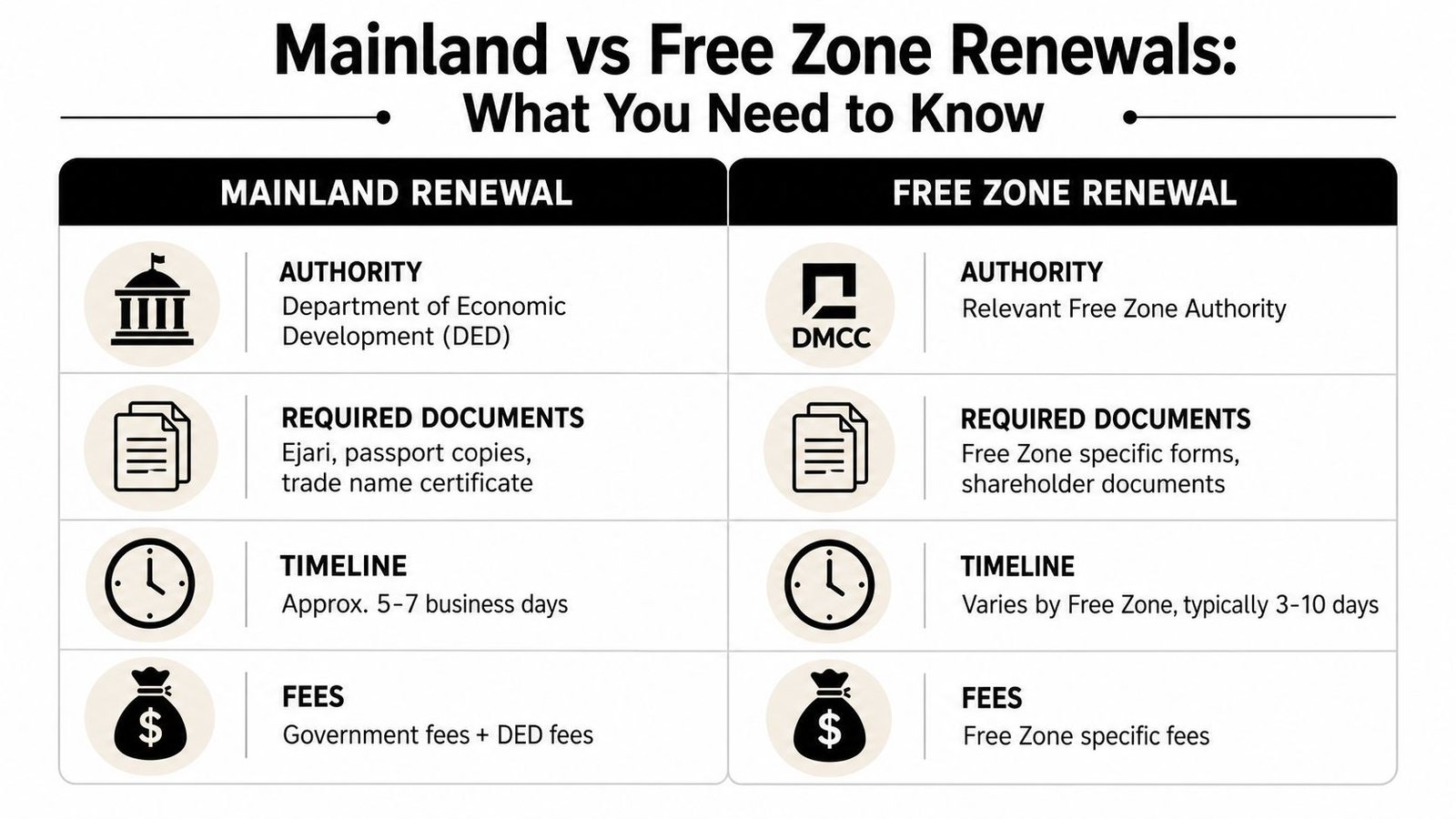
A mainland company renews through ADDED, usually through TAMM. A free zone company renews with its own authority, using that zone's portal, document rules, and approval process. That single detail changes the checklist, the risk points, and the kind of delay you are likely to face.
A common mistake is following the wrong guide. I see mainland companies prepare internal corporate documents perfectly, then get stuck because the tenancy record is not updated. I also see free zone companies assume a municipal lease check will drive the process, when the actual problem is an outdated passport, a wrong signatory, or a document mismatch inside the zone portal.
What changes between the two routes
For mainland Abu Dhabi, the lease record usually determines whether renewal moves quickly or stalls. The tenancy contract needs to be valid and correctly reflected in the government system. If the lease has expired, the unit details do not match, or the municipal record has not updated, the file can stop even when every other document is ready. Pending government dues linked to the licence can also block progress.
For free zones, the renewal file is often more contained within the zone authority's own system. The authority typically asks for updated company records, shareholder identification documents, and the current licence copy through its portal. The trade-off is different. You usually deal with fewer external system checks, but the zone can be strict on exact matches across shareholder names, passport numbers, visa status, and authorised signatory details.
The practical difference is where the risk sits.
- Mainland route: Delays usually come from tenancy validation, linked government records, or unpaid dues on the file.
- Free zone route: Delays usually come from document accuracy, expired IDs or passports, signatory issues, or missing corporate paperwork inside the zone system.
- Decision point: Follow the renewal path tied to the authority named on the licence. The company's legal setup decides the process.
How penalties and knock on issues differ
Late renewal does not create the same pattern of trouble in both setups. On the mainland side, late renewal can lead to clearer fine exposure and linked compliance costs. Sovereign Group's Abu Dhabi licence guidance notes a fixed AED 200 monthly delay fee for late licence renewal, and it explains how related issues can extend to documents such as the Establishment Card, with a total cost of AED 1,100 if that process is pulled in later, according to Sovereign Group's Abu Dhabi licence guidance.
In free zones, the bigger cost is often time. A passport that expired on file, a shareholder name that does not match the licence record, or a missing signature can keep the renewal pending until the file is corrected. Mainland delays often produce direct fines sooner. Free zone delays often produce admin back-and-forth and hold up related company tasks.
A licence issue rarely stays isolated. It can affect immigration files, banking updates, invoicing, and routine company administration.
How to Renew Your License Online A Practical Walkthrough
How does the mainland TAMM process work
For mainland companies, the standard online path runs through TAMM. You log in using UAE Pass, which is the national digital identity used across many government services in the UAE. If you don't have working access to UAE Pass before you start, stop there and fix that first.

The practical sequence usually looks like this:
- Log in with UAE Pass. The system requires that identity layer before you can access the service.
- Open the licence renewal service. Confirm you're inside the correct company file.
- Check the lease record. The system validates the Tawtheeq tenancy contract against the Abu Dhabi Municipality database.
- Review company details and activities. Make sure the activity list and responsible parties still match the official record.
- Clear pending charges. If dues are sitting on the file, the application can stop there.
- Pay and submit. Save the receipt and the renewed licence once issued.
A Tawtheeq contract is the registered tenancy contract recognised by Abu Dhabi Municipality. That document isn't a side attachment. It is one of the core checks in the mainland workflow.
According to the verified process data provided for Abu Dhabi, the TAMM workflow requires UAE Pass authentication and automatically validates Tawtheeq against the municipality database, with a 92% first-time approval success rate for compliant businesses. The same verified data notes that applications with compliant records perform better than offline submissions.
How does a free zone online renewal usually work
Free zone renewal is similar in principle but different in layout. You log in to the specific portal for your zone, open the licence renewal service, upload the requested documents, review company details, and pay the charges shown by the authority.
The exact menu names differ across Abu Dhabi free zones. A company in ADGM won't see the same interface as one in Masdar City or KIZAD. What doesn't change is the logic. The authority wants current records, current IDs, and a clean file.
Use this short check before you press submit:
- Portal access works: The authorised signatory or admin can log in without delays.
- Identity documents are current: Passport copies, Emirates ID copies, and the existing licence copy are ready if the zone requests them.
- Records match reality: Shareholder names, business activities, and company contact details are updated.
- Payment method is ready: Most zones accept digital payment through card or transfer methods listed on the portal.
A Breakdown of Renewal Fees Fines and Timelines
A week before expiry, founders usually lose time and money. The mainland company sees a fixed government fee structure, while the free zone company often finds a longer invoice because the zone bundles licence renewal with facility, establishment card, or visa-related charges on the same file.
What does a standard mainland renewal cost
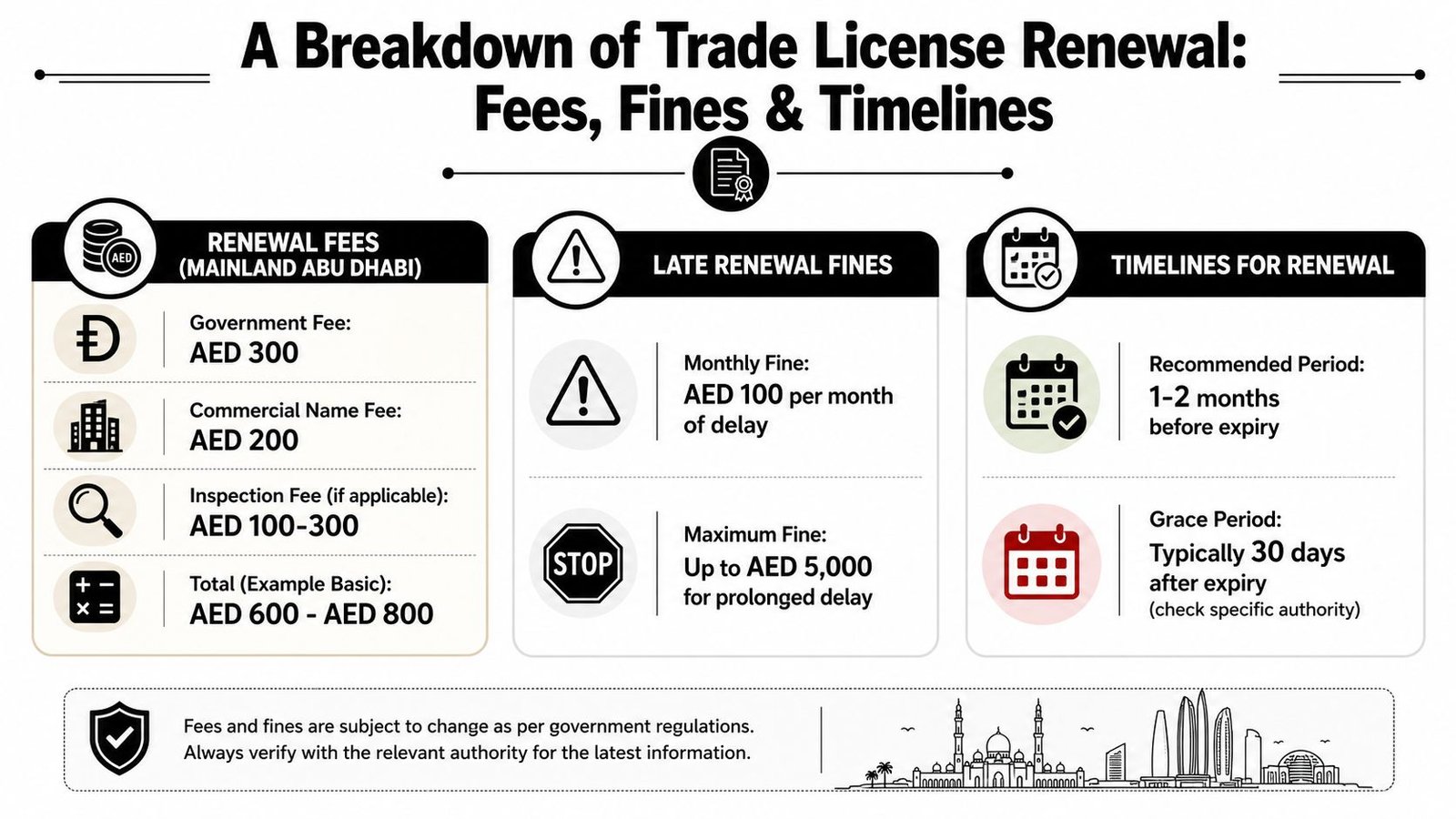
For mainland Abu Dhabi, use the official baseline fee as your starting point. The core renewal components total AED 950.00 for an on-time renewal. That includes an Organizational Entities Fee of AED 890.00, a licence renewal fee of AED 10.00, and Abu Dhabi Chamber Fees of AED 50.00.
That gives you a clean budgeting number for the licence itself. It does not cover the supporting items that often decide whether the application moves, such as tenancy validity, unpaid government charges, or file corrections that have to be cleared before approval.
Free zone renewals need a different budget mindset. Some zones show a straightforward renewal invoice. Others combine the licence with office package renewals, immigration file charges, or admin fees tied to the company setup in that zone. In practice, that means a mainland founder can often estimate the government side with more certainty, while a free zone founder should check the portal invoice line by line before assuming last year's total will repeat.
What happens if you renew late
For mainland licences, the late penalty is fixed at AED 200 per month. If you renew one month late, that adds AED 200. Two months late adds AED 400.
The fine is rarely the biggest problem. The bigger cost is delay inside the business. Bank updates, immigration-related steps, client onboarding checks, and internal approvals often slow down once the licence is close to expiry or already expired.
Free zones also impose late penalties, but the structure can differ by authority. Some apply a straightforward monthly or staged penalty. Others hold the renewal until bundled dues are settled. That is the practical difference founders need to watch. Mainland late cost is usually easier to predict. Free zone late cost is often easier to underestimate.
Renew early if the file has any moving parts, especially lease issues, shareholder changes, or old dues that may still be attached to the company record.
How long does renewal usually take
Timing depends on jurisdiction and file condition more than on the button you click. A clean mainland file submitted early can move fast. A free zone file can be just as quick, but only if the zone records, facility contract, and authorised signatory access all line up on the first pass.
Early submissions usually close faster because nothing is being fixed under pressure. Late submissions are slower because every small mismatch matters more once the licence is close to expiry.
Use this timing view as a practical guide:
| Scenario | Typical operational reality |
|---|---|
| Mainland, filed early with clean records | Often the fastest route, especially when tenancy and company details already match government records |
| Free zone, filed early with all portal documents ready | Usually smooth, but timing depends on the zone's internal review steps and bundled charges |
| Filed close to expiry | More follow-up, more payment checks, and less room to correct errors without disrupting operations |
| Filed late | Fines apply, approvals slow down, and other company processes can stall while the licence status is unresolved |
The safest habit is simple. Start the review well before the expiry month, confirm what your authority will charge, and clear every linked due before you open the renewal application.
Common Renewal Mistakes and How to Avoid Them
Which mistake blocks the most applications
The most common avoidable failure is unpaid dues attached to the company file. Verified Abu Dhabi renewal data states that failure to clear outstanding dues, including municipality fees and regulatory penalties, causes immediate application suspension in 40% of cases.
That number matches what operators see on the ground. A founder prepares the passport copies, confirms the lease, logs into the portal, and then the file stops because a charge from an earlier process is still open. The renewal team can't push past that block by arguing with the system.
The fix is simple. Check payment status before you begin the upload stage.
- Municipality-related charges: Review anything linked to premises and local records.
- Regulatory penalties: Confirm there isn't an old fine or pending charge on the commercial file.
- Chamber items: Make sure sector-linked payment obligations aren't sitting unresolved.
Why does the lease document trip people up
For mainland companies, the tenancy record needs to do more than exist. Verified Abu Dhabi process data states that the lease must remain active for at least one full month beyond the intended application date. If it doesn't, the TAMM renewal can be rejected at the validation stage.
This catches many businesses because the office team assumes the lease and licence expire around the same time, so both can be handled together. That's the wrong sequence. In practice, the lease needs to stay ahead of the renewal file, not chase it.
Check this before anything else: If the tenancy contract won't stay valid for one full month after the day you plan to apply, fix the lease first.
What should you do if the licence has already expired
An expired licence doesn't always mean the same outcome in every jurisdiction. Verified Abu Dhabi process data states there is an exact 30-day grace period from the expiry date, after which the licence enters non-operational status.
A grace period is the short post-expiry window in which the authority still allows a renewal path without treating the file as a full re-issue case. Once that window passes, the problem stops being a standard renewal issue and turns into a more expensive and slower compliance issue.
There is also a niche point some guides miss. A verified update referenced through this discussion of ADRA's no-fee expired licence initiative notes that under specific conditions, some expired economic licences may be renewed with zero fees. Treat that as a special-case policy point, not the default assumption. If your licence has already expired, check the exact authority and current eligibility before acting on general advice.
Your Pre-Renewal Checklist for a Smooth Process
The cleanest renewals are boring. The company knows its expiry date, the lease is valid, the records match, and the person with signatory authority can log in. That's what you want every year.
What should you do 45 days before expiry
Start with a calendar check and a file review. Don't start with the payment screen.
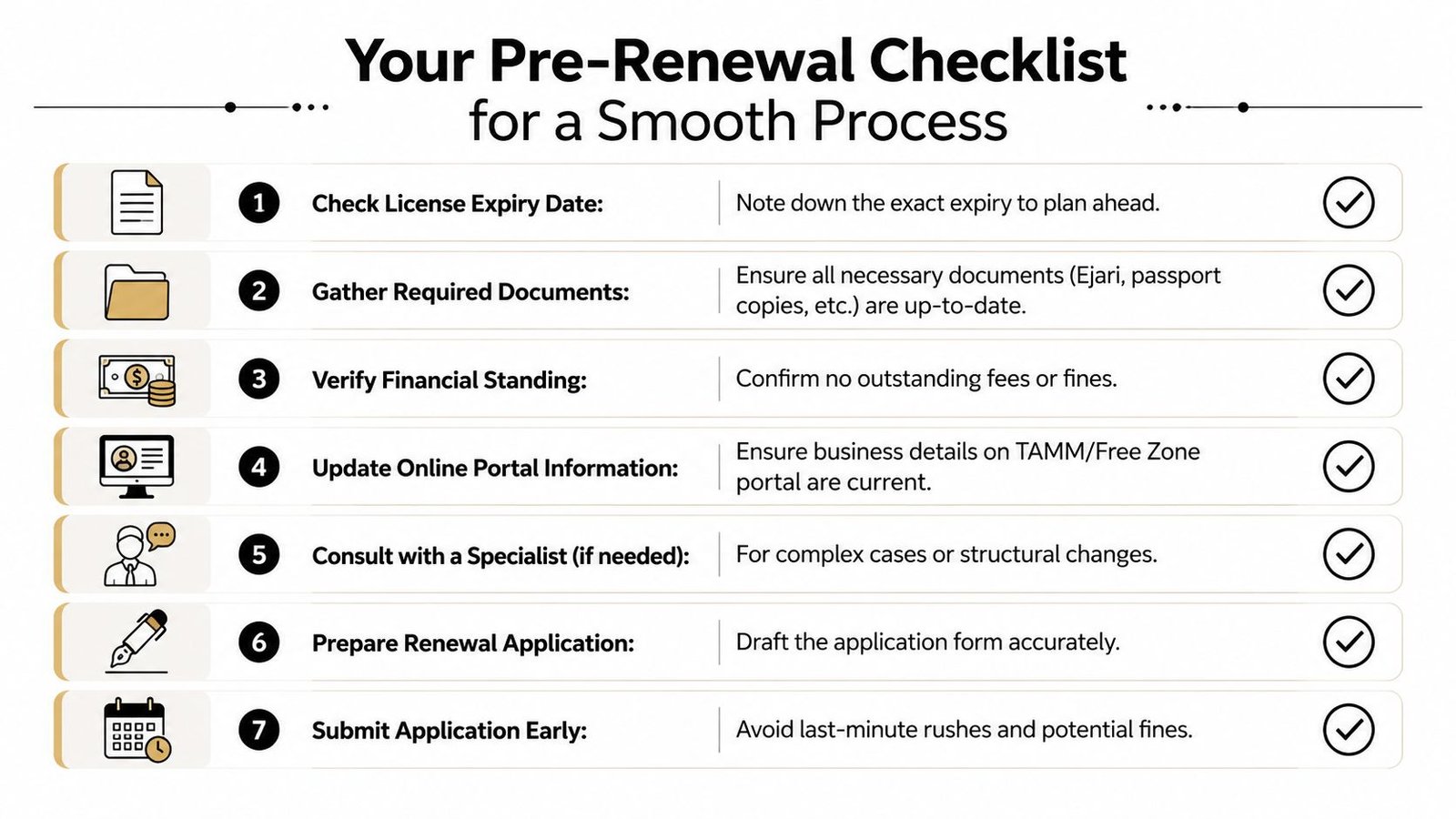
- Confirm the exact expiry date: Put it in your calendar and assign an owner internally.
- Check the lease position: Mainland companies should confirm the tenancy record will remain valid beyond the intended filing date.
- Review company records: Make sure shareholder details, business activities, contact details, and authorised signatory information are accurate.
- Test portal access: Log into TAMM or the free zone portal early so identity or password issues don't eat your submission window.
If the company operates across Abu Dhabi, Dubai, or Sharjah, keep records jurisdiction-specific. UAE filings often look similar on the surface, but each authority checks its own file and its own records.
What should you do in the final days before submission
In the last stretch, the focus shifts from record review to risk removal. At this point, small mistakes become expensive ones.
Use this final checklist:
- Clear all dues first. Don't assume the portal will tell you everything in a friendly order.
- Prepare current documents. Existing licence copy, identification documents, and any authority-specific items should be ready before login.
- Review special approvals. If your activity needs extra regulatory clearance, make sure that isn't the missing piece.
- Submit while there is still room to correct. If something bounces, you want time to fix it before the expiry date, not after.
A good internal habit is to store the renewed licence, payment proof, and portal confirmation in one shared company folder the same day approval arrives. That saves time later when banks, immigration teams, auditors, or HR ask for the latest version.
If you'd like a calm, hands-on team to handle trade license renewal in Abu Dhabi, visa-linked compliance, and wider UAE company admin, Inpro Corporate Services L.L.C. can help you get it done without the usual last-minute scramble. Not sure where to start? Book a free strategy call with the team.