


You're probably in one of two positions right now. Either you already trade across borders and you're looking at the UAE as the next logical base, or you've been told “set up a trading company in Dubai” and you're trying to work out what that means in operational terms.
The problem is that most guidance stops at labels. Mainland. Free Zone. Offshore. General Trading. Specific Trading. Those terms matter, but they don't answer the core question founders ask once money, inventory, and customers are involved. Which setup supports the way you'll sell, import, store, clear, and invoice goods?
That's the only lens that matters in 2026. A trading company in UAE isn't just a registration exercise. It's a logistics and market-access design decision. If you get it right, the company structure supports your margins and your expansion. If you get it wrong, you'll still get a licence, but you'll feel the mistake later through customs friction, product registration issues, weak banking posture, or a sales model that doesn't fit the jurisdiction you chose.
Table of Contents
- The 2026 Blueprint for Your UAE Trading Company
- Your Core Decision Mainland, Free Zone, or Offshore
- Choosing the Right Trading Licence and Activities
- The Step-by-Step Company Formation Roadmap
- Post-Setup Essentials Banking, Tax, and Ongoing Compliance
- Your UAE Trading Launch Checklist
The 2026 Blueprint for Your UAE Trading Company
A founder who sees the UAE only as a local sales market usually under-builds the company. A founder who sees it as a regional trading hub usually makes better structural decisions from day one.
That distinction matters because the UAE's value isn't limited to local consumption. The U.S. Department of Commerce's UAE market overview says the UAE has been the top U.S. export market in the Middle East and Africa since 2009, and that more than 1,500 American companies use it as a base for business across the Middle East, Africa, Europe, and Asia. That tells you something important. Serious firms don't use UAE entities only to sell inside one city. They use them to coordinate distribution across multiple markets.

Why founders still choose the UAE
The attraction isn't the slogan. It's the operating logic.
If you import electronics from East Asia, hold stock near a port, re-export some shipments to Saudi Arabia, and sell selected lines into Dubai retail or B2B channels, the UAE can support that. But only if your company structure matches those flows. Founders who treat the incorporation certificate as the main deliverable miss the point. The key asset is a company that fits customs movement, warehousing, invoicing, and channel control.
Practical rule: Decide first whether you are building for local UAE distribution, regional re-export, or a hybrid of both. Everything else follows from that.
Start with the trade model, not the licence brochure
The right starting questions are operational:
- Where will goods enter first: Port, airport, or direct cross-border movement?
- Who will be importer of record: Your UAE entity, a distributor, or another affiliate?
- Where will revenue come from: UAE retail, UAE wholesale, regional exports, or all three?
- Who controls customer access: Your own sales team, an appointed distributor, or a commercial agent?
- Where will stock sit: Free Zone warehouse, mainland warehouse, or no UAE storage at all?
A trading company in UAE works best when those answers are clear before anyone chooses a jurisdiction. A lot of bad setups happen because founders pick the cheapest licence first, then discover the business model doesn't fit.
Your Core Decision Mainland, Free Zone, or Offshore
This is the fork in the road. Most problems later can be traced back to this choice.
A company that needs to invoice UAE customers directly and manage local market access has different requirements from one that mainly buys, stores, and re-exports goods. And an entity created to hold assets or sit above operating subsidiaries is a different animal again.
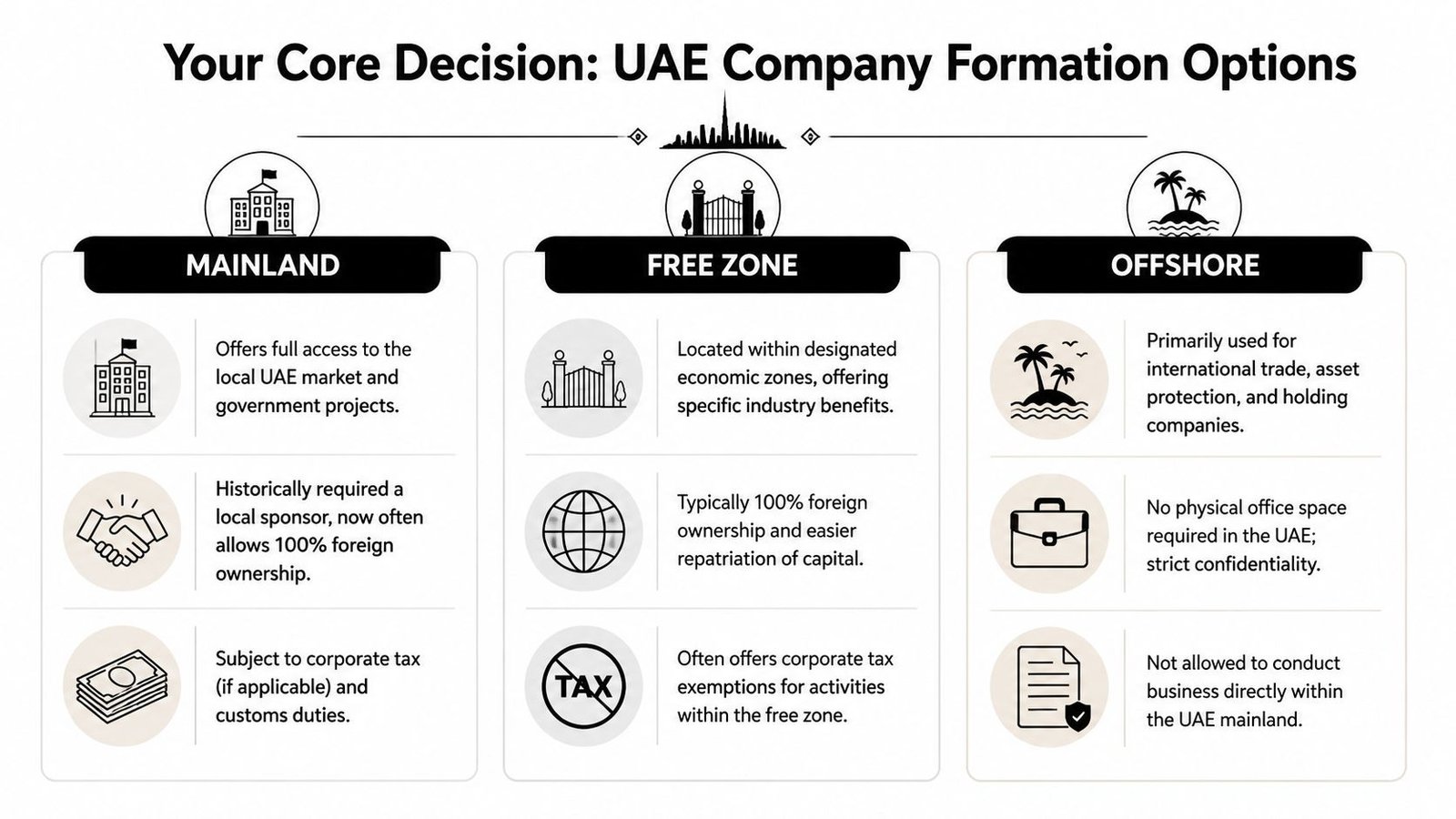
What each structure is really for
Mainland is for direct access. If you want your company to sell into the UAE market in a straightforward way, hire locally around that commercial activity, and keep control over local customer relationships, mainland is usually the cleanest structure.
Free Zone is for controlled international trade operations. It suits re-export, warehousing, regional distribution planning, and many founder-led setups that want operational efficiency with a strong ownership position. It can also work well when the UAE office needs to retain strategic control while sales execution varies by market.
Offshore is not an operating answer for most trading businesses. It can have uses in holding, asset structuring, or cross-border ownership arrangements, but it is not the vehicle for directly trading in the UAE mainland market.
The wrong question is “Which licence is best?” The right question is “Which entity can legally and commercially support how I'll move goods and close sales?”
A practical comparison
| Criteria | Mainland | Free Zone | Offshore |
|---|---|---|---|
| Direct UAE market access | Strong fit | Limited by operating model | Not suitable for direct mainland trading |
| Regional re-export | Possible, but not always the leanest route | Often the natural fit | Can support holding structures, not local operations |
| Control over local sales channels | High | Can be high, depending on structure | Low for UAE operating activity |
| Warehouse-led trade model | Possible | Often attractive for transit and re-export planning | Not an operating warehouse structure |
| Best use case | UAE distribution and onshore commercial activity | Re-export, stockholding, hub operations | Holding and international structuring |
One point gets overlooked too often. The UAE distribution and sales channels guidance from the U.S. Department of Commerce notes that many exporters use agents or distributors, but some open mainland or free-zone offices specifically to retain control over product registration and market access. That matters if you sell regulated or brand-sensitive products. Once someone else controls the registration position, you may discover that “market entry” came at the price of strategic dependence.
The electronics example that makes the choice clearer
Take a company trading consumer electronics.
If the plan is to bring stock into JAFZA, hold inventory, split shipments, and re-export to other Gulf markets, a Free Zone structure often makes more sense than mainland. The business model depends on transit efficiency, warehousing logic, and regional routing. In that case, paying for broad onshore access you won't use can be wasteful.
If the same company wants to supply retailers in Dubai and Abu Dhabi directly, run local promotions, manage returns inside the UAE, and hold the commercial relationship itself, mainland becomes more compelling. The cost can be higher in some cases, but the company gains cleaner local market access.
If the founder says, “I'll set up offshore first because it's simpler, then I'll sell locally later,” that usually means doing the job twice.
Here's one way to look at it:
- Choose mainland when local UAE sales are central to the revenue model.
- Choose Free Zone when trade flow efficiency and regional re-export are the commercial engine.
- Choose offshore when you need a non-operating structure, not a trading floor.
The strategic decision isn't about what sounds prestigious. It's about where friction will appear once the first container, invoice, or distributor agreement lands on your desk.
Choosing the Right Trading Licence and Activities
After jurisdiction, activity selection becomes the next make-or-break decision, often leading founders to either overbuy flexibility or underbuy future room.
General trading versus specific trading
A General Trading licence appeals to founders who want freedom. It sounds like the safe option because it can accommodate a broader range of goods. In practice, that flexibility has a price. It can raise extra questions during banking, compliance reviews, and operational planning because “we trade many things” is less convincing than a clearly defined commercial model.
A specific trading licence such as electronics trading, garments trading, or foodstuff trading is narrower but often cleaner. If you already know your category, specific activity selection usually produces a sharper business narrative. Banks understand it more easily. Customs classification planning is more straightforward. Internal controls are easier to build.
That doesn't mean general trading is wrong. It means it should match a real business pattern, not founder indecision.
Why activity mapping matters before filing
The most reliable setup approach is to match the licence to the activity scope first. The trade setup guidance referenced here makes that point clearly and also warns about common mistakes, including choosing a jurisdiction that doesn't support the intended distribution model or underestimating importer-of-record obligations, which can lead to duplicate customs filings and delays.
That warning is more practical than it sounds. Founders often think the activity list is administrative. It isn't. It affects how your company presents itself to regulators, banks, customs stakeholders, and counterparties.
Use this filter before you file:
- Map your first product lines: Don't license for ten categories if you're launching with two.
- Check import and export lanes: Your chosen activities should fit the countries and routes you expect to use.
- Match storage to product reality: Electronics, cosmetics, and food products don't create the same operational requirements.
- Define the importer position: If your entity will be importer of record, structure for that from the start.
- Leave room, but not confusion: Add realistic expansion headroom without turning the file into a vague generalist profile.
A licence should describe the business you are ready to operate, not the business you might imagine five years from now.
A founder setting up for electronics re-export, for example, is usually better served by a well-matched electronics trading activity than by a bloated list of unrelated goods. Broad activity scope feels flexible early on. Later, it can look unfocused.
The Step-by-Step Company Formation Roadmap
The UAE formation process is manageable when the sequence is right. It becomes frustrating when founders treat every step as independent. It isn't. Each approval enables the next one.
A recent indicator of how active the UAE remains as a trade-oriented environment comes from Capital.com's 2024 UAE trading activity report, which says UAE users placed 19.5 million trades totalling $468.9 billion in volume across 23 markets. That's financial trading rather than merchandise trading, but it still reinforces a useful point. The market is accustomed to transaction velocity, and companies entering the UAE need to be organised enough to move at that pace.
Here is the roadmap most founders should expect.
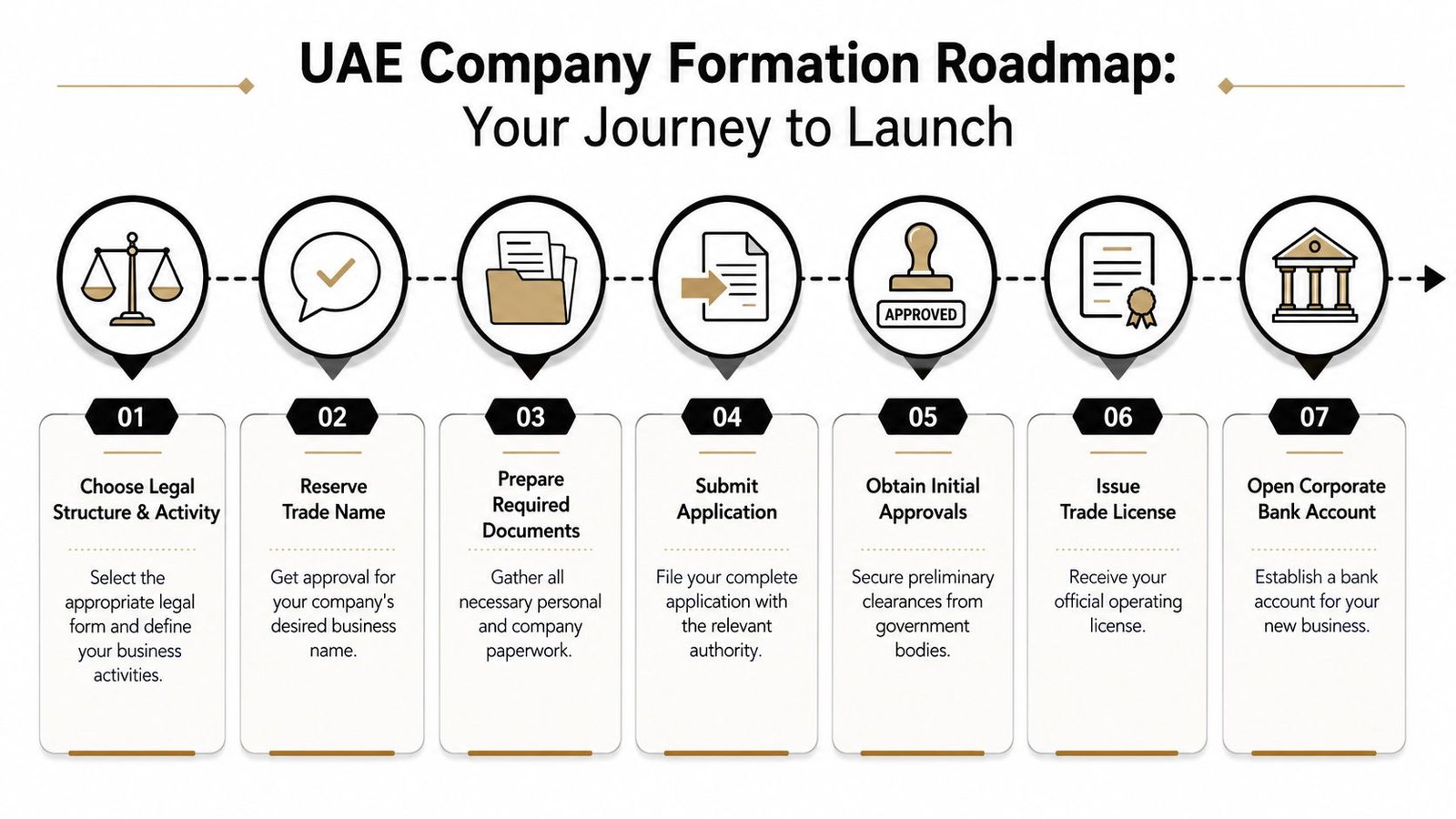
The sequence that actually matters
The journey usually starts with legal structure and activity selection. That sounds obvious, but the bankability and operability of the future company are largely set during this step.
Then comes trade name reservation and initial approval. These steps establish that the proposed entity and activities are acceptable to the issuing authority. If the shareholder profile is simple and the activity is straightforward, this stage moves cleanly. If the shareholding chain is layered or foreign corporate shareholders are involved, document review becomes more exacting.
After that comes document preparation. Founders often underestimate the work involved. Passport copies are the easy part. The friction appears when corporate documents from another country need attestation, translation, board resolutions, or proof that the signatory has authority to act.
To visualise the journey, use this quick reference:
Where founders usually get delayed
The delay points are rarely mysterious.
- Attestation gaps: Overseas company documents aren't prepared in the form the UAE authority expects.
- Name conflicts: The preferred trade name triggers compliance or similarity issues.
- Activity mismatch: The selected licence activity doesn't align neatly with the intended trade model.
- Office documentation problems: The lease or facility document isn't suitable for the authority or for later banking.
- Weak shareholder pack: The application lacks a coherent paper trail for ownership and business purpose.
Common friction point: A founder can receive the licence and still not be operational because the post-licence immigration, banking, and tax steps were not prepared in parallel.
The visa and activation stage
Once the licence is issued, the company still needs to be activated. That usually means obtaining the Establishment Card, completing the relevant e-channel or immigration registration where applicable, and then moving into the visa process for investors and employees.
The investor visa path generally includes entry permission where required, medical testing, biometrics, Emirates ID processing, and residence completion. The exact path differs by jurisdiction and by the applicant's status inside or outside the UAE, but the principle stays the same. A company only becomes practically usable when the founder can sign, bank, travel, hire, and transact through it without dependency on temporary workarounds.
The final commercial milestone is usually the corporate bank account. Many founders treat that as a separate project after formation. It shouldn't be. The bank file should be built while the company file is being built.
Post-Setup Essentials Banking, Tax, and Ongoing Compliance
A licence means the company exists. It does not mean the company is ready.
The true test starts after issuance, when the business has to satisfy a bank, organise tax registrations, maintain government records, and renew without disruption. It is then that weak setups become obvious.
Why the bank account is the real stress test
Banks don't just review the licence. They review the story behind it.
For a trading company in UAE, that means the bank typically wants a credible explanation of what you trade, where goods come from, where customers are located, how funds move, and why the UAE entity is commercially necessary. A vague answer like “general trade worldwide” can trigger more questions than it solves.
A stronger file usually includes:
- A one-page business summary: Products, supplier regions, customer markets, and expected transaction pattern.
- Proof of substance: Office arrangements, warehouse logic if relevant, and the people who will operate the business.
- Source of funds documents: Clear evidence showing where capital is coming from.
- Commercial support: Draft supplier agreements, client discussions, invoices, or a pipeline narrative that makes sense.
- Ownership clarity: A simple, transparent explanation of shareholders and ultimate control.
Banks want coherence. If the licence says electronics trading, the business summary should talk about electronics. If the entity says it serves GCC re-export flows, the logistics plan should support that.
A bank account application fails most often when the company file is technically complete but commercially thin.
Tax registration is part of setup, not a later task
Too many founders think tax can wait until revenue starts. That approach creates avoidable pressure.
A proper post-setup review should determine whether the company needs VAT registration, Corporate Tax registration, or both, and what ongoing filing obligations apply to the chosen structure and activity. Even when a founder expects a preferential outcome or believes a Free Zone position may be favourable, the registration and compliance side still needs to be handled correctly. Assumptions are expensive in tax matters.
The practical point is simple. Tax status should be reviewed alongside licence issuance, banking, and invoicing design. It should not be treated as an accountant's problem for later.
Compliance is an operating function
Renewals, immigration records, amendments, shareholder changes, licence activity updates, and document validity checks all sit in the background. Ignore them and the company becomes harder to run than it needs to be.
For trading companies, ongoing compliance has a direct commercial effect:
- Expired records can delay visas
- Unmanaged amendments can block bank updates
- Old activity scopes can create issues when the business expands
- Poor document control can slow contract signing and customs-related administration
This is why experienced founders treat PRO support and government liaison as an operating function, not a clerical afterthought. The company may trade goods, but it runs on paperwork discipline.
Your UAE Trading Launch Checklist
A good setup doesn't begin with forms. It begins with a short list of decisions made in the right order.
Pre-launch actions that save time later
Use this checklist before you commit to a jurisdiction or submit an application:
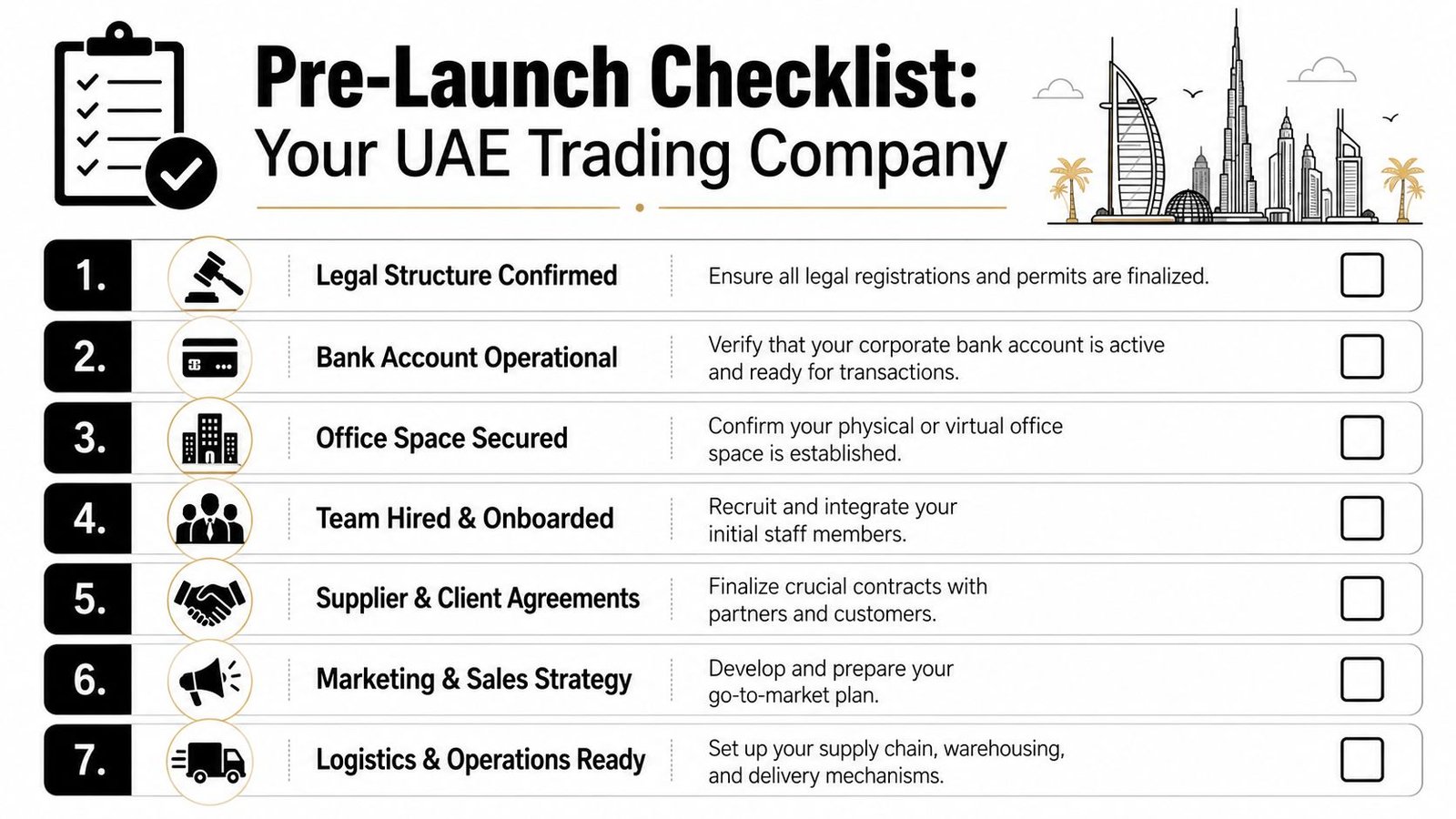
- Define the trade model: Local UAE distribution, regional re-export, or hybrid.
- Shortlist your actual product categories: Start with what you'll really trade first.
- Choose the jurisdiction based on revenue logic: Mainland for direct UAE market access, Free Zone for hub-style trade operations, offshore only when a non-operating structure is the point.
- List your customs touchpoints: Entry points, storage, importer-of-record responsibility, and delivery path.
- Prepare shareholder documents early: Passport copies, corporate records if any, and signing authority evidence.
- Draft a bank-ready business summary: Products, counterparties, source of funds, and why the UAE entity exists.
- Check who controls market access: Your office, a distributor, or an agent.
What a launch-ready file looks like
A launch-ready trading company in UAE has three things aligned. The licence matches the activity. The jurisdiction matches the sales and logistics model. The banking narrative matches both.
That's the difference between a company that merely exists and one that can trade.
If you want expert help turning that plan into a working UAE entity, Inpro Corporate Services L.L.C. can support the full process from jurisdiction selection and licensing to visas, banking, tax registration, and ongoing compliance. The value isn't just faster paperwork. It's getting the structure right before costly friction appears.