


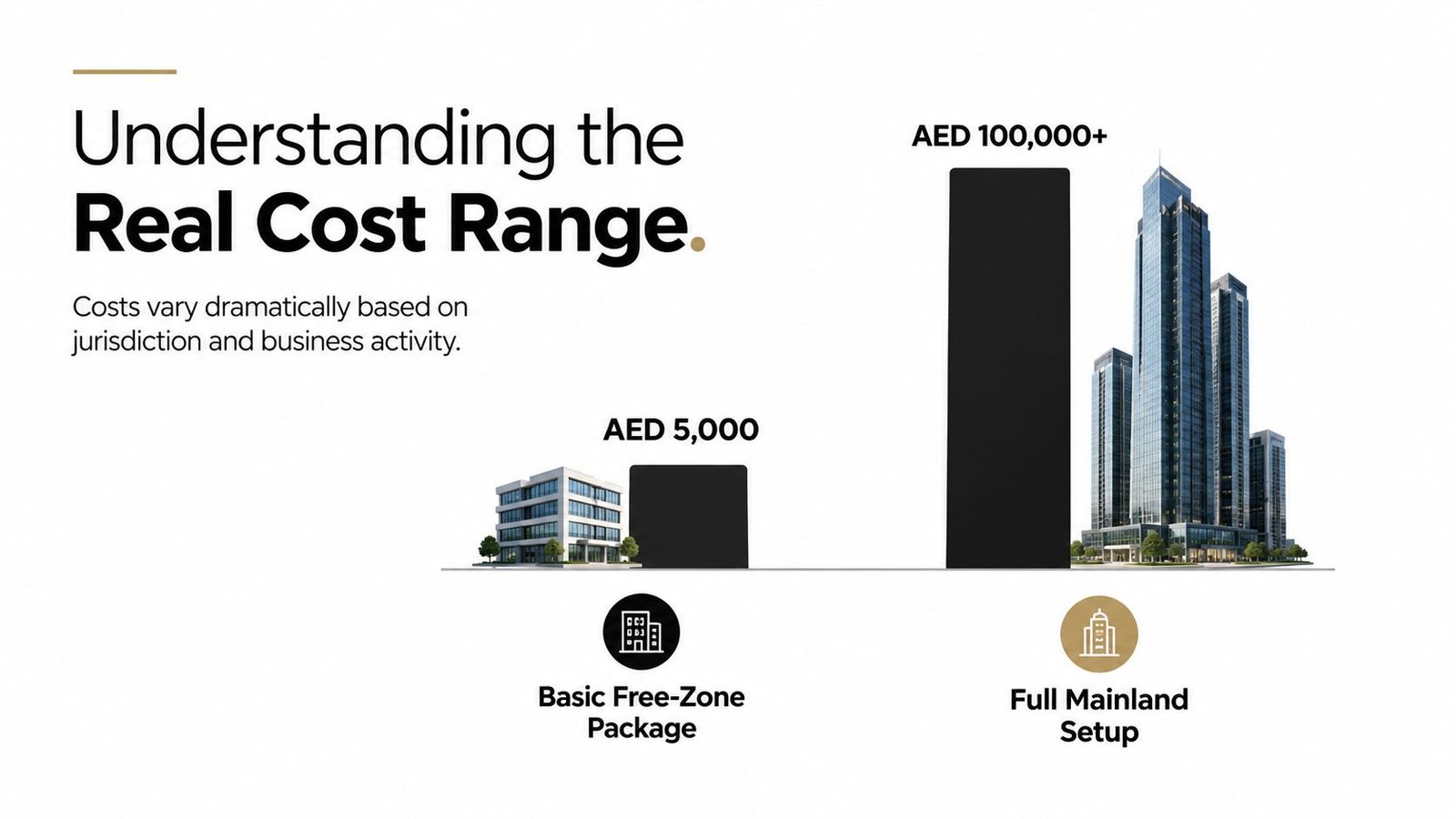
A lean UAE free-zone package can start at AED 5,000, while a mainland company with a physical office and multiple visas can exceed AED 100,000. The right UAE business setup cost depends on where you'll operate, what activity you'll carry out, whether you need direct local-market access, and how many people require visas.
That range surprises many founders because the advertised licence price is often only the entry point. Establishment cards, immigration processing, workspace, document attestation, employee visas, tax administration, and annual renewals can change the first-year cash outlay significantly. For an international entrepreneur relocating to Dubai, a freelancer in Sharjah, an HR team managing employee visas, or an investor applying for a Golden Visa, the sensible question isn't “What's the cheapest licence?” It's “What structure will work without forcing an expensive change later?”
Table of Contents
- Understanding the Actual Cost Range
- What Goes Into the One-Time Formation Fees
- Government Registrations and Regulatory Fees
- Comparing Free Zone, Mainland, and Offshore Costs
- Real Budget Scenarios for Different Business Types
- Hidden Costs and Common Budget Mistakes
- Choosing the Right Jurisdiction for Your Business
Understanding the Actual Cost Range
The advertised licence fee is rarely the full first-year bill. In the United Arab Emirates, published market data places free-zone packages around AED 7,000 to AED 15,000 when they include a licence, flexi-desk, and one visa. Mainland companies with physical offices and multiple visas can reach AED 50,000 to AED 100,000 or more. Another market guide places a basic free-zone licence near AED 4,888 and mainland setup from AED 14,000, before operating requirements are added. Review the published UAE setup cost comparison for the underlying ranges.
What causes the difference in UAE business setup cost?
Four variables usually drive the gap:
- Jurisdiction: Free zones, mainland authorities, and offshore registrars support different operating models.
- Business activity: Consultancy, trading, industrial, and regulated financial activities can require different approvals.
- Visa requirement: Each owner or employee may add immigration, medical, identification, and insurance costs.
- Workspace: A shared flexi-desk costs less than a dedicated office with a registered tenancy, but it may provide less room and flexibility.
Free-zone pricing also varies sharply. A zero-visa licence at SHAMS can start at AED 5,750 per year, while a comparable DMCC package is listed at AED 20,285. Adding one residence visa raises the published first-year totals to about AED 11,743 at SHAMS and AED 35,484 for DMCC's Basic Biz package. The free-zone pricing data from Binderr illustrates why a low-cost setup depends on the zone, package, visa allocation, and workspace terms.
Which setup paths should founders compare?
A Free Zone company often fits internationally focused services, digital businesses, consultants, and founders who can work from shared space. A Mainland company suits businesses requiring direct access to UAE customers, local contracts, physical premises, or government opportunities. An Offshore company is generally used for holding and asset-structuring purposes, rather than ordinary commercial operations in Dubai, Abu Dhabi, or Sharjah.
The practical comparison is formation cost against operating fit. A cheaper package can become expensive if the business later needs additional visas, a larger office, regulated approvals, or mainland access. Budgeting should therefore cover formation, visas, workspace, compliance, and renewals before choosing a jurisdiction.
What Goes Into the One-Time Formation Fees
A licence is only the starting point of the formation bill. Depending on the authority and business activity, the initial setup may also involve trade-name reservation, initial approval, incorporation documents, an establishment card, immigration file registration, visa allocation, medical processing, Emirates ID processing, and workspace.
What does the licence actually cover?
A trade licence authorises the activities recorded on the company's registration. It does not automatically include unlimited visas, a private office, access to the local market, or approvals for regulated activities. Review the package line by line, including visa slots, the registered address, renewal terms, and whether immigration services are included or charged separately.
As noted above, SHAMS and DMCC illustrate how widely free-zone packages can differ. The comparison is useful because the headline licence fee may represent different operating assumptions, such as workspace access, visa capacity, and administrative support. Use the figures from the earlier comparison as a starting point, then confirm the current inclusions with the relevant authority or provider.
Which formation items should appear in the quote?
Ask the provider or authority to separate the following:
- Licence and registration: The charge for issuing the business licence and registering the entity.
- Establishment card: The immigration record that allows the company to sponsor residence visas.
- Workspace: A flexi-desk, shared office, or dedicated premises connected to the licence.
- Visa processing: Immigration applications, medical fitness procedures, Emirates ID, and related administration.
- Document work: Incorporation resolutions, constitutional documents, translations, attestations, and professional handling.
- Post-licence support: Banking assistance, tax registration, accounting, and employee visa processing.
Also ask whether the quote includes the company's registered address for the full licence term. A low-cost package may provide only a basic address arrangement, while a business serving clients in person may need premises that meet authority, tenancy, or customer-facing requirements. That distinction can change the cash needed at launch.
A lower quote can suit a solo consultant who needs one visa and no local premises. It may not suit a growing agency that plans to hire staff, meet clients privately, or sell directly to UAE customers. The cheapest package becomes expensive when missing services must be added immediately or the company later needs restructuring.
Government Registrations and Regulatory Fees
Government registrations can be free while the surrounding compliance work still affects the launch budget. Corporate tax registration is free, and VAT registration is also free through the Federal Tax Authority, which administers federal taxation in the UAE. The company must still prepare accurate documents, financial information, and timely follow-up.
How long does VAT registration take?
The Federal Tax Authority's VAT registration process takes around 20 business days, according to published UAE company formation guidance. That waiting period can affect invoicing, banking arrangements, and the planned trading date. Whether registration applies depends on the company's taxable activities and obligations, so founders should confirm the facts before submitting an application.
What does document attestation cost?
MOFA attestation authenticates documents through the UAE Ministry of Foreign Affairs. The listed fee is AED 150 for individuals and AED 2,000 for commercial documents. These amounts cover the government attestation itself, not licensing, visas, translation, courier services, or professional handling.
Practical rule: Separate regulatory filing costs from licence, office, and immigration costs. A quote that labels registration as “free” may still exclude the document preparation and compliance work needed to complete it.
The larger cash requirement often comes from preparing consistent records, correcting mismatched documents, and meeting filing deadlines after incorporation. Owners who handle submissions themselves may reduce advisory fees, but they still need to allocate staff time and assign responsibility. Check whether the quote covers only the government charge or also includes application review, document preparation, and follow-up. That distinction gives a clearer view of the money required to move from formation to active operation.
Comparing Free Zone, Mainland, and Offshore Costs
Jurisdiction determines more than the licence fee. It affects customer access, workspace requirements, visa capacity, renewal costs, and the company's ability to operate inside the UAE. A free zone can suit an international consultant, while a mainland licence fits a business selling directly to UAE customers. An offshore structure serves a separate purpose and should not be assessed as an operating licence.
How do the three jurisdictions compare?
| Jurisdiction | Cost Position | Ownership | Market Access | Ongoing Decision Factor |
|---|---|---|---|---|
| Free Zone | Often offers lower-entry packages with licence, shared workspace, and limited visa capacity | Foreign ownership is commonly available, subject to activity and authority rules | International and zone-based operations. Direct mainland trading may require a distributor or additional approval | Renewal fees, visa quotas, and workspace rules vary by authority |
| Mainland | Usually carries higher office, licensing, and immigration overhead | Foreign ownership is available for eligible activities | Direct UAE market access | Annual office renewal, employee visas, and activity-specific compliance can drive the recurring budget |
| Offshore | Varies by registrar and structure | Ownership depends on the structure and registrar | Holding and international structuring. Not intended for ordinary UAE commercial operations | Banking, substance, filings, and registrar renewal requirements require advance review |
The comparison should follow the intended operating model rather than the advertised entry fee. Confirm whether the quotation includes immigration files, office documentation, renewal charges, and authority approvals. A low first-year price can become less useful if the business later needs more visas or direct local contracts.
When does a Free Zone make sense?
Free zones suit companies serving international clients, providing professional services, selling digitally, or operating without unrestricted access to local UAE customers. Shared workspace may reduce the initial commitment, but the authority's visa quota and renewal terms still affect the cash required to continue operating.
The trade-off is access. A founder may save on premises while accepting limits on mainland trading, employee capacity, or activity selection. Review the permitted activity, number of available visas, renewal cost, and any approval needed for local sales before choosing a zone.
Why does Mainland cost more?
Mainland companies generally face higher overhead because office premises, licensing, and visa-linked compliance add recurring expense. Published guidance places registration fees around AED 1,000 to AED 5,000, visa costs commonly around AED 3,000 to AED 7,000 per person, and office or flexi-desk facilities around AED 5,000 to AED 35,000 or more annually, depending on the arrangement. These figures appear in the mainland licensing cost analysis.
A DET LLC is a limited liability company licensed through Dubai's Department of Economy and Tourism. Its final budget depends on the activity, visa count, office arrangement, and compliance requirements. The broader UAE market access can justify that recurring cost when local contracts and physical operations are central to revenue.
What is an Offshore company?
An Offshore company generally supports holding assets, investments, or international arrangements. It does not replace a mainland or free-zone operating company when the business needs UAE premises, employee visas, or direct local trading. Before selecting offshore, confirm banking, tax, substance, and commercial-use implications with a qualified adviser.
Real Budget Scenarios for Different Business Types
A UAE setup budget becomes useful only when it matches the way the business will operate. Visa count, workspace, approvals, staffing, and access to local customers can change the first-year cash requirement substantially.
What might a lean free-zone setup cost?
A freelance designer serving overseas clients has a different cost profile from a trading company. For example, a designer using a SHAMS flexi-desk and requiring one residence visa could budget AED 11,743 for the first year, including the establishment card and medical processing. The exact quote depends on the selected activity and package, but the scenario shows why a headline licence price is not a complete operating budget.
The founder should also confirm what happens after incorporation. Visa renewal, health insurance, accounting, banking, and any required tax or compliance filings may not be included in the initial package. A low-infrastructure model works when the founder needs one visa and limited physical operations. It becomes less suitable when the business hires staff, holds inventory, requires regulated approvals, or signs frequent local contracts.
What might a mainland SME need?
A small mainland SME with a physical office and several employee visas can require AED 50,000 to AED 100,000 or more in the first year, according to the published 2026 UAE setup market data. The range reflects more than licensing. Office rent, tenancy requirements, immigration files, approvals, staff onboarding, administration, and working capital all affect the amount.
Build the worksheet around the business model rather than a package label:
- Company licence and registration
- Office lease and tenancy requirements
- Founder and employee visas
- Establishment and immigration files
- PRO support for applications and renewals
- Accounting and tax administration
- Insurance and employee onboarding
- Banking and operational working capital
Many founders use AED 15,000 to AED 25,000 as a planning range for a free-zone company after adding office, visas, and administration. A smaller mainland setup is often planned at AED 25,000 to AED 50,000. These figures are not fixed quotations. Additional visas, a larger office, or activity-specific approvals can push the mainland budget higher, while a founder-only service business may need considerably less.
Hidden Costs and Common Budget Mistakes
A licence quote can look affordable while leaving out the cash required to operate. The largest surprises usually come from the administrative chain after incorporation, including medical screening, Emirates ID processing, health insurance, PRO handling, renewals, accounting, and activity-specific compliance. Each employee visa also creates a repeatable process for applications, records, renewals, and related support.
Which costs are commonly missed?
Request an itemised quote covering:
- Immigration processing: Visa applications include government submissions and related processing, not only the visa label.
- Medical and identification steps: Residence applicants generally need medical fitness processing and Emirates ID procedures.
- Insurance: Health insurance or other cover may apply to residents and employees.
- PRO services: A PRO, or public relations officer service, manages government submissions and document follow-up.
- Renewals: Licences, establishment cards, visas, and workspace arrangements can generate recurring annual or periodic bills.
- Accounting: Bookkeeping, financial records, tax returns, and reporting continue after incorporation.
- Audit or activity requirements: Certain structures and activities may require extra reporting or professional review.
A “starting from” price is a marketing entry point, not a first-year operating budget.
Does a Free Zone always reduce tax?
No. The jurisdiction alone does not determine the corporate tax result. The standard UAE corporate tax rate is 9% on profit above AED 375,000 for mainland companies and free-zone entities that do not qualify for the special free-zone regime, according to guidance on UAE corporate tax and qualifying free-zone income.
A qualifying free-zone company may receive 0% corporate tax only on qualifying income. It must maintain real substance in the UAE, separate qualifying from non-qualifying income, and keep non-qualifying revenue below 5% of total revenue or AED 5 million, whichever is lower. The conditions require proper records and suitable tax advice. A free-zone licence by itself does not secure the treatment.
How can founders control the budget?
Confirm the business activity before comparing authorities, and obtain the visa quota and renewal pricing in writing. Ask whether the quote includes medical processing, identification procedures, insurance, PRO work, and accounting, rather than treating these as optional extras. Compare a flexi-desk with the premises the business needs, then check the terms for renewal and upgrades.
The cheapest structure can become expensive if it restricts local sales, adds approval requirements, or limits employee growth. Review the full first-year cash outlay and the recurring compliance cost before choosing the package.
Choosing the Right Jurisdiction for Your Business
Use the business model as the first filter. If you serve international clients from a shared workspace and need limited visas, a Free Zone may provide the simplest financial starting point. If your revenue depends on UAE customers, local contracts, or a physical operation, Mainland access may justify the additional office and compliance spend.
An Offshore structure fits a different purpose. It can suit holding investments or assets where UAE residency and day-to-day local trading aren't required, but it shouldn't be selected as a low-cost replacement for an operating licence.
Which option fits your situation?
- Choose Free Zone when international clients, online services, consultancy, or a lean team are central to the model.
- Choose Mainland when direct UAE market access, local premises, government work, or a larger visa requirement matters.
- Choose Offshore when the primary objective is holding or international structuring rather than operating inside the UAE.
The licence fee is only the starting point. Visa count and workspace requirements usually have the strongest effect on first-year cash outlay, while accounting, tax, renewals, and immigration administration shape the cost of staying compliant. A founder should also consider relocation plans, employee growth, banking requirements, and future activities before committing to a structure.
A useful quote should show each government fee and professional service cost separately, identify what renews, and state what isn't included. That approach gives international founders, freelancers, HR professionals, and Golden Visa applicants a clearer view of the commitment across Dubai, Abu Dhabi, Sharjah, and the wider UAE.
Inpro helps founders compare Mainland, Free Zone, and Offshore structures, arrange licensing, attestations, PRO services, visas, accounting, and tax registration, and estimate the likely full setup budget. Visit Inpro to request a personalised cost review and choose a UAE setup that matches your market access and staffing plans.