

A UAE Free Zone Visa is a residence permit issued through the free zone authority where your company is licensed, typically valid for 2 to 3 years, and available mainly as an investor or partner visa or an employment visa sponsored by your free zone company. The right visa depends on your role, the authority's rules, and the office package behind your company's visa quota.
You may be planning a move to Dubai, Abu Dhabi, or Sharjah while setting up a company, hiring overseas staff, or checking whether a Golden Visa is the better route. The part that often causes trouble comes later: a founder buys an attractive low-cost workspace, then discovers that the company can't sponsor the intended team because its office footprint supports fewer visas than expected.
That's why a UAE free zone visa should be treated as both an immigration decision and a workspace and compliance decision. This guide explains the sponsorship structure, visa categories, quota logic, application stages, renewal risks, and the differences between free zone and mainland arrangements across the United Arab Emirates.
Table of Contents
- What a UAE Free Zone Visa Actually Is
- How Free Zone Visa Sponsorship Works
- Free Zone Visa Types and Who Qualifies for Each
- Visa Quotas and Why Your Office Size Decides Them
- The Free Zone Visa Application and Renewal Process
- Free Zone Visa vs Mainland Visa
- Common Free Zone Visa Mistakes and How to Avoid Them
- Free Zone Visa FAQs and Next Steps
What a UAE Free Zone Visa Actually Is
A UAE Free Zone Visa is a residence authorisation issued through a free zone company or authority. It's normally connected to the sponsoring entity's active licence, rather than to a mainland employer structure. In Dubai, a major free zone authority states that free zone visas are generally issued for 2 to 3 years, while a UAE news explainer commonly describes a 3-year validity period for many free zone visas, making the expiry date a key planning point for founders and families (DMCC's guide to Dubai free zone visas).
What does the visa allow?
The visa gives an approved person the right to reside in the UAE under the relevant sponsorship arrangement. An owner may apply through an investor or partner route, while a staff member usually applies through an employment route sponsored by the free zone company.
The visa doesn't stand alone. Your company must hold the required licence and maintain its immigration file with the relevant authority. The person's residence status is therefore connected to the company's continuing eligibility, not just to an individual application.
Why do founders choose a free zone route?
The UAE has 40 free zones, according to the official United Arab Emirates government platform (UAE government portal). Each zone has its own activities, licensing packages, premises rules, and administrative systems. Dubai locations such as Dubai Multi Commodities Centre, or DMCC, appeal to some trading and professional businesses, while Abu Dhabi and Sharjah offer different authority structures and commercial settings.
A free zone setup can suit a founder who wants to establish a company within a defined business community, employ people under that company, and build a residence plan around the company's actual operations. It may be less suitable if the team needs broad mainland work access or a large number of sponsored employees from the beginning.
Practical rule: Choose the company structure, office package, and visa plan together. Treating them as separate purchases creates avoidable problems later.
How Free Zone Visa Sponsorship Works
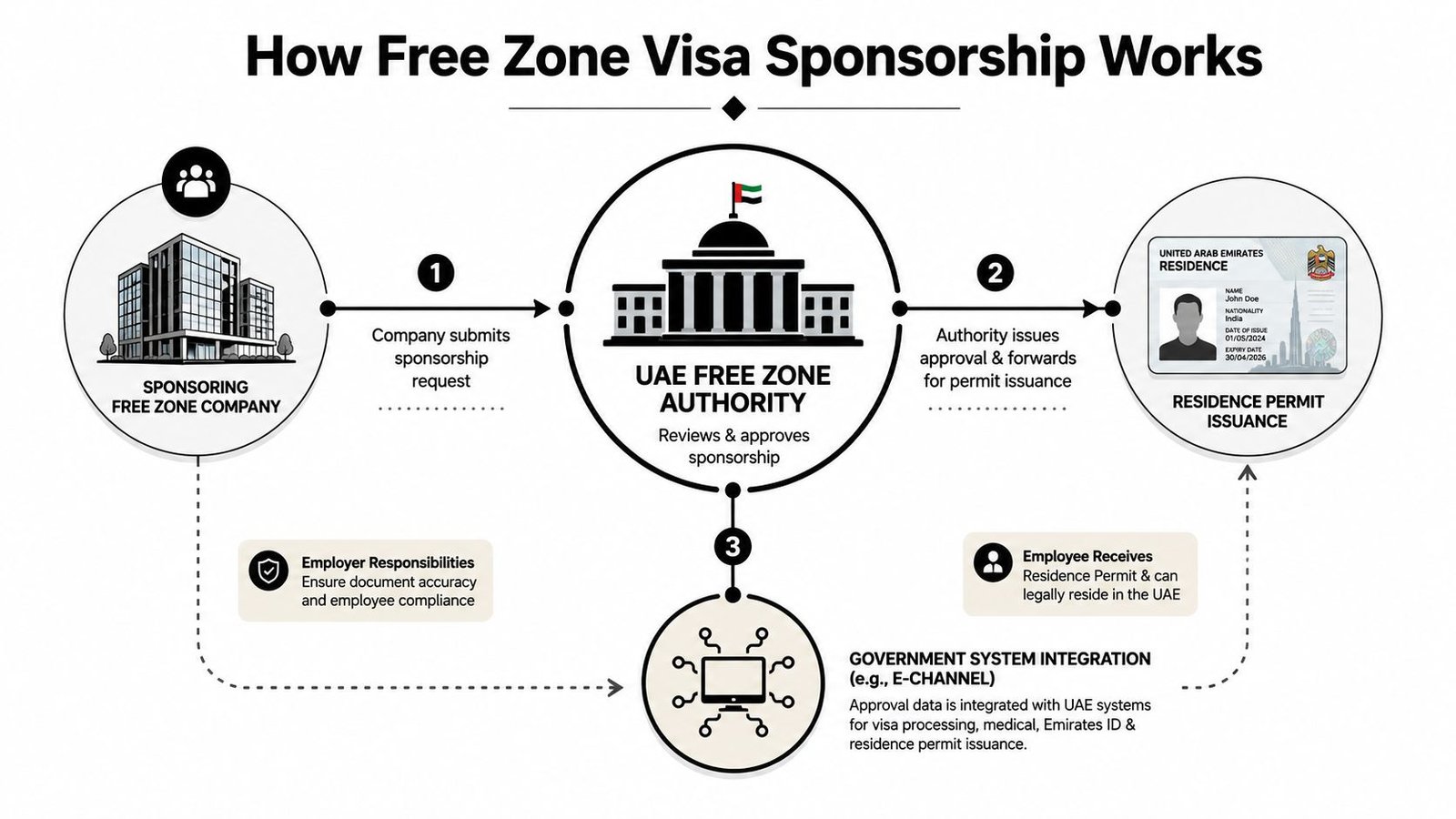
A free zone visa isn't a generic immigration product that any business can order independently. It's a residence permit issued through the governing authority of the specific free zone, with the application moving through the relevant UAE immigration system.
For a Dubai company, the route is generally through GDRFA Dubai, the General Directorate of Residency and Foreigners Affairs in Dubai. Companies in other emirates generally deal with ICP, the Federal Authority for Identity, Citizenship, Customs and Port Security. The authority depends on where the company is licensed, so a Dubai free zone process shouldn't automatically be applied to a company in Abu Dhabi or Sharjah.
What happens inside the authority workflow?
The company's immigration file connects several stages that applicants often see as separate tasks:
- Entry permit: Permission for a person outside the UAE to enter for the residence process, or a document used alongside an in-country status change.
- Medical fitness: A required health screening for residence applicants.
- Emirates ID: The identity card application managed through the UAE's identity authority.
- Residence stamping: The final residence record issued after the required approvals.
The free zone authority coordinates the company-side application, while GDRFA Dubai or ICP handles the relevant immigration approval. The result is a controlled workflow rather than a simple employer letter.
Which law governs the process?
The legal foundation for UAE residence visas, including free zone visas, is Federal Decree-Law No. 29 of 2021, together with its Executive Regulations under Cabinet Resolution No. 65 of 2022. These references matter because the free zone's portal and internal rules operate within the wider federal residence framework (overview of the Dubai free zone visa framework).
The practical lesson is straightforward. Your trade licence, establishment records, immigration file, applicant documents, medical result, Emirates ID application, and residence record must remain consistent across the authorities involved.
Free Zone Visa Types and Who Qualifies for Each
Most founders only need to distinguish between an owner route and an employee route at the start. Dependents then connect to the primary resident's status, subject to the applicable requirements and approval.
What is an investor or partner visa?
An investor or partner visa is a residence route for a company owner or shareholder. The applicant's relationship with the company must be supported by the company's ownership records and the free zone authority's rules.
This route suits a founder relocating to the UAE to operate their own licensed business. It isn't the same as an employee visa, even if the founder also performs day-to-day work for the company.
Who qualifies for an employment visa?
An employment visa is a residence route sponsored through the free zone company for an employee. The company must have an active licence, the required immigration standing, and enough approved visa capacity for the role.
The employee normally needs a valid offer or employment arrangement and the documents requested by the authority. Employment processing through a free zone is administered through the relevant free zone system, rather than being treated as a standard mainland company application.
How do dependent visas fit in?
A dependent visa is a residence route linked to an eligible primary visa holder, commonly for a spouse or child. The family member doesn't become a free zone employee just because their residence is connected to the founder or employee.
Founders should check the authority's current requirements for relationship documents, accommodation, insurance, and sponsorship eligibility before making relocation commitments. Document preparation can take longer when certificates are issued overseas.
Does the zone change the eligibility rules?
Yes. The UAE has 40 free zones, and each authority can set its own licensing, office, quota, and portal requirements (UAE government platform). A process that works for a Dubai authority may not match the requirements of an Abu Dhabi or Sharjah free zone.
Start by identifying your role, then confirm the authority's rules for that role. Owners usually examine the investor or partner route first, employers check the employment route, and families assess dependent sponsorship after the primary residence plan is clear.
Visa Quotas and Why Your Office Size Decides Them
A company's visa capacity is often determined by more than how many people the founder wants to hire. The licence package, office type, and leased premises can set the ceiling, which makes workspace selection part of the immigration plan.
Common Dubai free zone patterns include 1 to 3 visas for virtual office or flexi-desk packages, 3 to 6 visas for serviced offices, and approximately 1 visa per 9 square metres of leased physical office space. These are common patterns, not a universal UAE rule, and the exact calculation depends on the authority and package (industry guidance on Dubai free zone visa quotas).
| Office Setup | Typical Visa Quota | Best Suited For |
|---|---|---|
| Virtual office or flexi-desk | 1 to 3 visas | Solo founders and small initial teams |
| Serviced office | 3 to 6 visas | Growing teams needing additional capacity |
| Physical leased office | Approximately 1 visa per 9 square metres | Businesses planning a larger hiring runway |
Why does this affect hiring?
Suppose your first plan involves one founder and a small number of employees. A flexi-desk may appear suitable because it keeps the initial premises commitment low. If the business later needs more sponsored staff, the founder may have to upgrade the office, amend the package, or request additional approval.
That change can affect both budget and timing. The right question isn't only, “Where will we sit?” It's also, “How many people must this company sponsor before the next licence and visa review?”
Workspace should follow the hiring runway, not just the first month's headcount.
A founder who plans recruitment early can compare the effective cost of a larger office against the administrative cost of changing packages later. The free zone authority should confirm the exact quota before the company commits to a workspace.
The Free Zone Visa Application and Renewal Process
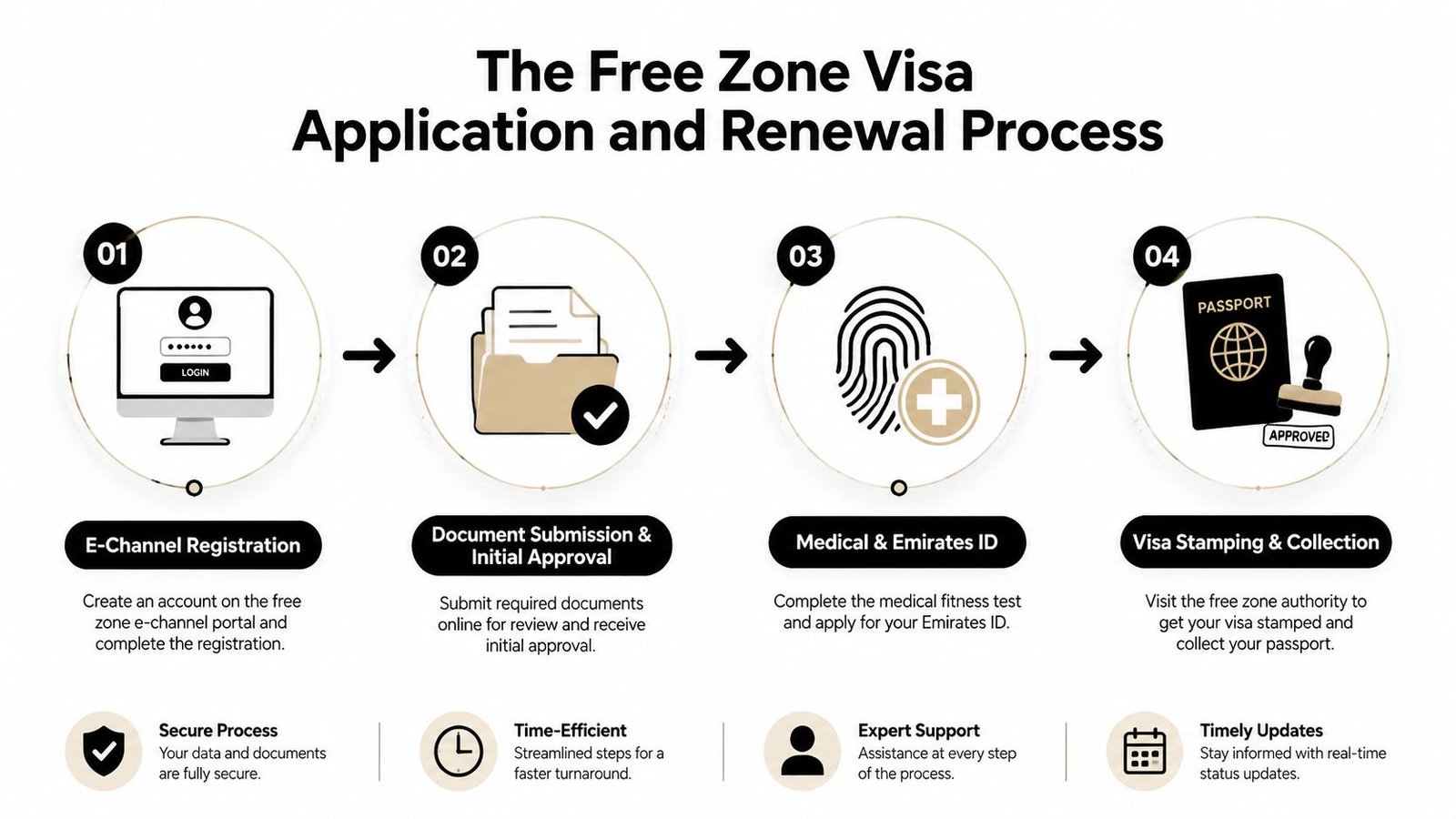
The application usually follows a defined sequence. The exact screens, documents, and approval points vary by authority, but the logic remains consistent: establish the company's eligibility, obtain immigration approval, complete the applicant checks, and record the residence status.
Where does the application begin?
The first administrative stage is E-Channel registration, a government system used to streamline visa processing. A published UAE guide identifies E-Channel registration as the first step for obtaining a free zone visa (Gulf News guide to UAE free zone visas).
The company or its authorised representative submits the relevant details and supporting documents through the authority's channel. The applicant's location matters because a person outside the UAE generally needs an entry permit, while someone already inside may follow a status-change route.
What happens after submission?
The authority reviews the file and, once approved, issues an entry permit where applicable. The applicant then enters the UAE under that permit or completes a status change from within the country.
Next comes the medical fitness test. The applicant attends an approved centre, completes the required screening, and waits for the result to be connected to the residence application.
How are Emirates ID and stamping completed?
After the medical stage, the applicant completes Emirates ID biometrics, where required. The identity application must match the passport and immigration file, so differences in names, dates, or document details can cause a hold-up.
The final stage is residence visa stamping, or the current digital residence recording process used by the relevant authority. Once the residence record is approved, the applicant can use the resulting documentation for everyday UAE administration, subject to the conditions attached to the visa.
What changes during renewal?
Renewal is not an automatic extension. The company normally needs an active trade licence, valid establishment records, and a continuing basis for the sponsored person's residence. The applicant's documents and medical requirements should be checked against the authority's current renewal process.
Set calendar reminders well before the expiry date. A PRO services partner such as Inpro Corporate Services L.L.C. can coordinate submissions, medical appointments, Emirates ID steps, renewals, and document follow-up through the relevant government channels.
Free Zone Visa vs Mainland Visa
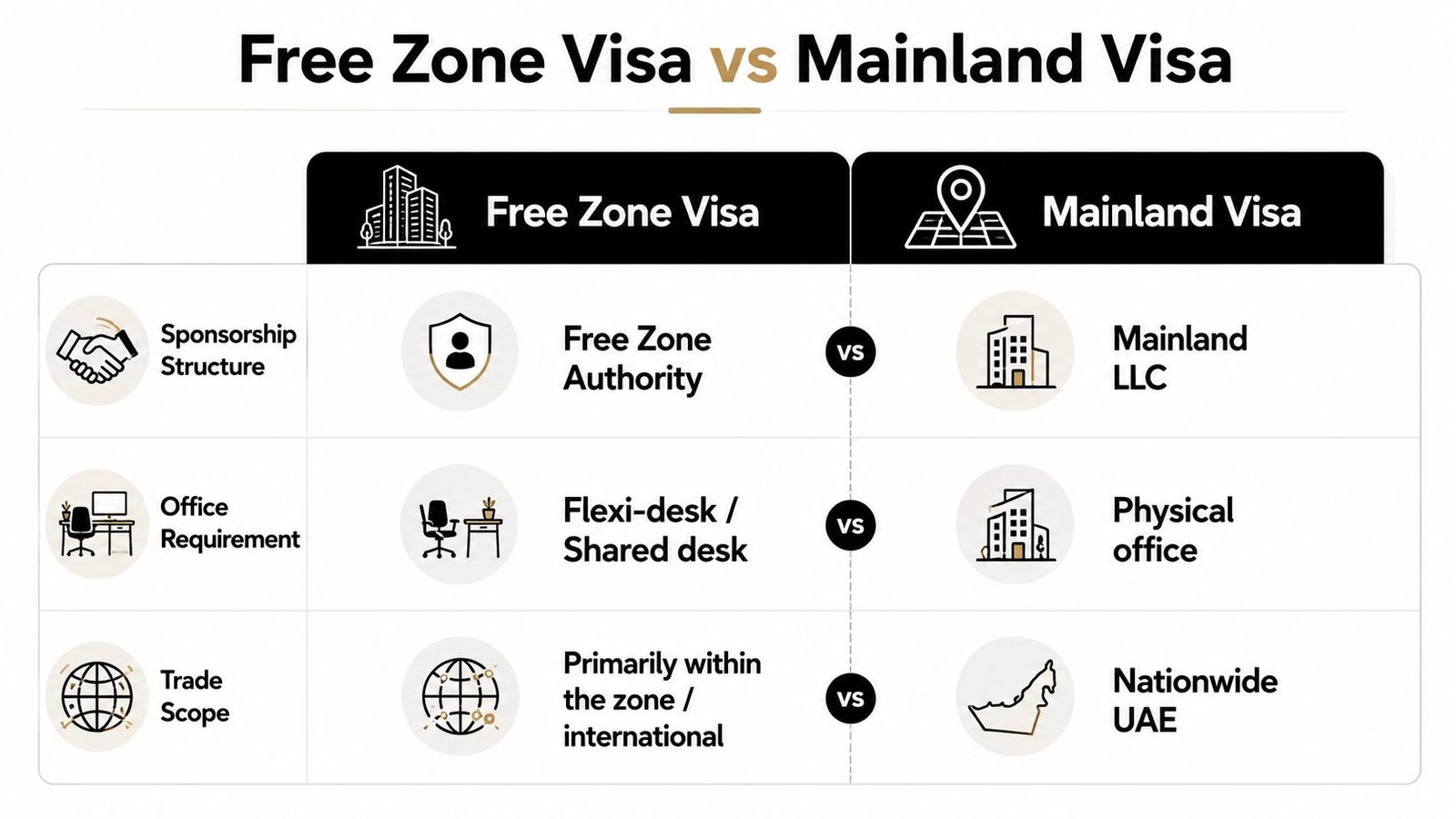
The main difference is the sponsorship structure. A free zone visa is connected to the relevant free zone authority and its licensed company, while a mainland company is licensed through the emirate's economic department, often called the DED, or Department of Economic Development.
Work location also matters. Free zone employment is generally tied to the licensed business and the zone's permitted arrangements, while a mainland employment structure is designed for work through a mainland company and its approved activities. A free zone visa shouldn't be treated as automatic permission to work for an unrelated mainland employer.
| Question | Free Zone Visa | Mainland Visa |
|---|---|---|
| Who sponsors it? | The free zone authority and licensed company structure | A mainland company licensed by the relevant economic department |
| Where is the business centred? | A defined free zone and its permitted activities | The wider mainland market, subject to licensing |
| What drives the decision? | Zone rules, office package, quota, and activity | Mainland premises, activity, employment, and immigration requirements |
Ownership, premises, customer access, and hiring plans can all affect the choice. Corporate tax treatment also needs separate advice, including whether a company may qualify as a Qualifying Free Zone Person for relevant income under UAE corporate tax rules. A free zone label alone doesn't settle that question.
Choose based on where your customers are, where your staff will work, and how many visas the company must sponsor. Inpro can help founders compare mainland and free zone jurisdictions with clear pricing and timelines.
Common Free Zone Visa Mistakes and How to Avoid Them
A founder in Dubai chooses the cheapest flexi-desk package, expecting to sponsor a growing team. The authority then confirms that the package supports only a limited quota, perhaps one visa in a zone-specific package, leaving the founder to change premises or reduce the initial hiring plan. The prevention is simple: obtain written confirmation of the quota before signing the licence and office package.
Another founder renews the company late because the trade licence seemed like a separate matter. The visa file depends on the company's continuing eligibility, so an expired licence or establishment record can interrupt sponsored residence processing.
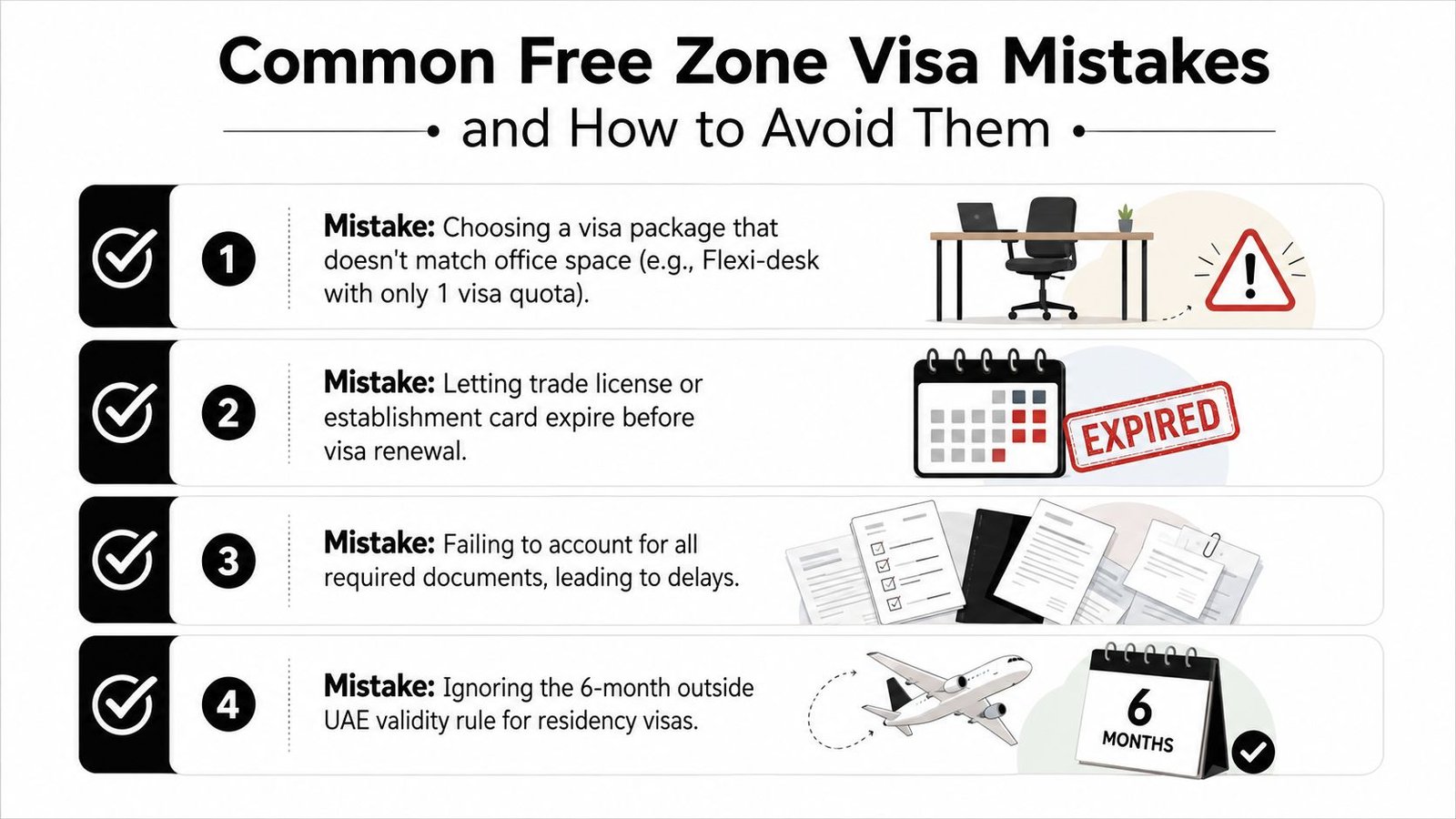
Which errors create the most disruption?
- Choosing the wrong quota package: Match the office setup to your planned founder, employee, and dependent sponsorship needs. Don't rely on a package name alone.
- Letting the trade licence lapse: Keep the trade licence and establishment card aligned with the visa renewal calendar. A residence file can't be treated as independent from the sponsoring company.
- Assuming renewal happens automatically: Record the residence expiry date, licence expiry date, passport expiry date, and any required appointment dates in one shared tracker.
- Leaving documents until the last minute: Overseas degrees, marriage certificates, and other civil documents may need attestation or translation. Start checking those requirements before the applicant's travel date.
There's also a travel-related risk. The infographic highlights the 6-month outside UAE validity rule for residency visas, so anyone planning extended time abroad should confirm how the rule applies to their specific residence status before leaving.
Before setup, ask three questions: How many visas does this package support? What must remain valid at renewal? Which documents need attestation?
A PRO team can track the company file, coordinate authority submissions, and flag missing documents. That doesn't remove the founder's responsibility, but it gives the process an owner instead of leaving deadlines across scattered inboxes.
Free Zone Visa FAQs and Next Steps
How long does the full process take?
There isn't one universal timeline from company licence to stamped residence visa. The duration depends on the free zone, the applicant's location, document readiness, authority approvals, medical appointment availability, and Emirates ID processing.
Treat the process as a sequence rather than a single promise. A complete file usually moves more predictably than one waiting for an attested certificate, corrected passport detail, or an authority response.
Can you move a visa between free zones?
A free zone visa is tied to its sponsoring company and authority, so moving to another zone usually requires a new company-side sponsorship process. The exact path may involve cancellation, a new entry or status application, and fresh authority approval.
Don't cancel the existing residence until the replacement route has been checked. The practical order depends on whether the applicant is changing employers, restructuring the company, or relocating the business between emirates.
What happens if you sell the company?
Selling the company can change the basis on which an investor or partner visa was issued. The outgoing owner should confirm whether the visa must be cancelled or replaced, while the incoming owner needs to establish their own eligibility under the authority's rules.
Employees may also be affected if their sponsoring entity changes. Review the company transfer documents and immigration file together rather than treating the sale as only a commercial transaction.
Is a Golden Visa the same as a free zone visa?
No. A free zone visa is connected to a free zone company or authority. A Golden Visa is a separate UAE residence route with its own eligibility conditions and federal approval process, so an applicant should assess that route independently rather than assuming a company visa converts automatically.
A sensible starting point is to compare the chosen free zone's activity, office footprint, visa quota, market access, and renewal requirements. UAE immigration administration operates through established authority workflows, but the correct route still depends on accurate information at the outset.
Inpro Corporate Services L.L.C. helps founders with UAE company formation, free zone licensing, visa applications, document attestations, renewals, and ongoing regulatory compliance. Visit Inpro Corporate Services L.L.C. to compare your setup options, request clear timelines, and plan your visa quota around the workspace and team you intend to build.