


A UAE investor visa can provide renewable residency, family sponsorship, business ownership and continuity, banking access, and a practical base for operating in the United Arab Emirates. The exact route may offer 5 or 10 years of residence, with public-investment eligibility tied to AED 2 million, but the outcome depends on your structure, eligibility, and separate authority approvals.
The surprising part is that the visa itself is only one piece of the decision. It can support a founder's move to Dubai, Abu Dhabi, Sharjah, or a UAE free zone, but it doesn't automatically create tax residency, guarantee a bank account, secure government contracts, or grant access to every business jurisdiction.
An investor visa is a residence permit linked to an investment or a UAE-registered business, rather than to a single employer. Mainland means a business licensed by the economic department of an emirate and generally able to trade across the UAE. A Free Zone is a designated business jurisdiction with its own licensing authority and rules. Golden Visa is a separate long-term residence category for eligible investors and other qualifying applicants.
The UAE's investment and residence policies have developed together. Foreign direct investment inflows rose from USD 15.08 billion in 2018 to USD 19.884 billion in 2020, according to the U.S. Department of State's 2022 investment climate statement for the UAE. The Golden Visa was first announced in 2019, making it a relatively recent part of that wider policy direction.
This guide follows the decisions founders usually make after choosing residence: family stability, jurisdiction and ownership, hiring, banking, tax planning, market access, renewal continuity, and whether a Golden Visa is a better alternative. Before applying, check eligibility, document attestation, medical screening, licensing requirements, and the evidence needed at renewal.
Table of Contents
- 1. Extended Residency Duration and Family Sponsorship Rights
- 2. Access to Mainland, Free Zone, and Offshore Business Ownership
- 3. A More Independent Base for Hiring and Team Planning
- 4. Greater Ownership Flexibility in Suitable Free Zones
- 5. A Practical Base for Banking and Trade Finance Discussions
- 6. Better Conditions for Personal and Corporate Tax Planning
- 7. A Local Base for Government Contracting and Market Access
- 8. Renewal Continuity and the Golden Visa Alternative
- UAE Investor Visa: 8-Point Benefits Comparison
- Choose the Visa That Matches Your Plan
1. Extended Residency Duration and Family Sponsorship Rights
Residency becomes more useful when it supports the whole household, not just the founder. Depending on the investment route, the UAE's investor-linked Golden Visa provides a renewable residence status of 5 or 10 years, removes the need for a local sponsor, and allows eligible investors to sponsor family members, including spouses and children. The UAE government's Golden Visa guidance also states that holders can remain outside the UAE for more than the usual six-month period without losing residency validity.
What does family sponsorship mean in practice?
A founder relocating from London to Dubai can plan the move around the family's needs, rather than treating the business owner's visa as a temporary work permit. The spouse and children still need their own applications and supporting documents, and school admission remains a separate process, but the family can build its residence plan around a stable principal status.
A couple from Singapore who co-found a technology company may also decide that one partner holds the principal investor-linked residence while the other is sponsored as a spouse. That arrangement can simplify the initial relocation, although the sponsored spouse's ability to work may require a separate work permit, freelance permit, or other approval.
Practical rule: Treat family paperwork as its own workstream. Marriage certificates, birth certificates, passport copies, and any required attestations should be checked before the main application is submitted.
The benefit is continuity, not an automatic right to every service. Schools, landlords, employers, banks, and regulators may request additional documents. Children's sponsorship arrangements also need review as they approach adulthood, because family sponsorship conditions can change with age and status.
2. Access to Mainland, Free Zone, and Offshore Business Ownership
An investor-linked residence can give a founder a practical base from which to own or manage a UAE business, but the residence permit doesn't decide the best jurisdiction. The choice between Mainland, Free Zone, and Offshore structures depends on the activity, customers, ownership plan, regulated-sector approvals, and how the company will hold or move assets.
How should founders compare UAE jurisdictions?
A Dubai Free Zone may suit a software, e-commerce, or professional-services company that wants a defined licensing environment. A Mainland company may be more suitable where the business needs direct access to customers across the UAE, physical retail, local service delivery, or an activity that requires an emirate-level licence. Abu Dhabi, Sharjah, Dubai, and other emirates each have their own licensing channels and sector priorities.
An Offshore entity is generally considered for holding or asset-ownership purposes, not as a universal operating company. It may form part of a group structure, but it doesn't automatically give the group permission to conduct regulated activity, employ staff, invoice local customers, or open every type of bank account.
A founder might own an operating company in a Dubai Free Zone, use a Mainland entity for UAE client work, and consider a holding structure in a financial centre such as Abu Dhabi Global Market, known as ADGM, where the proposed activity and approvals fit. That structure can work, but each entity creates its own licensing, accounting, banking, and compliance obligations.
A residence visa doesn't replace a business licence. The authority assesses the company's activity, ownership, office requirements, permits, and documents separately from the immigration application.
Before committing capital, confirm the exact activity with the relevant licensing authority. A public-facing financial service, healthcare business, education provider, or other regulated operation may need approvals beyond the trade licence. A Public Relations Officer, or PRO, can coordinate government paperwork, but a PRO can't turn an ineligible activity into an approved one.
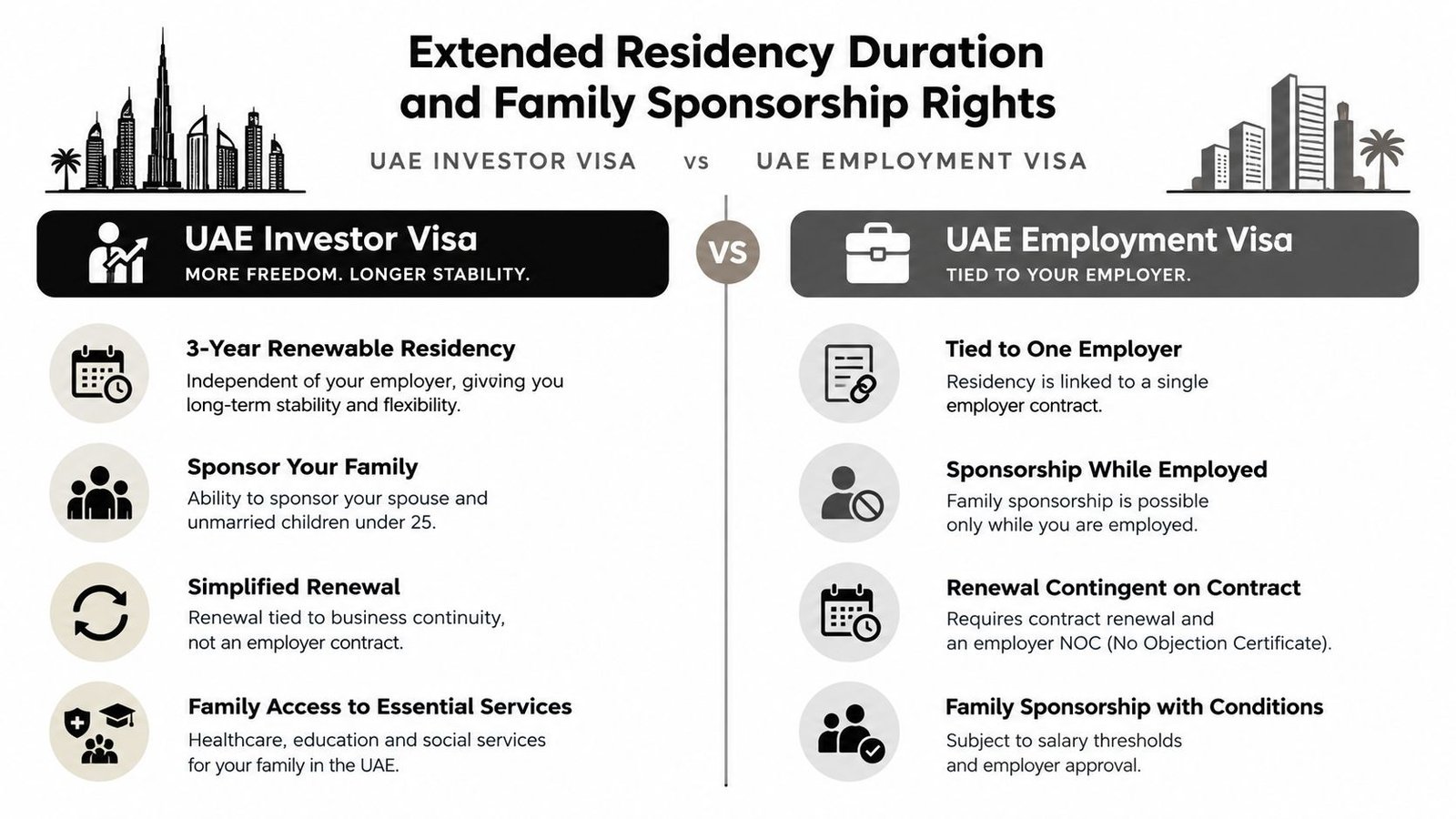
A short explanation of investor and employment residence routes can help founders separate personal residence from company ownership before they choose a licence.
3. A More Independent Base for Hiring and Team Planning
The useful hiring benefit is indirect. An investor-linked residence separates the founder's personal residence from an employer's sponsorship, which can make it easier to keep planning when the company changes its activity, office, ownership, or staffing model. It doesn't give the founder an unlimited right to sponsor employees, and it doesn't remove the need for employment contracts, work permits, labour approvals, or establishment files.
Can an investor visa remove employee visa limits?
No single residence permit should be treated as a promise of unlimited employee visas. Employee capacity depends on the company's licence, office arrangement, immigration file, labour classification, activity, and the rules of the relevant authority. A Free Zone company and a Mainland company may follow different processes, while some sectors require additional approvals.
A Dubai-based software founder may begin with a small technical team and later add sales, support, and operations staff. The sensible approach is to confirm the company's permitted headcount and visa process before signing employment offers. If the company has entities in both Dubai and Abu Dhabi, decide which entity will employ each person rather than assuming that one licence can sponsor every role.
Employment paperwork remains important. The Ministry of Human Resources and Emiratisation, or MOHRE, regulates many private-sector employment matters for Mainland companies. Free Zone employers may deal with their own authority for parts of the process, while still needing to meet applicable UAE employment and immigration requirements.
Fast processing isn't a substitute for compliant employment. Check the offer letter, contract, salary, insurance, work permit, and authority requirements for every hire.
Batching documents can reduce avoidable back-and-forth. Prepare passport copies, photographs, signed offers, qualifications where relevant, and company documents together. Prioritise roles that affect launch or client delivery, but don't promise a start date until the required approval is confirmed. The investor visa helps the founder maintain a stable base. It doesn't guarantee that every employee application will be approved.

4. Greater Ownership Flexibility in Suitable Free Zones
Many UAE Free Zones are designed to support foreign ownership, which can be attractive to founders who want to retain control of a new company. That is a benefit of the selected company structure and licensing regime, not a blanket consequence of holding an investor visa.
Does an investor visa guarantee 100% ownership?
No. Ownership depends on the activity, jurisdiction, licence, and any approval imposed by the relevant regulator. A founder may be able to establish a fully foreign-owned company in a suitable Free Zone, but regulated activities such as financial services, insurance, banking, telecommunications, and other controlled sectors can have additional conditions.
A German software architect may choose a Dubai Free Zone for a software development company because the proposed activity fits the jurisdiction and the founders want a clear ownership structure. A fintech team considering the Dubai International Financial Centre, or DIFC, needs a separate regulatory review because a financial-services licence is not the same as a general technology licence.
The distinction matters for funding. Investors and future buyers will examine the licence, shareholders, beneficial owners, contracts, intellectual property, accounts, and regulatory status. A structure that looks simple at formation can become expensive to change if it cannot serve Mainland customers or support the company's planned activity.
Use this short ownership check before signing:
- Activity: Confirm that the exact service, not just a broad label, is permitted.
- Customers: Decide whether the company will sell inside the UAE, internationally, or both.
- Regulation: Ask whether a regulator or department must approve the activity.
- Group structure: Separate operating, holding, and asset-owning functions where appropriate.
- Exit plan: Consider how a future investor would review ownership and licences.
The visa supports the founder's presence, but it doesn't settle any of these corporate questions. A licensing adviser or PRO can help coordinate the application, while legal and tax advice may still be needed for ownership, contracts, and group design.
5. A Practical Base for Banking and Trade Finance Discussions
A residence visa can help establish a founder's connection with the United Arab Emirates, but it doesn't guarantee a corporate bank account, credit facility, or trade-finance approval. Banks assess the company, owners, activity, source of funds, expected transactions, counterparties, office arrangements, and compliance profile.
What does the visa actually change for banking?
It gives the bank one piece of the onboarding file. The company still needs a valid licence and corporate documents, and the founder should be ready to explain where funds come from, what the business sells, who its customers are, and which countries it will pay or receive money from.
An e-commerce founder importing products through a UAE company should prepare supplier contracts, purchase orders, expected shipping routes, and customer information before approaching a bank. A consulting company seeking working capital should have signed contracts, invoices, management accounts, and a clear explanation of how the facility will be repaid. Those documents are more persuasive than merely pointing to a residence card.

The practical preparation is straightforward:
- Build the file early: Keep the licence, constitutional documents, ownership chart, passport copies, and proof of address together.
- Explain the activity plainly: A bank should be able to understand the business model without decoding marketing language.
- Show expected flows: List currencies, countries, suppliers, customers, payment platforms, and transaction types.
- Keep records: Accounting entries, invoices, contracts, and tax filings can support later reviews.
- Separate expectations: Account opening, overdrafts, loans, and trade finance are different bank decisions.
The investor visa may help a founder maintain a relationship with a UAE bank while travelling or expanding. It doesn't override anti-money-laundering checks, credit assessment, sanctions screening, or the bank's risk appetite.
6. Better Conditions for Personal and Corporate Tax Planning
The UAE's investor-residency framework is often discussed alongside the country's tax environment, but a residence visa is not the same as tax residency. The United Arab Emirates does not impose federal personal income tax, yet a founder's home country may continue to tax worldwide income, controlled companies, dividends, gains, or assets.
Does an investor visa make someone tax resident?
Not automatically. Tax residency depends on the applicable rules, the person's facts, time spent in each country, home and economic ties, and any tax treaty or certificate process. A founder who keeps a home, management role, family connection, or business activity in another country should obtain cross-border advice before assuming that UAE residence ends foreign obligations.
Corporate tax treatment also needs a separate review. The company's activity, taxable income, ownership, accounting records, Free Zone status, and qualifying conditions can affect the result. A Free Zone licence is not a promise that every type of income will receive the same treatment, and a Mainland company should be assessed under the UAE corporate tax rules that apply to it.
A UK entrepreneur moving to Dubai may have a different position from a US founder who remains subject to US reporting and tax rules. Neither should rely on the residence card alone. Keep lease records, utility evidence, entry and exit records, company documents, and financial statements in an organised file, then ask a qualified adviser how those documents support the intended position.
The visa can support a tax plan. It cannot create one by itself.
Value-added tax, or VAT, is another separate obligation. Registration, invoicing, returns, bookkeeping, and record retention depend on the business and its taxable supplies. Before launch, map the company's customers, suppliers, payment flows, and jurisdictions. That work is more reliable than choosing a Free Zone solely because someone described it as tax-free.
7. A Local Base for Government Contracting and Market Access
A UAE-registered business can create a route into local procurement and commercial opportunities that may not be available to a foreign company with no local operating presence. The investor visa helps the founder stay close to clients, authorities, suppliers, and tenders, but it doesn't give the holder priority or guarantee a government contract.
Does investor residence guarantee tender access?
No. Government procurement bodies set their own registration, technical, financial, insurance, local-content, security, and trading-history requirements. A company may need to register as a vendor with the relevant federal or emirate authority before it can submit a bid.
A logistics company in Dubai may want to provide warehousing or delivery services to a public entity. A technology supplier in Abu Dhabi may need to show implementation capacity, data controls, references, and support arrangements. The founder's residence can make local management easier, but the tender decision rests on the company's eligibility and proposal.
Market access also depends on jurisdiction. A Free Zone company may serve UAE customers, but the proposed activity and contracting model should be checked before the company markets itself as able to deliver every service across the country. A Mainland licence may fit better for certain local operations, while a regulated activity may require a specialist licence.
Register first, bid second. Confirm the tender portal, vendor category, required documents, bid security, and delivery obligations before spending time on a proposal.
Founders should also avoid treating a government contract as a banking or immigration shortcut. A tender award doesn't automatically change the company's visa quota, bank risk rating, tax treatment, or licence permissions. Those decisions remain separate.
8. Renewal Continuity and the Golden Visa Alternative
The strongest benefit may be continuity, provided the underlying eligibility remains valid. Ordinary investor or partner residence routes can be tied to an active company, licence, investment, and immigration file. Renewal therefore requires more than remembering an expiry date.
What evidence may be required at renewal?
Recent independent guidance indicates that UAE investor or partner visa renewals may require DEWA and Ejari proof, together with a six-month bank statement showing a minimum balance of AED 50,000 or the company's registered capital, whichever is higher. These requirements can change, so applicants should confirm them with the relevant authority or service channel before renewal. The reported procedural update is a reminder that residence benefits can depend on ongoing evidence.
DEWA refers to Dubai Electricity and Water Authority. Ejari is Dubai's registered tenancy system. These documents may connect the company or resident to an active address and operating record, rather than merely showing that a licence was once issued.
A founder should create a renewal file well before expiry:
- Residence evidence: Keep tenancy and utility documents current.
- Company evidence: Store the renewed trade licence, shareholder documents, and approvals.
- Banking evidence: Retain statements and explanations for unusual transactions.
- Activity evidence: Keep contracts, invoices, accounts, and correspondence showing genuine operations.
- Family evidence: Review dependent residence documents separately from the principal file.
The Golden Visa is a different route. The UAE Ministry of Economy's investor guidance describes a renewable residence permit valid for 5 or 10 years, with no sponsor requirement, family sponsorship, and eligibility linked to a minimum AED 2 million capital threshold for public investments or a qualifying property route.
Dubai's scale also shows why founders compare the options. The General Directorate of Residency and Foreigners Affairs, or GDRFA, granted about 66,000 Golden Visas in the first half of 2026, alongside more than 1 million new residence permits, according to reported Dubai immigration figures. That adoption doesn't mean every applicant qualifies, and it doesn't remove the need to maintain the investment and supporting evidence.
UAE Investor Visa: 8-Point Benefits Comparison
| Item | Implementation Complexity 🔄 | Resource Requirements ⚡ | Expected Outcomes 📊⭐ | Ideal Use Cases 💡 | Key Advantages ⭐ |
|---|---|---|---|---|---|
| Extended Residency Duration and Family Sponsorship Rights | Moderate, paperwork and family verification for visas 🔄 | Family documentation, health insurance, school costs ⚡ | Multi-year (3‑yr) residency for holder + sponsored family; stable settlement 📊 | Family relocation; founders with dependents | Stable independent residency; spouse work flexibility; family access to services ⭐ |
| Access to Mainland, Free Zone, and Offshore Business Ownership | High, multiple jurisdiction rules and licensing 🔄 | Multiple licences, legal counsel, compliance across jurisdictions ⚡ | Diversified entities, tax & regulatory optimisation 📊 | Companies needing holding structures, fintech, cross‑jurisdiction ops | Flexibility to choose jurisdiction, asset protection, tax optimisation ⭐ |
| Sponsorship of Employees Without Employment Visa Quotas | Low–Moderate, sponsor processes simpler, HR workflows needed 🔄 | Employee documents, medical checks, HR administration ⚡ | Rapid hiring and quicker visa approvals; scalable teams 📊 | Startups and high‑growth firms needing fast hires | No quota limits; faster onboarding for key hires ⭐ |
| Exemption from Local Ownership Requirements in Free Zones | Low, standard Free Zone setup procedures 🔄 | Free Zone licence fees, sector eligibility checks, compliance ⚡ | 100% foreign ownership and full operational control 📊 | Bootstrapped founders, VC‑backed startups, tech/e‑commerce firms | Retain full equity and decision‑making; simplify exits and funding ⭐ |
| Access to UAE Banking and Trade Finance Without Employment Restrictions | Moderate, bank KYC and credit underwriting 🔄 | Corporate records, audited statements, bank introductions ⚡ | Corporate accounts, trade finance, working capital facilities 📊 | Import/export merchants, e‑commerce, project‑based businesses | Easier account opening and access to trade lines; improved credit options ⭐ |
| Zero or Minimal Personal Income Tax and Streamlined Tax Planning | Moderate, residency documentation and cross‑border tax planning 🔄 | Tax advisors, residency proofs, structured entities ⚡ | Significant personal tax savings and efficient profit retention 📊 | High‑income founders, holding companies, international entrepreneurs | Zero federal personal income tax; Free Zone corporate benefits ⭐ |
| Priority Access to Government Contracts and Tender Opportunities | High, procurement compliance and bid preparation 🔄 | Certifications, track record, performance bonds, tender resources ⚡ | Potential long‑term, high‑value government contracts; steady revenue 📊 | Suppliers to government, infrastructure, education, healthcare sectors | Preferential eligibility and credibility when bidding on tenders ⭐ |
| Simplified Residency Renewal and Long-Term Business Continuity | Low–Moderate, maintain active business and documentation 🔄 | Audited financials, active trade licence, proof of investment ⚡ | 3‑year renewable residency for holder and family; continuity for planning 📊 | Families planning long stays, mortgage/education timelines, long‑term founders | Predictable multi‑year renewals; reduced admin vs employer‑tied visas ⭐ |
Choose the Visa That Matches Your Plan
The right route depends on what your residence needs to support. An investor route generally suits a founder whose residence is linked to a UAE business or qualifying investment. An employment visa is linked to an employer, so the employer usually controls the underlying sponsorship relationship. A freelance route may suit an eligible independent professional who doesn't need a company structure for the intended work. The Golden Visa is a separate long-term category with its own eligibility criteria, including investor routes linked to qualifying public investments or real estate.
The main distinction is between residence flexibility and business permission. An investor visa can help a founder live in the UAE without being tied to a single employer, sponsor family members, and maintain a base while the business develops. It doesn't decide whether the company belongs in Dubai Mainland, Abu Dhabi Mainland, Sharjah, a specialist Free Zone, or an Offshore structure. It also doesn't approve a regulated activity, open a bank account, grant tax residency, or make a company eligible for every tender.
Use this decision checklist before applying:
- Business activity: What exactly will the company sell, and does it require sector approval?
- Jurisdiction: Will the business serve UAE customers directly, operate internationally, or hold assets?
- Family: Do you need to sponsor a spouse or children, and are their documents ready?
- Employees: Which entity will employ staff, and what immigration and labour approvals apply?
- Banking: Will the company need a current account, payment services, trade finance, or credit?
- Time in the UAE: How often will you be present, and does the selected route support your travel pattern?
- Home-country tax: Could another country continue to tax your income, company, assets, or management activity?
- Renewal evidence: Can you maintain the licence, address, banking records, investment, and operating proof?
- Golden Visa: Do you meet, or should you separately assess, the criteria for a 5-year or 10-year route?
The exact application channel also matters. Dubai applications may involve the GDRFA or another designated authority, while federal and other emirate processes can differ. Document attestation, medical screening, Emirates identity procedures, insurance, licensing, and dependent applications should be planned as separate steps.
Founders often lose time by treating all approvals as one package. They are not. Visa approval, company licensing, bank account opening, tax treatment, employee sponsorship, and tender eligibility are separate decisions. A well-designed setup links them together without assuming that one approval guarantees the next.
Not sure where to start? Book a free strategy call with the Inpro team to compare your UAE setup and visa options.
Inpro helps founders and companies compare Mainland, Free Zone, and Offshore setups, coordinate Investor and Golden Visa applications, and manage PRO, licensing, attestation, and immigration workflows. Visit Inpro to review your UAE options and discuss the documents, jurisdiction, banking, and renewal evidence your plan requires.