

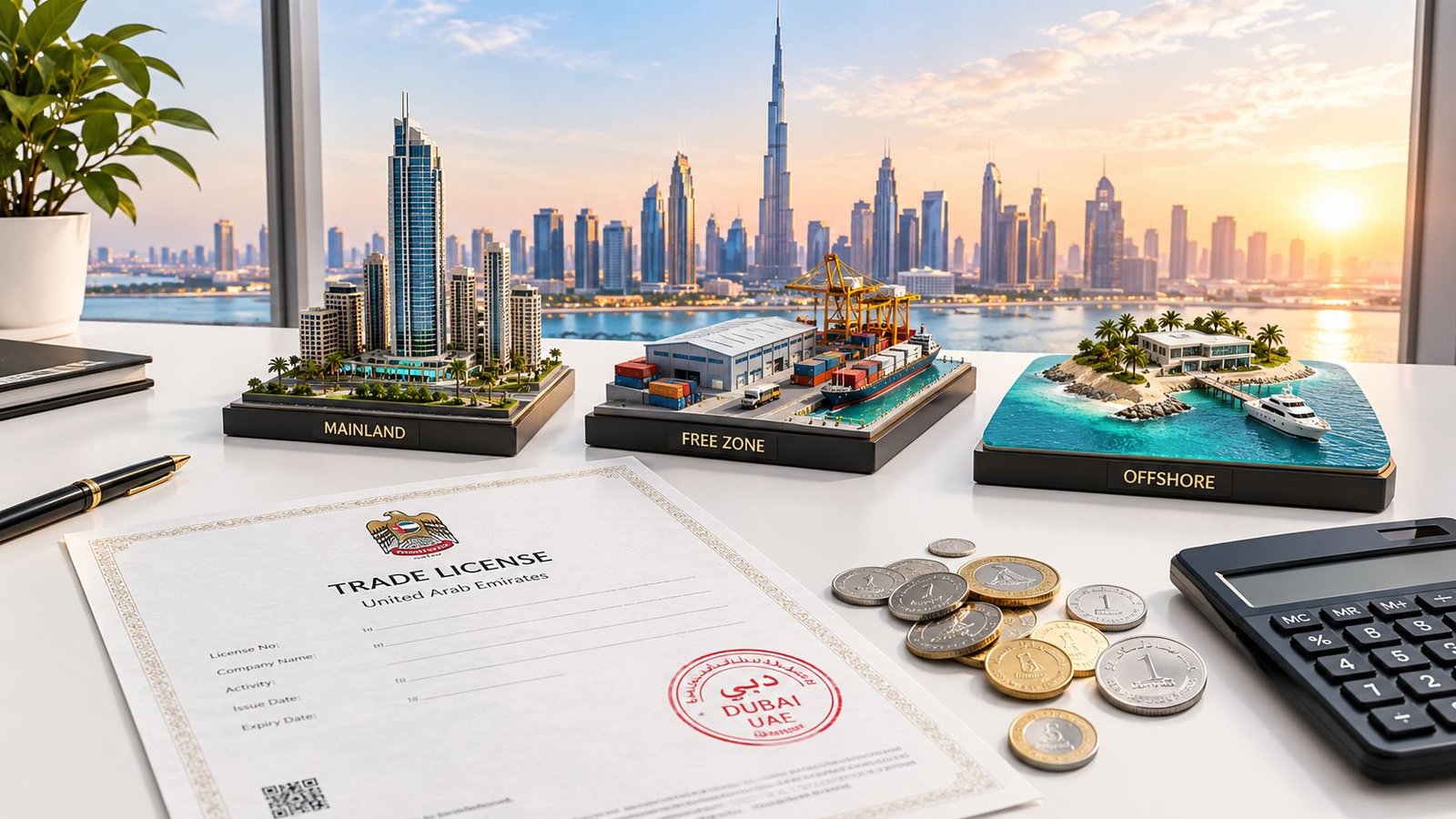
AED 15,000–25,000 is a typical first-year range for a Dubai mainland company, while UAE free-zone packages can begin around AED 4,888–12,900. The final UAE trade license cost depends less on the licence label than on visas, office space, establishment cards, approvals and the jurisdiction you choose.
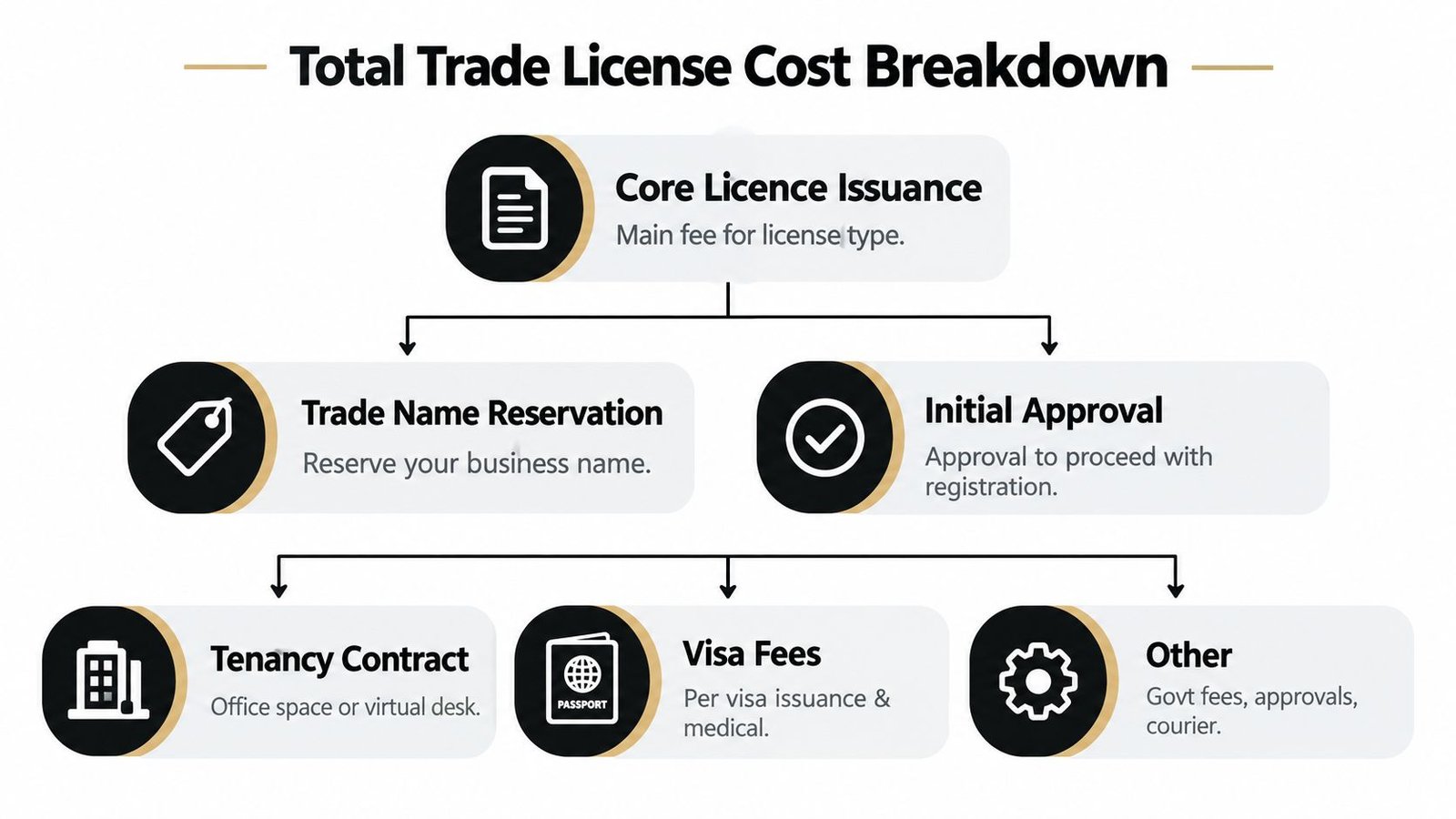
That distinction matters because a posted government fee can look surprisingly low beside the amount needed to open and operate a real company. Dubai's official service page lists AED 1,070 for licence fees plus knowledge and innovation fees, and AED 300 for Dubai Chamber membership, but those figures don't cover every item that may apply to your business. The wider first-year budget can rise once you add trade name reservation, initial approval, tenancy registration, visas, office requirements and activity-specific permissions, as shown in the Dubai trade licence cost breakdown.
This guide separates the headline fee from the true first-year and renewal cost. It compares mainland, free-zone and offshore structures across Dubai, Abu Dhabi and Sharjah, then shows how a freelancer, a small services company and a local-market trading business might plan their budgets.
Table of Contents
- How Much Does a UAE Trade License Really Cost
- What a UAE Trade License Is and Why Prices Vary
- Mainland Free Zone and Offshore Costs Compared
- What Makes Up Your Total Trade License Cost
- Real Cost Scenarios for Different Founder Types
- How to Predict Reduce and Plan for Renewal Costs
- Choosing Your Next Step with Confidence
How Much Does a UAE Trade License Really Cost
What is the practical budget for a new UAE company?
A basic free-zone service licence with one visa may begin around AED 4,888–6,500 in budget zones such as SHAMS, UAQ FTZ and Ajman Free Zone. Dubai free zones may start around AED 12,500 for a basic licence, according to the 2026 UAE business setup calculator.
A Dubai mainland Limited Liability Company, or LLC, commonly costs around AED 15,000–25,000 in its first year before higher office, visa or regulated-activity requirements. Mainland commercial setups can reach AED 25,000–40,000 or more when the company needs larger premises, additional visa quotas or further approvals.
These figures describe starting points, not a complete operating budget. A licence gives you permission to conduct approved activities. It does not automatically cover the office, immigration file, visas, approvals or other requirements attached to your business model.
Why does the licence price look lower than the actual budget?
A quotation may show only the issuance fee. Another may include government registration, a flexi-desk, an establishment card and a selected number of visas. Both can be accurate while covering different parts of the setup.
For example, a zero-visa licence-only setup may suit a founder who already has another immigration arrangement. A company hiring staff needs a different package, with visa quotas, immigration registration and workspace requirements. Free-zone pricing guides place zero-visa packages around AED 12,900 in some Dubai zones, a one-visa package around AED 14,900, and larger visa bundles at AED 20,000 or AED 25,000-plus.
Practical rule: Ask for both the first-year total and the renewal total. Confirm what the quote includes before comparing providers.
Which factors move the UAE trade license cost?
Four choices usually have the greatest effect:
- Jurisdiction: Mainland, free zone and offshore structures support different business needs.
- Business activity: Trading, professional, industrial and tourism activities can require different approvals.
- Physical presence: A private office costs differently from a flexi-desk or virtual business centre address.
- People and visas: Employees, investors and dependants add processing costs and recurring obligations.
The same founder could receive a low free-zone quote for remote consultancy, then face a much higher first-year bill for mainland importing, leased premises and staff visas. Renewal can also change if the company must retain office space, renew visas or maintain activity-specific approvals.
The useful comparison is the full cost of operating in the chosen jurisdiction, not the headline licence fee alone. Choose the structure that supports the work you need to do without paying for capacity you will not use.
What a UAE Trade License Is and Why Prices Vary
What is a trade licence?
A trade licence is a government-issued permission to carry out specified business activities in the United Arab Emirates, or UAE. The activity written on the licence defines what the company can legally sell, provide or produce.
A commercial licence generally supports buying and selling goods. A professional licence usually covers services and consultancy work. An industrial licence relates to manufacturing or production, while tourism activities may require their own category and external permissions. The correct activity matters because it affects approvals, premises and the authority that reviews the application.
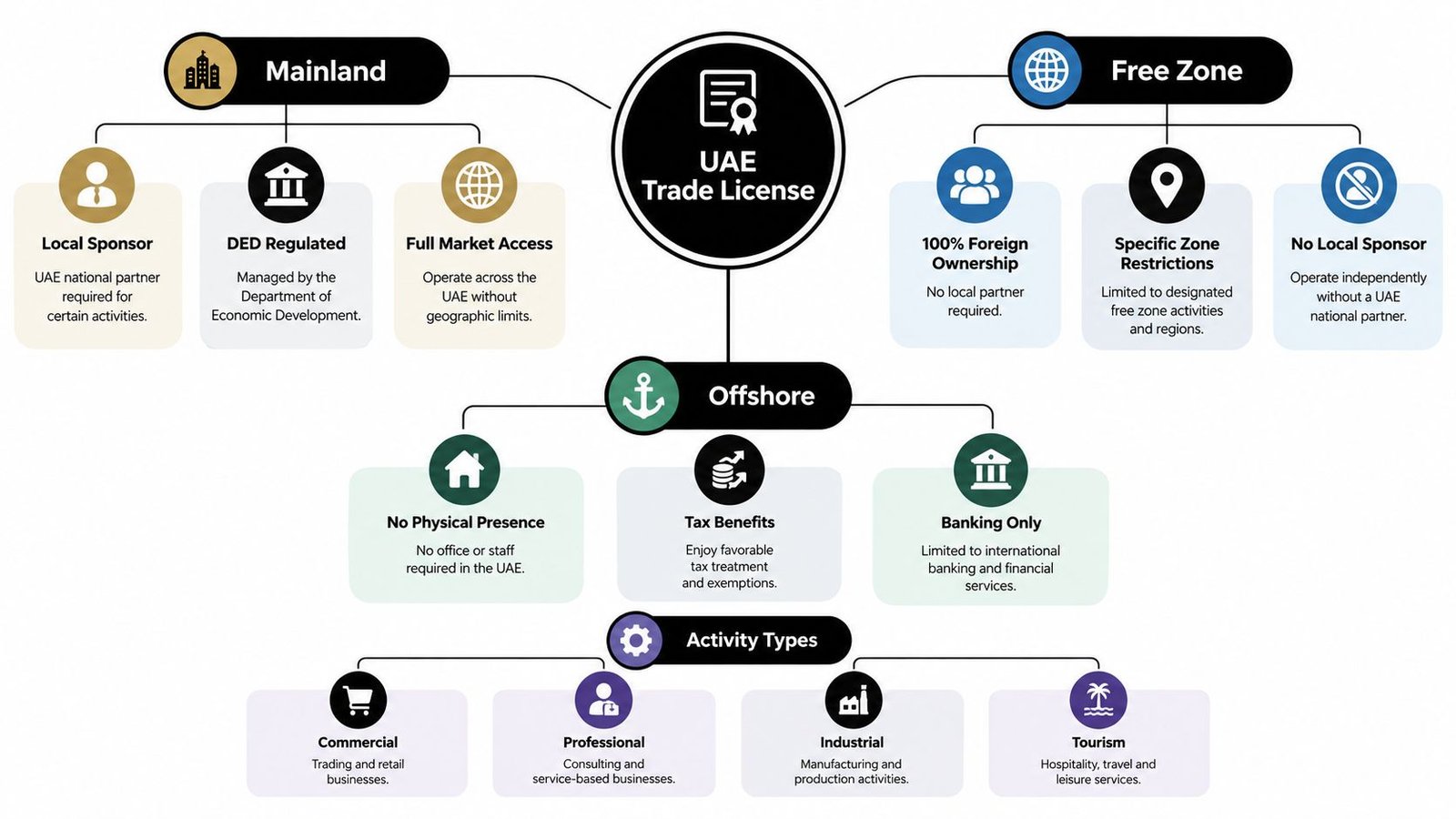
What is a mainland company?
A mainland company is licensed by the economic authority of the emirate where it operates. In Dubai, the relevant authority is the Department of Economy and Tourism, commonly called DET, and it was formerly known as the Department of Economic Development, or DED.
Mainland licensing is often the natural fit for companies that need to sell directly across the local UAE market, contract with mainland clients or operate from a regulated physical location. Dubai, Abu Dhabi and Sharjah each have their own processes and fee schedules, so “mainland” describes the jurisdictional model, not one universal price.
What is a free zone?
A free zone is a designated business jurisdiction with its own licensing authority, packages and operating rules. Free zones can suit founders who want a packaged setup, a defined business centre solution or a structure built around specific sectors.
Ownership rules, office options, visa capacity and access to the mainland market depend on the chosen zone and activity. A budget free zone in a northern emirate may offer a different entry point from a premium Dubai zone such as the Dubai Multi Commodities Centre, or DMCC, the Dubai International Financial Centre, or DIFC, and Abu Dhabi Global Market, or ADGM.
What is an offshore company?
An offshore company is a corporate structure designed for activities such as holding assets or managing international business without a normal UAE operating office. It generally isn't the structure for a founder who wants to hire local employees, rent an operating shop or issue UAE employment visas.
Offshore structures can have banking, ownership and asset-planning uses, but they require careful professional advice. A low registration price isn't useful if the company needs a physical presence, local trading access or immigration capacity.
Why can the same activity have different prices?
Think of jurisdictions as different commercial neighbourhoods. A remote consultant may only need permission to provide a service and a compliant business address. A Dubai trading company may need a warehouse, customs-related arrangements, a tenancy contract and staff visas.
The activity, legal form, emirate, office requirement and visa quota then combine into the final bill. The licence is one component of the business setup, much like a tenancy contract is one part of opening a physical shop. Neither price alone describes the full commitment.
Mainland Free Zone and Offshore Costs Compared
Which jurisdiction fits which founder?
Jurisdiction affects more than the headline licence fee. The right choice depends on where customers are, how many people need visas, whether the business requires premises and which approvals apply. A solo consultant serving overseas clients may need a simple free-zone package and compliant business address. A trading company selling in Dubai may need mainland licensing, a shop or warehouse, and capacity for staff.
The table shows planning bands, not fixed quotations. Activity, legal form, office arrangement, visa allocation and approvals can change both the first-year bill and the renewal cost.
| Jurisdiction | Typical First Year Cost | Market Access | Best For |
|---|---|---|---|
| Mainland | AED 15,000–25,000 for a typical Dubai LLC, with commercial setups reaching AED 25,000–40,000 or more | Direct UAE mainland operations, subject to activity and regulatory rules | Local-market companies, shops, trading businesses and growing teams |
| Budget free zone | AED 4,888–6,500 for selected basic service packages with one visa | Free-zone operations, with mainland access subject to the applicable rules and arrangements | Freelancers, consultants and solo founders |
| Dubai free zone | Around AED 12,500 for a basic licence, with visa bundles increasing the total | Free-zone operations and international or sector-focused businesses | Startups, professional firms and companies seeking Dubai presence |
| Premium free zone | AED 20,000–50,000 or more at zones such as DMCC, DIFC and ADGM | Sector-led access, with zone-specific rules and approvals | Regulated, financial, commodities and larger international structures |
| Offshore | Varies by registered structure and service requirements | Holding or international corporate purposes rather than ordinary local operations | Holding companies, investors and asset-planning structures |
The free-zone bands reflect the 2026 setup calculator. The broader mainland and free-zone ranges are also consistent with independent UAE trade licence cost guidance. Treat both as budgeting references, then confirm the current quotation with the relevant authority or adviser.
Is the cheapest jurisdiction always the cheapest choice?
No. A low-entry package can become expensive when the company later needs several employment visas, a private office, regulated approvals or direct mainland operations. Changing the structure may involve new registration work, revised contracts, and further immigration or banking administration.
Renewal also follows the operating model. A basic licence may remain relatively simple, while an office lease, visa allocation and recurring approvals continue to affect the annual budget. The licence price is therefore only one part of the first-year and renewal calculation.
Premium zones can suit a defined business need. DMCC, DIFC and ADGM serve profiles that may require a recognised sector ecosystem, specialised regulation or a particular legal environment. Compare that value with the company's requirements, rather than with a basic package built for a solo consultant.
How should a local UAE seller choose?
A founder selling goods directly to customers in Dubai, Abu Dhabi or Sharjah should examine mainland licensing first. The founder should then confirm whether the activity requires specific premises or approval from another authority. A remote services firm with overseas clients may find a free zone more proportionate.
The economical structure is the one that matches the company's next stage of work, not the one with the smallest number on the first quote.
What Makes Up Your Total Trade License Cost
Which charges appear before the licence is issued?
The first layer usually covers the legal registration itself. Dubai's official service information lists AED 1,070 for licence fees plus knowledge and innovation fees, as well as AED 300 for Dubai Chamber membership, as shown on the official Dubai trade licence service page.
That posted amount is a useful government benchmark, but it isn't a complete mainland company budget. Depending on the structure, the file may also include:
- Trade name reservation: The authority records the proposed company name and checks whether it can be used.
- Initial approval: This confirms that the authority can proceed with the proposed setup before final documents and premises are completed.
- Legal documents: The Memorandum of Association, or MoA, sets out the company's ownership and governance terms. Notarisation may apply.
- Licence issuance: The authority issues the licence for the approved activity and legal form.
- Chamber membership: A company may need membership with the relevant chamber, including Dubai Chamber where applicable.
The fixed-looking items don't stay fixed across every activity. A regulated consultancy, clinic, industrial operation or food business may need additional approvals from another government body.
When does office space change the total?
A tenancy contract is the document proving the company's business premises. In Dubai, Ejari is the tenancy registration system used to record eligible rental contracts. A private office, shop, warehouse or other formal premises can add substantially more than a packaged flexi-desk.
Office requirements also affect visa capacity. A business centre package may offer a defined allocation, while a private office can support a different quota under the zone or authority's rules. Founders should therefore ask whether the quote includes the desk, the registration, the establishment card and the number of visas supported by that arrangement.
What are the immigration and staffing charges?
An establishment card is the immigration file that connects the company to the relevant immigration system. It helps the company apply for residence visas and manage immigration records. The cost may sit inside a free-zone package or appear separately on a mainland quotation.
For employee processing, MOHRE means the Ministry of Human Resources and Emiratisation, the federal authority involved in labour and employment processes. A UAE residence visa workflow can involve entry permission, medical fitness processing, Emirates Identity Card application and residence issuance. The Emirates Identity Card is the official identity document issued to UAE residents.
Employee, investor and dependent visas should be listed separately in a quote. This is especially important for HR teams, because adding staff can affect both the visa bill and the office or quota requirement.
How do you read a quote accurately?
Ask the provider to show these fields:
- Licence activity and legal form.
- Government issuance and registration fees.
- Office, flexi-desk or Ejari costs.
- Establishment card and immigration file.
- Visa, medical and Emirates Identity Card processing.
- Chamber membership and activity approvals.
- Professional, agent or PRO service fees.
- Renewal cost and the date it becomes payable.
A PRO, or Public Relations Officer service, handles government-facing document and application work. It can save time, but it should be shown as a distinct service rather than hidden inside an unclear package. When a quote omits office, visa or renewal items, the low headline price may reflect missing scope.
Real Cost Scenarios for Different Founder Types
A founder's first-year budget can change sharply by jurisdiction. The licence fee is only the starting point. Office requirements, residence visas and activity approvals often decide the final total.
How much might a zero-visa freelancer spend?
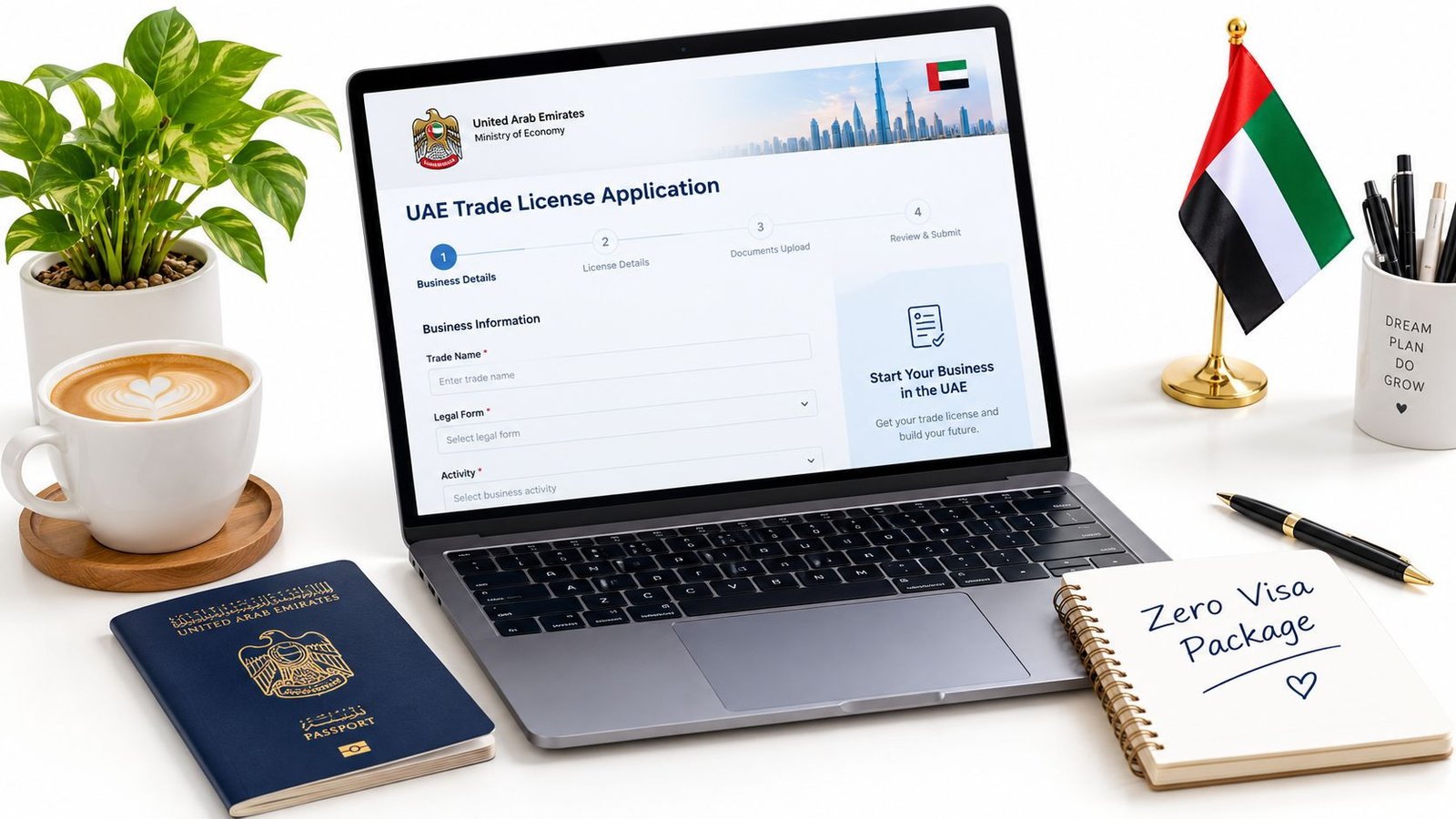
Consider a consultant serving overseas clients who does not need employee visas and wants a compliant UAE base. A zero-visa free-zone package in Dubai may sit around AED 12,900. Selected budget zones may offer basic packages in the AED 4,888–6,500 range when one visa is included, as shown in the UAE business setup cost calculator.
The founder should check whether the quoted package covers the establishment card, business centre address, immigration file and any activity approval. A zero-visa setup can fit someone who will not relocate immediately, although hiring or relocating later may require an upgrade.
Planning lesson: Match the package to the founder's actual immigration needs. Paying for unused capacity raises the first-year bill, while choosing too little capacity can create extra setup work later.
What does a small services company need?
Two founders providing marketing, software or management consultancy services may need two residence visas, a flexi-desk or shared office and an establishment card. A Dubai free-zone package with one visa is listed at roughly AED 14,900. Larger bundles can reach AED 20,000 or AED 25,000-plus, according to the free-zone cost guide.
The total depends on how the founders are recorded, whether as shareholders, employees or investors, and whether each visa forms part of the advertised package. Check medical processing, Emirates Identity Cards, insurance and extra approvals as separate line items.
Planning lesson: For a two-person company, the second visa may affect the budget more than the base licence. Compare visa capacity and the renewal structure before selecting a free zone.
What changes for a mainland trading LLC?
A company importing or selling goods in the UAE may need a Dubai mainland LLC, or Limited Liability Company, registered tenancy, Dubai Chamber membership and several visas. Its first-year budget may fall around AED 15,000–25,000. A more involved mainland commercial setup can reach AED 25,000–40,000 or higher once office space, visa quotas and activity approvals are included, based on this mainland and free-zone cost comparison.
Trading activities may also require premises suited to the operation. A flexi-desk suitable for a consultant may not meet the practical or regulatory needs of a goods-based business.
Planning lesson: The company is paying for more than a licence. Its budget must cover a place to operate, immigration capacity and the approvals required for lawful trading.
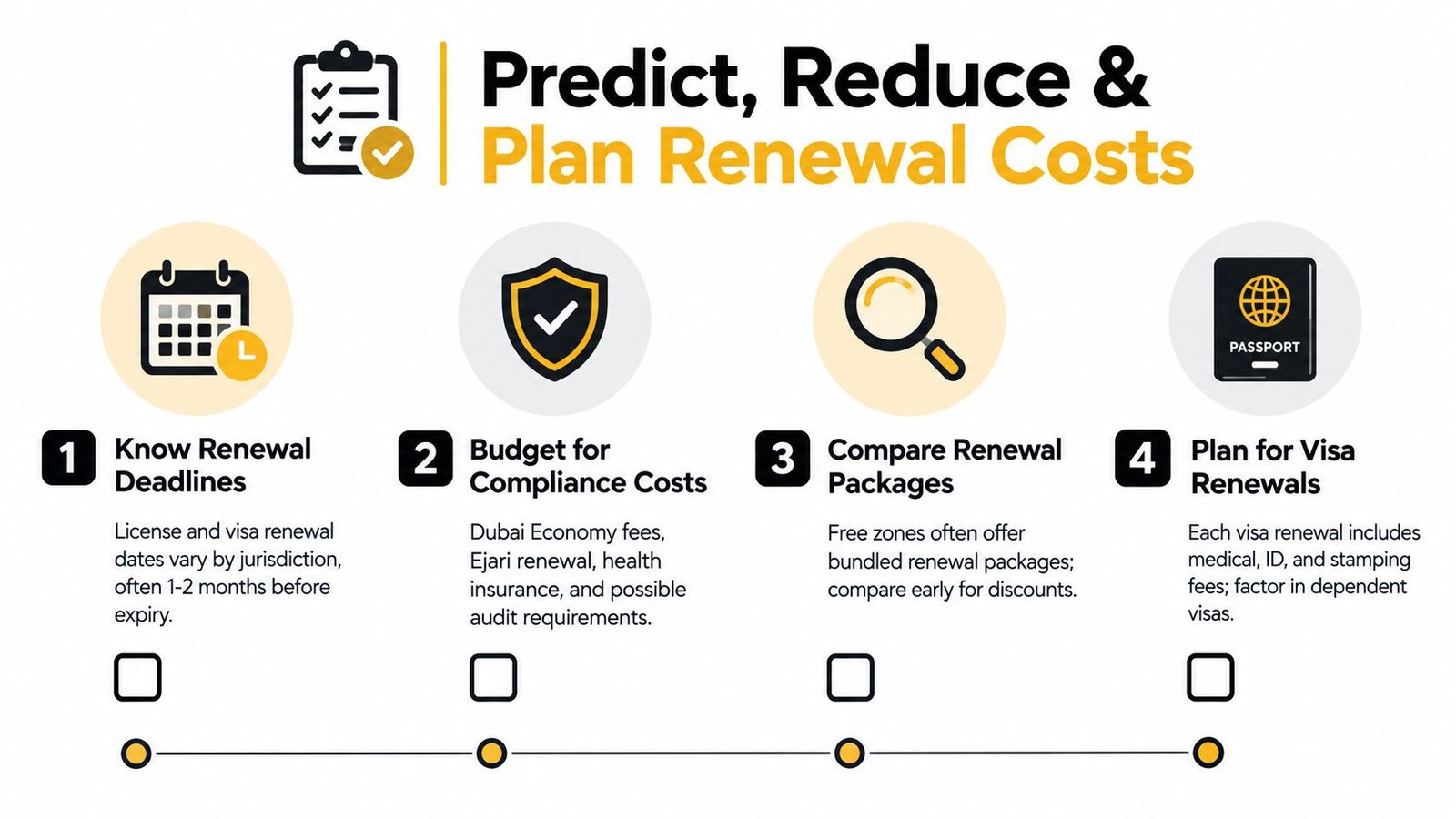
How to Predict Reduce and Plan for Renewal Costs
What should you budget for after the first year?
Renewal is a recurring operating cost, not an administrative footnote. Dubai mainland renewals commonly fall around AED 8,000–15,000 annually, and some market fee calculations may equal 5% of annual rent, capped at AED 20,000 in certain cases, according to this Dubai trade licence renewal guide.
The renewal bill can also include tenancy renewal, Chamber membership, establishment card charges, activity approvals and immigration services. A business that looked inexpensive at formation may become less attractive if it requires a costly premises or a large visa quota every year.
How can you predict the recurring total?
Use a simple renewal file for each company. Record the licence expiry date, tenancy expiry date, visa expiry dates, establishment card status and the approval dates for regulated activities. Set aside a separate amount for each category rather than assuming the next invoice will match the formation quote.
- Confirm the jurisdiction schedule: Free zones often bundle renewals differently from mainland authorities.
- Count active visas: Include employees, investors and dependants where the company handles those applications.
- Check premises requirements: A renewal may depend on a valid office or registered tenancy.
- Review activities: Remove activities the company no longer needs, but confirm the effect before changing the licence.
- Request a written estimate: Ask for government fees, service fees and any tax, accounting or compliance work to be separated.
Can founders reduce renewal costs safely?
Yes, but cost control should follow the business model. A small remote team may be able to use a compliant shared office rather than a larger private lease. A founder who doesn't need visas can compare a zero-visa renewal rather than paying for unused quota. A company with local customers should not choose a restricted structure because the initial package is cheaper.
Renewal habit: Start comparing packages before the expiry window, then check every visa and tenancy date against the licence date.
The practical timing depends on the authority and service. Founders should avoid leaving renewal until the final days because missing documents, expired tenancy records or pending approvals can delay the file. An early review also gives the company time to change office capacity or activity selection lawfully instead of making a rushed decision.
Choosing Your Next Step with Confidence
Which setup suits your operating model?
A solo consultant with overseas clients may begin by comparing budget free zones and visa requirements. A remote team that needs several residence visas should compare free-zone bundles, office capacity and second-year pricing. A company selling goods or operating a customer-facing site in Dubai, Abu Dhabi or Sharjah should assess mainland access, premises and activity approvals before looking at the cheapest package.
A Golden Visa applicant should keep personal immigration eligibility separate from the company's licence decision. A Golden Visa is a residence pathway, while a trade licence authorises the company's business activity. The two may interact in an application workflow, but they answer different legal questions.
What should you do before applying?
Prepare the activity description, ownership details, expected visa count, office preference and target customers. Then request a written comparison showing first-year cost, renewal cost, included government services and excluded approvals.
You can handle a straightforward application directly with the relevant authority, but a formation or PRO provider can help when the file involves multiple visas, attestations, regulated activities, banking or mainland premises. Inpro Corporate Services L.L.C. provides company formation, licensing, PRO and visa processing, bank account support, and accounting, tax and value-added tax registration services for UAE businesses.
Inpro Corporate Services L.L.C. can help you compare Mainland, Free Zone and Offshore options, separate first-year fees from renewal costs, and coordinate licensing, visas, attestations and government submissions. Visit Inpro Corporate Services L.L.C. to discuss your UAE trade licence requirements and request a clear setup plan.