


There's no single UAE trade licence renewal cost: published benchmarks range from AED 600 to AED 20,265, depending on the authority and activity. Dubai mainland lists AED 600 for a general licence or AED 3,000 for certain activities, JAFZA starts at AED 5,000, Ajman Free Zone at AED 4,878.75, and DMCC lists AED 20,265 for a one-year licence.
Those figures are useful for comparison, not as final invoices. The right budget depends on the company's activity, office or desk, visa allocation and any outstanding charges. Match those details to the licensing authority before treating a published price as your renewal bill.
Table of Contents
- UAE Trade Licence Renewal Fees
- Mainland Free Zone and Offshore Renewal Rules
- Add-On Costs Beyond the License Fee
- When a Multi-Year Renewal Is Worth Paying
- Renewal Costs for Real Company Situations
- How to Renew Before Penalties Start
- Get an Itemised Renewal Quote
UAE Trade Licence Renewal Fees
A trade licence is the authority's permission for a company to carry out named business activities for a set term. Treat renewal as one budget with three parts: the licence line, the add-on charges, and the penalty exposure if the deadline is missed. A cheaper licence fee can still be the wrong choice once premises, visas and linked filings are priced in.
| Authority | Where it sits | Published renewal figure | What the figure is |
|---|---|---|---|
| Department of Economy and Tourism (DET) mainland schedule | Dubai mainland | AED 600 general; AED 3,000 contracting; AED 3,000 general trading or investment | Government service fee only, shown in Dubai's published licence issuance and renewal fee schedule%20of%202011.html). |
| Jebel Ali Free Zone (JAFZA) | Dubai free zone | AED 5,000 for one group of up to seven activities; AED 8,500 for two groups; AED 500 for each extra activity | Licence fee by activity group, as set out in JAFZA's renewal guidance. |
| Dubai Multi Commodities Centre (DMCC) | Dubai free zone | Set by DMCC for the licence type and term | Licence line before other company charges; confirm the amount on the DMCC renewal invoice. |
| Ajman Free Zone | Ajman free zone | From AED 4,878.75 | Starting baseline. Package, visas, lease, fines and VAT can change the final bill, according to Ajman Free Zone's renewal service. |
| Dubai Development Authority (DDA) | Dubai free zone | Authority tariff plus per-transaction knowledge and innovation charges | The renewal tariff is the starting point; other company requirements can sit outside it. |
| Abu Dhabi and Sharjah mainland and free zones | Other emirates | Set by the relevant emirate or zone | Each authority sets its own tariff. The figures here aren't benchmarks for those jurisdictions. |
| Offshore registrar | Offshore, no UAE trade licence | Registrar renewal fee | Registrar maintenance only, not a UAE trade-licence fee. |
What do these figures leave out?
The table gives you the licence line, not the full annual bill. Premises, immigration and establishment-card charges, municipality or sector approvals, VAT where applicable, and penalties can be billed separately. JAFZA's activity-group pricing shows why the exact activity list matters: a second group or extra activity changes the licence line itself. Ajman Free Zone says its published starting amount can move with the package, activity, facilities, linked services, visa quota, lease, renewal duration and other charges, so the invoice or service notice should state whether VAT is included.
Use the same discipline for multi-year pricing. A longer term saves cash only when the discount beats the cost of locking in the wrong activity list, office arrangement or visa allocation. If any of those may change, pay for flexibility first and revisit the discount once the company profile is stable.
Practical rule: Confirm the activity and licensing authority first. Then compare the fee for that exact licence against the premises, visa and other lines on the renewal invoice.
Mainland Free Zone and Offshore Renewal Rules
A mainland company is licensed by an emirate's economy department, such as Dubai's Department of Economy and Tourism, and can trade across the United Arab Emirates, open locations in different emirates and bid for government contracts, but it needs a physical office. A free zone company is licensed by a zone authority, such as JAFZA, DMCC or Ajman Free Zone, and follows that zone's renewal rules. An offshore company is registered for holding or international business and doesn't renew a UAE trade licence of the mainland or free-zone kind.
| Criterion | Mainland | Free zone | Offshore |
|---|---|---|---|
| Local market | Can trade across the UAE and bid for government contracts | Trades within the zone and internationally; local sales must fit the company's structure and rules | International trade only |
| Premises | Physical office required | Office generally required; flexi-desk options are available | No UAE office |
| Visas | Investor and employee visas through labour and immigration processes | Visa numbers follow the zone's quota | No UAE visas |
| What drives renewal | Activity, legal form and emirate tariff | Package, activities, facility and visa quota | Registrar maintenance, not a UAE trade licence |
| Ownership | 100% foreign ownership for many activities | 100% foreign ownership | 100% foreign ownership |
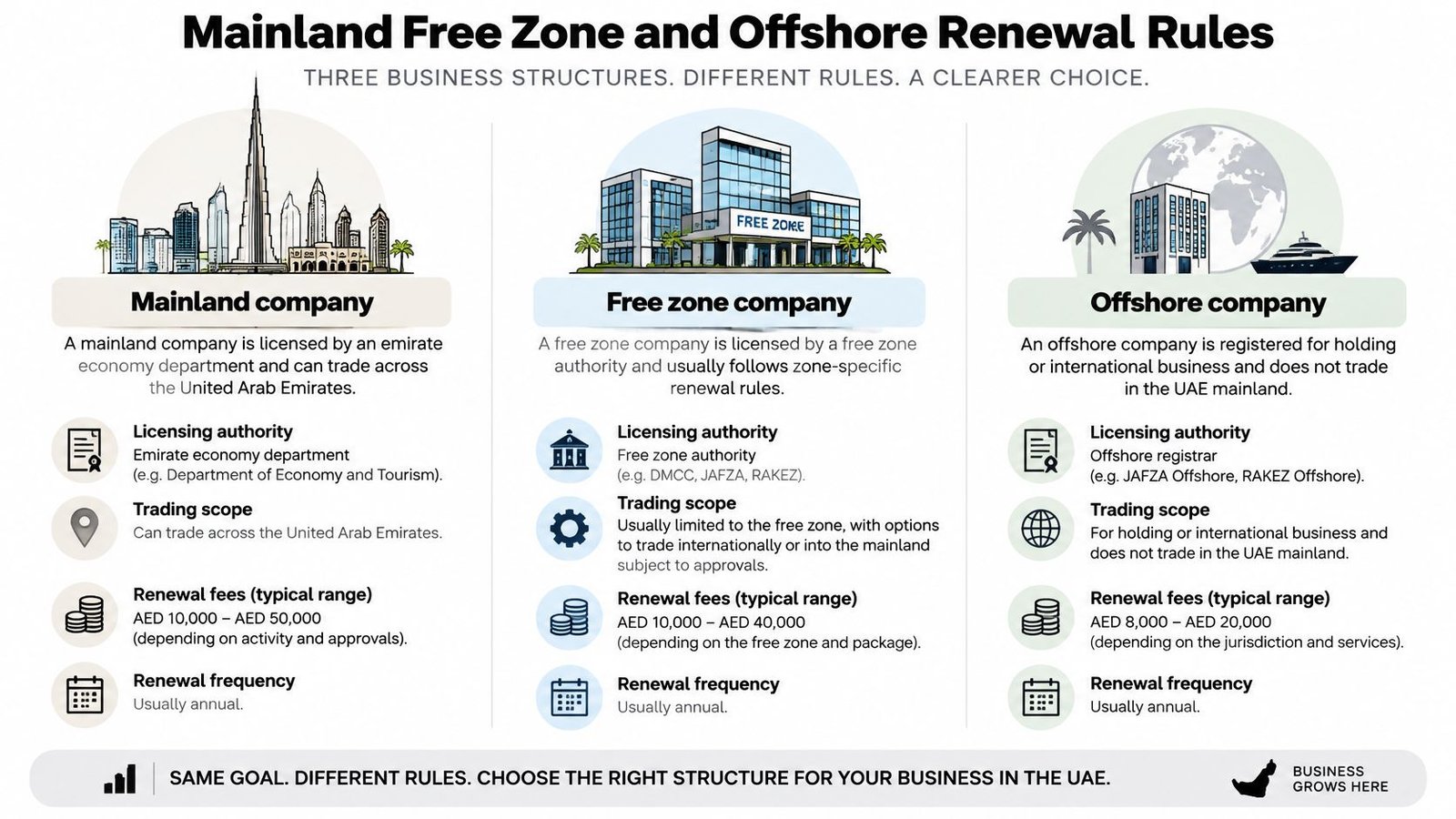
Who can sell to customers in Dubai?
Mainland is designed for direct access to the local market. A free zone can suit a business focused on its zone or international customers, but a company that invoices UAE customers outside the rules attached to its structure may lose the benefit of choosing that setup. A mainland company also needs to factor its physical office into its renewal plan, while a free zone company should check whether its office or flexi-desk contract remains valid and whether its visa quota still fits.
An offshore company is a separate choice for international holding or trade. It has no UAE office or UAE visas, so its renewal budget doesn't include the usual establishment-card and employee visa stack. For a fuller comparison of zone options, see Dubai free zone licence costs.
A cheaper licence can be the wrong choice if it blocks the market access your business needs.
Abu Dhabi and Sharjah authorities set their own tariffs, so don't apply a Dubai price to a company licensed elsewhere.
Add-On Costs Beyond the License Fee
The licence line is rarely the biggest number on a renewal invoice. A realistic budget stacks the establishment card, visa and immigration transactions, premises and any required activity approvals on top of it, plus whatever is already sitting unpaid on the company file.
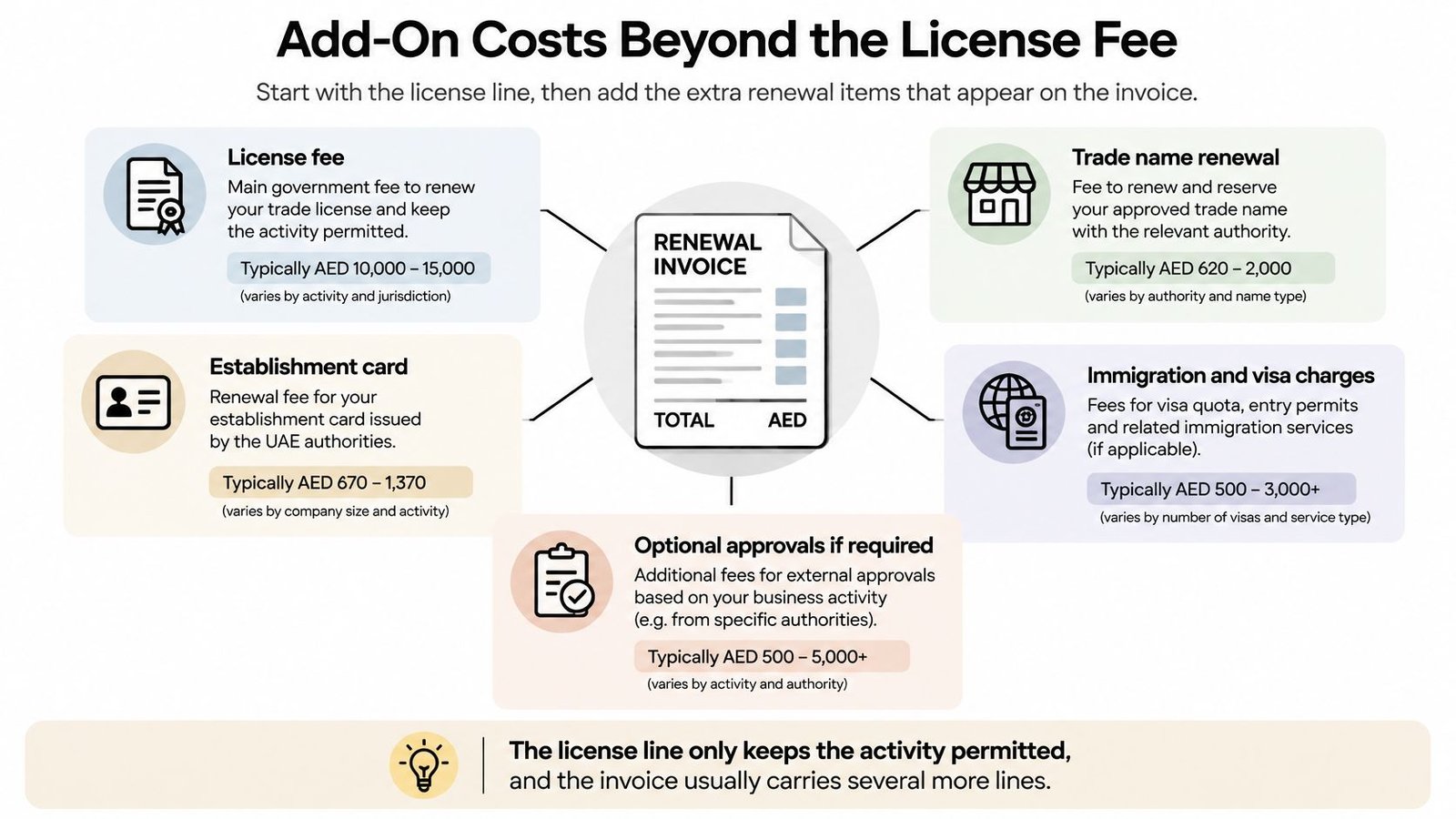
On Dubai mainland, the establishment card renews through the General Directorate of Residency and Foreigners Affairs (GDRFA) as a separate charge with its own government fee, service fee and small per-transaction add-ons. The Dubai Development Authority's commercial-licence renewal guidance lists AED 10 each for the Knowledge Dirham and Innovation Dirham per transaction on top of its tariff. Each amount is small on its own. Together they justify their own line in the budget.
Take a Dubai mainland trading company with two employees and a licence renewal invoiced at AED 3,000. That figure covers the activity and nothing else. The establishment card, both visa renewals, the office or flexi-desk contract and any chamber or sector approvals all land separately, and each owner or employee visa carries its own renewal requirements. Headcount moves the total even when the activity stays the same, so two companies holding identical licences can pay very different amounts to stay compliant.
What should your estimate show?
Ask for an itemised breakdown rather than one blended total. Government filing, trade-licence and visa charges are set by the relevant authorities and sit separately from a service provider's professional fee, and each PRO service carries its own government fee plus service fee. Confirm whether VAT is included on every line.
A useful annual estimate has three lines:
- Licence: the authority's renewal fee for the activity and licence type.
- Premises and immigration: office or desk contract, establishment card and each visa transaction.
- Contingency: fines or outstanding charges already on the company file, which have to be settled before the renewal completes.
When a Multi-Year Renewal Is Worth Paying
A longer term can cut the licence cost, but only for a company that will stay put. DMCC's official schedule lists a one-year trading or service renewal at AED 20,265, with discounts of 5% for two years, 10% for three years and 20% for five years, as shown in its schedule of charges.
| Term | Discount | Implied licence outlay | Saving versus yearly payments |
|---|---|---|---|
| 1 year | None, base | AED 20,265 | None |
| 2 years | 5% | About AED 38,504 | About AED 2,026 |
| 3 years | 10% | About AED 54,716 | About AED 6,080 |
| 5 years | 20% | AED 81,060 | AED 20,265 |
Those savings compare each discounted payment with paying AED 20,265 every year. They cover only the licence line. The full renewal budget also holds the office lease, the establishment card, each visa and any regulated-activity approval, and every one of those follows its own timetable. Late fees sit in the same budget: DMCC's schedule lists penalties for renewing after expiry, so a company that misses its deadline can lose the benefit of a discount before it starts. Price the full stack first, then judge the discount.
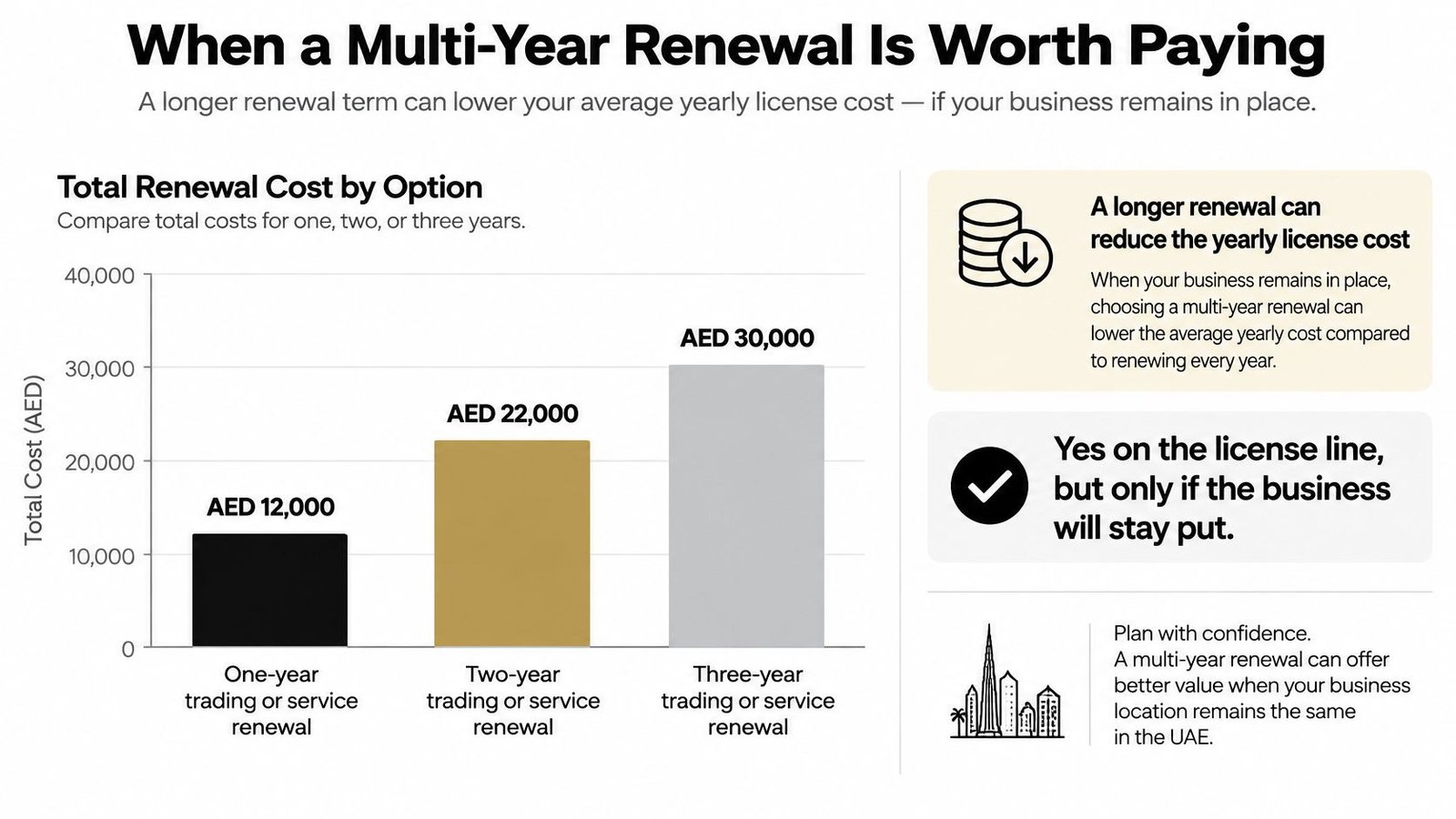
How do you test whether the discount pays off?
Take the longer term only when the activity, zone, office and visa plan should stay unchanged for the whole period. A move to mainland, a cancellation or an activity change can leave prepaid years unused. Weigh the saving against the chance of restructuring. Five years at 20% off saves AED 20,265, but a company that exits in year three has paid for time it will not use.
JAFZA publishes renewal guidance for its licence holders, but it does not set out a comparable multi-year discount scale, so companies there should price each year on its own. A one-year renewal is the safer choice for founders testing the UAE, firms weighing a regulated activity or anyone unsure about keeping the same office. Commit to the multi-year term once those four points are settled, not before.
Renewal Costs for Real Company Situations
The biggest cost driver changes with the company's structure. A solo consultant may focus on their facility and visa quota; a contractor may need to budget around activity and premises; and a holding company may have no UAE trade-licence renewal at all.
Which line item should each business check first?
A solo consultant using a flexi-desk in a Dubai or Ajman free zone should check the package and facility included in the renewal, then whether the company has a residence visa to renew. The number of visas available is tied to the zone's quota, so the first figure to confirm is the visa count.
A Dubai mainland contractor should confirm that the licence activity is classified as contracting, then check its office lease and any sector approval that applies. Contracting isn't priced like a general licence. Start with the activity fee and verify it with the licensing authority. For related mainland setup costs, see Dubai mainland licence costs.
A trading firm in JAFZA should check how its activities fall into licence groups before it reviews staffing. Adding activities or moving from one group to two can change the licence line even if headcount is unchanged. Confirm the activity group first.
An offshore holding company used alongside a UAE operating company pays registrar maintenance, not the UAE operating company's trade-licence renewal. It can't use that registrar fee to cover UAE visas or local customer invoices. Confirm the registrar renewal fee.
A founder who's also applying for a Golden Visa should track the company licence and personal residence file separately. Family visas create another renewal timeline. Confirm the visa count for the company's immigration budget.
What if I only need the company on paper?
A company that appears dormant can still owe licence and premises costs, and an expired licence can bring fines. Don't assume that stopping daily operations pauses the company's renewal obligations. Check the licence status and office arrangement before deciding to let a file lapse.
How to Renew Before Penalties Start
Treat late fees as part of the same renewal budget as the licence line and the add-ons. The cheapest renewal is the one filed on time, so the work starts before the expiry date, not after the first fine arrives.
- Diary the expiry date. Start several weeks ahead so there is time to resolve a lease, document or approval issue before the licence lapses.
- Check the company details. Match the activity list, lease and shareholder names against the current licence.
- Ask for outstanding fines. Clear them before renewal, because unpaid amounts can affect the final invoice or block the process.
- Review the invoice. Confirm whether the amount includes VAT and separate authority charges from professional fees.
- Pay and keep receipts. Save proof of payment for both government charges and any PRO service.
- Update the tax record. Check whether the renewed licence details need updating in the company's tax registration.
- Track related expiries separately. The establishment card and each visa have their own renewal dates, and a valid trade licence does not extend them.
What can late renewal cost?
Late fees are set by each authority rather than by a single UAE-wide rule. Each licensing body publishes its own schedule, and the charge depends on the jurisdiction and on how long the licence has lapsed. Across the main authorities, the structure generally looks like this:
| Authority or schedule | How the charge is structured |
|---|---|
| Dubai mainland licensing | A fee charged per month of delay, with escalation if the licence stays unrenewed, and possible closure after prolonged non-renewal |
| DMCC | Late fees banded by the number of days the licence has been expired |
| JAFZA | A charge applied to an expired licence |
| Dubai licensing breaches | Fines set per violation, ranging widely depending on the breach |
The figure that matters for a given company sits in its own authority's current schedule, so confirm it with the licensing body or a PRO rather than assuming a number from another zone's table.
The fine itself is rarely the largest expense. An expired licence can stall immigration filings, visa renewals and other government work, and that interruption usually costs more than the penalty line. That is the strongest argument for renewing early even when the late fee looks small.
Inpro handles recurring government work from a company's first visa through annual licence renewal, and prepares and submits PRO applications to GDRFA, the Federal Authority for Identity, Citizenship, Customs and Port Security (ICP), the Ministry of Human Resources and Emiratisation (MOHRE), and licensing authorities. See PRO services in the UAE.
Get an Itemised Renewal Quote
Get an itemised renewal quote before the expiry date, not a headline price. A useful quote separates the authority fee, VAT, premises, establishment card, each visa and the professional service fee. Before paying, confirm three things: the activity list is correct, the office or flexi-desk contract is still valid, and the visa count matches the company's current needs.
Then compare the multi-year saving with the chance of a move, cancellation or activity change. If the company is staying in the same zone with the same premises and visa structure, the discounted term may make sense. If those details are unsettled, a one-year renewal preserves flexibility.
Owners abroad can have government filings prepared remotely, but they still need to attend steps that require their presence, such as biometrics or medicals. Inpro bases quotes on the business activity, licence type and number of visas, and provides government charges separately from its professional fee. Its cost estimator helps compare UAE company setup paths, and a free PRO consultation is available.
Inpro can prepare an itemised renewal quote based on your activity, licence type and visa count, with government charges separated from professional fees. Use the Inpro cost estimator or book a free PRO consultation to check your renewal budget before the expiry date.