


A standard UAE residency visa usually moves in 5 to 7 working days once the main post-entry process is under way, while tourist and visit visas can now be issued in 24 to 48 hours in many cases. That's the best-case version. The actual uae visa processing time depends on visa type, jurisdiction, document quality, and whether your company has prepared the file properly before submission.
If you're hiring someone critical, opening a new branch, or trying to get an investor on the ground quickly, that difference matters. Founders often think the delay sits with the government. In practice, the biggest variable is usually the application itself. A clean, complete file moves. A sloppy file stalls at the first checkpoint.
Table of Contents
- The High-Stakes Wait for a UAE Visa
- Decoding the Main Phases of Visa Processing
- Processing Timelines by Visa Type and Jurisdiction
- The Step-by-Step Visa Application Workflow Timeline
- Key Factors That Influence Your Visa Approval Speed
- How to Expedite Your Visa with PRO Services
- Your Visa Timeline Optimisation Checklist
The High-Stakes Wait for a UAE Visa
A typical founder scenario is simple. The offer is signed, the onboarding date is set, and sales has already put the new hire into next week's meetings in Dubai. Then the key question lands. How long will the visa typically take, and what can still derail it?
Published timelines help, but they are only the outer limit of the process. On the ground, visa timing is a project with dependencies, handoffs, and failure points. The teams that get approvals through quickly usually do two things well. They prepare the file properly before submission, and they control the steps that sit outside the government system.
Fast systems expose weak files
The UAE approval system is quicker than many founders expect. That speed creates a different problem. Errors surface faster.
A missing attestation, a passport scan that does not meet portal standards, mismatched company records, or a delayed signature from the sponsor can stop the case at the first gate. Once that happens, the issue is rarely the official service window. The delay comes from rework, resubmission, and missed appointment slots.
Practical rule: Visa speed in the UAE depends heavily on whether the file is ready before submission.
That is why experienced HR teams and PROs do not treat visa processing as a passive waiting period. They treat it like an operational sequence. Documents are checked before the offer is final. Passport validity is reviewed early. The correct jurisdiction is confirmed before anyone promises a start date or books travel.
What actually changes the timeline
Founders often ask for one number. In practice, each case moves at the pace of its weakest variable.
For one applicant, the delay is document legalisation. For another, it is the company's licence jurisdiction or quota position. For an in-country case, the timing may depend on medical appointments and status change sequencing. For a visitor, the main decision may be whether standard processing is enough or whether paid priority handling is worth the cost.
That is the trade-off. You can either accept the timeline as something that happens to you, or manage the inputs that shape it.
The second approach is faster, more predictable, and much easier to plan around.
Decoding the Main Phases of Visa Processing
A founder hires someone for a Monday start, books travel, then learns the visa file is only at the entry permit stage. That is how timeline mistakes happen. The issue is usually not one slow authority. It is treating a multi-step process like a single approval.
A UAE residency case moves through a chain of approvals and appointments. Each phase has its own trigger, and one missed requirement can hold everything behind it. That is why quoted service windows only tell part of the story.
What the standard timeline covers
For a standard residency case, the sequence usually looks like this:
Entry permit issuance
The sponsor submits the first immigration file through the relevant authority. Once approved, the applicant can enter the UAE or move to the next in-country step, depending on the case.Status change inside the UAE
If the applicant is already in the country, immigration status must be updated before the residence file can continue.Medical fitness and biometrics
The applicant completes the required appointments. These are operational steps, not paperwork only, so scheduling matters.Emirates ID and residence completion
After the earlier checks clear, the authority completes the residence process and final records are updated.
For many employment cases, the quoted processing window refers to the core residency stage after the applicant is already in the system and the file is submission-ready. It does not usually include document collection, attestations, quota issues, or sponsor-side delays before filing.
That distinction affects planning. A file can sit for days before the official process begins if the company is still waiting on a signature, a payment, or a supporting document.
Where time is won or lost
Processing speed improves when each phase is prepared before the previous one finishes. That is the lever founders and HR teams can control.
The common pressure points are straightforward:
- Document readiness: Low-quality scans, name mismatches, and missing attestations trigger rework fast.
- Appointment sequencing: Medical and biometric slots can move the case quickly if booked early, or slow it down if booked after each approval lands.
- Sponsor turnaround: Delayed signatures, late fee payments, and slow internal approvals leave the file idle.
- Jurisdiction rules: Mainland, free zone, Dubai, and federal channels can require different steps or review patterns.
A well-run case treats these as project dependencies, not surprises. Good operators line up the next action before the portal requests it.
The key lesson for employers
Visa processing in the UAE is sequential. Each gate clears the path for the next one.
The practical response is simple. Prepare personal documents early, verify sponsor records before submission, and match travel dates to appointment capacity. If speed matters, use a PRO or experienced setup advisor to control the handoffs. In my experience, that is where predictable timelines come from.
Processing Timelines by Visa Type and Jurisdiction
A founder approves an offer on Monday and wants the employee on site next week. That timeline may be realistic for a visit visa. It is rarely realistic for an employment residence process unless the company file, candidate documents, and appointment sequence are already lined up.
That is why broad SLA comparisons create bad planning. Visa timing depends on the visa class, the authority channel, and how much of the work can be completed before the file reaches each approval gate.
A practical timing table
| Visa Type | Typical Processing Time (Working Days) | Expedited Service Time (Working Days) | Governing Authority |
|---|---|---|---|
| Tourist or visit visa | 2 to 5 | 24 to 48 hours | ICP or GDRFA |
| Multiple-entry tourist visa | 5 to 7 | 24 to 48 hours | ICP or GDRFA |
| Employment visa, Mainland | 5 to 7 for the main residency process after entry | Depends on pathway and readiness | Relevant mainland labour and immigration authorities |
| Employment visa, Free Zone | 5 to 7 for the main residency process after entry | Depends on pathway and readiness | Free Zone authority plus immigration channels |
| Investor or partner visa | Depends on licence and supporting file | Depends on authority channel and readiness | Free Zone or mainland authority plus immigration channels |
| Golden Visa | Depends on eligibility route and approvals | Depends on authority channel and readiness | Relevant federal and emirate-level channels |
The table is useful for planning, but only if it is read correctly.
Tourist and visit visas usually move on cleaner, shorter tracks. Employment, investor, and Golden Visa cases are less predictable because they often depend on company records, eligibility review, post-approval appointments, and document quality. In practice, the “visa type” is only half the timeline. The other half is how clean the file is when it enters the system.
Why jurisdiction changes the clock
Jurisdiction changes the number of handoffs.
A mainland case may involve labour-linked approvals tied to the employer's status before the immigration side progresses. A free zone case may start inside the zone's own portal and internal review path before it reaches federal immigration channels. Dubai-linked processing can also behave differently from federal channels used in other emirates. Founders do not need to memorise every authority rule, but they do need to understand that each extra checkpoint creates another opportunity for delay.
The practical trade-off is simple. Some jurisdictions are faster for standard hires with clean company records. Others are more efficient for investor-led or licence-linked applications. There is no universally fast route. The route that wins is the one that fits the company structure and has the fewest unresolved dependencies.
Where founders and HR can gain time
The biggest timing gains usually come before submission, not after it.
Three levers matter most here:
- Choose the right visa path early: A temporary entry option, a full employment residence process, and an investor route serve different business goals. Picking the wrong path creates rework.
- Match the jurisdiction to the case: The fastest route for a mainland employee is not always the fastest route for a free zone shareholder or senior hire.
- Prepare for post-entry steps in advance: Medical fitness, Emirates ID biometrics, and status change steps can compress the timeline if appointments and documents are ready early.
A quoted authority timeline is only the government portion. The real business timeline includes sponsor readiness, applicant readiness, and appointment availability.
What this means for travel and hiring
For travel, standard processing is usually acceptable when dates are flexible and the application is straightforward. Express processing makes sense when the trip date is fixed and the cost of delay is higher than the premium.
For hiring, use a wider planning window than the headline visa estimate. Check the company's licence and quota position, confirm the candidate's document set, and map the case to the correct jurisdiction before issuing a start date. That is how HR teams avoid promising a joining date based on the fastest possible scenario instead of the most likely one.
The Step-by-Step Visa Application Workflow Timeline
A visa file moves fastest when everyone involved knows what happens next. That includes the employer, the applicant, and whoever is handling submissions.
Start with the visual sequence below, then map your specific case onto it.
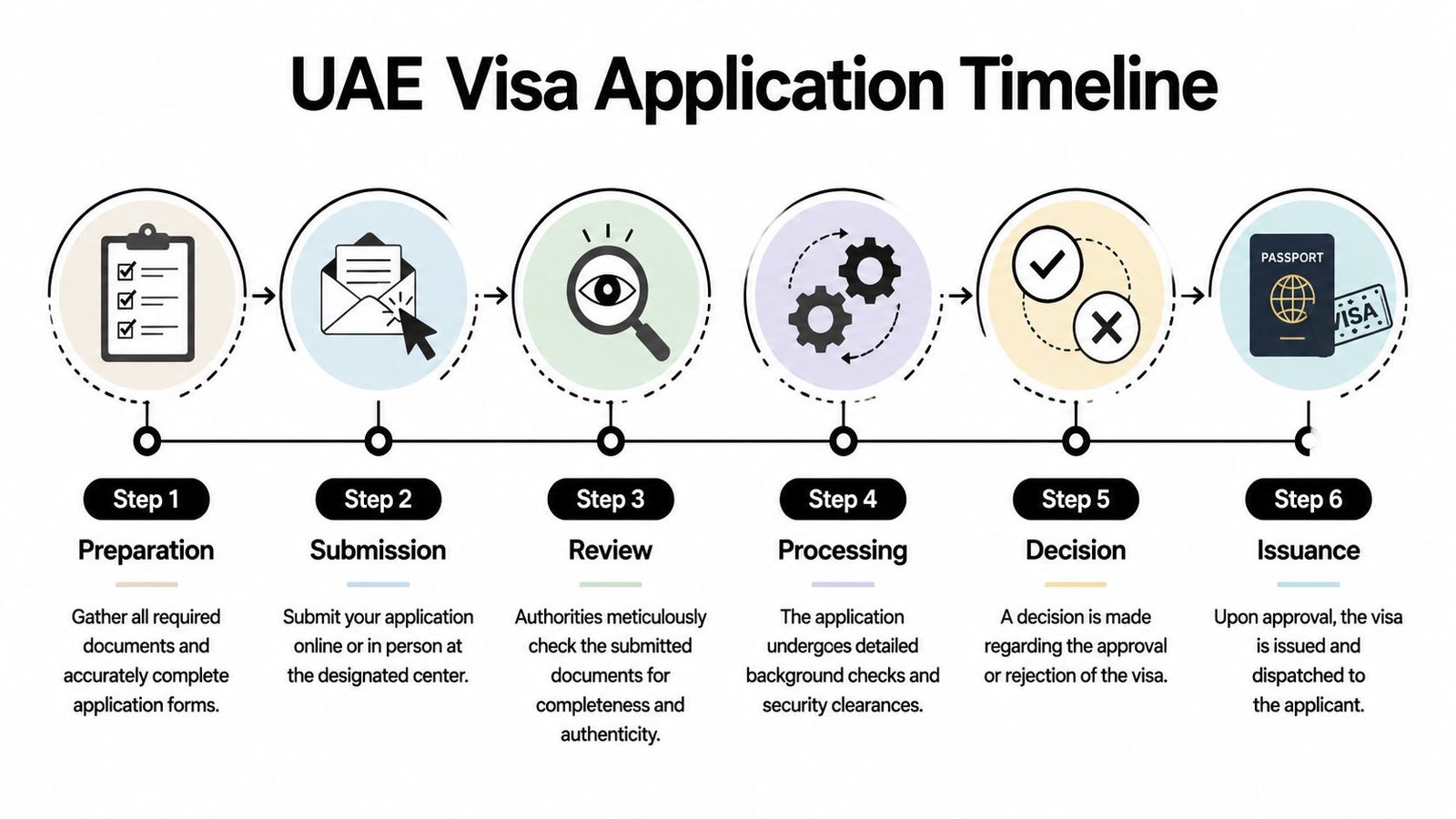
The application sequence on the ground
Preparation comes first. Most avoidable delays typically arise from insufficient preparation. Passport copies, photographs, attestations where required, sponsor documents, and application data should be checked before anyone opens a portal.
Submission follows. The sponsor or authorised representative submits the case through the relevant authority channel. If something basic is wrong, the file may not progress cleanly to review.
Authority review happens next. Officers verify the application, compare submitted details, and clear it for the next step. In practical terms, incomplete or inconsistent files stop behaving like “fast” files at this stage.
Here's the embedded video overview for readers who want a visual walk-through of the process:
What applicants need to do at each step
The applicant's job isn't passive. Their response speed affects the total uae visa processing time.
- Before submission: Confirm passport validity is comfortably beyond the minimum and that the biographical page scan is clean.
- After initial approval: If entry or status change is required, follow the instruction immediately. Don't let the file sit while travel plans are debated.
- At the medical stage: Attend on the earliest slot that works. If you delay the appointment, the residence clock stretches.
- At biometrics and ID stage: Bring the exact required documents and arrive prepared. Rebookings waste momentum.
The process feels long when each step is handled separately. It feels short when the next action is already lined up before the current one finishes.
The workflow founders should manage
Think of the file as a mini project plan:
- Collect and verify documents
- Submit the correct application
- Monitor review status actively
- Move the applicant to medical and biometrics quickly
- Close the residence step without gaps
The mistake I see most often is inactivity between approvals. Someone gets the initial go-ahead, then waits a day or two to schedule the next action. That dead time compounds.
A good workflow doesn't just ask whether the authority is processing. It asks whether the applicant and sponsor are ready for the next checkpoint before the system asks for it.
Key Factors That Influence Your Visa Approval Speed
Two applications can look similar on paper and move very differently in practice. The difference usually comes down to a handful of variables. Some you control directly. Others you can only plan around.

The variables you control
The first is document quality. Clean scans, correct attestations, aligned names across documents, and complete sponsor paperwork remove most of the obvious friction. Weak scans and missing supporting papers are one of the biggest reasons an application drops out of the fast lane.
The second is submission discipline. If your team sends files late in the week, around public holidays, or without checking whether all signatures and approvals are in place, you create avoidable idle time.
The third is internal sponsor readiness. Your company's licence, establishment records, signatory availability, and compliance posture all affect whether a file can move smoothly. Founders sometimes focus on the employee's documents and forget the sponsor side can stall the case too.
The variables you need to plan around
Some checks depend on the applicant profile and authority review path. That can include security screening depth, nationality-linked review patterns, or extra verification requests. You can't force those to disappear, but you can avoid making them worse with inconsistent information.
Medical outcomes matter too. If the medical stage doesn't clear cleanly, the process pauses. No amount of chasing makes a blocked medical step move faster.
A final factor is seasonal and operational workload. As noted earlier, tourist visa channels in busy periods can stretch because queues build and working calendars interrupt flow. The same practical lesson applies more broadly. If you know your hiring wave is coming, file early rather than at the point of need.
Good visa management is mostly risk management. The winning move is to remove the delay you can prevent before worrying about the delay you can't.
How to Expedite Your Visa with PRO Services
A founder gets verbal acceptance from a senior hire on Tuesday and wants the person on the ground by next week. At that point, speed depends less on chasing the authority and more on whether the company can move a clean file through each stage without a reset.
PRO support helps most when it is used as a project management layer, not just a typing service. The goal is to remove dead time between steps, catch errors before submission, and keep the sponsor side ready so the application does not stall for reasons no applicant can fix alone.
Paying for urgent processing versus building a fast file
Priority handling has a place. As noted earlier, some visa channels offer faster processing for an added fee. That can make sense when the file is complete, the travel or joining date is fixed, and the cost of delay is higher than the premium charge.
The trade-off is straightforward. Urgent handling improves queue speed. It does not improve file quality.
If the passport copy is unclear, an attested document is missing, the job title creates a mismatch, or the sponsor record needs attention, the file still stops. Founders often spend on speed before they invest in readiness. In practice, the order should be reversed.
What a strong PRO team changes
A good PRO team shortens the timeline by controlling the variables around the official SLA.
- Pre-checking the full case: The team reviews applicant documents, sponsor records, approvals, and formatting before anything is filed.
- Choosing the right path early: Different jurisdictions and visa categories have different expectations. A PRO team reduces wrong-channel submissions and avoidable rework.
- Sequencing the next steps: Medicals, Emirates ID biometrics, signatures, and status changes are lined up in advance so one approval leads straight into the next action.
- Responding to exceptions fast: If an authority asks for clarification or an extra document, someone handles it the same day instead of letting the case sit.
- Keeping one owner accountable: One person tracks dependencies, reminders, and handoffs so the application does not get lost between HR, the employee, and the government portal.
That last point matters more than many teams expect.
Visa delays often come from gaps between steps, not just from the authority review itself. A file gets approved, but nobody books the medical. A signatory is travelling. HR is waiting for finance. The candidate misses a message asking for a revised scan. Each pause looks small on its own. Together, they turn a normal case into a slow one.
Experienced PRO teams also make better judgment calls. They know when to submit immediately, when to hold for one corrected document, and when paying for priority service is worth it. That is where time gets saved.
For founders and HR leads, the decision is not whether PRO support is cheaper than doing it yourself on paper. The primary question is whether your internal team can keep documents, approvals, appointments, and follow-ups moving without gaps. If the answer is no, PRO support is often the faster route because it reduces mistakes before they create a waiting period.
Your Visa Timeline Optimisation Checklist
The fastest applications usually look boring. Everything is ready, the right authority receives the right file, and the applicant moves through each appointment without pause.
Use this before every new application
- Check passport validity early: Make sure the passport has more than six months remaining and the copy is sharp and readable.
- Audit names across documents: The passport name, company records, and supporting papers should match exactly.
- Confirm attestation requirements: Don't assume a degree certificate or civil document can be uploaded as-is.
- Verify sponsor readiness: Check licence status, immigration file readiness, authorised signatory access, and any internal approvals before filing.
- Choose the submission window carefully: For tourist files, the verified guidance indicates that timing around working days and busy periods matters. Avoid obvious congestion points where possible.
- Prepare the applicant for immediate follow-up: Once approval arrives, the next step should already be understood.
- Book medical and biometrics promptly: Don't let approved files sit unused while calendars drift.
- Use express handling selectively: Pay for urgency when the file is already clean and the business case for speed is clear.
- Track every dependency in one place: One owner should know the status of documents, submission, appointments, and approvals at all times.
The UAE system is fast when you respect how it works. The official timelines matter, but preparation matters more. Treat the visa as a managed workflow, not a waiting game, and your uae visa processing time becomes far more predictable.
If you want a team that handles company setup, PRO work, and end-to-end visa processing without the usual administrative drag, Inpro Corporate Services L.L.C. helps founders and HR teams structure the process properly from day one. They support Mainland, Free Zone, and investor cases, manage document and government-channel workflows directly, and bring the kind of operational control that keeps visa timelines tight and realistic.