

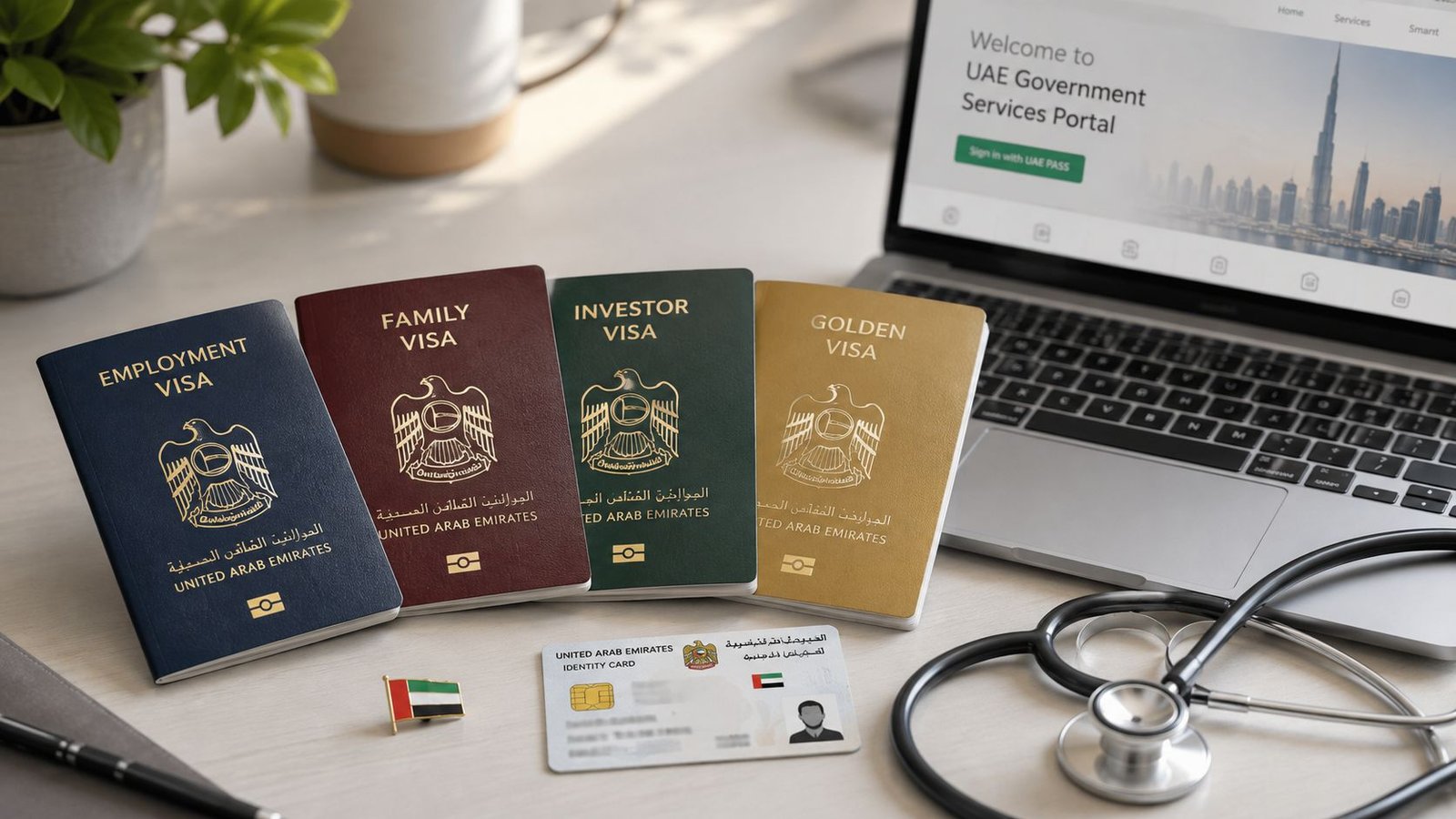
The UAE visa renewal process depends on your visa category, with grace periods ranging from 30 to 180 days after expiry. A standard renewal usually takes 5 to 10 working days when you start 30 to 60 days before expiry, provided your medical fitness test, Emirates ID application, documents, and payment are completed without exceptions.
Your residence permit is approaching its expiry date, your employer is asking for an updated Emirates ID, or your family's sponsorship file needs attention before a bank or tenancy transaction is affected. The process feels difficult when every visa is treated as if it follows the same rules. It doesn't.
The United Arab Emirates uses a category-aware system. The correct renewal route depends on the visa holder, the sponsor, the emirate that issued the permit, and whether the file sits with the General Directorate of Residency and Foreigners Affairs, the Federal Authority for Identity, Citizenship, Customs and Port Security, or an Abu Dhabi channel. The practical rule is simple: identify the category and issuing authority first, then build the renewal around the legal expiry date.
Table of Contents
- How the UAE Visa Renewal Process Works
- Grace Periods and Timing by Visa Category
- Which Authority Handles Your Renewal
- Step-by-Step Renewal Workflow in 2026
- Fees, Fines, and What a Renewal Really Costs
- Common Rejection Reasons and How to Avoid Them
- Your Renewal Checklist Before You Apply
How the UAE Visa Renewal Process Works
Your renewal route starts with the visa category and the authority that issued it. Employment, family-sponsored, investor or partner, and Golden visas follow related steps, but the sponsor, documents, authority, and timing differ. Treat those details as one compliance workflow, because a missing company record or an incorrect application channel can delay the permit.
What are the main UAE residence visa categories?
An employment visa is sponsored by an employer and normally connects the residence permit to the employment relationship and work authorisation. In Dubai, the employer or its authorised PRO usually works through the General Directorate of Residency and Foreigners Affairs, known as GDRFA Dubai.
A family-sponsored visa covers a spouse, child, parent, or another eligible dependent whose residence is linked to a UAE sponsor. Dubai family files generally use GDRFA. Files issued in Sharjah, Ajman, Umm Al Quwain, Ras Al Khaimah, or Fujairah usually follow the federal route.
An investor or partner visa connects the resident to business ownership or participation. Before applying, confirm that the company licence is active, shareholder records are current, and the renewal matches the licensing authority, such as a mainland Department of Economy and Tourism or a free zone authority.
A Golden Visa provides long-term residence for eligible investors, professionals, students, entrepreneurs, and other approved categories. The responsible channel depends on the emirate and the applicant's category. Some cases use emirate residency channels, while Abu Dhabi applications can involve the Residents Office or the federal authority.
How are medical fitness and Emirates ID handled?
Renewals are filed online or through authorised service centres. Medical fitness and Emirates ID renewal normally run alongside the residence transaction, since the final permit depends on connected government records rather than one uploaded form. Electronic issuance has replaced the need for a physical visa sticker in the passport.
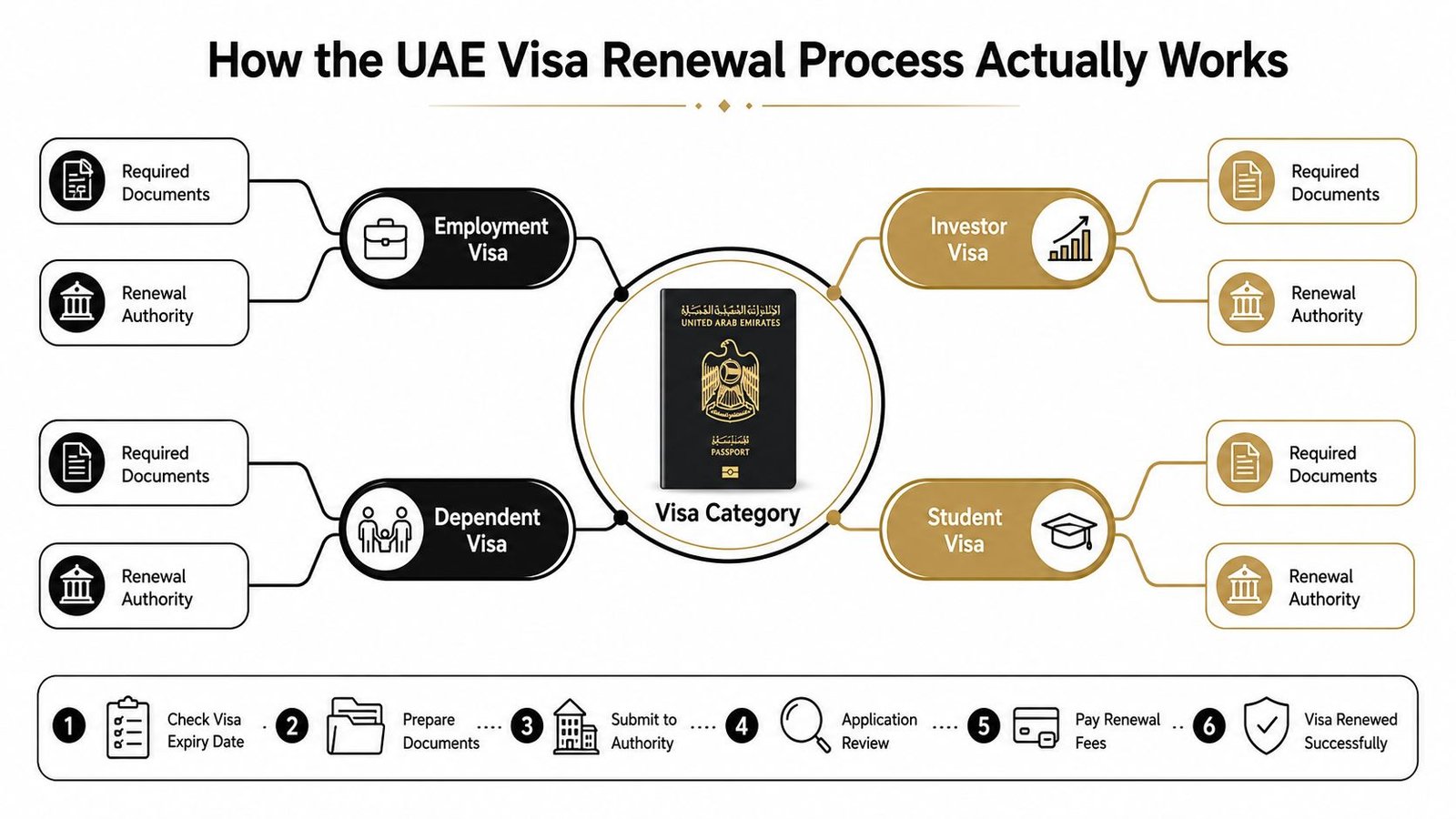
For Dubai, GDRFA's residence renewal service supports UAE Pass authentication, online submission, electronic payment, and digital delivery. Use Amer Service Centres or Customer Happiness Centres when a document needs correction. Keep the category, sponsor file, emirate authority, medical result, and Emirates ID application aligned before submission.
Grace Periods and Timing by Visa Category
A UAE residence permit doesn't give every holder the same post-expiry window. The federal framework assigns grace periods by category, so a founder, employee, dependent, property owner, or Golden Visa holder may have a different legal stay period after expiry.
Which residence visa holders receive each grace period?
The current category structure is:
| Visa Category | Grace Period After Expiry | Recommended Renewal Start |
|---|---|---|
| Golden, Green, and Blue Residence holders, plus specified family and special categories | 180 days | Start before expiry and keep the full file ready early |
| Skilled workers in levels 1–3 and property owners | 90 days | Start 30–60 days before expiry |
| Guarantor- or host-based permits | 60 days | Start 30–60 days before expiry |
| All other residence categories, including many employment and family files | 30 days | Start 30–60 days before expiry |
These periods are described in the UAE residence visa extension guidance. The 180-day period applies to Golden, Green, and Blue Residence holders and certain special groups, including widows, divorced women, students finishing their studies, and some relatives of UAE citizens. The 90-day period applies to skilled workers in levels 1–3 and property owners. Guarantor- or host-based permits receive 60 days, while other categories receive 30 days.
Why shouldn't you rely on the grace period?
A grace period is a legal buffer, not a recommended project plan. Waiting until the final days leaves no room for a passport problem, a delayed medical result, an unpaid fine, or a sponsor record that needs correction.
Start the file 30 to 60 days before expiry. Golden Visa and investor files often deserve earlier preparation because eligibility evidence, company records, or licensing documents may require separate attention. If the permitted stay period ends, violations accrue daily, and Dubai guidance commonly cites AED 50 per day after the grace period ends in the federal service information.
Practical rule: Treat the expiry date as the deadline for a completed renewal, not the date to begin collecting documents.
The same federal framework can feel different in Dubai and the other emirates because GDRFA Dubai and the federal channels apply their own operational checks. Your category and issuing emirate determine the result, so never copy another resident's timeline without checking the authority attached to your file.
Which Authority Handles Your Renewal
The authority is determined mainly by where the residence file was issued, not where you currently live or work. A Sharjah resident working for a Dubai company may still renew through the federal channel if the residence file belongs to Sharjah.
What does GDRFA Dubai handle?
GDRFA means the General Directorate of Residency and Foreigners Affairs. GDRFA Dubai handles Dubai-issued residence visas, including many employment, family, and investor files. Applications are submitted through GDRFA Smart Services, often using UAE Pass, or through Amer Service Centres when the file needs in-person checking.
What does ICA or ICP handle?
ICA, commonly used for the federal identity and citizenship authority, is now associated with the Federal Authority for Identity, Citizenship, Customs and Port Security, or ICP. The federal route covers residence files issued in Sharjah, Ajman, Umm Al Quwain, Ras Al Khaimah, and Fujairah. It also handles relevant federal entry permits and connected residence services.
Where do Abu Dhabi renewals go?
Abu Dhabi mainland cases use ICP smart channels and the Abu Dhabi Residents Office for applicable residence services, including Golden Visa matters. Abu Dhabi's Residents Office states that certain visas can be extended for 30 days twice without exiting the country, which can provide an operational buffer when a renewal is close to expiry.
| Authority | Emirates Covered | Portal / App | Renewal Use Case |
|---|---|---|---|
| GDRFA Dubai | Dubai-issued residence files | GDRFA Smart Services, Amer | Employment, family, and investor renewals |
| ICP federal channels | Sharjah, Ajman, Umm Al Quwain, Ras Al Khaimah, Fujairah | ICP Smart Services | Federal residence renewals and related permits |
| Abu Dhabi Residents Office and ICP | Abu Dhabi mainland and applicable Abu Dhabi cases | Residents Office and ICP channels | Standard Abu Dhabi files and Golden Visa cases |
UAE Pass is the practical login credential for many digital government services. Payment is made through the available electronic payment options in the selected portal, and the renewed residence file is delivered electronically. Processing speed depends on the file and whether exceptions arise, so the federal benchmark is best treated as about 5 to 10 working days, rather than a guaranteed appointment-to-approval promise.
Step-by-Step Renewal Workflow in 2026
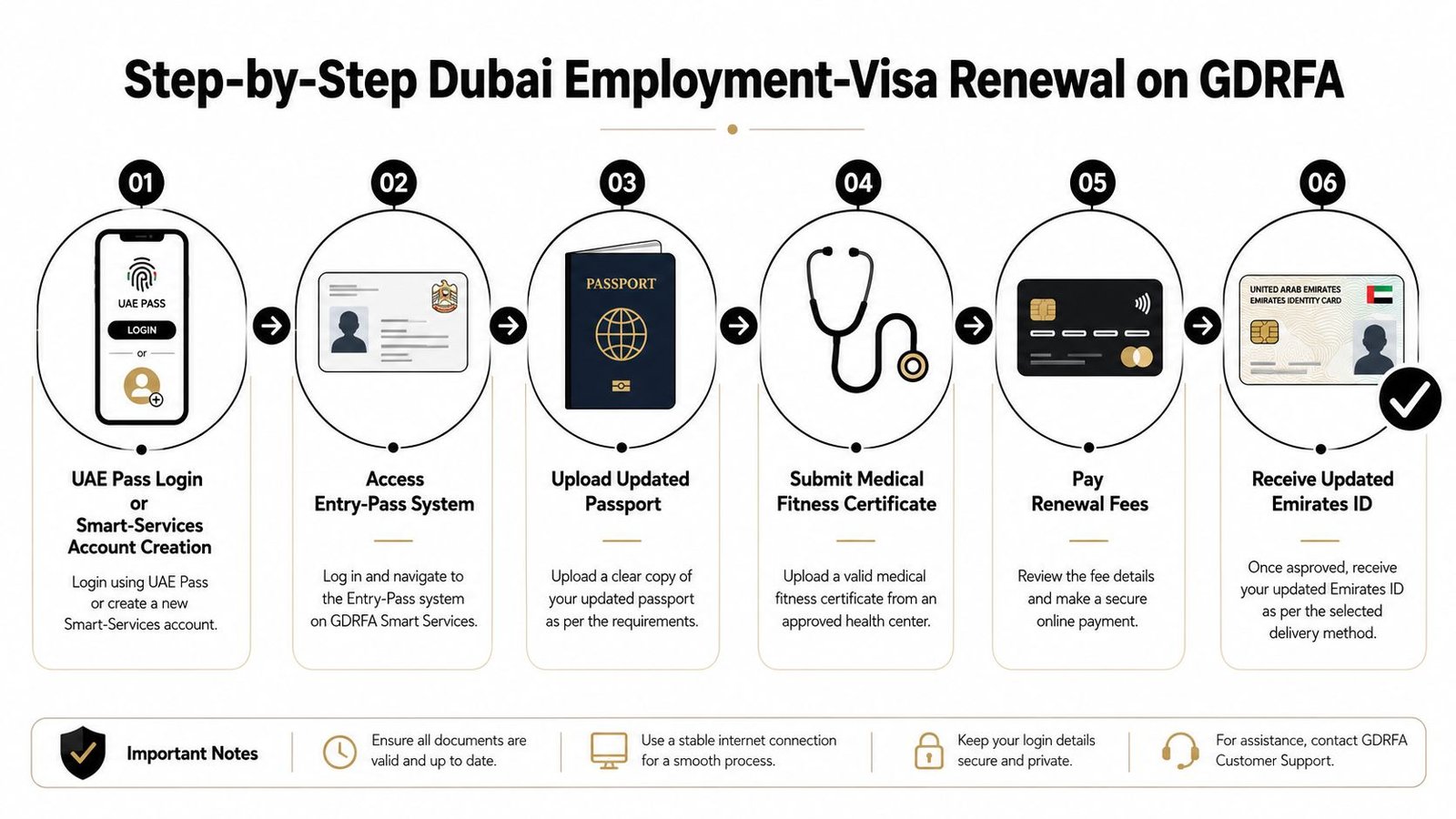
A Dubai employment renewal can fail even when the fee is paid, because the process depends on the visa category, sponsor record, emirate authority, and the order of medical and identity steps. Use the workflow below for Dubai employment files, then adjust the authority and service labels for Abu Dhabi and the northern emirates.
What should you confirm before opening the transaction?
Check the expiry date, passport validity, sponsor status, and Emirates ID details first. The employer or authorised PRO must also confirm that the trade licence and employment records are active before submitting the residence transaction.
Use UAE Pass to sign in to GDRFA Smart Services, or choose an authorised service channel if the applicant cannot complete the digital application. Verify the current entry-pass and residence records before expiry, then select the renewal service linked to the correct sponsor.
How does the Dubai renewal sequence work?
Authenticate the file. Sign in with UAE Pass or create the required smart-services access. Select the correct applicant and sponsor record. A wrong profile can send the file into correction instead of approval.
Select residence renewal. Choose the employment residence service that matches the category and confirm the sponsor details. The trade licence, labour card, Emirates ID, and passport information must match the immigration record.
Upload or verify documents. Submit the current passport and any requested employment or company records. If a new passport has been issued, replace the old document before applying. Mismatched details commonly delay review.
Complete medical fitness. Book the examination at an authorised medical fitness centre, using a priority clinic where the category and service channel allow it. The result must reach the government system before the residence transaction can close.
Renew the Emirates ID. Apply through ICP and complete biometrics when required. Link the Emirates ID application to the residence file. These are connected records, so handling them as separate, unrelated applications creates avoidable errors.
Pay and submit. Pay the charges shown in the selected portal, review the application carefully, and submit it for GDRFA review. Keep the payment receipt and application reference.
Download the electronic permit. After approval, download the electronic residence file. Check the name, passport number, sponsor, and validity details before using it for follow-on checks.
For Abu Dhabi, Sharjah, and the northern emirates, apply the same control logic through the applicable ICP or Abu Dhabi channel. Do not assume Dubai portal names or document labels apply elsewhere. The ICP residence renewal service shows that completed conditions must be present before approval, so payment alone does not complete the transaction.
The medical result needs active monitoring. If it has not appeared, repeated submissions will not fix the underlying issue. Check the medical centre reference, applicant identity details, and result status, then ask the centre or authorised PRO to correct the record.
For companies managing several employees, maintain one renewal register containing the expiry date, visa category, emirate, sponsor, medical status, Emirates ID status, payment reference, and final electronic permit. This gives the PRO team a clear escalation point when an application stops moving and separates Dubai files from federal cases that follow different portal rules.
Fees, Fines, and What a Renewal Really Costs
Budgeting fails when applicants confuse federal government charges with medical centre charges, Emirates ID costs, typing fees, and PRO service fees. The government schedule gives a reliable starting point, but the total payable amount depends on the transaction selected and the service channel.
What official fees should you expect?
The Federal Authority's published fee schedule lists the following amounts for specific extension actions:
| Component | Official Fee |
|---|---|
| Application fee for visa extensions | AED 100 |
| Entry permit extension | AED 500 |
| Extension of a 14-day visa for nationals of certain countries | AED 250 |
| Multiple-entry visa extension to complete Golden or Blue Residency procedures for six months | AED 1,000 |
| Extension of entry permit validity before arrival | AED 50 |
These figures come from the ICP service fee schedule. They are statutory amounts for the listed actions, not a universal all-in price for every residence renewal.
What else belongs in the budget?
Your working budget should separate:
- Government charges, including the applicable residence or extension application fee.
- Medical fitness charges, where the category requires an examination.
- Emirates ID charges, paid through the identity application.
- Overstay or other immigration fines, if the permitted stay period has been exceeded.
- Typing, Amer, or service-centre charges, where an assisted channel is used.
- PRO handling fees, if an authorised representative manages document preparation and submission.
Don't use a generic online quote as your final figure. Check the transaction screen for the exact category, duration, sponsor, and emirate before payment.
What happens when the renewal is late?
ICP states that residence and visa violations accrue per day after the permitted stay period, while Dubai guidance commonly cites AED 50 per day after the grace period ends. That daily exposure is why lead time is a compliance control, not a convenience.
A rejected or incomplete application doesn't automatically protect you from an expiry consequence. Keep evidence of submission, resolve the rejection reason promptly, and confirm that the electronic residence file has been issued.
Common Rejection Reasons and How to Avoid Them
A renewal queue is a compliance checklist, not just a form-submission exercise. Most avoidable delays begin before the applicant clicks submit, when the passport, medical result, Emirates ID record, or sponsor file doesn't agree with the transaction.
Which document problems stop renewals?
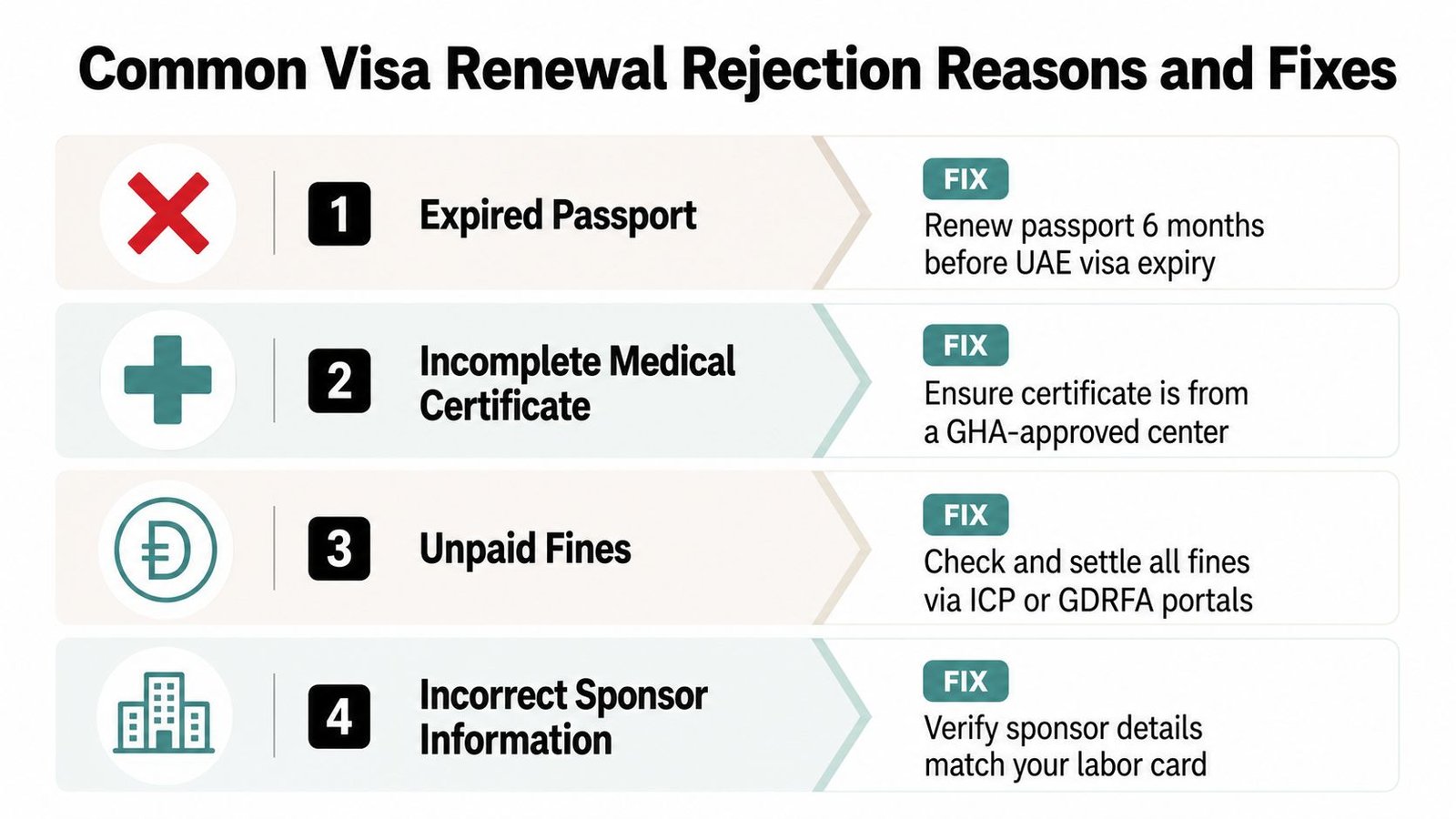
Passport validity is the first check. If the passport has insufficient validity for the requested residence period, renew the passport before starting or ask the processing team whether a shorter permitted term is available. The passport number, nationality, date of birth, and name must also match the immigration record.
Medical fitness must be visible in the system. Book the examination early enough for the result to be processed, and confirm that the result is connected to the right applicant. If the examination produces a medical issue requiring follow-up, resolve it through the authorised medical process before submitting the residence renewal again.
Emirates ID linkage errors are common in multi-step files. Open the ID application within the correct residence file, complete biometrics when requested, and check that the status shows the application is under process. A missing link, duplicate application, or different spelling can stop the residence transaction.
What sponsor and company issues create delays?
Unpaid fines can block a sponsor or applicant until the balance is settled. A company file may also fail if the trade licence is inactive, the sponsor details are outdated, or the employment record doesn't match the immigration transaction.
Before submission, check these less obvious triggers:
- Entry permit type: Confirm that the permit matches the residence route being renewed.
- Arabic name fields: Make sure the Arabic and English records correspond across passport, Emirates ID, and immigration systems.
- Trade licence status: Verify that the employer or investor company's licence is active.
- Sponsor information: Compare the sponsor record with the labour or company ownership documents.
- Fine status: Check outstanding amounts before paying the renewal transaction.
- Medical result: Confirm that the authorised centre has transmitted the result.
Don't resubmit a rejected application without reading the reason code. Repetition doesn't correct a mismatched sponsor, missing result, or inactive licence.
A short pre-submission audit catches more problems than repeated portal attempts. Save copies of the uploaded documents, payment receipt, medical reference, Emirates ID application, and application number in one file for the applicant or employee.
Your Renewal Checklist Before You Apply
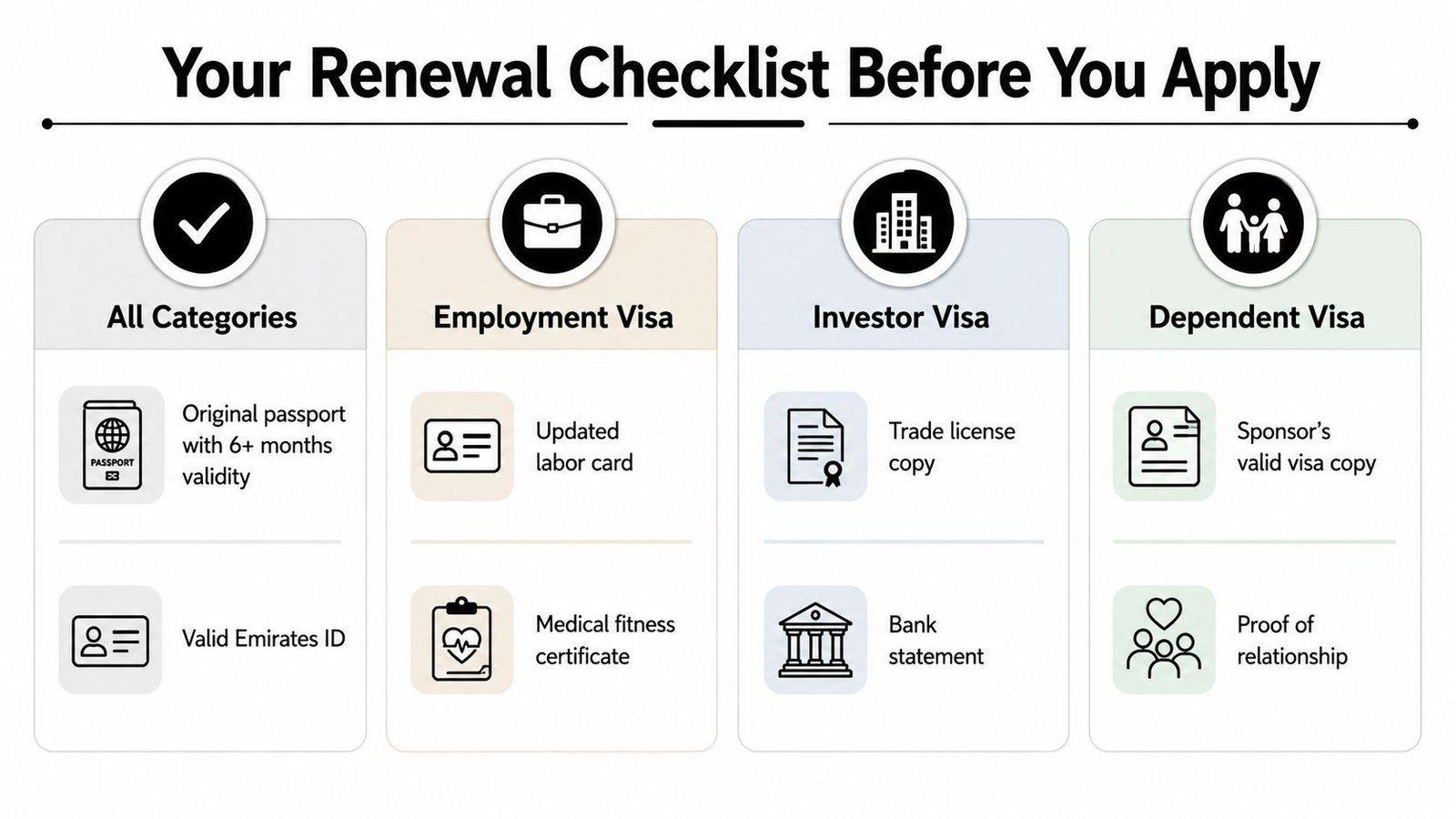
Use the checklist as a self-audit before the renewal enters the government queue. The right documents differ by category, but every applicant should begin with identity records and then add sponsor, employment, company, or Golden Visa evidence.
What should every applicant prepare?
- Original passport: Check that the passport has sufficient validity for the requested residence period.
- Current Emirates ID: Keep the existing card and confirm the personal details match the passport.
- Recent photograph: Use the required passport-style photograph with a white background.
- UAE Pass access: Confirm that the account is active and linked to the correct mobile number.
- Medical fitness status: Book the examination where required, or prepare evidence of an applicable exemption.
- Fine clearance: Check and settle immigration or overstay fines before submitting.
- Authority confirmation: Identify whether the file belongs to GDRFA Dubai, ICP, or an Abu Dhabi channel.
What changes by visa category?
For an employment visa, add the updated labour card, employment records, and employer or PRO authorisation if someone is submitting on the employee's behalf.
For a family or dependent visa, prepare the sponsor's valid residence details, attested marriage or birth documents where applicable, and proof of the relationship. The sponsor's own immigration status must be in order before dependent renewals can proceed.
For an investor or partner visa, check the trade licence, shareholder or partnership documents, and any required tenancy or EJARI record. EJARI is Dubai's official system for registering tenancy contracts, so the relevant tenancy record should match the company or applicant information where requested.
For a Golden Visa, keep the nomination or approval evidence, category-specific eligibility documents, passport, Emirates ID, and any authority correspondence together. Golden Visa files can involve more eligibility evidence than a standard employee renewal.
When should you start?
Start ordinary renewals 30 to 60 days before expiry. Begin investor renewals earlier when the residence depends on a licence renewal, and prepare Golden Visa files ahead of the expiry window because the approval evidence may require additional review.
A clean file contains the correct category, issuing emirate, sponsor, passport, medical status, Emirates ID application, payment record, and final electronic permit. If you want a managed process, Inpro Corporate Services L.L.C. handles UAE company, PRO, and visa workflows, including employee, investor, and Golden Visa renewal support. Visit the team with your visa category, emirate, and expiry date ready so they can assess the correct renewal route and next documents.