

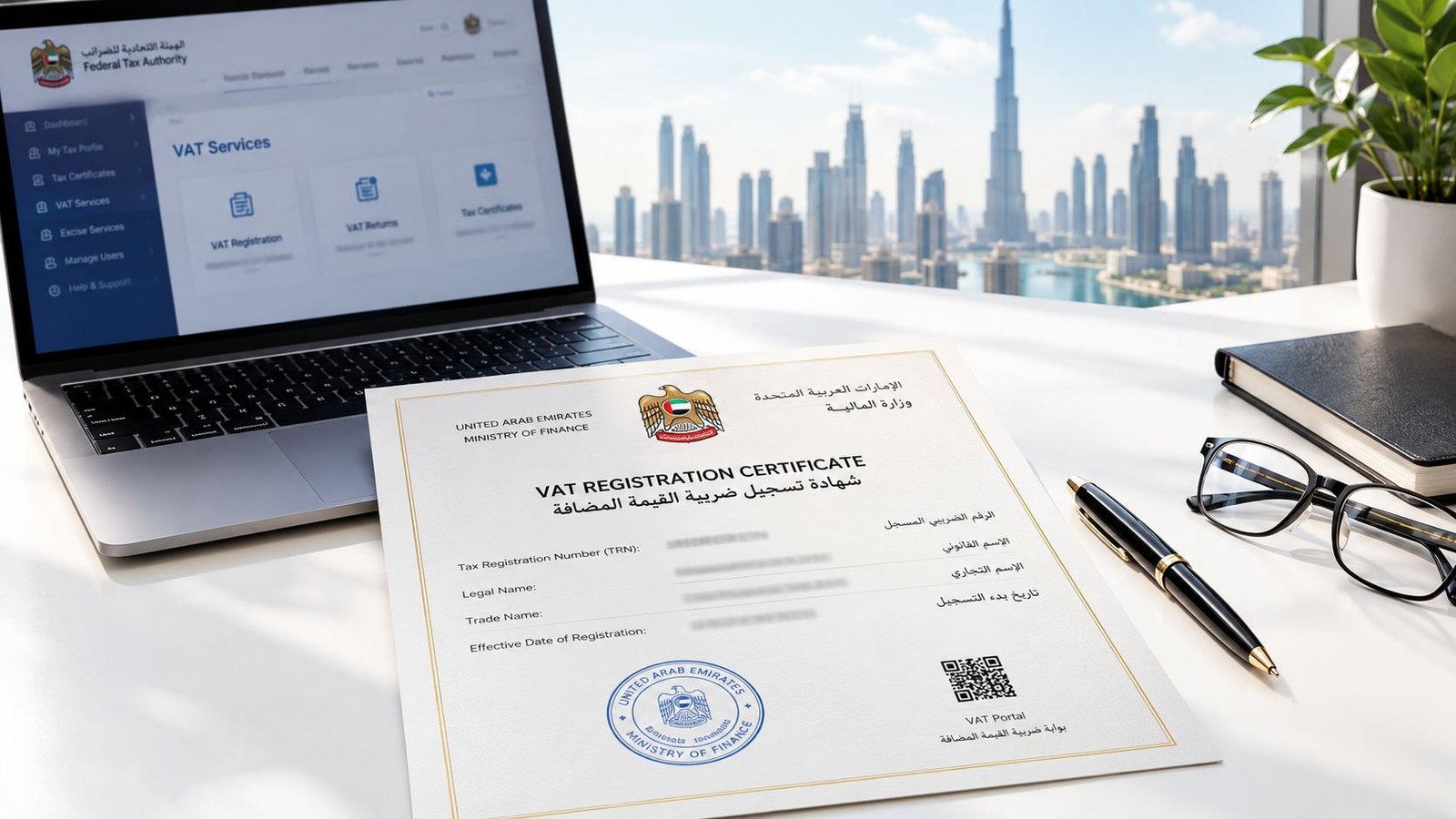
The UAE VAT registration certificate is the official Federal Tax Authority document that confirms an approved business registration for Value Added Tax. Registration becomes mandatory when taxable supplies and imports exceed AED 375,000, while voluntary registration starts at AED 187,500.
But is the certificate the registration itself, or only proof that the registration exists? For a founder, that distinction matters. The FTA records the registration in its systems, while the certificate gives banks, free zones, customs teams, customers, and other authorities a document they can review.
Table of Contents
- What a VAT Registration Certificate Is in the UAE
- Who Needs to Register and When
- Documents Required for VAT Registration
- How to Apply and How Long It Takes
- Downloading, Printing, and Replacing the Certificate
- Common Pitfalls and Documentation Gaps
- After Registration and How Inpro Helps
What a VAT Registration Certificate Is in the UAE
What document proves that your company is registered for UAE VAT? After the Federal Tax Authority, commonly called the FTA, approves a taxable person's application, it issues a digital VAT registration certificate through its online tax services. The certificate is tied to the business's Tax Registration Number, or TRN.
The document confirms the approved VAT registration and normally displays the entity's legal name, TRN, and registration date. A UAE tax registration guide describes it as an official FTA document connected to the TRN.
The registration itself remains in the FTA's records. The PDF certificate works like a passport for that registration: it gives a bank, free zone authority, customs team, customer, or another organisation something they can inspect when asking for proof.
That proof is the end of a compliance journey, not the first filing step. The business must first establish whether registration is required. Mandatory registration applies when taxable supplies and imports exceed AED 375,000 over the previous 12 months, or are expected to exceed that amount within the next 30 days. Voluntary registration starts at AED 187,500, according to UAE government VAT guidance.
What does the certificate prove?
It proves that the named taxable person has an approved VAT registration and a TRN. It does not replace the trade licence, commercial registration, tax return, or accounting records.
The certificate can matter across the UAE. Mainland companies in Dubai, Abu Dhabi, and Sharjah may need one, and free zone entities or resident sole proprietors may need registration when they make taxable supplies under UAE VAT rules. Location alone does not settle the question.
Operationally, keep the PDF in a controlled folder and a retrievable backup. Banks, free zones, and customs may request it at different points, and a missing or outdated copy can slow an otherwise approved process. The next steps cover eligibility, supporting documents, EmaraTax, and what to do if the certificate must be retrieved or replaced.
Who Needs to Register and When
The threshold decision depends on taxable supplies and imports, not on every amount shown in a bank account. A business should review its sales and import activity across the relevant period, then separate taxable, exempt, and out-of-scope activity before deciding whether registration is required.
Zero-rated supplies still count as taxable supplies, even though VAT is charged at zero. Exempt supplies and supplies outside the scope of VAT generally don't count towards the registration calculation. The FTA explains this distinction in its guidance on the VAT registration threshold calculation.
Which threshold applies?
| Scenario | Threshold | Action Required | Deadline |
|---|---|---|---|
| Mandatory registration | More than AED 375,000 in taxable supplies and imports over the previous 12 months | Submit a VAT registration application | Within 30 days of becoming required to register |
| Expected mandatory registration | Expected to exceed AED 375,000 within the next 30 days | Prepare and submit the application | Within 30 days of becoming required to register |
| Voluntary registration | AED 187,500 in taxable supplies and imports | Apply if registration is commercially or operationally useful | No mandatory registration deadline applies |
| Below the voluntary threshold | Below AED 187,500 | Continue monitoring taxable activity | Reassess as turnover changes |
The 30-day application window is not a planning suggestion. Once the mandatory registration obligation arises, the business should organise its records, authorised signatory details, and supporting documents without delay.
A UAE resident company, whether based on the mainland or in a free zone, should assess its taxable activity. Sole proprietors and other resident businesses should do the same. Non-resident businesses, branches of foreign companies, entities established in Gulf Cooperation Council countries, government bodies, and charities can fall under special rules, so their position should be checked against the specific activity and supply arrangement rather than assumed from the licence alone.
Practical rule: Review turnover, imports, and the nature of every supply before deciding that a company is below the threshold.
If several entities share ownership or control, ask whether their activities should be considered under VAT group rules. Keep the review organised across the ownership structure, rather than checking only the newest company or the entity with the largest bank account.
Documents Required for VAT Registration
A strong application tells one consistent story. The trade licence, ownership documents, authorised signatory information, address evidence, and financial records should all identify the same business and show why the entity needs VAT registration.
The exact documents can vary by entity and by questions raised through the portal. Founders should prepare the following sets before starting the application.
| Entity Type | Core Documents | Supporting Documents |
|---|---|---|
| Individual or sole establishment | Emirates ID, passport copy, trade licence | Proof of address, utility bill, or Ejari, plus financial records where relevant |
| Limited liability company | Trade licence, memorandum of association, partners' IDs, authorised signatory details | Certificate of Good Standing for the Enterprise, bank statements, financial records |
| Free zone company | Free zone licence, ownership documents, authorised signatory details | Lease or office agreement, business unit allowance, bank statements, customs records where relevant |
| VAT group | Details for each related entity and one controlling member | Evidence of control, ownership links, and records supporting the group structure |
Why does the FTA ask for these documents?
The Emirates ID and passport help identify the individual or signatory. The trade licence confirms the legal activity and licensed entity. For an LLC, the memorandum of association and partners' IDs help connect the application to the ownership structure.
Address evidence serves a different purpose. An Ejari, utility bill, lease, or office agreement helps show where the business operates. This can matter when the address on the application differs from the address shown in a licence or free zone record.
Financial records support the threshold assessment. Bank statements can help explain revenue movements, audited financials can support turnover evidence, and customs records can clarify import-heavy activity. These records aren't substitutes for the core documents, but they can answer questions before the FTA asks them.
Two issues often trigger extra requests. The FTA may ask for further evidence where a trade licence is under six months old, or where the turnover disclosed in the application doesn't align with the financial information provided. A clear explanation and matching records usually create a cleaner review.
How to Apply and How Long It Takes
What turns a completed VAT registration form into a usable VAT Registration Certificate? The process begins with access to EmaraTax and ends only when the FTA approves the application, issues the TRN, and makes the certificate available for business use.
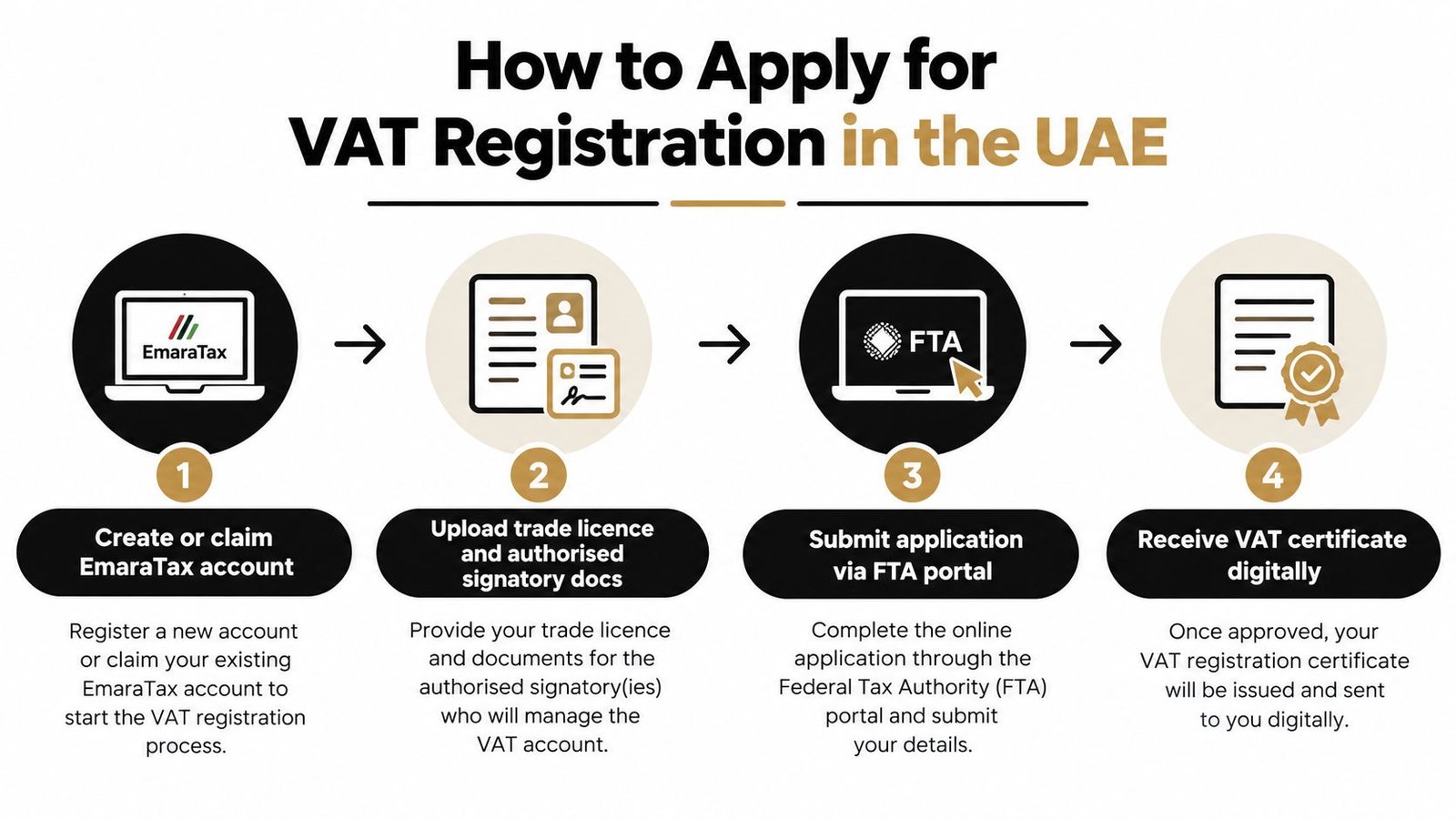
An authorised person creates or claims an EmaraTax account, the FTA's digital tax services platform, using the establishment's trade licence and authorised signatory information. The application then follows four practical stages:
- Set up the account. Confirm the establishment profile, contact details, licence information, and signatory access.
- Open the VAT registration service. Select the VAT registration application and check that the business details match the licence.
- Complete the declarations. Answer questions about taxable activities, imports, turnover, business relationships, and the reason for registration.
- Upload evidence and submit. Attach the required documents, review every declaration, and submit the application through the FTA portal.
Why can EmaraTax show more than one stage?
EmaraTax may show the initial account review separately from the VAT form submission. The first stage confirms the taxable person's profile and user access. The VAT form collects the details the FTA needs to decide whether to approve the registration.
A completed profile does not confirm that the VAT application was submitted. An uploaded document does not confirm acceptance either. Read each status label carefully and check whether the portal is requesting an action, clarification, or additional document.
Processing time depends on the application's accuracy and whether the FTA asks questions. A clear submission may proceed without further action, while a clarification request can extend the review. The FTA's VAT registration service confirms that the certificate becomes available in the taxpayer's e-Services dashboard after approval.
Check the EmaraTax inbox, email notifications, application status, and document requests regularly. A message waiting in the portal can matter as much as the original submission.
Approval marks the end of the registration journey, not merely the filing of a form. Once the TRN is issued, the business can access the certificate in its digital tax account and may need to present it to a bank, free zone authority, customs team, or customer. Save the approved PDF in a controlled company folder, record who can access it, and give the invoicing and tax administration teams a reliable copy.
Downloading, Printing, and Replacing the Certificate
What should you do with the VAT registration certificate after approval? Treat it as the final record of the compliance journey, then prepare it for the banks, free zone authorities, customs teams, and corporate customers that may request proof in different formats.

How do you download the official PDF?
Sign in to the EmaraTax account linked to the taxable person. Open the certificate area, select the VAT registration certificate, and download the PDF. Use the digitally issued file, not a screenshot. A screenshot may leave out identifying details, document controls, or features that a reviewing authority expects.
Store the PDF in a controlled company folder with the TRN, legal name, registration date, and access history. Give the invoicing and tax administration teams a reliable copy, while limiting access to authorised staff. A bank or free zone may request a stamped extract rather than the standard digital certificate, so ask which format its process accepts before submitting anything.
A printed Certificate of Registration extract can be requested for AED 250. Confirm the current request route and fee before paying, since digital tax services may change.
Payment and soft-copy downloads may follow separate instructions. Dubai Customs also has its own certificate request service for VAT registration certificates. Retrieval can therefore involve more than one portal when the document is needed for a customs workflow or another authority.
The following video shows the certificate display and download context:
If the file is lost, account credentials are unavailable, or company details have changed, check the document before sending an old copy. Compare the legal name, address, authorised signatory, and licence details. Then use the available FTA certificate or amendment service, or ask the receiving authority which official extract it requires.
Common Pitfalls and Documentation Gaps
Many registration problems aren't caused by a complicated tax calculation. They come from documents that disagree with one another.
A trade licence may show one legal name while the authorised signatory's Emirates ID reflects another spelling. A power of attorney may be missing, expired, or too limited for the person submitting the application. A registered address may no longer match the Ejari or free zone lease, and an old memorandum of association may not reflect the current ownership or management structure.
Which details should be checked before submission?
- Legal identity: Compare the trade licence, passport, Emirates ID, memorandum of association, and EmaraTax profile.
- Signing authority: Confirm that the authorised signatory has the right documents to act for the business.
- Registered address: Check the licence, lease, Ejari, and tax account for consistent address details.
- Ownership records: Make sure amendments, partner changes, and updated constitutional documents are available.
- Financial evidence: Ensure declared turnover can be explained by the bank records, invoices, accounts, and import documentation.
The certificate can also create operational friction after approval. A bank may ask for a stamped “To Whom It May Concern” extract instead of the standard PDF. A free zone may require the certificate to be uploaded to its own portal. A customs team may ask for a TRN-linked declaration before processing an import VAT recovery workflow.
These requests don't necessarily mean the FTA certificate is defective. They mean the receiving organisation has its own document-control process. Ask for the precise document name, signature requirement, stamp requirement, and acceptable file format before requesting a replacement.
A certificate is useful only when the people who need it can retrieve the current, authoritative version quickly.
Old access details create another risk. If a former signatory remains attached to the EmaraTax account, the new management team may struggle to receive notices, answer clarification requests, or complete later filings. Treat signatory changes as a tax-account handover, not just a corporate administration update.
After Registration and How Inpro Helps
What changes once your VAT registration certificate is issued? The application is finished, but compliance continues. The business must issue compliant tax invoices, show its TRN where required, apply the 5% VAT rate to most goods and services, and keep records that support its VAT returns.
The UAE VAT framework began on 1 January 2018 with a 5% rate on most goods and services, as explained by the Federal Tax Authority's VAT registration information. Store the certificate with sales and purchase invoices, customs documents, accounting entries, and correspondence with the FTA. These records form one evidence trail if the authority or another organisation asks how the business handles VAT.
What should happen after approval?
Give one person responsibility for the tax account and appoint a backup. Keep the certificate, TRN, registration details, licence amendments, and financial records in a shared, controlled location. After a licence renewal, ownership change, office move, or authorised-signatory change, check whether the FTA profile also requires an update.
Retrieving or presenting the certificate can create practical delays. A bank might request a stamped “To Whom It May Concern” extract rather than the standard PDF. A free zone may require an upload to its own portal, while customs may ask for a TRN-linked declaration before processing an import VAT recovery workflow. Ask each organisation for the exact document name, signature and stamp requirements, and accepted file format before requesting a replacement.
A certificate helps only when the right people can quickly retrieve the current, authoritative version.
Old EmaraTax access details create another risk. Treat a signatory change as a tax-account handover so the new team can receive notices, answer clarification requests, and complete later filings.
Inpro supports UAE company formation, PRO administration, tax and VAT registration, filings, and document workflows. Its team can help organise first VAT records, prepare bookkeeping, respond to FTA correspondence in Arabic and English, and handle certificate retrieval.
Visit Inpro for help with registration and the compliance steps after your TRN is issued.