

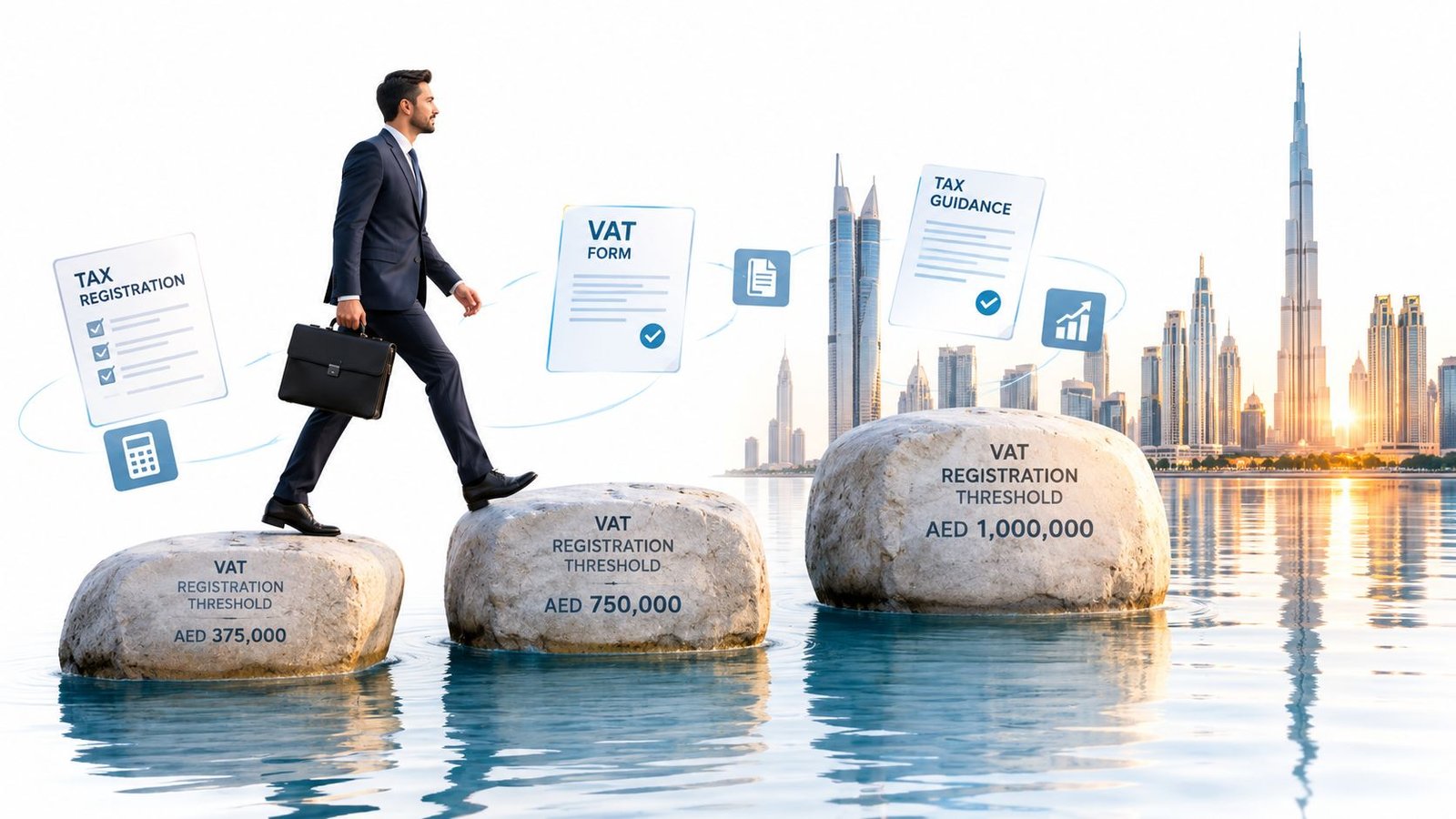
For a UAE-resident business, mandatory VAT registration starts when taxable supplies and imports exceed AED 375,000, while voluntary registration is available from AED 187,500, measured over the preceding 12 months or expected within the next 30 days. The rule can work differently for a non-UAE-resident supplier, which may need to register from its first relevant taxable UAE supply when no UAE-based party is responsible for accounting for the tax.
You may be opening a Dubai company, preparing a Free Zone launch in Ras Al Khaimah, or selling software to UAE customers from overseas. The question often appears simple: has the business reached the VAT threshold? In practice, you also need to identify what counts as taxable activity, where the supplier is resident, and who is legally responsible for settling VAT.
That distinction matters because a Free Zone company, a Mainland company and an offshore entity don't automatically face the same registration exposure. The Federal Tax Authority, or FTA, assesses the business activity and supply chain, not only the label on the licence.
Table of Contents
- What You Need to Know About VAT Registration in the UAE
- Mandatory Versus Voluntary VAT Registration Thresholds
- How VAT Registration Rules Change by Business Structure
- Documents and Steps Required for VAT Registration
- Real Examples for Free Zone, Mainland, and Offshore Businesses
- Obligations After VAT Registration in the UAE
- Get Clear Guidance on Your VAT Registration Path
What You Need to Know About VAT Registration in the UAE
Suppose your startup has begun invoicing customers, importing stock or paying VAT-bearing business expenses. Your first task is to separate those transactions from income that is exempt or outside the scope of UAE VAT. The UAE framework, established through Cabinet Decision No. 52 of 2017, uses taxable activity to determine whether a UAE-resident business must register or may register voluntarily. The Cabinet Decision establishing the UAE VAT registration thresholds sets the mandatory threshold at AED 375,000 and the voluntary threshold at AED 187,500.
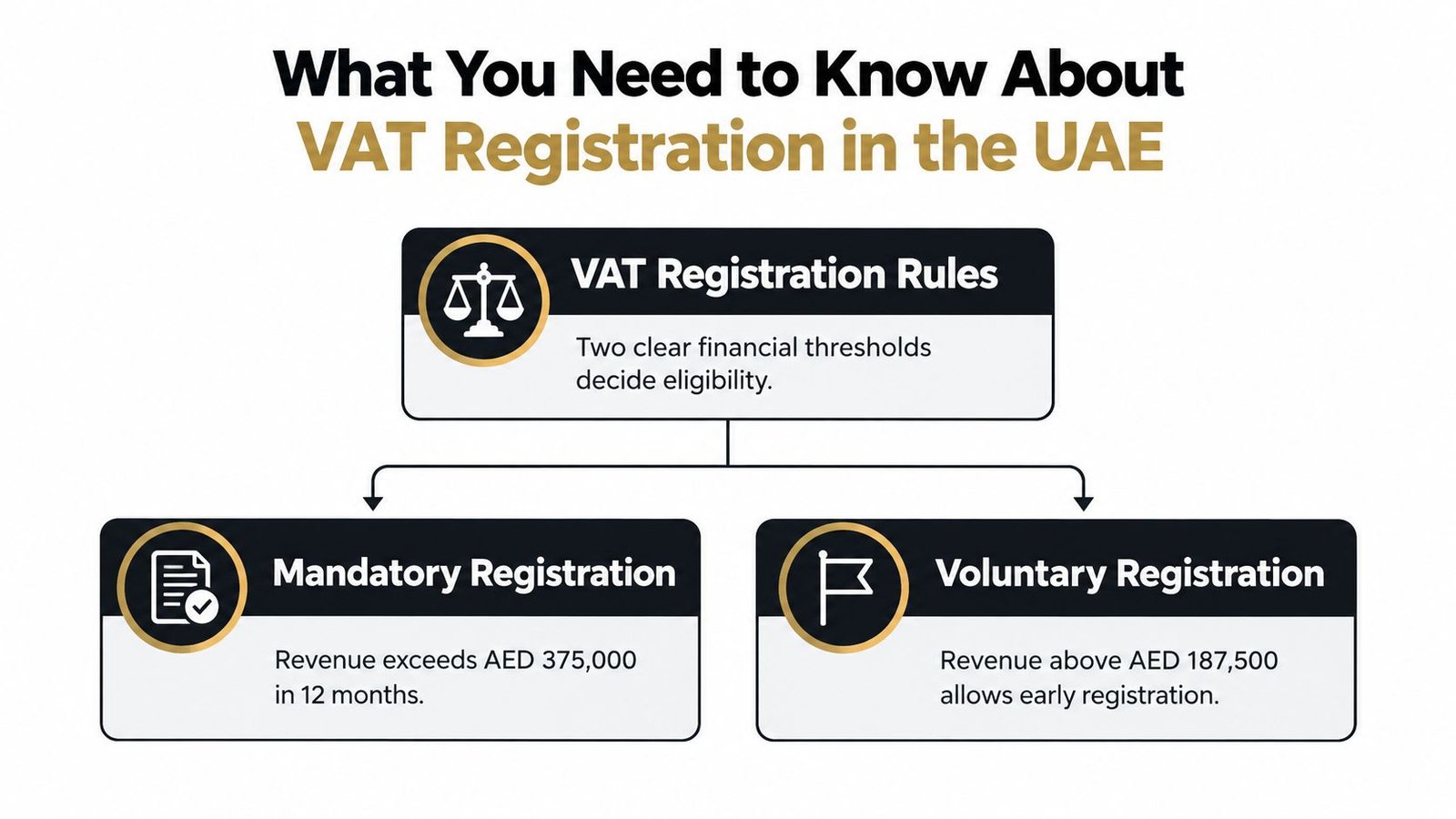
What counts towards the UAE VAT thresholds?
Taxable supplies are supplies on which UAE VAT applies under the relevant place-of-supply rules. For a UAE-resident business, the mandatory test looks at the value of taxable supplies and imports over the preceding 12 months, or the value the business expects to exceed within the next 30 days. This forward-looking test means you shouldn't wait until a full year of invoices has been issued if a signed contract or planned transaction makes the threshold likely to be exceeded.
The voluntary route uses the lower threshold of AED 187,500, which is exactly 50% of the mandatory threshold. A business may qualify based on taxable supplies, imports or VAT-taxable expenses over the previous 12 months, or expected during the next 30 days.
Practical rule: Don't compare the threshold with total turnover before classifying each revenue stream. Exempt and out-of-scope transactions can affect the calculation differently from taxable activity.
Why does this matter for startups and Free Zone operators?
A new technology company may have modest customer revenue but substantial taxable setup costs. A trading business may have a different profile because imports and taxable sales can drive its registration position. Free Zone operators also need to assess their actual supplies rather than assume that a Free Zone licence removes VAT obligations.
The key decision has two parts. First, calculate the relevant taxable activity using both the historical and expected tests. Second, confirm whether the business is a UAE resident for VAT purposes, or whether it is a foreign supplier making taxable supplies in the United Arab Emirates.
Mandatory Versus Voluntary VAT Registration Thresholds
The mandatory VAT registration threshold is a legal trigger for a UAE-resident business. If the value of taxable supplies and imports exceeds AED 375,000 in the preceding 12 months, registration is required. The same obligation can arise when the business expects to exceed that amount within the next 30 days, even if its historical figures remain below the threshold.
That forward-looking test is where founders often lose time. A company may have a large customer contract, a confirmed import order or a planned launch that changes its expected taxable activity quickly. Waiting for the cash to arrive or for annual revenue to appear in the accounts doesn't necessarily delay the registration obligation.
When does voluntary registration make sense?
Voluntary VAT registration is the early-registration route for a business that has reached the lower threshold but isn't yet required to register. For a UAE-resident business, that threshold is AED 187,500 in taxable supplies, imports or VAT-taxable expenses over the previous 12 months or expected within the next 30 days.
Voluntary registration can suit a startup with significant taxable expenses, a supplier working mainly with VAT-registered corporate customers, or a business that wants its invoicing and accounting processes ready before compulsory registration. It also creates ongoing administration, so the decision shouldn't be based only on the possibility of recovering input VAT.
Ask three practical questions:
- Customer profile: Will customers expect a VAT invoice, or are they consumers who may focus on the final price?
- Expense profile: Does the business have documented VAT-taxable expenses that make registration financially useful?
- Operational readiness: Can the company issue compliant invoices, maintain records and file returns on time?
The right answer depends on the business model, not merely on being close to a threshold.
Why is residency the hidden distinction?
The resident thresholds aren't a safe harbour for every foreign founder. The FTA VAT registration service guidance states that a non-UAE-resident business making taxable supplies in the UAE must generally register regardless of supply value when no UAE-based party is responsible for accounting for the tax.
For many non-resident suppliers, the effective threshold is therefore nil, rather than AED 375,000. An overseas SaaS provider, e-commerce seller or foreign company entering Dubai or Abu Dhabi directly can't assume that low initial revenue prevents registration.
The deciding issue is often the supply chain. Identify the supplier, customer, place-of-supply treatment and party legally responsible for VAT before relying on the resident thresholds.
How VAT Registration Rules Change by Business Structure
Business structure affects the VAT analysis, but the trade licence alone doesn't settle it. A Mainland company in Dubai or Abu Dhabi will usually assess the UAE-resident thresholds against its taxable supplies and imports. A Free Zone company may have separate corporate tax considerations, but it still needs to examine its taxable UAE activity for VAT.
An offshore entity requires more care. If it is not UAE-resident and makes taxable supplies in the UAE, the AED 375,000 threshold isn't applicable to foreign businesses where no other UAE party is responsible for settling the VAT. The FTA guidance on registration for VAT confirms this distinction.
What changes between Mainland, Free Zone and Offshore structures?
| Business Structure | Mandatory Threshold | Key Registration Trigger |
|---|---|---|
| UAE Mainland company | AED 375,000 for a UAE-resident business | Taxable supplies and imports exceed the threshold over the preceding 12 months or are expected to exceed it within the next 30 days |
| UAE Free Zone company | Depends on the entity's VAT residence and activity | Assess taxable UAE supplies, imports and the actual supply chain. A Free Zone licence doesn't automatically remove VAT exposure |
| Offshore or other non-UAE-resident supplier | No resident threshold where the non-resident rule applies | Taxable supplies in the UAE generally require registration when no UAE-based party is responsible for accounting for VAT |
A Qualifying Free Zone Person is a company that may meet conditions under UAE corporate tax rules for particular Free Zone treatment. That status shouldn't be treated as a blanket VAT exemption. VAT registration depends on the nature and place of supplies, not only on whether the company operates from a Free Zone.
Does an offshore structure avoid UAE VAT registration?
No, not automatically. A foreign company selling directly to UAE customers may have registration exposure from the first relevant taxable supply if the customer or another UAE party isn't legally required to account for VAT.
Reverse-charge treatment can change who accounts for tax in some transactions, but you need to establish that responsibility for the specific supply. Contracts, customer status and invoices should support the conclusion.
A low-revenue offshore company can face a different VAT result from a higher-revenue UAE-resident company. Residency and tax responsibility come before turnover.
Documents and Steps Required for VAT Registration
A strong VAT application tells a consistent story about the business. The FTA needs to understand who supplies what, where the activity occurs and why the business meets the registration conditions. Founders should prepare evidence before opening the application rather than trying to reconstruct the position afterwards.
What documents should you prepare?
The exact evidence depends on the entity and its activity, but a practical file may include:
- Trade licence details: These identify the legal entity, licensed activities and registered address.
- Ownership and identity documents: Passport and visa copies may be relevant for owners, authorised signatories or responsible managers.
- Bank account information: This helps connect the applicant to its operating and financial arrangements.
- Contracts and invoices: Customer agreements and issued invoices show the nature, value and location of supplies.
- Import records: Customs and import documents support the calculation where imported goods form part of the activity.
- Business-activity evidence: Website details, premises information, supplier records and evidence of a UAE customer base can help explain how the business operates.
An overseas SaaS provider should be ready to explain its contracting entity, customer location and invoicing flow. A Dubai trading company should organise purchase, import and sales records. The documents should agree with the answers in the application.
How do you apply through the FTA?
The application is submitted through the FTA's online tax services. The authorised person enters the entity's legal details, business activity, contact information and financial data, then uploads supporting documents and submits the request for review.
Before submitting, reconcile the figures used in the application with the accounting records. Check that the registration basis is clear, whether it is the historical 12-month test, the next-30-day expectation, the voluntary threshold or the non-resident rule.
Don't treat registration as a form-filling exercise. If the business has several entities, related-party arrangements or customers in different jurisdictions, map the supply chain first. That work is often faster than correcting an application built on an incorrect assumption about residency.
Real Examples for Free Zone, Mainland, and Offshore Businesses
The same question can produce different answers depending on where the supplier is based and who accounts for VAT. These examples are simplified decision patterns, not substitutes for reviewing the actual contracts and transactions.

What happens to a Dubai Mainland trading company?
A Dubai Mainland trading company imports products and sells them to UAE customers. Its management should track taxable sales and imports as a rolling record rather than checking the position only at year-end.
If its taxable supplies and imports exceed AED 375,000 during the preceding 12 months, mandatory registration applies. The company also needs to assess expected activity in the next 30 days, because a confirmed order or contract can create an obligation before the historical figure crosses the threshold.
How might a Ras Al Khaimah Free Zone startup approach registration?
A software startup licensed in a Ras Al Khaimah Free Zone has not reached mandatory registration, but its taxable supplies, imports or VAT-taxable expenses exceed AED 187,500 over the relevant test period. It may consider voluntary registration if its customers, expense base and accounting systems make early registration sensible.
The Free Zone location doesn't answer the VAT question on its own. The founders should classify the supplies, review customer locations and confirm whether the entity is treated as a UAE-resident business for this analysis.
The practical choice is between early administration and delayed registration. Voluntary registration may help the business manage taxable expenses and corporate invoicing, but it also creates filing and record-keeping duties.
What about an offshore SaaS or e-commerce business?
A foreign SaaS company sells subscriptions directly to UAE customers from outside the United Arab Emirates. Its revenue is below the resident threshold, but no UAE-based customer or intermediary is responsible for settling VAT.
That company can't rely on the resident threshold because its initial sales are limited. The non-resident rule may require registration for taxable UAE supplies regardless of value. The company should review its contracts, customer status, service treatment and invoicing before launch.
The same issue can affect an offshore e-commerce seller shipping goods into Dubai or Abu Dhabi. The right analysis follows the transaction, not the low-revenue label.
The following video can help founders visualise the role of setup and documentation in the wider UAE compliance process.
Obligations After VAT Registration in the UAE
Registration is the start of a compliance cycle, not the final administrative step. Once registered, the business needs records that show taxable sales, VAT charged, business purchases and the calculation behind each return.
The accounting team should keep taxable, exempt and out-of-scope transactions distinct. Total company revenue can hide the activity that matters for VAT, and poor classification can affect both the registration assessment and the figures reported after registration.
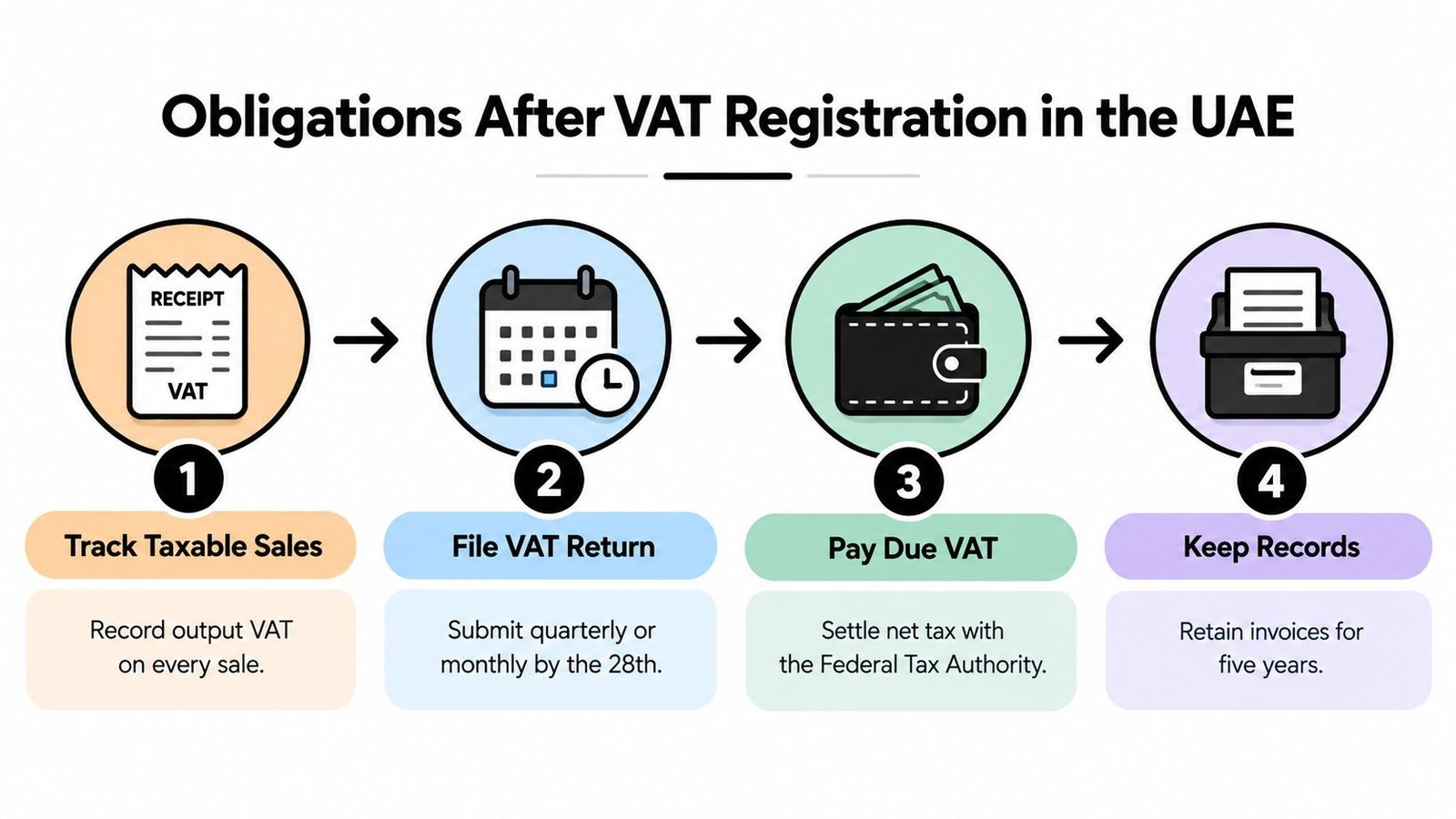
What should the monthly and quarterly routine include?
Build the following checks into the normal finance process:
- Record each taxable sale: Keep the invoice, customer details and VAT calculation together.
- Review purchases: Separate recoverable business expenses from costs that require different VAT treatment.
- Reconcile the VAT account: Compare sales records, purchase records, bank activity and accounting entries before filing.
- Prepare the return: File according to the tax period assigned to the business and confirm the submission deadline shown in the FTA system.
- Settle the balance: Arrange payment of net VAT due rather than treating filing and payment as unrelated tasks.
- Retain evidence: Keep invoices, import records, contracts and workings in an organised archive.
The infographic shows a common compliance rhythm of tracking sales, filing the return, paying due VAT and keeping records. Your actual filing period and deadline should be confirmed from the FTA account and current guidance.
How can a founder avoid late-registration problems?
Assign one person to monitor taxable activity and expected contracts. That person should review the rolling figures whenever the company signs a major contract, adds a new sales channel, starts importing or changes its customer base.
A useful internal report has separate lines for taxable supplies, exempt supplies, out-of-scope activity, imports and taxable expenses. It should also record the reason for any change in expected activity, so the business can explain when it identified a registration obligation.
The best VAT process is the one that catches a registration trigger before the filing deadline becomes an emergency.
Get Clear Guidance on Your VAT Registration Path
UAE VAT registration requirements depend on more than a single revenue figure. The outcome turns on taxable activity, residency, business structure, customer location and responsibility for accounting for VAT.
For a UAE-resident Mainland or Free Zone business, start with the historical 12-month calculation and the next-30-day expectation. Then assess whether the voluntary route fits the expense base and customer model. For an overseas or offshore supplier, begin with the supply chain and tax-accounting responsibility instead of assuming that a low turnover keeps the business outside the system.
Keep the evidence practical. Contracts, invoices, import documents, licence details and operating information should tell the same story as the registration application. If the business operates across Dubai, Abu Dhabi, Sharjah and Free Zones, review each transaction flow rather than applying one label to the whole group.
An accountant, tax adviser or PRO services provider can help test the classification and prepare the application. Inpro offers UAE company formation support alongside accounting, tax and VAT registration and filing services, so founders can address setup and ongoing compliance through one provider.
If you're unsure whether your Mainland, Free Zone or offshore structure meets the UAE VAT registration requirements, visit Inpro to review your registration path with a team that supports company setup, VAT registration and ongoing filings. Bring your licence details, customer model and recent transaction records, and ask for a practical assessment of the next step.