


The VAT registration threshold in the UAE is AED 375,000 in taxable turnover over a 12-month period, and knowing exactly what counts towards that total is what keeps founders out of trouble. If you're looking at a few strong invoices in Dubai, Abu Dhabi, or a free zone and wondering whether you need to register now or later, the timing of the calculation matters just as much as the number itself.
A lot of new businesses in the United Arab Emirates get caught by the same problem. They treat VAT as something to handle once revenue feels “big enough”, then a busy month pushes them past the line and the paperwork suddenly becomes urgent. The safer approach is simpler: track taxable turnover every month, understand what goes into the total, and act before the Federal Tax Authority asks why you waited.
Table of Contents
- What Is the VAT Registration Threshold
- Understanding Mandatory vs Voluntary Registration
- How to Calculate Your Taxable Supplies
- Rules for VAT Groups and Non-Residents
- The VAT Registration Process Step by Step
- Ensuring Compliance and Next Steps
What Is the VAT Registration Threshold
Founders often assume the VAT threshold is a simple January to December revenue check. In practice, that mistake causes late registrations, rushed corrections, and avoidable penalties.
In the UAE, the VAT registration threshold for resident businesses is AED 375,000. Once a business reaches that level of taxable turnover, VAT registration stops being optional and becomes a legal requirement.
The number itself is straightforward. The difficulty is knowing when you have crossed it and what should be counted. New businesses rarely earn in a neat monthly pattern. Revenue can spike after one contract, drop the next month, then rise again with project billing, ecommerce campaigns, or milestone payments. Free zone companies often get caught here as well, especially when founders assume their location changes the basic threshold test.
Why does this threshold matter so much
The threshold marks the point where the business must enter the UAE VAT system and start handling tax correctly. That means issuing VAT-compliant invoices, keeping supporting records, and preparing to file returns with the Federal Tax Authority.
Practical rule: Treat the threshold as a live compliance trigger. Review it regularly, not just at year-end.
A business that waits too long can end up owing VAT from the date registration should have taken effect, even if it did not charge VAT to customers at the time. In real terms, that usually means the business absorbs the tax cost itself while also dealing with penalties and corrective filings.
What does taxable turnover mean here
For threshold purposes, taxable turnover means the value of taxable supplies and imports that count toward VAT registration. The key issue is not just total sales. It is whether those sales fall within the categories that the UAE VAT rules treat as taxable for registration purposes.
Founders need to be careful with timing and classification. A consulting business serving overseas clients, a mainland trader selling locally, and a free zone company supplying into the UAE market can each have very different turnover profiles. The threshold remains the same, but the calculation can look different depending on the type of supply, where the customer is based, and whether the transaction is taxable, zero-rated, or outside the scope.
That is why the threshold should be monitored as the business grows, not checked once the accounts are closed.
Understanding Mandatory vs Voluntary Registration
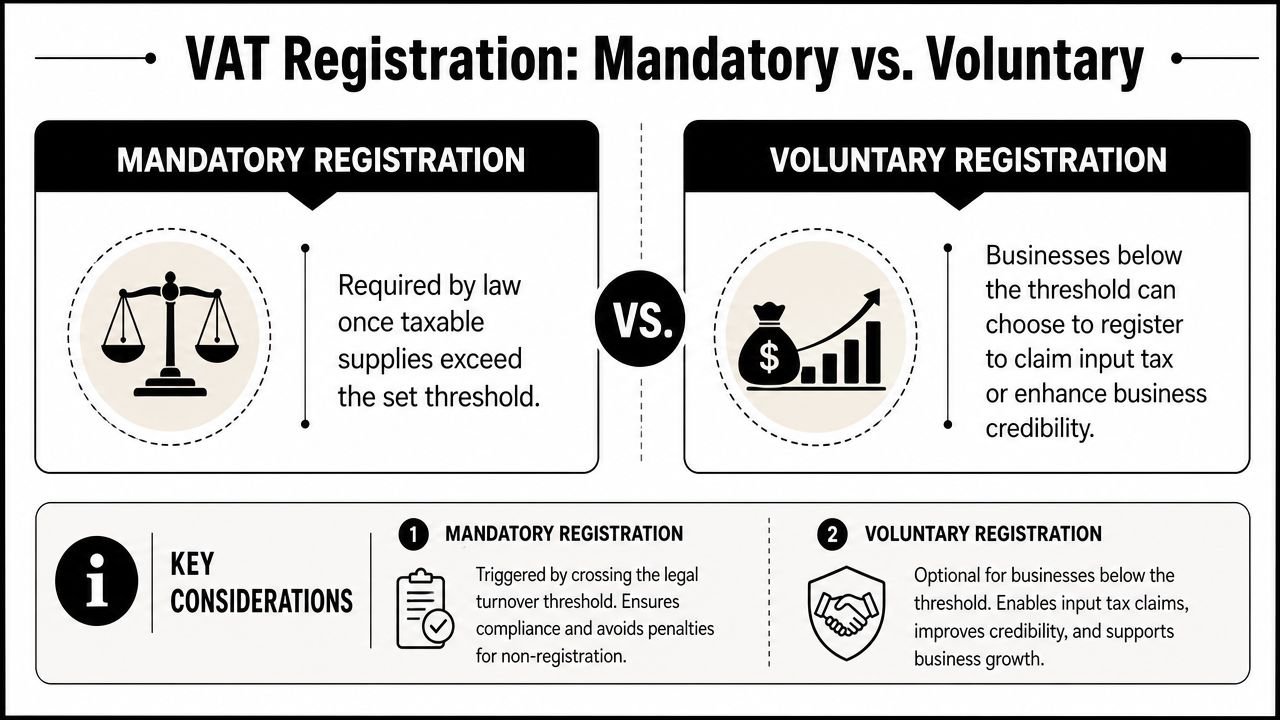
There are two different routes into VAT registration in the UAE. One is required by law. The other is optional and can make sense for some businesses, especially those with notable setup or operating costs.
| Registration Type | 12-Month Taxable Turnover |
|---|---|
| Mandatory registration | AED 375,000 |
| Voluntary registration | AED 187,500 |
What makes registration mandatory
For resident businesses, registration becomes mandatory when taxable supplies and imports exceed AED 375,000 over a rolling 12-month period, or when the business expects to exceed that amount within the next 30 days, according to KGRN's UAE VAT registration procedure guide. That same guidance states that registration is required within 30 days of crossing the threshold.
Founders often get the timing wrong. They wait until the business has “settled”, or until the next quarter, or until bookkeeping is cleaned up. The law doesn't wait for a convenient month.
When voluntary registration can make sense
Voluntary registration is the option for businesses below the mandatory line that still want to enter the VAT system. For a startup in Dubai Internet City, a consultancy in Abu Dhabi Global Market, or a Sharjah trading company with meaningful supplier costs, voluntary registration can help with reclaiming VAT on eligible business expenses and presenting cleaner tax documentation to larger clients.
The trade-off is administrative. Once you register, you're inside the filing and record-keeping system. That can be worth it if your customers expect VAT invoices or if your business has substantial input VAT on setup costs, rent, software, or outsourced services.
A founder who only looks at revenue misses half the picture. Input costs, customer expectations, and admin capacity all matter.
A simple way to think about it is this:
- Mandatory registration suits no one. It isn't a strategy choice. Once you cross the legal line, you must act.
- Voluntary registration can be useful when the business wants tax recovery or wants to look procurement-ready for corporate clients.
- Waiting on purpose sometimes works for small operations with limited taxable sales and modest expenses, especially if compliance would outweigh the benefit for now.
If you're choosing voluntary registration, decide for a reason. “It might be useful later” isn't a good enough basis. You want a clear operational benefit.
How to Calculate Your Taxable Supplies
A common early mistake looks like this. A founder sees AED 280,000 in billed revenue by September, assumes there is still plenty of room before registration becomes an issue, then signs a strong Q4 contract and realizes too late that the rolling test had already caught them.
That is why the calculation matters more than the headline threshold.
What income counts towards the threshold
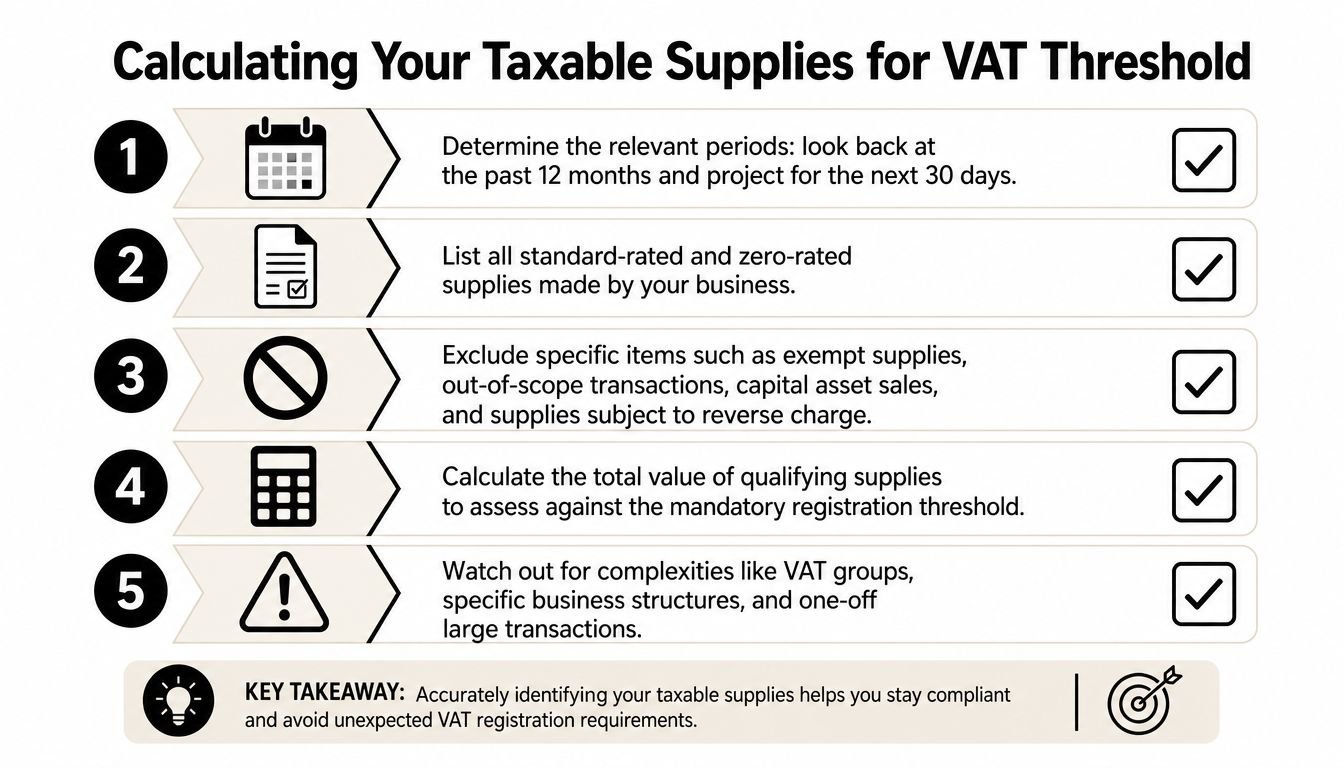
Taxable supplies are the goods and services your business provides that sit within the VAT system. For a new UAE business, the right starting point is your actual trading income, not every amount received in the bank.
In practice, these are the items founders usually need to include:
- Sales of services: consultancy fees, retainers, implementation work, design projects, technical support, and similar billed services
- Sales of goods: product sales, trading income, ecommerce orders, and wholesale or distribution revenue
- Imports relevant to registration rules: where imports form part of your taxable business activity, they may need to be considered in the registration review
Several cash movements do not belong in this calculation. Capital introduced by shareholders, director loans, loan proceeds, and internal transfers are funding items, not taxable supplies. If those are mixed into turnover reports, the threshold check becomes unreliable very quickly.
For new businesses, this is mostly a bookkeeping discipline issue. The chart of accounts should separate sales, funding, reimbursements, and non-trading receipts from day one.
How does the 12-month rule work
The threshold test is based on a rolling 12-month period. You review the value of taxable supplies and relevant imports over the previous 12 months from the date of review. You also consider whether the business is expected to exceed the threshold in the next 30 days.
That timing catches many new businesses because revenue rarely arrives in a neat monthly pattern. One large retainer, a seasonal sales spike, or a delayed batch of invoices can change the answer fast.
According to Stratrich's note on the 2025 VAT Executive Regulations amendments, businesses must review taxable supply turnover over the past 12 months, and Stratrich says this nuance causes an estimated 40% of new SMEs to misjudge registration timing. In the same note, Stratrich says first-time non-compliance penalties average AED 10,000, especially where businesses miss the 30-day window after a sudden increase in revenue.
The practical question is straightforward. What do the last 12 months show today, and what is already likely to be invoiced in the next 30 days?
A monthly review usually works well:
- Pull the latest 12 months of sales data. Use your accounting system or a controlled spreadsheet, not a quick scan of bank credits.
- Tag the taxable items clearly. Separate taxable sales from funding, pass-through receipts, and anything non-trading.
- Add the next 30 days of committed revenue. Signed contracts, recurring retainers, confirmed orders, and scheduled invoices matter.
- Recheck after any unusual month. A product launch, bulk order, or annual contract can move the total more than founders expect.
What mistakes trip up new businesses
Free zone companies often misread the issue. The free zone address does not create a different VAT registration threshold. A common problem is usually how the business measures turnover, especially where revenue is uneven or the company assumes low early sales give it more time than it has.
A Dubai free zone consultant may bill small monthly amounts for most of the year, then close two corporate retainers in one quarter. A trader may have a quiet first half and a heavy final quarter. An online seller may cross the line during a promotion period and miss it because the team is still watching year-to-date revenue instead of a rolling 12-month total.
The mistakes I see most often are practical ones:
- Checking too late: waiting for annual accounts or year-end cleanup instead of reviewing monthly
- Using inconsistent dates: counting some revenue on invoice date and other revenue on payment date without a defined method
- Ignoring committed near-term sales: leaving out signed work that falls inside the next-30-days test
- Treating free zone status as a shield: assuming the licence location changes the trigger when it does not
If revenue fluctuates, set one rule and follow it every month. Review the rolling total monthly. Review it again after any large invoice, contract win, or sales spike. That habit is simple, and it prevents a large share of avoidable registration delays.
Rules for VAT Groups and Non-Residents
A founder with three UAE entities often asks the wrong first question. They ask whether each company stays below the threshold on its own. The better question is whether the structure should stay separate for VAT at all, and whether any overseas entity in the group has a UAE registration issue before the first invoice is raised.

When should related companies think about a VAT group
A VAT group is a single VAT registration for eligible related entities. It is usually considered where companies under common control trade with each other, share staff or finance support, or operate as one commercial unit even though the legal entities are separate.
The practical benefit is administrative. Instead of treating every intra-group charge as a separate VAT event, the group files as one taxable person. That can reduce internal billing friction and simplify reporting.
The trade-off is responsibility.
Once entities join a VAT group, the position is no longer ring-fenced company by company. Errors in one entity can affect the whole group, and grouped reporting only works well if the books are consistent across all members. I usually tell founders to examine the operating reality, not just the org chart. Separate licences do not settle the issue on their own. Ownership, control, and how the businesses work day to day matter more.
For founders managing multiple entities, understanding the criteria for forming a VAT group is key. This short explainer breaks down the core concepts before you decide whether specialist review is needed:
How are non-resident businesses treated
A non-resident business is a business making taxable supplies in the UAE without being resident there for VAT purposes. For these businesses, the standard resident threshold is usually not the safe reference point.
In practice, a non-resident may need to register from the outset unless the VAT is fully accounted for in the UAE by another party under the applicable rules. That catches overseas founders who assume they can test demand first and sort the tax later.
A common mistake is waiting until sales volume feels meaningful. For non-residents, the timing issue is often much earlier than that. Review the VAT position before the first taxable UAE transaction, especially if the business is selling directly into the UAE, importing goods, or contracting with UAE customers without a local entity handling the tax side.
The VAT Registration Process Step by Step
A common founder scenario goes like this. Sales start unevenly, one strong month pushes turnover up, then the question lands late. Did the business cross the threshold already, and if so, when should the application have been filed?
Once registration is due, speed matters, but accuracy matters more. The practical job is to show the Federal Tax Authority when the threshold was crossed or when it became clear the business would cross it soon, using records that support the date you rely on.
What should you prepare before applying
Prepare the file before opening the portal. That is usually where the essential work sits, especially for new UAE businesses with fluctuating monthly revenue, mixed local and cross-border sales, or free zone activity that has been coded loosely in the accounts.
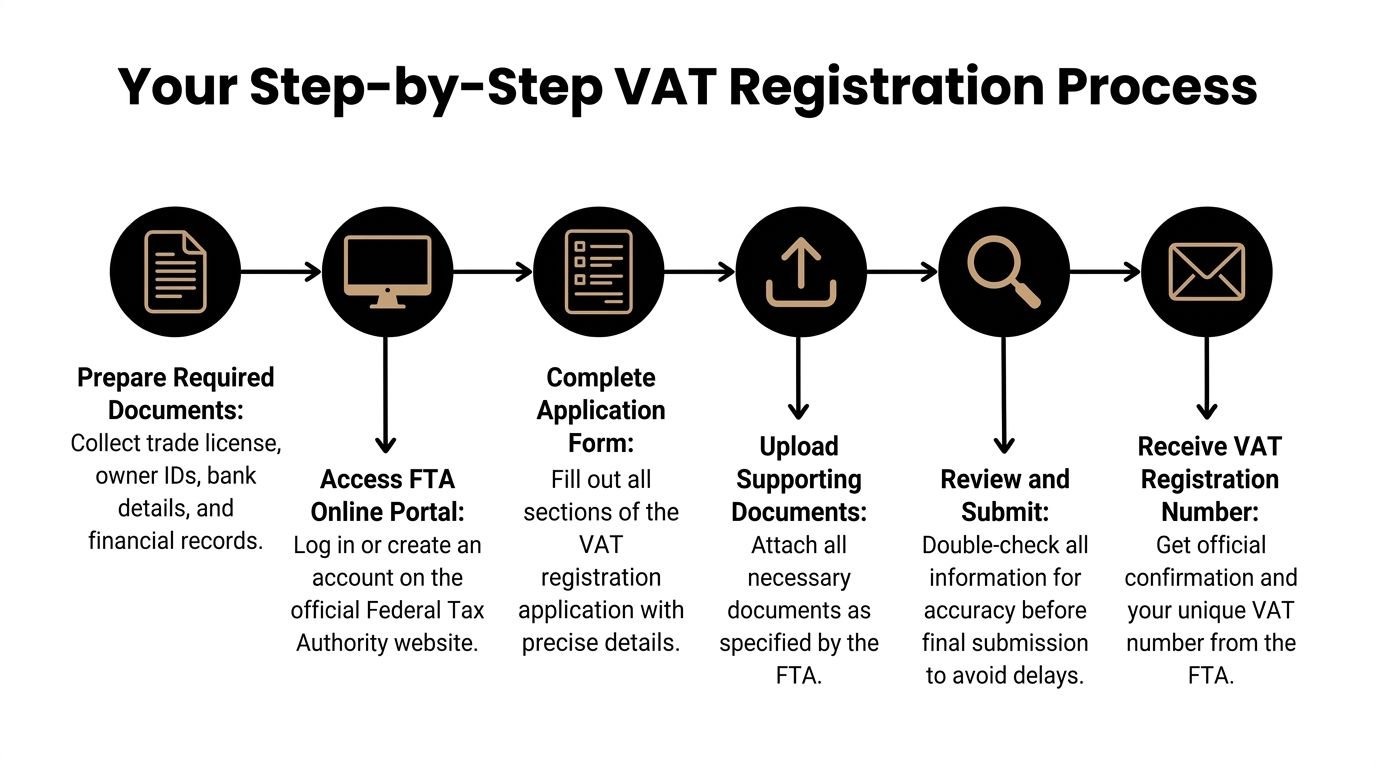
The application needs a clean story backed by documents. In practice, that usually means:
- Trade licence details: Active licence information and the legal business details exactly as registered.
- Identity documents for the authorised signatory: Emirates ID or passport details, depending on the structure and the person signing.
- Financial records: Sales reports, invoices, contracts where relevant, and working papers showing how taxable supplies were calculated.
- Bank and contact details: Current business banking and contact information that match the company records.
- Threshold timing support: A simple month-by-month turnover schedule showing when registration became mandatory, or why voluntary registration applies.
Founders often underestimate the timing analysis. The FTA is not only looking for a total figure. It also helps to show how that figure built up, especially where revenue moved sharply from one month to the next.
Ensure your sales reports, invoices, and bank movements match before starting the application. If they do not, fix that first.
How does the Federal Tax Authority application work
The Federal Tax Authority portal is the online system used for UAE tax registration and related filings. You access the account, complete the VAT registration form, upload the supporting documents, and submit the file for review.
The sequence is straightforward:
- Create or access the FTA account
- Enter the legal and commercial details
- Select the registration basis
- Provide turnover figures and the relevant dates
- Upload supporting documents
- Review the form carefully and submit
- Wait for approval and issuance of the Tax Registration Number
The turnover section deserves close attention. If the business crossed the mandatory threshold because of inconsistent but rising revenue, the figures should show exactly when that happened. If the business is in a free zone, the legal location alone does not answer the VAT question. The supplies themselves, the customer location, and how the transactions are treated for VAT all need to line up with the numbers in the application.
I also advise founders to avoid rough estimates where proper records exist. If the application date, invoice dates, and accounting reports point in different directions, approval can slow down and later compliance becomes harder.
What helps applications move smoothly
Well-prepared applications tend to move with fewer questions. Names match across the licence, bank records, and ID documents. Revenue evidence supports the date chosen for registration. The authorised signatory is clear from the outset.
Many businesses get help at this stage, especially where the accounts need tidying up before submission. Inpro Corporate Services L.L.C. provides company setup, PRO services, VAT registration support, and related compliance assistance for UAE businesses.
Use this checklist before filing:
- Match names exactly: Company name, licence details, and signatory details should be identical across the file.
- Show the sales trail: Use invoices, reports, and transaction records to support the registration date.
- Separate taxable, zero-rated, and out-of-scope items properly: This matters for businesses with exports, free zone operations, or mixed income streams.
- Keep copies of everything submitted: The same records will be needed later for filings and any follow-up questions.
- Resolve bookkeeping gaps before submission: Poor records usually create problems after registration, when returns and supporting documents have to agree.
A careful application saves time twice. It reduces delays now, and it gives the business a cleaner starting point for filing returns once the TRN is issued.
Ensuring Compliance and Next Steps
Registration isn't the finish line. It's the point where your VAT process starts needing discipline every month, not just attention when the business is setting up.
What should you do after registration
Start by updating invoicing, record-keeping, and internal controls. Your finance team, external accountant, or founder-led admin process needs to know when VAT applies, how invoices should be issued, and how supporting records should be stored.
Keep the process simple:
- Issue compliant invoices: The VAT treatment should be clear and consistent.
- Maintain organised records: Keep sales, purchases, and supporting documents easy to retrieve.
- Follow filing deadlines: Late filing and sloppy records create avoidable stress.
- Review unusual transactions early: New supply types, cross-border deals, and one-off contracts often need a closer look.
How can founders stay ahead of timing problems
The biggest practical protection is a monthly threshold review, even after registration. Growing businesses change shape fast. New branches, new legal entities, free zone expansions, or a shift from local to overseas clients can all affect how VAT needs to be handled.
If you're still below the line, don't treat that as a reason to ignore it. If you're already registered, don't assume the hard part is over. The businesses that stay compliant are usually the ones that keep good records and ask questions early, before a filing date or penalty notice forces the issue.
Not sure whether your taxable turnover has crossed the line, or whether a free zone setup changes your position? Book a free strategy call with Inpro Corporate Services L.L.C..