


The UAE Wage Protection System, or WPS, is the mandatory electronic salary transfer scheme run through the Ministry of Human Resources and Emiratisation and the Central Bank of the UAE, and it requires private-sector employers to pay wages through approved banks and agents so regulators can verify them. In Saudi Arabia, the wider GCC model has already grown from a small rollout into a labour-market system that now protects more than 8.5 million employees in 2024, so founders in the UAE should treat WPS as a core operating process, not a side admin task (Saudi Ministry of Human Resources and Social Development).
If you're setting up in Dubai, Abu Dhabi, Sharjah, or a free zone, the first payroll question is usually the same, can you pay salaries any way you like, or does the government need to see each payment path? With WPS, the answer is clear enough to save you stress later, because payroll data, contract data, and bank data all have to line up before salary runs go through cleanly.
Table of Contents
- What the UAE Wage Protection System Is
- Which Employers and Employees WPS Covers
- How the Employer Registration Workflow Works
- What a Monthly WPS Payroll File Must Contain
- Common Pitfalls and MOHRE Penalties
- Best Practices and the Inpro Approach to WPS
- Questions Founders Ask About WPS
- A Short Recap and Your Next Step
What the UAE Wage Protection System Is
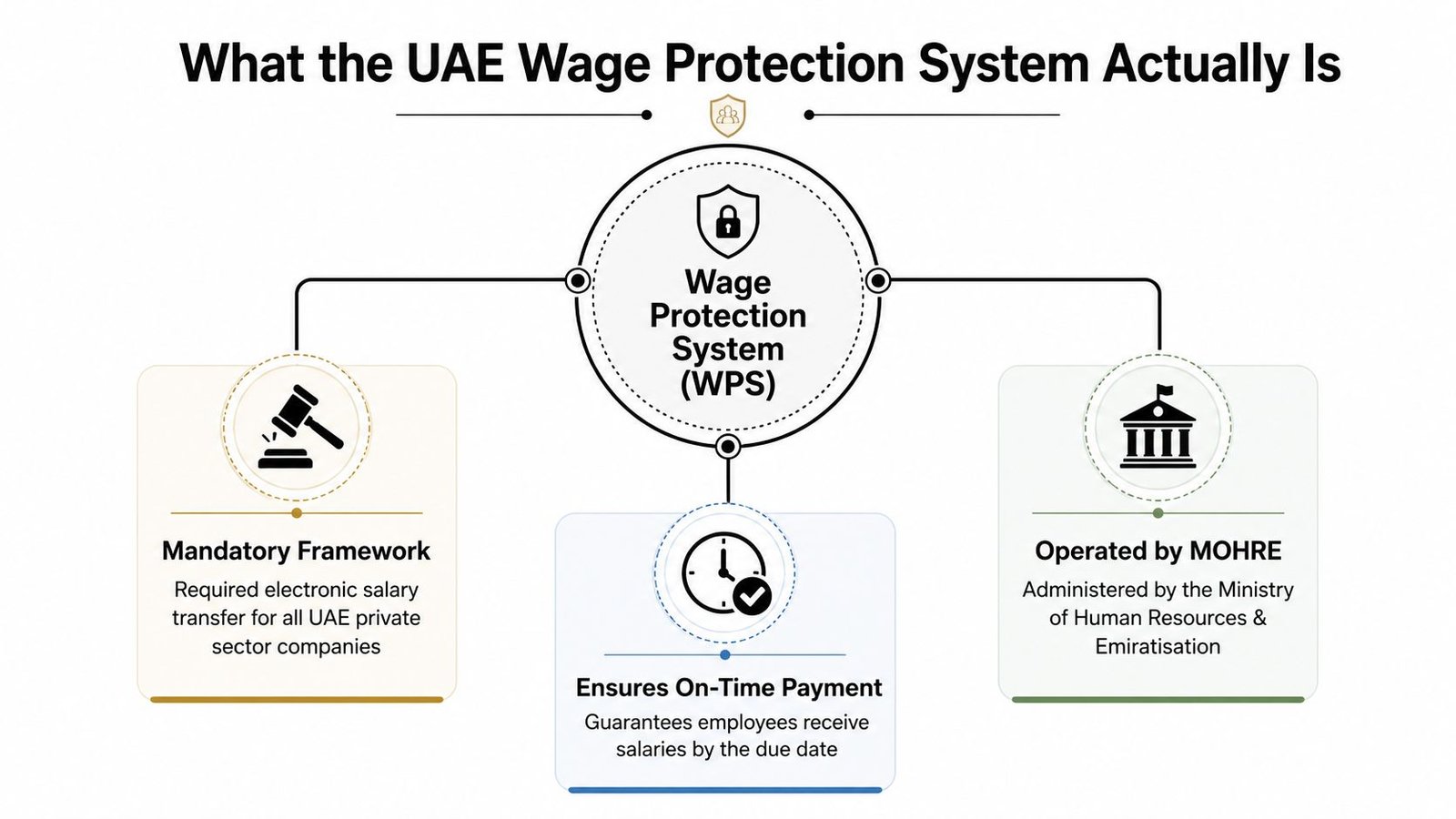
The UAE Wage Protection System is a mandatory electronic salary transfer framework that records private-sector wage payments through approved financial channels. It is overseen by MOHRE, the Ministry of Human Resources and Emiratisation, together with the Central Bank of the UAE, so payroll is not just an internal accounting task, it sits inside a government-monitored payment process (MOHRE WPS guidance).
For a first-time founder, the easiest way to understand WPS is to separate payroll calculation from payroll submission. Your accounting team or payroll provider can calculate salaries, allowances, and deductions, but WPS is the channel that checks whether those wages were sent through approved banks, financial institutions, and exchange houses in the format MOHRE expects. If the employee list, the bank details, or the file structure do not match the official record, the payment can fail the compliance check even when the company has enough cash to pay everyone.
That is why WPS appears so early in a UAE setup checklist. A salary can be due, funded, and still be treated as incomplete from a compliance point of view if the payment trail is wrong. The system checks whether the salary was paid in the right amount, through the right channel, and on the right schedule.
Why the UAE built WPS in the first place
Independent payroll guidance says WPS was launched in the UAE in 2009 by MOHRE and the Central Bank of the UAE (Zoho Payroll Academy). The point was to make salary payment traceable, so workers have a clearer record of what was paid, and regulators can see whether employers are meeting their obligations.
The logic is straightforward. A monitored wage channel reduces the chance that payroll is handled like an informal side task, and it gives the authorities a clearer view of payment status across the private sector. For a founder, the safest way to frame WPS is simple. It is part of the operating requirements for employing people in the UAE, not an optional payment preference.
Practical rule: if your company is hiring in the UAE, WPS is a compliance requirement that affects payroll, visas, and labour records.
Which Employers and Employees WPS Covers
A founder opening a company in the UAE often asks a simple question first. Do we need WPS for everyone, or only for some workers? The practical answer is that private-sector employers in the UAE are generally in scope, especially businesses registered with MOHRE and holding the right labour records. That includes many mainland companies in cities such as Dubai, Abu Dhabi, and Sharjah, plus a large share of free zone establishments that follow MOHRE labour rules.
Where founders often get confused
The confusion usually starts with assuming every business structure follows the same payroll rules. That is not how the system works. Some workers sit inside the standard WPS setup, while others fall into categories that need a separate check before payroll is filed.
The ILO and GCC regional analysis points out gaps in understanding around who is covered, especially for domestic workers and other vulnerable categories, and it notes the need to improve enforcement where violations happen (Fair Recruitment Hub regional analysis). That matters because many payroll explainers stop at “WPS is mandatory for private-sector employers” and never deal with the edge cases that create rejected files or compliance questions.
A founder should ask four questions before treating WPS as a simple yes-or-no issue:
- Entity type: Is the company under MOHRE labour rules, or under a separate payroll monitoring model?
- Worker category: Are these standard employees, domestic workers, drivers, or another special category?
- Location: Is the business in mainland UAE, or in a free zone with its own framework?
- Payment channel: Is salary being paid through an approved WPS channel, or through a structure that needs separate approval?
A free zone company cannot copy another company's payroll setup and assume it fits. The jurisdiction, labour record, and payment route all matter.
Why the edge cases matter so much
The main compliance risk is usually not the obvious employee on a standard contract. It is the worker who sits just outside the usual template. Some free zones run their own payroll monitoring, and some employment structures need a separate compliance check before the first salary file goes out.
For founders, the safer move is to confirm scope before hiring. That conversation is usually faster than fixing a payroll rejection later, especially if you are building in a free zone, hiring household staff, or changing the setup for a relocated team member. The question is not only “Do we have employees?” It is “Which employees, under which authority, paid through which channel?”
How the Employer Registration Workflow Works
WPS setup starts with the employer, not with the salary file. A new company first needs the right records aligned, then the payroll channel can be activated, and only after that does the monthly submission become routine.
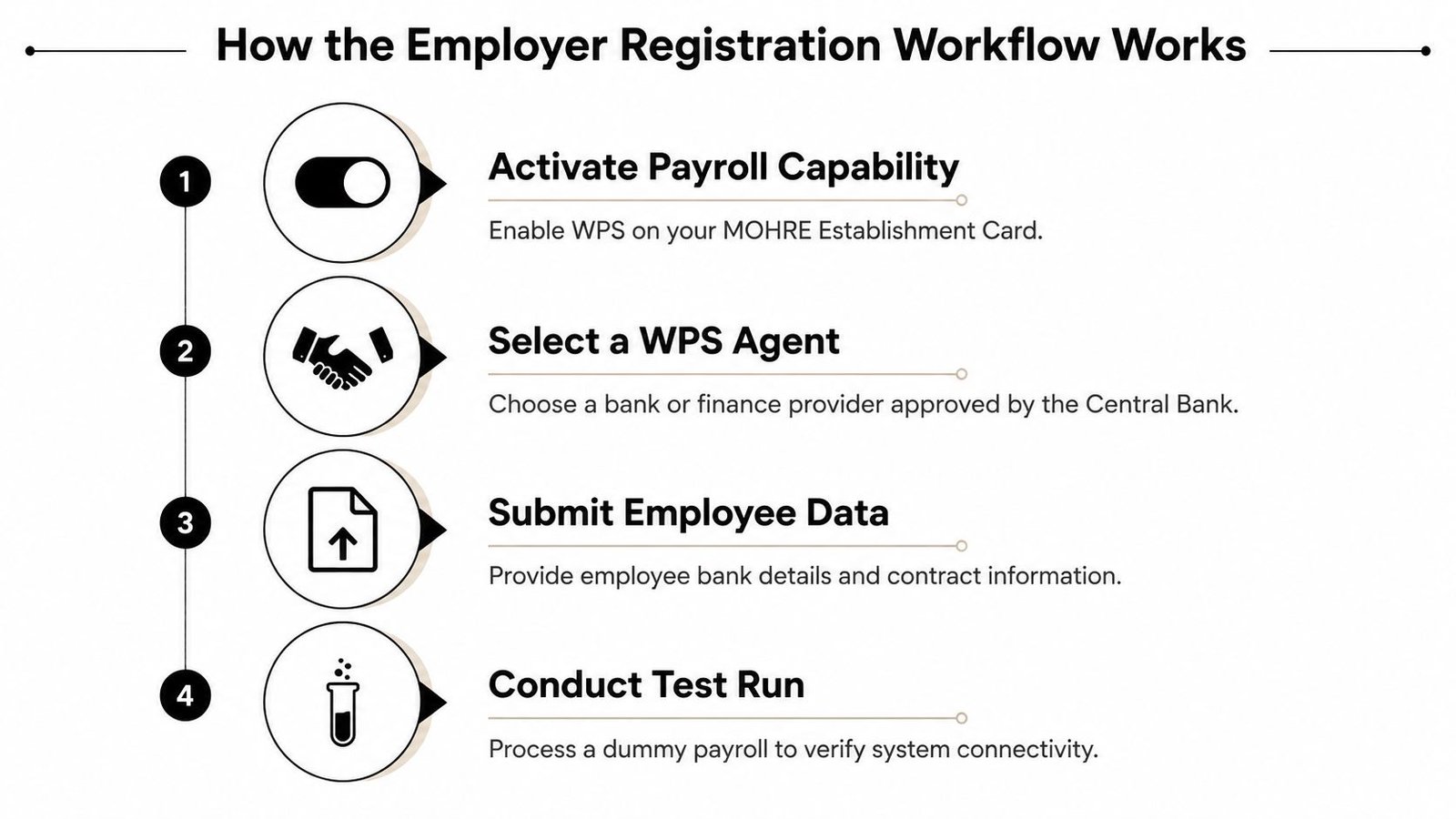
The sequence most new employers follow
The first step is to make sure payroll capability is active on the MOHRE establishment card. After that, the company chooses an approved WPS agent, usually a bank or financial provider recognised in the UAE payroll chain, and then prepares the employee data needed for the first submission.
The useful mental model is this, WPS registration is not a one-form event. It is a sequence of linked records, and the company's trade licence, establishment details, labour card, and authorised signatory list all have to be consistent. If the signatory or company details are off, the file can bounce before payroll even starts.
What usually delays the first payroll run
The first month is where founders feel the friction. A bank may ask for employee data in a clean format, and MOHRE records may need to match the company's internal payroll list before the salary file is accepted. A salary-dedicated account may also be needed depending on the provider and the setup.
A clean launch usually means getting these items ready before speaking to the bank or PRO:
- Trade licence and establishment data, because the employer identity must be consistent.
- Authorised signatory documents, because the payroll channel needs a valid person on file.
- Employee bank details, because mismatched routing data can trigger rejection.
- Labour and identity records, because the payroll file is checked against official records.
If the company's internal spreadsheet and MOHRE records disagree, the system will usually side with the official record.
For a first-time founder, the setup is easier when the business treats it like onboarding infrastructure. That means collecting documents early, checking spellings carefully, and avoiding last-minute changes to bank details after the file is prepared.
What a Monthly WPS Payroll File Must Contain
A WPS file is really a data file, and the system is only as clean as the details inside it. If a single field is wrong, the payment can look incomplete in the compliance report even when the money left the account.
The fields that matter
The file should carry the employee's ID, labour card number, UID, bank routing details, salary amount, and payment date. Those details are checked against MOHRE records, which is why payroll compliance is as much about data quality as it is about moving funds.
| Key Fields in a UAE WPS Payroll File | Purpose | Common Error |
|---|---|---|
| Employee ID | Links the worker to the company payroll record | Wrong internal number or duplicate entry |
| Labour card number | Matches the employee to labour records | Old card number or transposed digit |
| UID | Connects the worker to identity records | Missing or inconsistent UID |
| Bank routing details | Sends the salary to the correct account | Incorrect IBAN or bank code |
| Salary amount | Shows the wage to be paid | Wrong pay amount or missing allowance |
| Payment date | Shows when the wage was sent | Date outside the payroll cycle |
A rejected row often looks ordinary at first glance. For example, the payroll team may enter the correct salary amount but one bank digit is off, and the file then fails the audit check because the system can't tie the payment to the employee record. The employee may still be unpaid in the MOHRE statement until the mismatch is corrected.
A simple example of clean versus dirty data
A clean row says the worker's name, bank details, and salary line all match the establishment record. A dirty row can be just one typo away from a flag, even if the transfer itself was attempted. That is why HR teams in the UAE often build a pre-submit check into payroll day.
The habit that saves the most time is reconciliation before submission. Compare the salary file with the establishment card, employee bank records, and contract details before you send anything to the WPS agent. That small step prevents the kind of mismatch that turns a normal payroll run into a support call with the bank and a follow-up with MOHRE.
Common Pitfalls and MOHRE Penalties
A small Dubai marketing agency once paid salaries on time but entered the wrong routing code for several staff members. The transfer left the bank, but the MOHRE statement still showed the workers as unpaid or underpaid, because the system checks the payroll chain, not just the intention to pay.
That kind of problem is painful because it looks like a banking error at first and a compliance problem a day later. The employer believes the salaries are done, while the regulatory report says the opposite.
What happens after repeated WPS violations
Repeated failures can lead to blocked new work permits, limits on labour card renewals, fines, and in serious cases problems issuing or renewing employee visas. Those consequences are why WPS is treated as a make-or-break HR process in many UAE companies.
The damage is not only internal. A company's wage compliance status can show up in ways that matter to banks, free zones, and prospective clients, because payroll behaviour is part of the wider compliance picture. If your records look messy, it can slow other business processes that depend on a clean employer profile.

Why a “paid” transfer can still fail compliance
This is the part that confuses many first-time founders. A bank transfer on its own doesn't automatically mean WPS success. The payment has to match the employment contract data, the registered company details, and the authorised wage route expected by MOHRE and the approved intermediaries.
If the wrong employee record is attached, or the file is sent too late, the company can still face a flag even after money has moved. That is why payroll in the UAE needs both finance discipline and HR discipline, not one or the other.
Best Practices and the Inpro Approach to WPS
A clean WPS process usually starts with a short checklist that gets repeated every month. The best companies do not wait for a flag, they build controls into the payroll cycle before wages are due.
The monthly habits that reduce risk
Reconcile payroll against the establishment card before each run. Standardise employee bank details so IBANs, bank names, and salary components stay consistent. Submit the file a few days before the due date so there is room to fix a rejected row, and keep digital proof of payment and approval receipts organised for later checks.
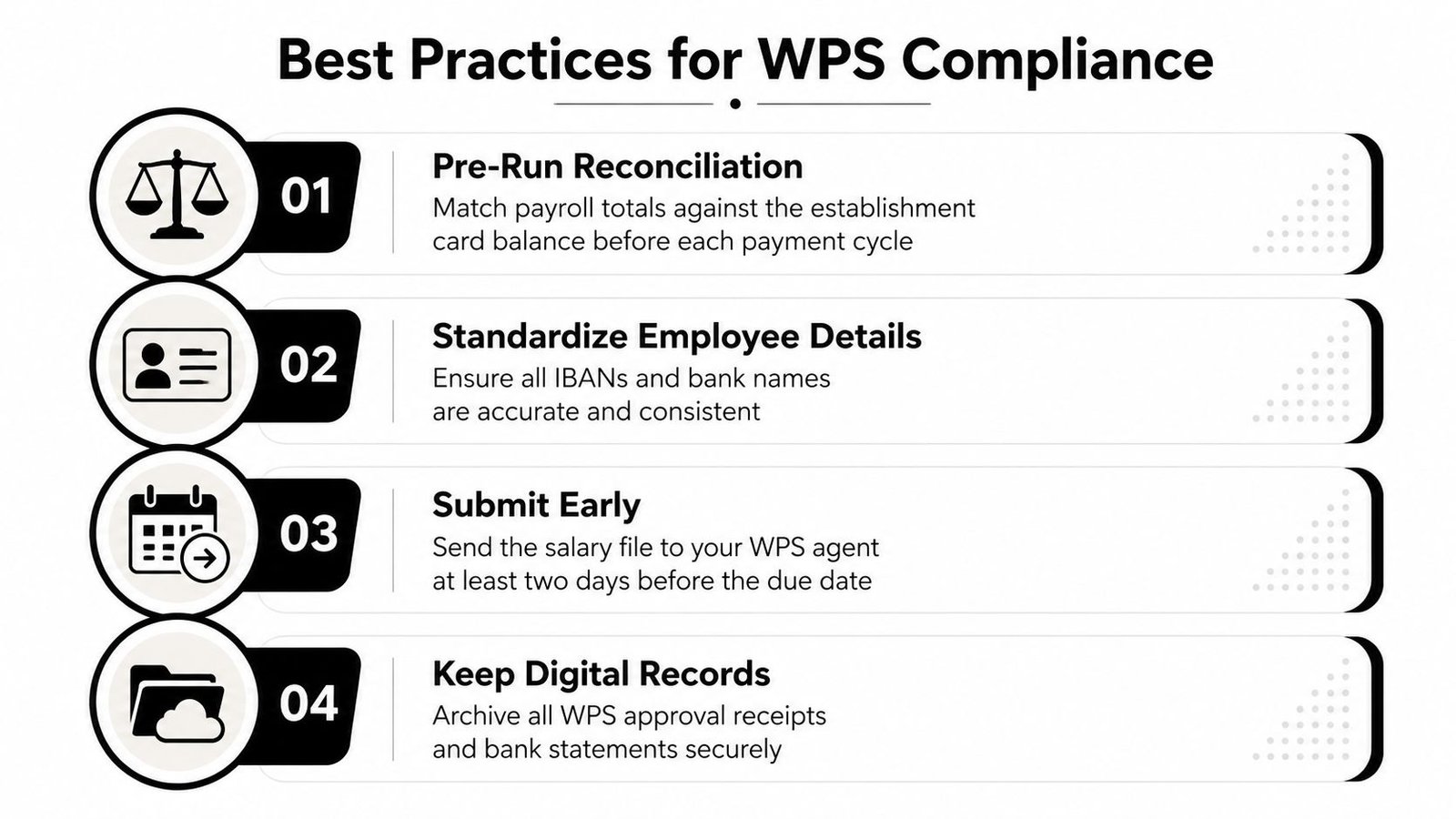
A practical archive should hold the salary file, bank confirmation, and the MOHRE-related confirmation trail for later retrieval. If a regulator, bank, or internal auditor asks for proof, the team should be able to find it without reassembling a month's work from scratch.
Choosing the right way to run payroll
For a small team, an in-house payroll clerk with approved software may be enough, as long as that person understands WPS rules and record matching. A mid-sized business may prefer an all-in-one HR platform that keeps employee data, payroll, and leave records in one place.
Some founders choose a PRO and corporate-services partner to own the workflow end to end, especially when the business is opening in the UAE for the first time or juggling visas, licensing, and payroll together. That setup can suit companies that want one accountable team handling government-facing steps rather than splitting them across finance, HR, and external vendors.
Good payroll practice is boring on purpose. The less drama there is on salary day, the better your records usually are.
The choice comes down to team size, how often records change, and how much admin your team can handle without mistakes. A two-person startup with one founder on operations has a different tolerance for complexity than a growing company in Dubai or Abu Dhabi with multiple visa categories and employee types.
Questions Founders Ask About WPS
Does WPS apply in every free zone
Free zones do not all follow the same payroll process. Many of them use MOHRE labour rules, while others keep their own payroll monitoring setup, so the employer has to check the zone's rules before assuming the mainland model applies.
What about domestic workers or drivers
The answer depends on the worker category and the contract structure. Some roles sit in a grey area, especially household staff and drivers, so founders should confirm the exact rule before adding that person to a payroll process.
What happens if an employee changes visa status
The payroll record should be updated as soon as the status changes, so the salary file still matches the employee's current records. If the visa, labour card, or employment record changes, payroll should be checked before the next submission rather than after a rejection.
How hard is it to switch banks or payroll providers
It can be simple if the employee data, company records, and new payment route are all ready before the handover. It gets messy when the switch happens in the middle of a pay cycle, because old routing details and new routing details can overlap and cause a file mismatch.
A clean switch works best as a controlled payroll update, not as a casual admin change. That keeps one clear record set in place instead of two partial ones that are hard to reconcile later.
A Short Recap and Your Next Step
WPS is mandatory for UAE private-sector payroll. It runs through MOHRE-approved channels, the monthly file has to match labour and identity records, and sloppy payroll data can block visas or trigger compliance flags.
If you only remember five points, make them these. WPS is an electronic salary transfer system. It uses approved banks and financial intermediaries. Payroll files go in monthly. The data has to match official records. Payment mistakes can create business problems beyond payroll.
For a founder, that means WPS should sit beside licensing and visa work from day one, not after hiring starts. If you're setting up in the UAE or expanding into the United Arab Emirates, the next sensible move is to map your company formation, payroll, and immigration steps together so nothing clashes at month end.
A CTA for Inpro Corporate Services L.L.C..