


A Dubai LLC is a mainland company form governed by the UAE Commercial Companies Law, and most commercial and industrial activities now allow 100% foreign ownership following the 2021 reform. It's usually the right structure when you need to sell directly across the United Arab Emirates, employ staff in Dubai, or work with government and local commercial customers.
You may be comparing a Dubai mainland licence with a free zone package, asking whether you still need a UAE national partner, or trying to work out why the advertised licence price doesn't match the actual setup budget. The answer starts with your business activity, not just the word “Dubai”. The activity code determines ownership permissions, approvals, office requirements, and the authorities involved.
Table of Contents
- What an LLC in Dubai Is
- How the 2021 Reform Changed Foreign Ownership
- Dubai LLC Compared to Free Zone and Offshore Companies
- How to Form a Dubai LLC Step by Step
- What a Dubai LLC Really Costs in 2026
- Running a Dubai LLC Visas Banking and Tax
- Pros and Cons of Choosing a Dubai LLC
- Is a Dubai LLC Right for You and What to Do Next
What an LLC in Dubai Is
A founder signing a Dubai contract, hiring local staff, or invoicing customers across the UAE needs to understand what the company structure can do. An LLC in Dubai is a separate mainland legal entity registered with Dubai's Department of Economy and Tourism, or DET. It operates under Federal Decree-Law No. 32 of 2021, the UAE Commercial Companies Law. The company can enter contracts, hold assets, issue invoices, and take on obligations in its own name. Shareholders are generally liable only up to the value of their shares, so personal assets remain separate from company liabilities, subject to the usual legal exceptions. The UAE Commercial Companies Law provides the legal framework.
A Dubai LLC is a mainland corporate form, separate from a free zone company and an offshore entity. The law allows a mainland LLC to have between 1 and 50 shareholders, with capital divided into shares.
The old model often linked to LLC formation required a UAE national to hold 51% of the shares or serve as a local sponsor. That is no longer the default for eligible commercial and industrial activities. Many activities can now be owned 100% by foreign investors, while strategically sensitive activities may still require restrictions, approvals, or a different licensing route. The ownership question follows the selected activity, not the company label alone.
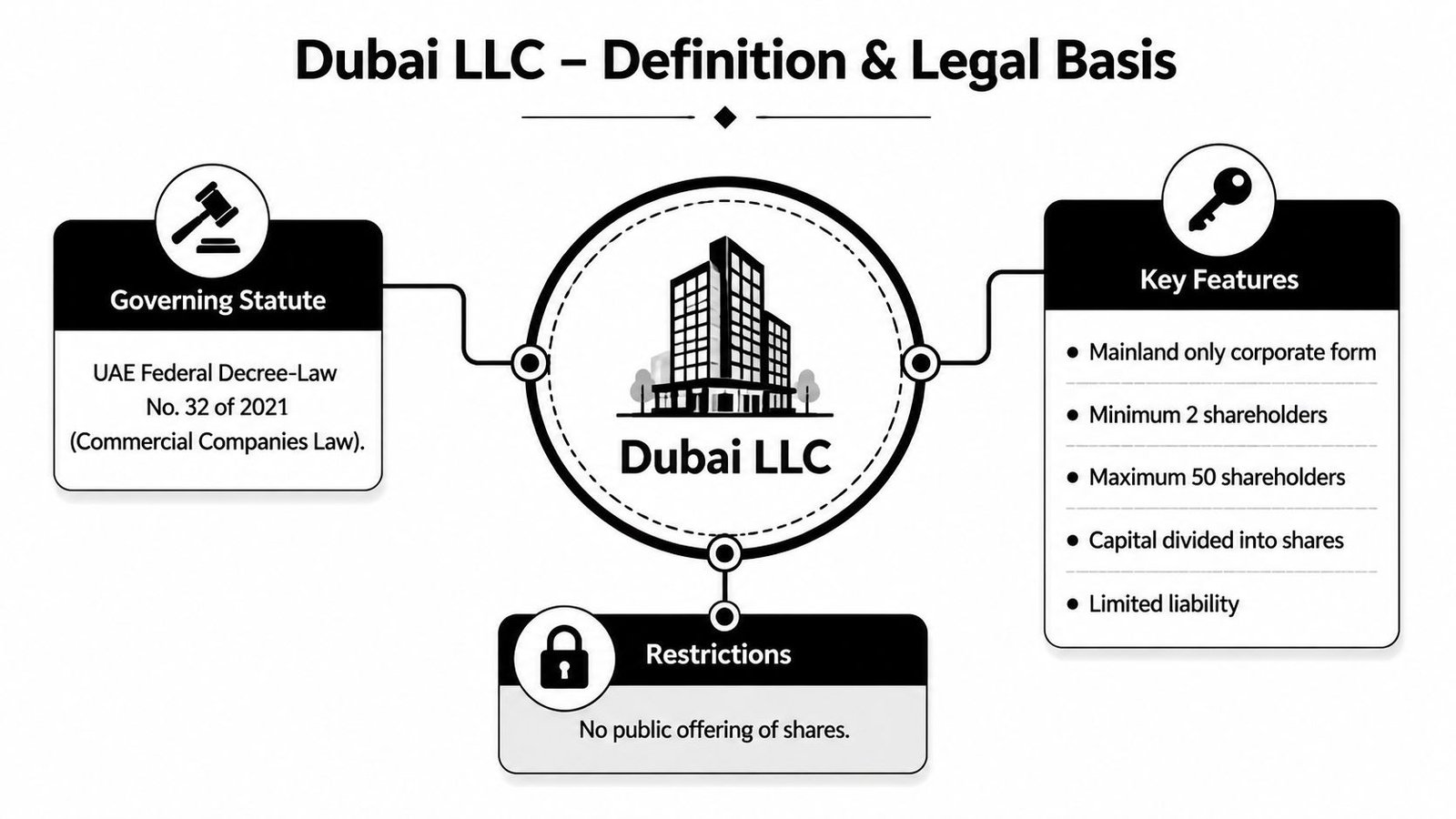
How is a Dubai LLC different from other company forms?
A sole establishment belongs to one individual and does not provide the same corporate separation as an LLC. A civil company generally serves professional activities and follows a different ownership and licensing route. A branch office extends an existing parent company into Dubai, rather than creating a new standalone company with its own shareholders.
The practical value of an LLC is market access. A mainland company can operate in the UAE under its Dubai licence and contract with customers across the country, subject to its approved activity. For a business requiring premises, employees, local contracts, or government work, an LLC is often the clearest default. Confirm the activity first, then choose the jurisdiction and legal form.
How the 2021 Reform Changed Foreign Ownership
Before the reform, a foreign founder visiting a Dubai licensing centre would often be told that a UAE national needed to hold 51% of a mainland LLC. In some arrangements, the local participant acted mainly as a sponsor or agent while the foreign founder ran the business. That legacy model is why many online guides still give a simple 51/49 answer.
The legal position changed with Federal Decree-Law No. 32 of 2021, which came into force on 2 January 2022. Dubai's economic authorities had already opened more than 1,000 commercial and industrial activities to full foreign ownership in June 2021, without an extra capital requirement or additional fees, according to this account of the Dubai mainland reform. The reform moved the question from nationality to activity.
What does the negative list mean?
The UAE uses a restricted or negative-list approach. Most ordinary commercial and industrial activities are open to foreign ownership, but strategic areas can still require Emirati participation, federal approval, or a different regulatory route. Activities connected with sensitive national interests, including areas such as oil, banking, insurance, telecommunications, and defence, should never be treated as ordinary DET licensing matters without checking the applicable regulator.
At a Dubai Department of Economy and Tourism service centre, that means the officer first looks at the proposed activity code. If the activity is eligible, the foreign shareholder can generally own the LLC without a local shareholder. If it falls within a restricted area, the founder may need special approval or a different structure. The legal guide on foreign company ownership in the UAE explains why the activity code and regulatory clearance matter more than a broad statement about Dubai.
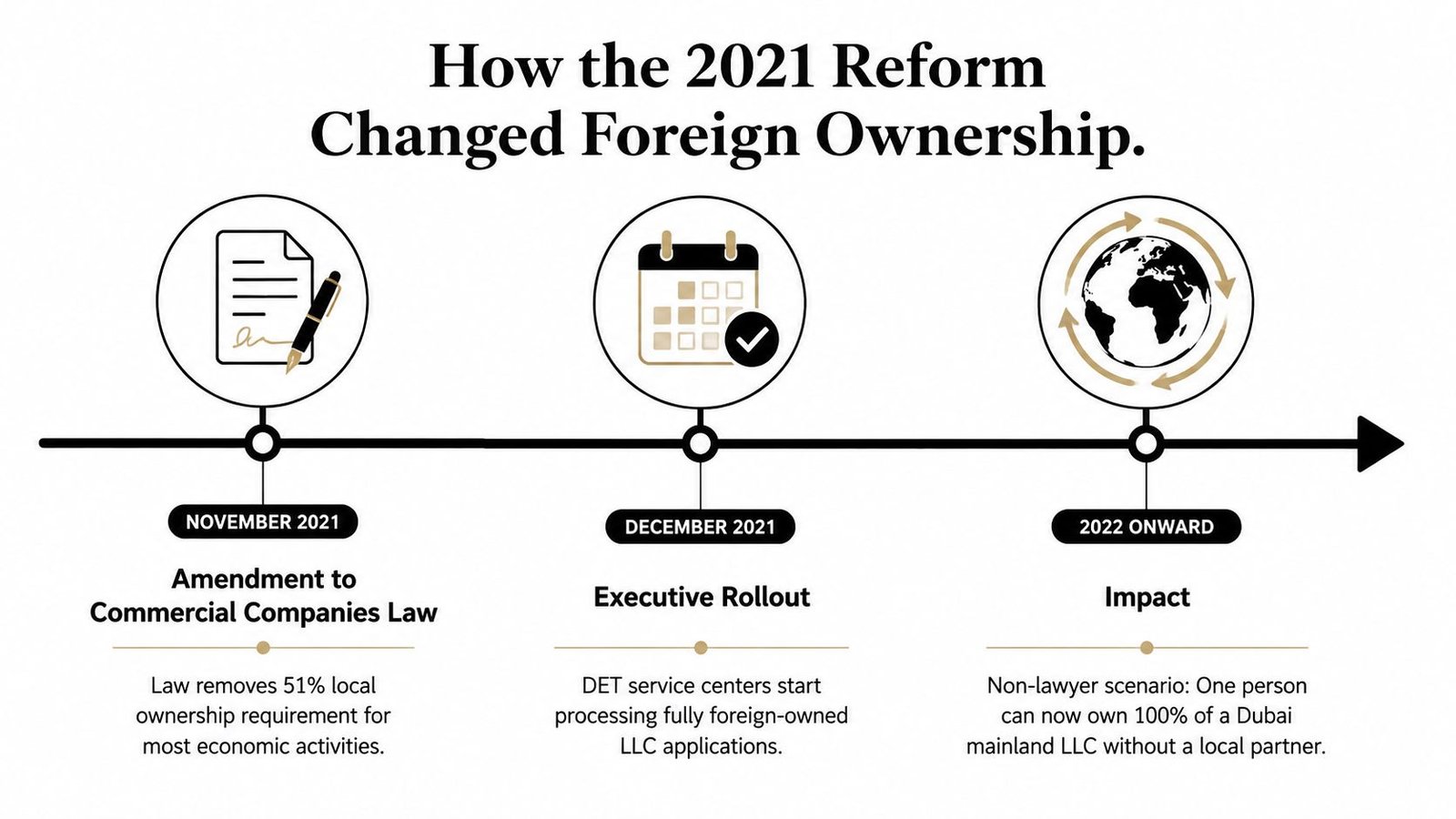
The on-the-ground result is simpler ownership documentation for eligible activities. Founders don't automatically need a local sponsor signature on the Memorandum of Association, and the shareholders can negotiate their internal profit-sharing and management arrangements within the legal framework. That doesn't remove the need for accurate licensing, regulated approvals, or a properly drafted constitutional document.
Practical rule: Don't ask only whether Dubai allows 100% foreign ownership. Ask whether your exact activity code allows it.
Dubai LLC Compared to Free Zone and Offshore Companies
The most expensive mistake is choosing a jurisdiction from a brochure instead of from the way the business will operate. A mainland LLC, a free zone company, and an offshore entity can all suit foreign founders, but they solve different problems.
A free zone company is licensed by a specific free zone authority, such as a technology, media, financial, or logistics zone. It can offer full foreign ownership and a defined regulatory environment, but its ability to sell directly into the mainland may depend on the activity, distribution model, approvals, and appointed local arrangements. An offshore company, such as an entity associated with JAFZA or RAK ICC, is normally used for holding assets or international contracting, not for running a staffed retail, consultancy, or operating business in Dubai.
| Feature | Mainland LLC | Free Zone Company | Offshore Company |
|---|---|---|---|
| Ownership | Most commercial and industrial activities allow 100% foreign ownership, subject to the activity and restrictions | Generally designed for foreign ownership within the relevant free zone rules | Foreign ownership is generally available under the chosen offshore framework |
| Market access | Suitable for direct mainland trading and local contracts, subject to licensing | Access depends on the free zone activity, mainland rules, and any required approvals | Not designed for ordinary local operating activity |
| Office | A mainland trade licence normally requires a registered office arrangement, including an Ejari-registered address where applicable | Office options depend on the zone and package | Physical office needs depend on the offshore jurisdiction and purpose |
| Visas | Visa capacity is linked to the establishment and office arrangements | Visa capacity is linked to the free zone package and workspace | Usually unsuitable for a normal employee visa operation |
| Tax | Federal corporate tax applies under the UAE regime | Qualifying free zone income may receive a 0% incentive, while other income can be subject to the federal regime | Tax treatment depends on substance, income, and applicable UAE rules |
| Customs and local sales | Better suited to goods entering and moving through the mainland market | Often efficient for zone-based logistics, re-export, or specialised activities | Not intended for ordinary mainland sales |
| Banking | Banks assess the licence, activity, office, owners, expected transactions, and source of funds | Banks apply similar checks, with added focus on the free zone activity | Offshore structures can face greater explanation requirements |
| Best fit | Local services, trading, government work, and a physical UAE operation | Specialised activities, regional operations, and founders prioritising a zone framework | Asset holding and international contracting |
The tax distinction needs careful handling. A free zone label doesn't automatically make all income tax-free, and a mainland LLC doesn't avoid corporate tax because it is small or foreign-owned. Choose a mainland LLC if you need to trade freely inside Dubai, work with UAE customers directly, or pursue government contracts. Choose a free zone if the activity fits its rules and you don't need unrestricted mainland operations. Choose offshore only when the company is for holding assets or international contracting.
How to Form a Dubai LLC Step by Step
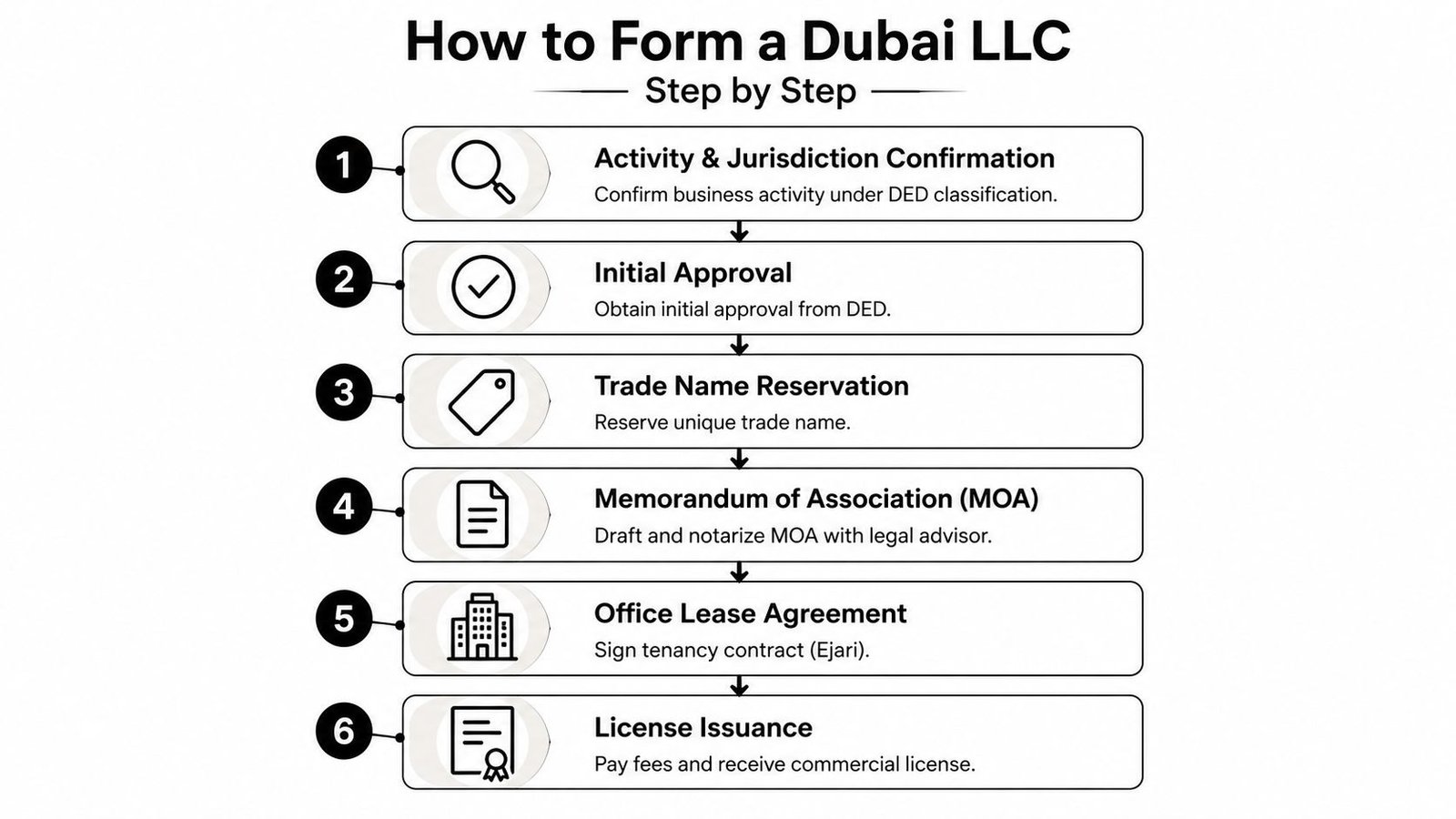
Formation works best when you treat it as an order of government touchpoints, not as one application. The first decision is the business activity, because DET classification determines the licence type, ownership position, and any outside approvals.
What happens before the licence is issued?
Confirm the activity and jurisdiction. Check the Department of Economy and Tourism activity classification and decide whether the business belongs on the mainland. A consultancy, trading operation, retail business, or physical service provider may need a different activity combination from the one used in its marketing description.
Obtain initial approval. DET reviews the proposed activity and shareholder details. Depending on the activity, other authorities may need to provide clearance.
Reserve the trade name. Choose a name that complies with UAE naming rules and reserve it through Dubai DET. Don't sign a long-term lease or print commercial documents before the name and activity position are clear.
Prepare the Memorandum of Association. The MOA records the shareholders, ownership, management arrangements, and company terms. Use a registered Dubai lawyer or qualified formation adviser for drafting and notarisation, particularly where there are several shareholders or different classes of commercial involvement.
What completes the mainland setup?
Register the office lease through Ejari. Ejari is Dubai's system for registering tenancy contracts. A mainland operating licence needs an acceptable physical office arrangement, which may be a flexi-desk or another permitted workspace depending on the activity.
Issue the licence. Submit the approved documents, lease registration, and required payments to receive the commercial licence. After that, open the immigration file, obtain the establishment card, and apply for labour or visa quota where relevant.
The normal sequence after the Ejari arrangement is ready can often be completed within 5 to 10 working days, according to the formation guidance supplied for this process. Documents commonly requested include passport copies, the UAE entry stamp where relevant, address proof, and a no-objection certificate for GCC residents where applicable. Visa applicants then complete the medical and Emirates identity procedures before visa stamping.
Practical rule: Keep the activity approval, trade name, MOA, office registration, immigration file, and visa process aligned. A mismatch between these records creates avoidable delays.
What a Dubai LLC Really Costs in 2026
The licence fee is only one part of the budget. A founder who compares a headline setup price with the actual cost of an operating Dubai company will usually find that the office, visas, accounting, and annual compliance create the larger financial commitment.
Independent 2026 guides place some mainland LLC summaries at roughly AED 2,500 to AED 8,500, while broader estimates put first-year real-world costs around AED 40,000 to AED 55,000, or in some cases AED 25,000 to AED 70,000, once office space, visas, and compliance are included. These ranges come from the 2026 Dubai LLC cost analysis, and they aren't contradictory. They describe different scopes.
| Cost Item | Setup (AED) | Annual (AED) |
|---|---|---|
| Trade name and initial government processing | Varies by application and activity | Renewal varies |
| MOA drafting and notarisation | Varies by shareholder structure | Usually not a recurring formation item |
| Office and Ejari | Starting near AED 5,000, depending on arrangement | Depends on premises, location, and renewal terms |
| Mainland commercial licence | From about AED 10,000 for some trading activities, with regulated activities reaching AED 25,000 or more | Renewal depends on the activity |
| Investor or employee visa | About AED 4,000 to AED 7,000 per person | Renewal and related immigration costs apply |
| Bookkeeping | Setup depends on records and opening work | From about AED 1,500 per month |
| PRO and compliance support | Varies | Depends on the service scope |
| Corporate tax work | Depends on registration and records | Filing and advisory cost depends on the entity |
A lean single-shareholder LLC may realistically require around AED 25,000 to AED 30,000 to stand up and AED 15,000 to AED 25,000 each year to keep running, based on the same 2026 cost guide. Treat that as a planning range, not a quotation. Regulated activities, larger offices, several visas, document attestation, and complex bookkeeping can move the total higher.
Running a Dubai LLC Visas Banking and Tax
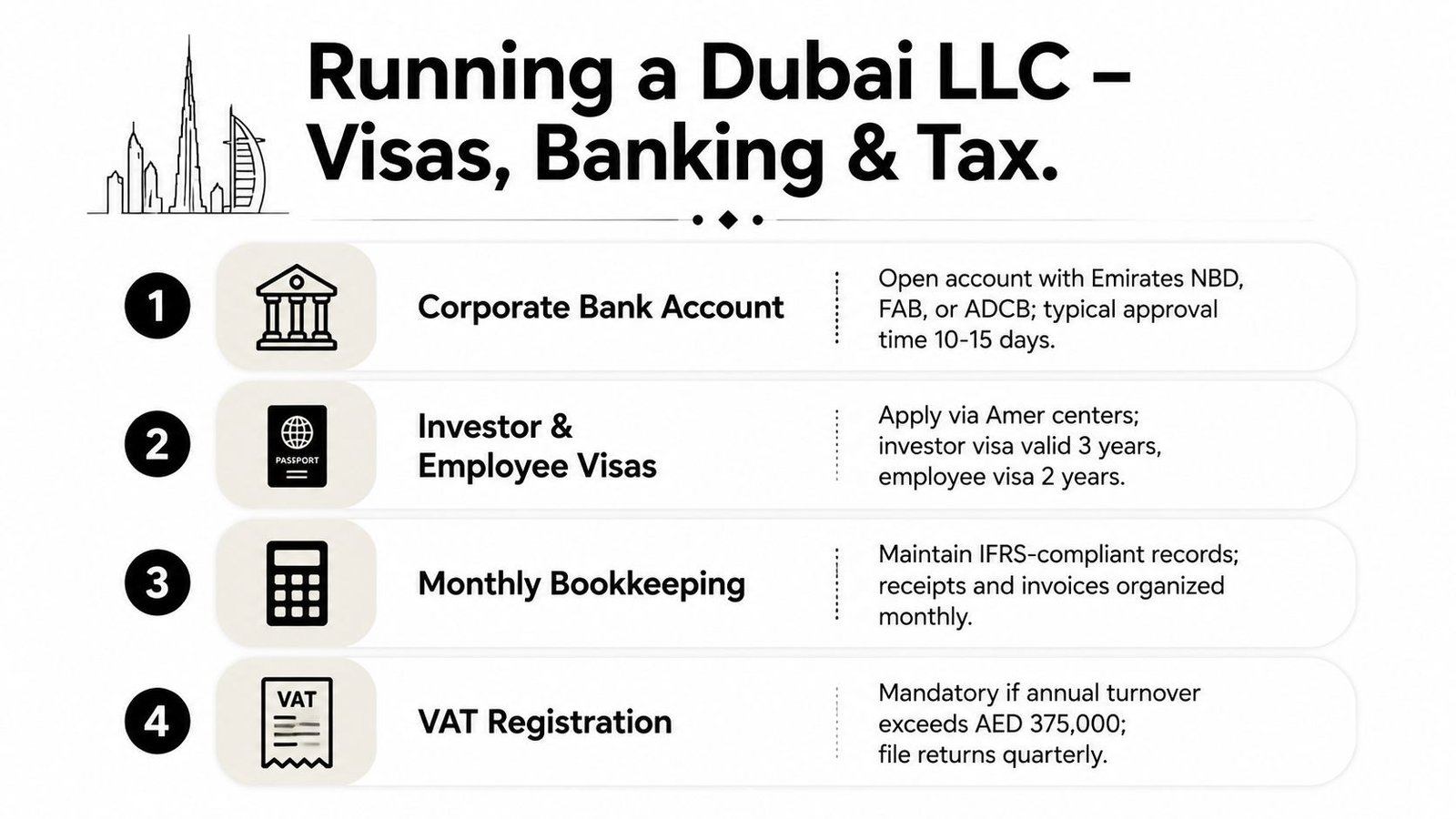
Once the licence is issued, the company carries ongoing operating duties. Corporate banking comes first. Emirates NBD, Mashreq, ADCB, and other UAE banks review the licensed activity, shareholder profile, office evidence, expected transactions, source of funds, and customer geography. A trade licence alone will not secure approval.
Prepare a clear business description, ownership documents, and available contracts or invoices. Explain how money will enter and leave the account. KYC, or know-your-customer, checks take longer when the business model, shareholders, residence history, or transaction flows are unclear.
The establishment card links the company to immigration and affects its ability to process investor and employee visas. A PRO, meaning a public relations officer who handles government submissions, can coordinate immigration applications, labour records, document attestations, and renewals. Keep Golden Visa applications separate from the ordinary company visa process because eligibility and supporting evidence follow different rules.
Monthly bookkeeping is part of running the company, not optional housekeeping. Keep invoices, receipts, bank records, payroll information, and related-party transactions in an organised accounting system. The company must retain accounting records for at least 5 years. UAE corporate tax applies at 0% on taxable income up to AED 375,000 and 9% above that threshold, as explained in this UAE LLC compliance guide.
When do VAT and corporate tax enter the picture?
VAT registration becomes mandatory when taxable turnover reaches AED 375,000, while voluntary registration is available below that level under applicable UAE rules. Corporate tax registration and filing sit with the Federal Tax Authority, or FTA. Related-party dealings may require transfer pricing records, and certain licensed activities may raise Economic Substance Regulations questions.
Set up accounting support, a registered agent or compliance adviser where needed, and a dependable PRO contact from the beginning. Accurate records make bank reviews, tax filings, employee administration, and future investor discussions easier to handle.
Pros and Cons of Choosing a Dubai LLC
A Dubai LLC is powerful because it is built for an actual UAE operating business. It isn't automatically the cheapest structure, and it shouldn't be sold to every founder as one.
What are the strongest advantages?
- Direct local market activity: A mainland LLC is suited to selling services or goods to UAE customers under a Dubai licence, subject to the activity rules.
- Government and semi-government work: Many public-sector procurement processes expect a locally licensed operating entity. The exact tender conditions still need checking.
- Flexible physical presence: You can choose an office location in Dubai outside a particular free zone and build the operation around your customers and staff.
- Clear corporate separation: The LLC can contract, invoice, own assets, and incur obligations independently of its shareholders.
- Room for several owners: The structure supports a broad shareholder range, which helps when founders, investors, or operating partners share ownership.
The ownership reform is a major advantage for eligible activities, but it isn't the whole decision. The licence still needs to match the business, and regulated work can require permissions beyond DET.
What are the drawbacks?
The baseline cost is often higher than a lean free zone package because mainland operations involve office registration, immigration administration, and wider compliance obligations. A physical or flexi office arrangement is part of the mainland operating model, so a founder who only needs a legal address may find the structure oversized.
Tax also needs proper planning. A mainland LLC doesn't receive the free zone treatment that may apply to qualifying free zone income, and its taxable profit must be assessed under the federal corporate tax rules. The company may also need to manage Ultimate Beneficial Owner information, Economic Substance Regulations where relevant, bookkeeping, tax registration, and financial reporting.
My view: Choose a Dubai LLC when local customers, government contracts, staff, or a physical UAE operation matter. Choose a free zone for a contained activity with a suitable zone licence. Choose offshore for holding or international contracting, not as a substitute for a local operating company.
Is a Dubai LLC Right for You and What to Do Next
Use four questions to make the decision quickly.
Does your activity need a mainland licence?
If the activity requires unrestricted local trading, a Dubai office, local fieldwork, or direct contracting across the UAE, a mainland LLC is the first structure to test. If the business can operate within a free zone activity framework and mainly serves overseas or regional clients, compare a free zone company before committing to mainland overhead.
Will you sell directly to UAE customers?
Direct UAE sales point towards mainland, especially where customers expect a local licence, local invoices, or a physical service presence. E-commerce and professional services need a closer activity review because the correct answer depends on the actual fulfilment and contracting model.
Do you need government contracts?
If public-sector or semi-government work is part of the plan, a mainland LLC is often the more practical starting point. Tender rules differ, so confirm the buyer's registration requirements before incorporating.
Will you employ people in Dubai?
If you need employee visas, office-based staff, or a continuing immigration file, mainland can provide the operating container you need. If you have no local staff and only require asset holding or international contracting, offshore may be more suitable.
Your immediate actions are straightforward:
- Confirm the exact activity on the Dubai Department of Economy and Tourism list.
- Check whether the activity is open to full foreign ownership or needs another approval.
- Reserve a compliant trade name.
- Shortlist an office or permitted flexi-desk arrangement.
- Prepare passport copies, address evidence, entry documents, and any required no-objection certificate.
- Prepare a banking file that explains your customers, services, expected transactions, and source of funds.
If you want a done-for-you assessment, Inpro Corporate Services L.L.C. can model the jurisdiction, formation steps, immigration requirements, and 2026 budget before you sign a commitment.
Inpro Corporate Services L.L.C. helps founders compare Dubai mainland, free zone, and offshore structures, then manages licensing, PRO work, visas, banking support, accounting, tax, and VAT workflows. Visit Inpro Corporate Services L.L.C. to discuss your activity and receive a practical setup path based on how you plan to operate in the UAE.