

A UAE trade licence is the legal authorisation to operate a business in a specific jurisdiction, tied to its approved activity, legal form, and operating location. Without the right licence, a company can't lawfully trade, open a corporate bank account, or sponsor visas.
You may be choosing between Dubai, Abu Dhabi, Sharjah, or a free zone while also trying to understand which activity describes your business. The terminology can feel harder than the decision itself, but the licence is easier to understand when you treat it as the operating system of a UAE business. It connects what the company does, where it operates, who owns it, and which government authority supervises it.
Table of Contents
- What a UAE Trade License Actually Is
- The Six Official License Types Explained
- Mainland Free Zone and Offshore Compared
- How Permitted Activities Shape Your License
- Documents and Application Process Step by Step
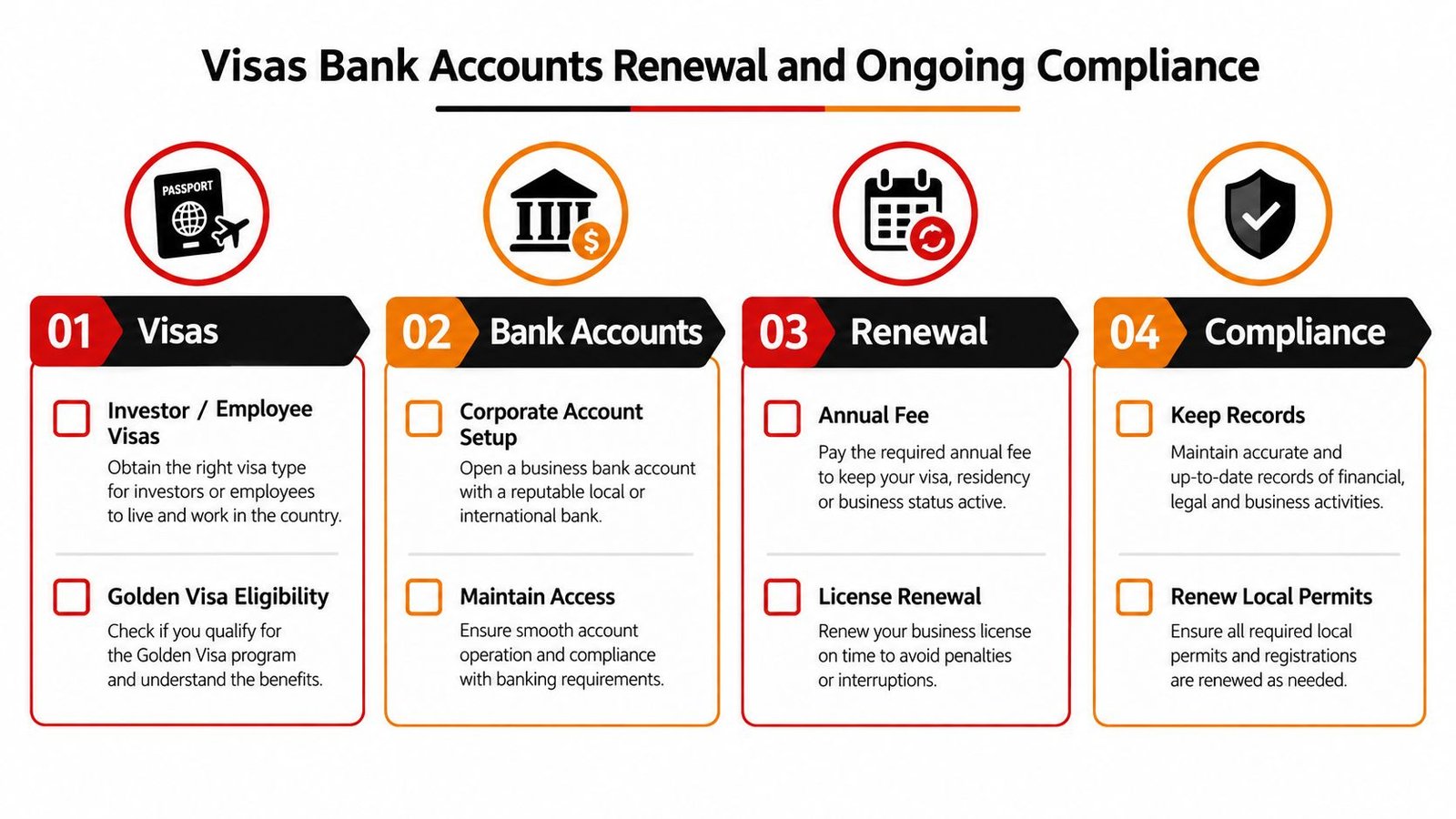
- Visas Bank Accounts Renewal and Ongoing Compliance
- Choosing the Right Trade License for Your Business
What a UAE Trade License Actually Is
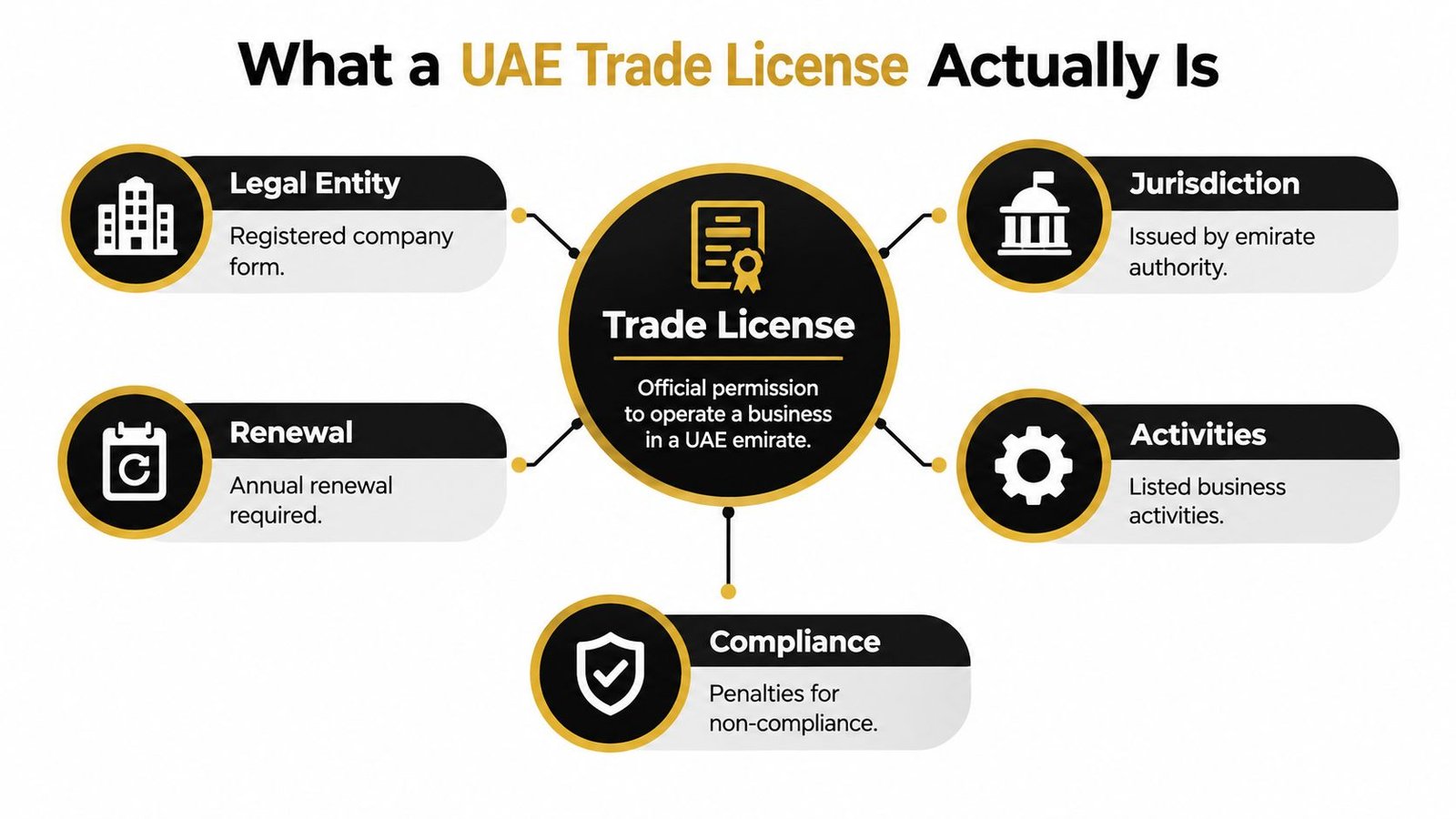
A trade licence is formal legal permission to conduct approved business activities in a defined United Arab Emirates jurisdiction. It isn't a certificate confirming that a company exists. The licence records the relationship between the business activity, trade name, legal form, regulator, and premises.
That relationship has practical consequences. A consultancy, online retailer, manufacturer, and travel company may all need business licences, but they won't necessarily receive the same licence classification or follow the same approval route. The UAE business framework matches the licence to the activity, legal form, and regulator, rather than issuing one generic permit for every business. The UAE Ministry of Economy and Tourism business guidance describes the trade licence as part of the legal framework for establishing and operating a company.
What does the licence connect?
Think of the licence as a control panel with several linked settings:
- Activity: The approved activity code describes what the company is authorised to do.
- Jurisdiction: The licence comes from a mainland authority or a free zone regulator, each with its own operating rules.
- Legal form: The record identifies whether the business is structured as a company, professional establishment, branch, or another permitted form.
- Trade name: The registered name must meet the authority's naming rules.
- Premises: Some activities require evidence of an approved office, shop, warehouse, or other location.
The licence then becomes the reference point for other government and commercial processes. Banks review the company licence when assessing a corporate account, and immigration authorities use the company record when processing investor or employee visa applications. A Golden Visa application is assessed separately under its own eligibility rules, but an entrepreneur's business documentation may form part of the supporting record.
The UAE's official platform provides licence enquiry and lookup services across the emirates, including commercial company licences, Abu Dhabi economic licences, and trade licence services in other emirates. That central verification role shows why licensing is a nationwide regulatory function, even though individual applications are handled by emirate-level authorities.
The Six Official License Types Explained
A UAE business licence type is a broad classification that places an activity within the country's licensing framework. The Ministry of Economy and Tourism recognises six licence types: industrial, commercial, crafts, tourism, agricultural, and professional. The categories are listed in its official UAE business establishment guidance.
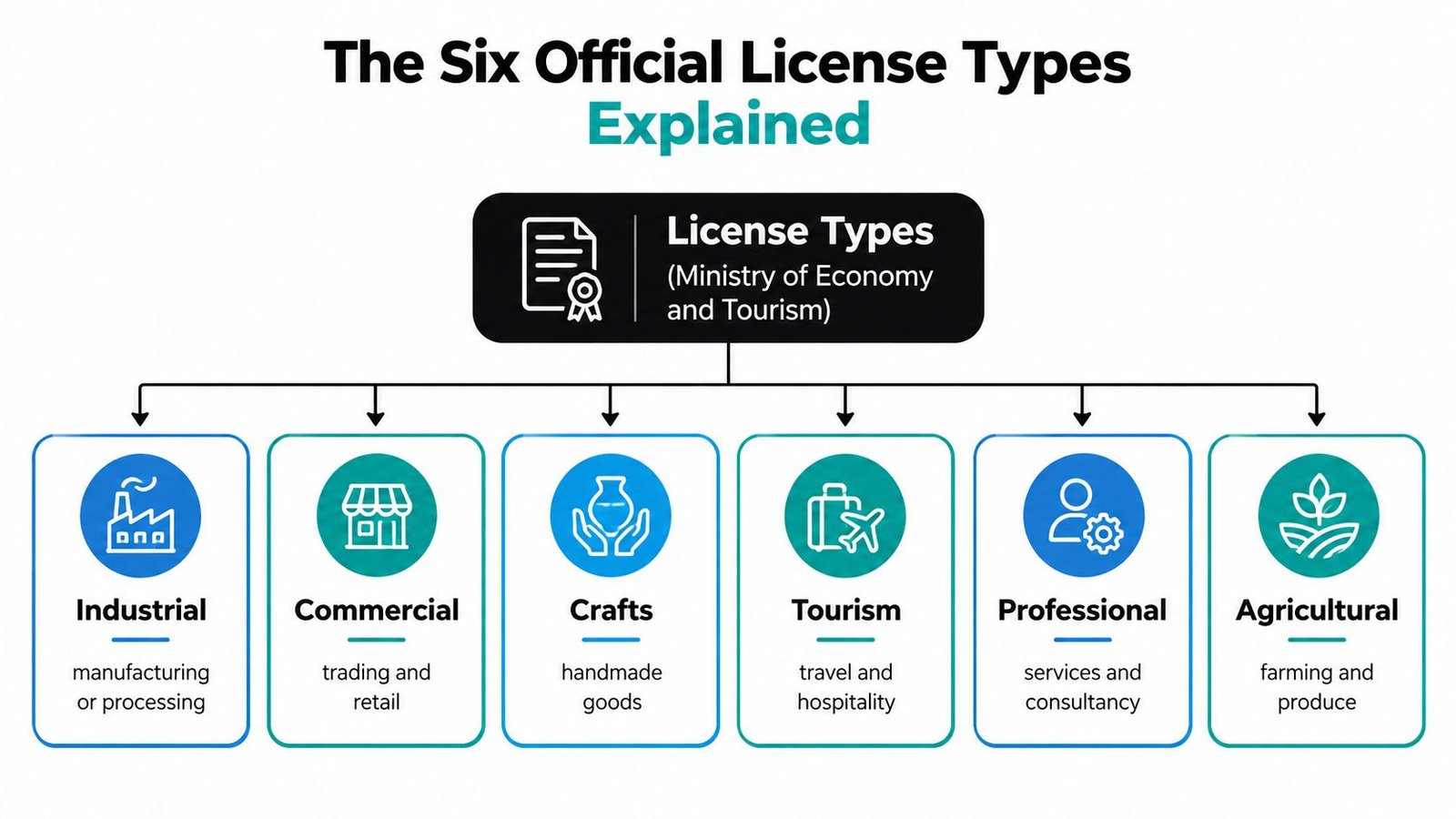
These six classes work like departments in a large building. Your business starts in the department that matches its main work, then the licensing authority checks the precise activity, jurisdiction, premises, and legal form. The category is the operating system's top-level setting, while the activity code determines what the company may do.
What does each licence type cover?
- Industrial licence: Covers manufacturing, production, processing, and related industrial operations. The authority may review the facility, equipment, environmental conditions, and other requirements linked to the activity.
- Commercial licence: Covers trading goods, retail, import and export, distribution, and selected commercial activities. An e-commerce company still needs an activity that accurately describes how it sells.
- Crafts licence: Covers skilled manual work and handmade goods. The permitted activity may describe the person's practical craft rather than a broad trading operation.
- Tourism licence: Covers tourism, travel, hospitality, and visitor services. Extra approvals may apply where the business involves regulated premises, transport, accommodation, or customer-facing operations.
- Agricultural licence: Covers farming, agricultural production, and produce-related activities. The authority may request information about land, production, or other operating conditions.
- Professional licence: Covers services based on expertise, consultancy, and professional work. A designer, adviser, engineer, or specialist provider may fit this category, depending on the exact activity and legal structure.
The label alone does not determine the business setup. Two companies with professional licences can have different activity codes, premises rules, ownership structures, and approval requirements. Those settings affect practical outcomes, including the documents needed for visa applications and corporate bank account reviews.
The classification also helps determine which authority handles the application and how the business can expand. A company combining consulting, software, trading, and physical products should list those activities before applying. Trying to place every revenue stream under the cheapest-looking label can leave the licence misaligned with the actual operation.
Mainland Free Zone and Offshore Compared
A jurisdiction is the legal territory and regulator under which your company operates. In the UAE, the main choices are mainland, free zone, and offshore. Dubai, Abu Dhabi, and Sharjah each have mainland licensing routes, while free zones operate under their own regulatory frameworks.
The distinction matters most when you ask a practical question: where will the company sell and deliver its services? A mainland company can generally trade across the UAE directly, subject to the activity and any sector-specific permits. A free zone company usually operates within its free zone and internationally, but it normally needs a distributor, mainland branch, or specific permit to sell directly into the mainland market.
Offshore structures serve a different purpose. They are commonly considered for holding assets or structuring international ownership, but they aren't a substitute for a local operating licence when the business needs to conduct ordinary UAE commercial activity.
What are the main differences?
| Jurisdiction | Market Access | Best For |
|---|---|---|
| Mainland | Direct access to the UAE market, subject to activity and regulatory requirements | Retailers, local service providers, contractors, and companies serving mainland customers |
| Free zone | Free zone and international operations, with separate requirements for direct mainland sales | International founders, sector-focused businesses, remote service companies, and businesses seeking a free zone ecosystem |
| Offshore | Primarily an international holding or structuring vehicle, not a normal local operating platform | Holding companies and investors whose needs don't require ordinary UAE trading operations |
Ownership rules, office requirements, visa capacity, permitted activities, and banking expectations vary by authority. A free zone may suit a founder whose clients are outside the UAE, while a mainland licence may be clearer for a company signing local contracts or operating a shop in Dubai.
The old explanation that a free zone company cannot access the mainland is now incomplete. Dubai Executive Council Resolution No. 11 of 2025 introduced new pathways for some free zone companies, including a branch route and a temporary permit, as described in this explanation of Dubai trade licence changes. The route still depends on eligibility, activity, and approval, so it doesn't remove the need to check the current rules before committing to a jurisdiction.
Practical rule: Choose the jurisdiction from your customer and operating model, not from the licence label alone.
How Permitted Activities Shape Your License
An approved business activity is the specific description of what your company may legally do. It sits beneath the broad licence type and often determines the documents, premises, approvals, and legal form available to you.
Suppose a founder describes the business as “technology”. That word may cover software development, information technology consultancy, software trading, online platform operation, or another regulated service. The authority needs a more precise activity because each option can create different compliance obligations.
Why can't you choose any activity?
Authorities use activity codes to control regulated work. A low-risk consultancy may require a straightforward application, while healthcare, education, food, transport, construction, financial, or other specialised activities may need approval from a third-party government body before the licence is issued.
The Ajman Department of Economic Development issuance process shows this sequence clearly. The process can include trade name reservation, immigration or federal identity approval for foreign applicants, third-party government approvals for higher-risk activities, lease authentication, fee payment, a Memorandum of Association for companies, and final licence issuance.
That sequence creates a direct cause and effect. The more regulated the activity, the more likely the authority is to request evidence before issuing the licence. Premises requirements can also change. A home-based service, a warehouse operation, and a customer-facing shop won't necessarily be assessed in the same way.
What happens if the activity is wrong?
If the activity doesn't cover the work you perform, the company may face problems with contracts, invoices, bank reviews, advertising, permits, or inspections. The issue isn't solved by holding a valid licence if the licence authorises a different business.
Review your expected revenue streams before applying:
- Write down what you will sell. Include products, services, subscriptions, commissions, and consultancy work.
- Separate activities that look similar. Software development isn't automatically the same as software trading or IT consultancy.
- Check the premises requirement. Confirm whether the activity needs an office, shop, warehouse, or specialised facility.
- Ask about future amendments. Adding an activity later may require authority approval, updated documents, or a change to the premises.
A careful activity review can prevent a cheap initial application from becoming an expensive correction.
Documents and Application Process Step by Step
A UAE trade licence works like the operating system of a business. The selected activity code, jurisdiction, and legal form determine which documents the authority requests and what the company can do next, from leasing premises to applying for visas or opening a bank account. The exact requirements vary by emirate, activity, ownership, and legal structure.
Which documents are commonly requested?
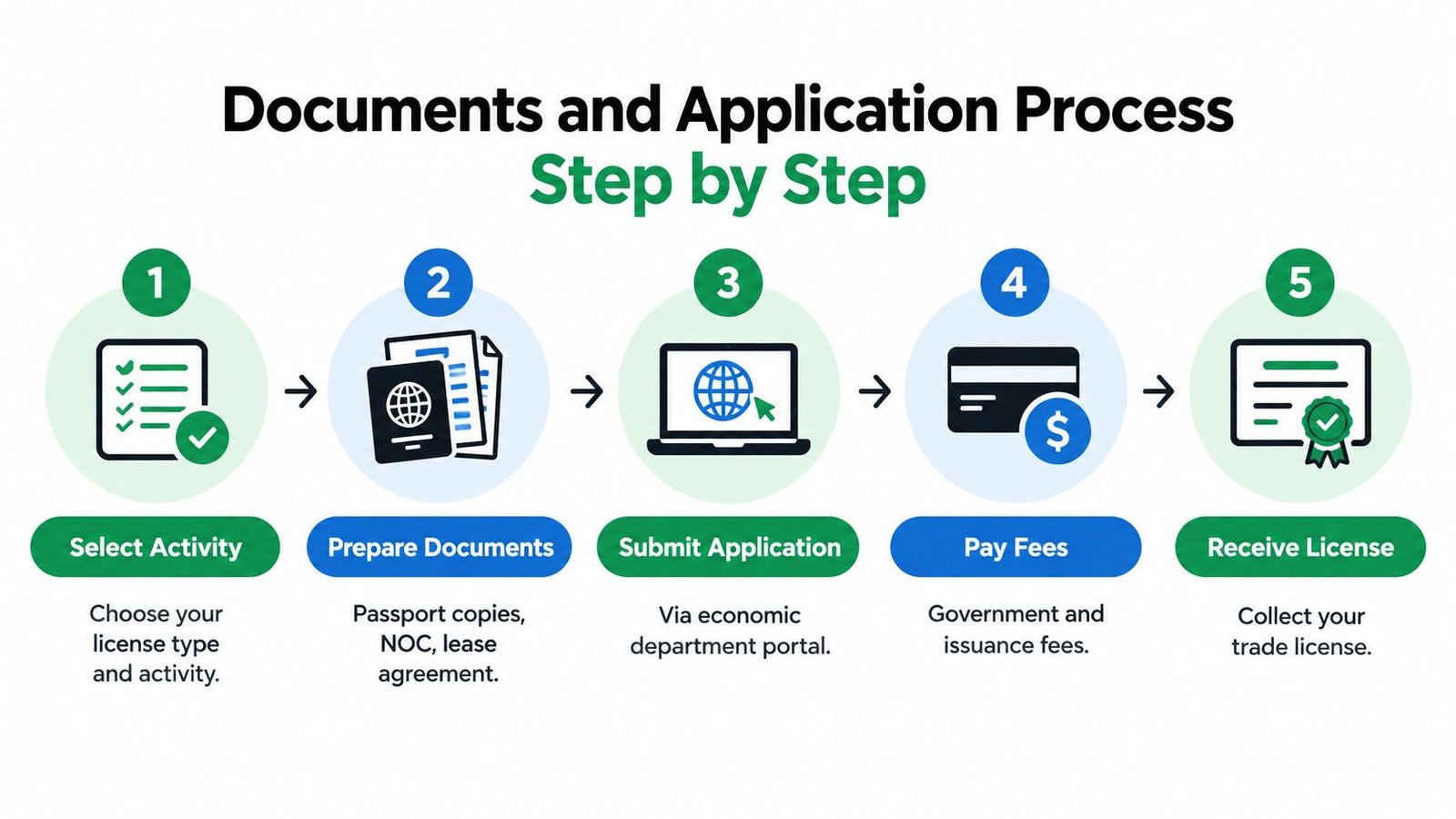
Prepare the file around four areas:
- Identity documents: Passport copies and, where required, UAE identity or immigration information for founders and authorised signatories.
- Business information: Proposed trade name, selected activities, ownership details, and preferred legal form.
- No-objection documentation: A no-objection certificate, or NOC, may apply in particular circumstances, depending on the applicant and activity.
- Premises evidence: A tenancy contract or lease document may need authentication before issuance.
- Corporate documents: Corporate shareholders may need incorporation certificates, constitutional documents, board resolutions, and proof of authority.
- Activity approvals: Regulated activities can require clearance from other government departments.
The activity code is the practical starting point. A consultancy, trading business, and food operation can face different approval and premises requirements, even when the owners submit similar identity documents.
How does the application usually proceed?
Treat the application as a connected set of decisions rather than a single form:
- Select the activity and legal form. Define what the business will do, then match it to the appropriate legal structure and jurisdiction.
- Reserve the trade name. The proposed name must meet the relevant authority's rules.
- Obtain initial approval. This confirms that the authority accepts the proposed setup at an early stage.
- Secure external approvals. Higher-risk or specialised activities may require clearance from another authority.
- Arrange and authenticate the lease. The premises must suit both the activity and the authority's requirements.
- Prepare the Memorandum of Association, or MOA, where needed. It records key company arrangements for applicable legal forms.
- Pay the required fees and receive the licence. Issuance follows after the authority accepts the complete file.
Dubai offers an online route through Invest in Dubai's trade licence service. In Abu Dhabi, the Abu Dhabi Registration Authority, or ADRA, handles registration and licensing through platforms such as TAMM. Applicants use UAE PASS, the United Arab Emirates digital identity, to access the digital process. ADRA serves as a unified registry for mainland and non-financial free zones in Abu Dhabi.
For orientation, Abu Dhabi's Trader Licence starts at AED 790 for a basic package with 6 investor-selected activities, with the published range extending to AED 5,500 depending on the activity set. Confirm the current fee schedule through the relevant government platform before applying.
Visas Bank Accounts Renewal and Ongoing Compliance
The licence continues to matter after incorporation because it supports the company's operating record. A valid company can use its establishment documents when applying for investor or employee visas, subject to immigration requirements and the applicant's eligibility. HR teams should also remember that employee onboarding involves separate immigration and labour steps, including processes connected with the Ministry of Human Resources and Emiratisation, known as MOHRE.
A Golden Visa is a separate immigration status with its own eligibility criteria. Holding a trade licence doesn't automatically qualify an applicant, but an entrepreneur or investor may need company records and financial or ownership evidence as part of a wider application.
Why do banks care about the trade licence?
A bank needs to understand who owns the company, what it does, and where it operates. The licence gives the bank a starting record for checking the stated activity against the business plan, invoices, contracts, website, and expected transactions.
A mismatch can slow account opening or prompt additional questions. For example, a company licensed for consultancy may need to explain why its account will receive regular payments for physical goods. The bank may also check whether the licence remains valid and whether the supporting corporate documents are current.
Banking preparation: Keep the licence, constitutional documents, shareholder records, business plan, customer contracts, and source-of-funds evidence consistent.
How does renewal work?
Trade licences in Dubai are renewed annually. Renewal timing and penalties are set by the relevant licensing authority, so there isn't one universal UAE penalty rule. One published Dubai penalty structure states AED 250 per month after expiry, with a separate AED 5,000 fine for operating with an expired licence, according to published Dubai renewal guidance.
Renewal may also involve updated tenancy records, government fees, immigration file checks, activity amendments, and other local permits. Free zone companies follow their own authority's renewal procedure, while Abu Dhabi businesses may use TAMM or the relevant free zone portal.
Set an internal reminder before expiry, check the lease and activity list, and confirm that visas and establishment records remain aligned. Treat renewal as an operating responsibility, not an administrative task to leave until the last day.
Choosing the Right Trade License for Your Business
The right licence usually becomes clear after answering three questions.
Where will you sell?
Choose mainland if direct UAE market access is central to your model. A free zone may fit a business serving overseas clients or operating within a specialised ecosystem, but direct mainland sales can require an approved route. Offshore is a different structure for holding and international arrangements, not a normal replacement for an operating company.
What will you do?
Start with the revenue activities. Don't choose a broad-sounding label that fails to cover your contracts, products, or services. Confirm whether the activity needs third-party approval, specific premises, or a particular legal form before you compare package prices.
How will you scale?
Consider future employees, visas, banking, premises, branches, local contracts, and additional activities. A structure that suits a solo freelancer may create restrictions when the business begins hiring or selling through the UAE.
The trade licence works best as a decision framework. Jurisdiction sets the market boundary, activity sets the authorised work, and legal form sets how the company is recorded and managed. Check all three together before paying for issuance.
Inpro helps founders compare Mainland, Free Zone, and Offshore setup options, prepare licensing and document workflows, and manage related visa and compliance steps. Visit Inpro to discuss your activity, preferred emirate, and intended market access before choosing a UAE trade licence.