

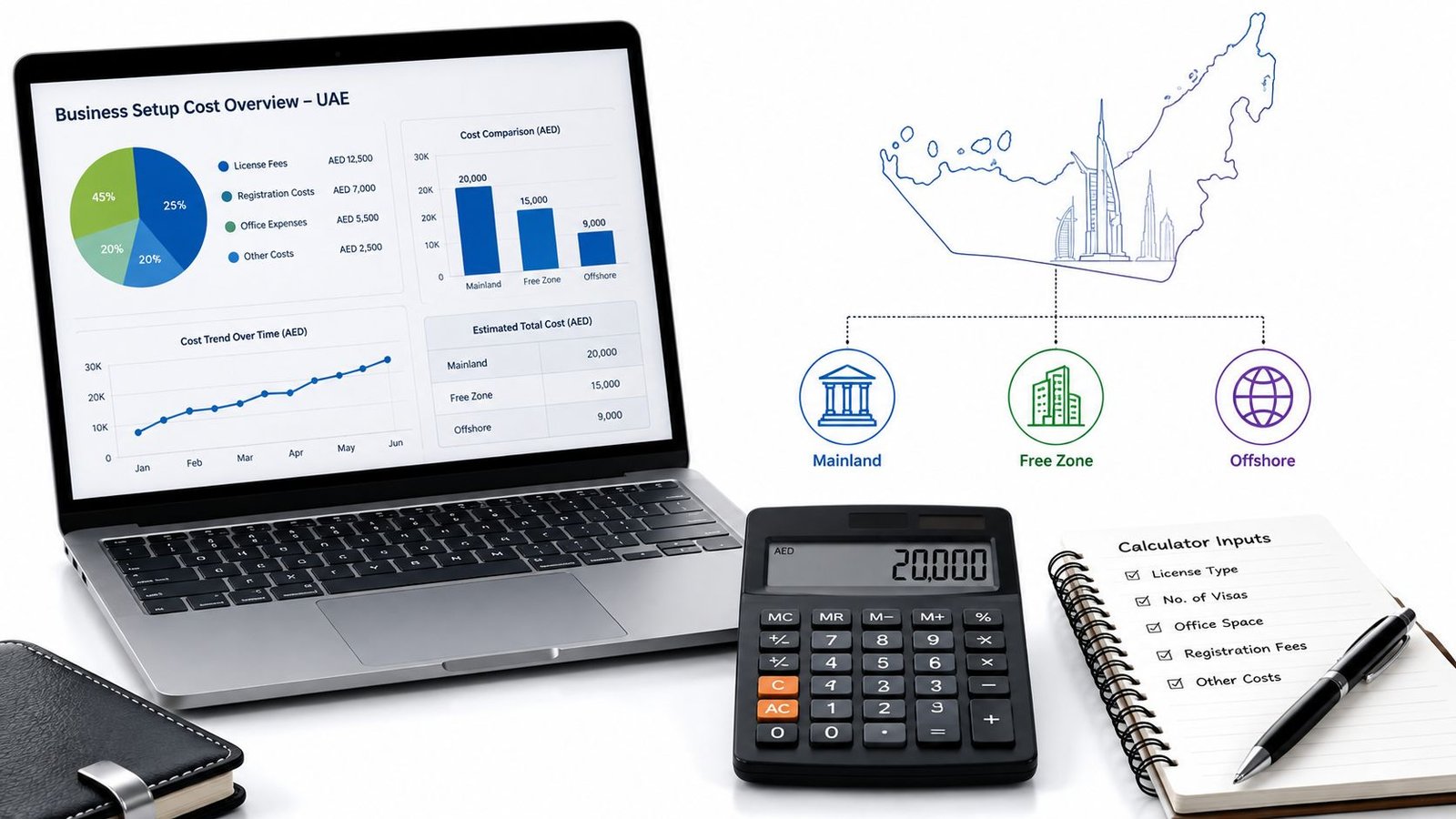
A UAE business setup cost calculator should show more than a licence fee. It must separate one-time formation costs from renewal, visa, accounting, and tax-registration costs, while comparing Mainland, Free Zone, and Offshore structures.
You may be comparing Dubai, Abu Dhabi, or Sharjah options and seeing headline quotes such as AED 12,500 or AED 25,000. The difficult part isn't finding a low number. It's understanding what that number excludes, when the next payment falls due, and how your activity, visas, premises, turnover, and tax status change the result.
Table of Contents
- What a UAE business setup cost calculator actually does
- Every input the calculator should ask you for
- How Mainland, Free Zone, and Offshore change the numbers
- VAT registration inputs and what triggers the compliance cost
- Corporate Tax inputs and the 0 percent versus 9 percent question
- Three worked scenarios from the same calculator
- Why the cheapest licence is rarely the lowest first-year cost
- Visa pathways and how they change the total
- How to read the calculator's output without being misled
- Practical next steps after you have your estimate
What a UAE business setup cost calculator actually does
A useful business setup cost calculator is a planning model, not a licence-price lookup. It takes your business activity, location, ownership structure, visa needs, office requirement, and expected financial profile, then produces two outputs: the first-year cost and the recurring annual cost.
The distinction matters because formation and operation happen on different financial timelines. A licence may be issued once, while renewal, registered-office arrangements, accounting, immigration administration, and tax filings continue. The UAE Ministry of Economy and Tourism's company-establishment guidance confirms that company-licence issuance fees vary by licence type, so a single universal setup price would already be misleading.
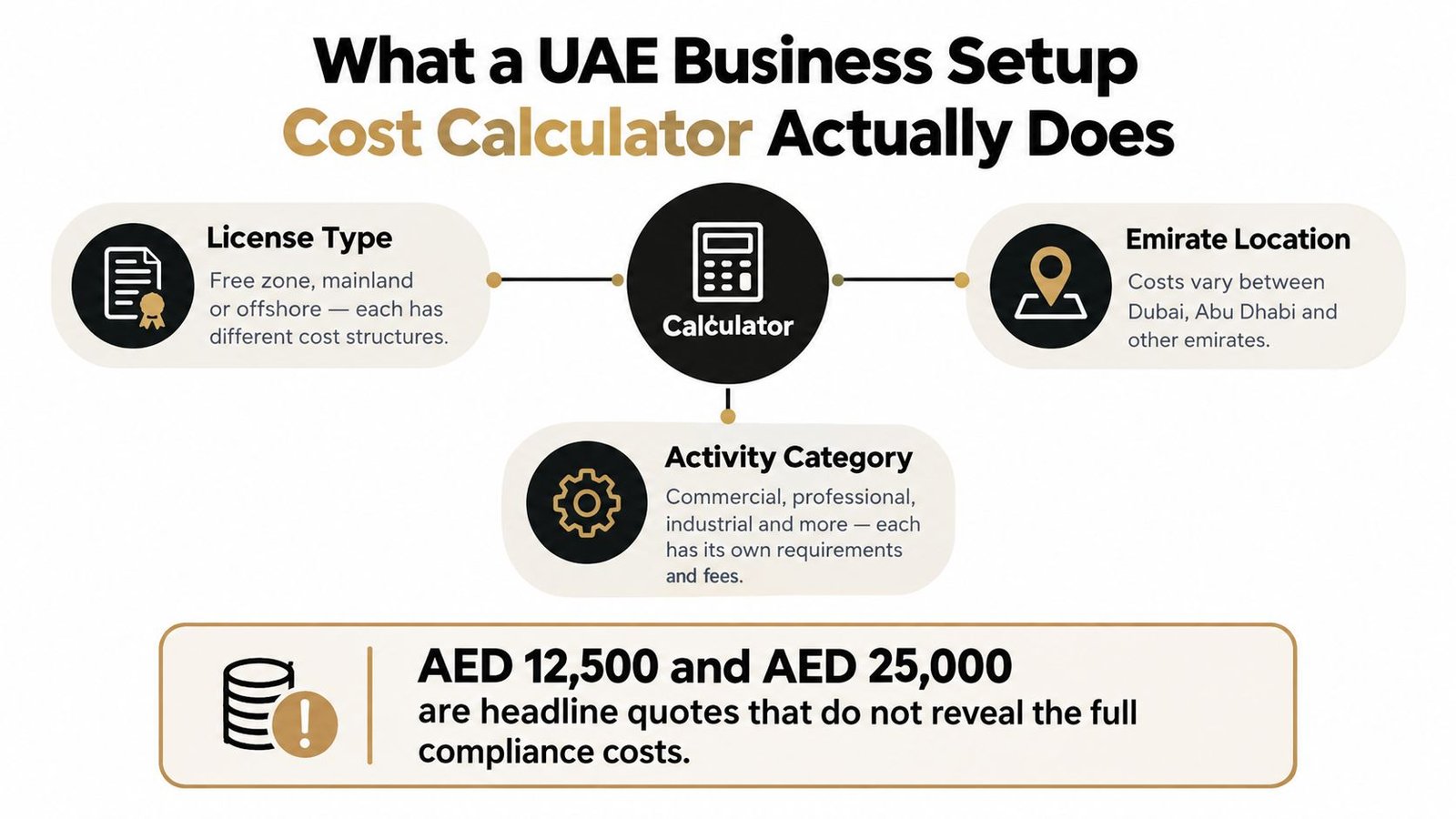
What should the calculator show?
Think of the model in three layers:
- Inputs: activity, emirate, jurisdiction, shareholders, visas, premises, turnover, expenses, and profit.
- Interpretation: licensing route, immigration requirements, VAT triggers, Corporate Tax position, and possible relief.
- Outputs: one-time formation, year-one total, and annual renewal or operating cost.
The result should separate mandatory, conditional, and optional items. For example, an office may be mandatory for one activity but unnecessary for another. A VAT registration may be triggered by taxable supplies, while Corporate Tax administration may apply even where the projected tax payable is zero.
Practical rule: Compare year-one totals first. Compare headline licence fees only after confirming that both quotes contain the same cost categories.
This approach gives a founder a realistic budget for launching in the United Arab Emirates, rather than an attractive number that changes as soon as visas, premises, or compliance enter the conversation.
Every input the calculator should ask you for
Start with the business activity, not the cheapest advertised price. Consulting, software, e-commerce, trading, recruitment, and manufacturing can require different licences, premises, approvals, and staffing assumptions. Select the activity precisely, because an incorrect category can invalidate the rest of the estimate.
The calculator should ask where you will sell and where customers are based. UAE customer demand can affect the practical choice between Mainland and Free Zone structures. Imported inputs, taxable expenses, and taxable turnover also feed into the VAT assessment. A SaaS company serving customers outside the UAE may therefore need a different cost model from a local service business.
Enter revenue and profit as separate figures. Revenue is sales received by the business. Profit is what remains after allowable costs, and Corporate Tax is assessed on taxable income rather than gross turnover. Add the expected financial year-end, because the entity's tax position determines registration and filing timing.
The other fields should include:
- Founder nationality and residency: These details can change document requirements, immigration processing, and the application route.
- Shareholder structure: Shareholder numbers and types affect incorporation documents, ownership records, and banking preparation.
- Visa seats: Model investor, partner, and employee requirements separately. Each seat can add immigration, medical, and Emirates ID costs.
- Office requirement: Choose a registered office, flexi-desk, shared workspace, or physical premises. Some activities require more substance than a basic desk.
- Imports and taxable expenses: Use these figures to assess VAT registration and separate recoverable input VAT from genuine operating costs.
- Free Zone status: State whether the entity expects qualifying income. Free Zone status alone does not make every income stream taxable at a 0% Corporate Tax rate.
| Calculator input | Cost line it drives |
|---|---|
| Activity category | Licence, approvals, premises |
| Emirate and jurisdiction | Formation, renewal, office |
| Shareholders | Incorporation documents and banking |
| Visa seats | Immigration, medical, Emirates ID |
| Expected revenue | VAT and tax-registration triggers |
| Expected taxable income | Corporate Tax scenario |
| Customer location | Jurisdiction and VAT treatment |
| Imports and taxable expenses | VAT analysis and cash flow |
| Financial year-end | Filing calendar and accounting work |
The output should show one-time formation fees separately from annual renewal, accounting, tax, visa, and premises costs. That year-one view exposes the actual cash requirement.
A calculator asking only for “business type” and “number of visas” produces a starting quote, not a reliable estimate. Add jurisdiction, activity, customers, revenue, profit, premises, and compliance inputs before approving the budget.
How Mainland, Free Zone, and Offshore change the numbers
The same founder can receive three different cost profiles because the jurisdiction changes market access, premises, licensing, and tax assumptions.
Mainland means a company licensed by the Department of Economy and Tourism, commonly called the DED, in Dubai, or by the equivalent authority in Abu Dhabi or Sharjah. It generally suits companies trading directly across the UAE, bidding for local contracts, or requiring premises outside a Free Zone. Since the ownership reforms introduced in 2021, 100% foreign ownership is available for most activities, subject to the applicable activity rules.
Free Zones are designated business districts in Dubai, Abu Dhabi, Sharjah, Ras Al Khaimah, and Ajman. Examples include Abu Dhabi Global Market, known as ADGM, and other sector-specific zones. They can suit international services, technology companies, holding structures, and businesses that want a defined licensing environment. A Free Zone company still needs to assess local-market access, office rules, employee capacity, and Corporate Tax treatment.
Offshore structures are generally used for holding companies and asset protection. They aren't a substitute for an operating licence. An Offshore company cannot trade in the UAE or rent office space, so the calculator should prevent founders from comparing an Offshore registration with an operating Mainland or Free Zone company as though they serve the same purpose.
| Factor | Mainland | Free Zone | Offshore |
|---|---|---|---|
| Primary use | UAE market operations | Sector-specific or international operations | Holding and asset protection |
| Local trading | Direct UAE access | Depends on structure and activity | Not permitted |
| Office model | Often activity-dependent | Zone-specific | No UAE office |
| Tax scenario | Standard regime assessment | Qualifying-income assessment | Structure-specific analysis |
| Typical calculator focus | Premises and local operations | Licence package and market access | Holding purpose and administration |
For a detailed view of the operating route, review Mainland company setup in Dubai. Don't choose a jurisdiction because its licence line is lower. Choose the one that supports your customers, employees, banking needs, and required business substance.
VAT registration inputs and what triggers the compliance cost
Value Added Tax, or VAT, is a consumption tax applied to taxable supplies. The calculator should assess it from business activity and timing, rather than solely from the fact that a company has been incorporated.
For a UAE-resident business, mandatory registration applies when taxable supplies and imports exceed AED 375,000 during the previous 12 months, or when the business expects to exceed that amount within the next 30 days, according to the Federal Tax Authority's VAT registration rules. Voluntary registration becomes available when taxable supplies, imports, or qualifying taxable expenses exceed AED 187,500 over the previous 12 months or are expected to exceed that amount within the next 30 days.
The model should exclude exempt and out-of-scope supplies from the threshold calculation. It should also ask whether the business is UAE-resident or non-resident, because foreign businesses can face separate registration logic. A non-resident business making UAE taxable supplies may trigger mandatory registration regardless of value where no UAE party accounts for the tax, as explained in the FTA registration guidance.
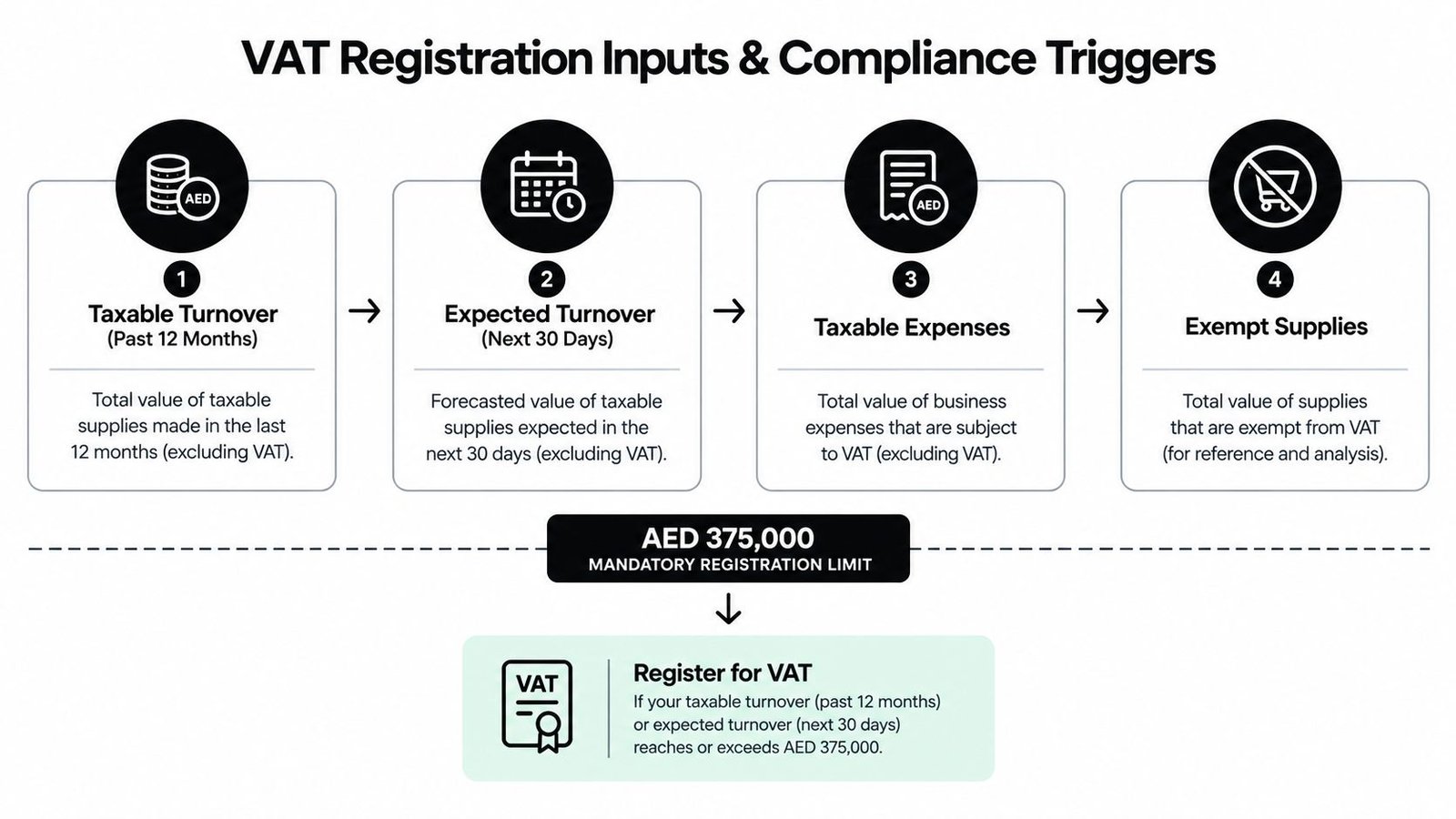
How does the calculator turn turnover into a cost?
It should calculate the trigger date, then add the expected cost of VAT return preparation, record-keeping, and payment administration. The UAE standard VAT rate is 5%, but input VAT may be recoverable, so the model must distinguish cash-flow timing from an unrecoverable business expense.
For example, a Dubai consultancy expects taxable supplies to cross AED 187,500 in its fourth month. The calculator should flag voluntary registration as an available choice, show the related administration, and continue monitoring whether the business later crosses AED 375,000. A required business must submit its VAT application within 30 days of becoming obligated, while the FTA publishes an estimated processing time of 20 business days after receiving a complete application. The FTA VAT registration threshold guidance can help founders check the underlying trigger.
Corporate Tax inputs and the 0 percent versus 9 percent question
Corporate Tax is a tax on taxable income, not gross revenue. The calculator should begin with accounting profit, then model taxable income after the relevant adjustments and exemptions have been assessed.
Under the UAE regime, taxable income up to AED 375,000 is subject to a 0% rate, while taxable income above AED 375,000 is generally subject to 9%. The regime applies to financial years beginning on or after 1 June 2023, and it operates separately from VAT, as confirmed in the Federal Tax Authority Corporate Tax FAQs.
A Free Zone company isn't automatically tax-free. A Qualifying Free Zone Person may receive a 0% rate on qualifying income, while non-qualifying income is generally taxed at 9%. Free Zone Persons, including qualifying Free Zone Persons, must register for Corporate Tax. The calculator should therefore ask for jurisdiction, residency, expected income type, and Free Zone status instead of applying a blanket result.
When can Small Business Relief apply?
Eligible UAE-resident taxable persons may elect Small Business Relief where revenue is AED 3 million or less for the relevant tax period and each preceding qualifying period ending on or before 31 December 2026. The election isn't automatic. The business must register for Corporate Tax and elect relief in its return, and eligible businesses still have a filing obligation, according to the FTA Small Business Relief guidance.
A freelancer needs a separate test. A natural person conducting business in the UAE generally becomes required to register for Corporate Tax when total business turnover exceeds AED 1 million in a Gregorian calendar year. Failure to submit a required registration application can result in an AED 10,000 administrative penalty, according to the FTA guide for natural persons.
The calculator should show projected tax payable and a separate compliance workload line. Zero tax doesn't mean zero bookkeeping, registration, record-keeping, or filing work. Founders can also review Corporate Tax in the UAE before confirming their assumptions.
Three worked scenarios from the same calculator
A useful model becomes easier to understand when the activity, staffing, and customer profile change. The following scenarios use the supplied figures to show how the tax and compliance logic changes. They don't provide invented licence prices, so the year-one totals should remain illustrative and itemised, not presented as confirmed quotes.
Scenario one, solo Dubai consultant
The founder uses a freelance permit, expects revenue of AED 240,000, has no employees, and doesn't require an office. The business may qualify for voluntary VAT registration because its taxable expenses or supplies can exceed AED 187,500, but registration isn't mandatory on the supplied revenue alone. The natural person's turnover is below the AED 1 million Corporate Tax registration trigger, so the calculator should show no Corporate Tax registration requirement on these assumptions.
Scenario two, Dubai Free Zone SaaS company
The software company expects revenue of AED 1.8 million, has three employees on visas, and serves mostly overseas customers. It crosses the mandatory VAT threshold if the revenue represents taxable supplies and imports within the relevant period. Corporate Tax requires a qualifying-income review, because Free Zone status doesn't automatically apply a 0% rate to every income stream.
Scenario three, Sharjah Mainland trader
The trading company expects revenue of AED 12 million, employs eight people, and operates a physical warehouse. The calculator must include warehouse-related premises, staffing, immigration, bookkeeping, and tax administration. It should also model Corporate Tax using taxable profit rather than AED 12 million of revenue, and apply the standard 5% VAT rate to relevant local sales.
| Scenario | Profile | Year-one total (illustrative) |
|---|---|---|
| Solo consultant | Dubai freelance permit, AED 240,000 revenue, no employees, no office | Formation plus selected administration |
| Free Zone SaaS | AED 1.8 million revenue, three employee visas, mainly overseas customers | Formation, visas, VAT, accounting, tax assessment |
| Mainland trading company | Sharjah, AED 12 million revenue, eight employees, warehouse | Formation, premises, visas, VAT, accounting, Corporate Tax assessment |
The lesson is simple: revenue alone doesn't determine total cost. People, premises, market access, and tax status create the spread.
Why the cheapest licence is rarely the lowest first-year cost
A low licence quote may be accurate and still be a poor budget. It may cover issuance while excluding renewal, registered-office or flexi-desk requirements, immigration establishment-card charges, visa processing, medical examinations, Emirates IDs, document attestation, accounting, and tax support.
The Ministry of Economy and Tourism company-establishment information states that licence issuance fees vary by licence type. That makes a fixed “UAE setup price” unreliable before you even consider the company's activity and location.
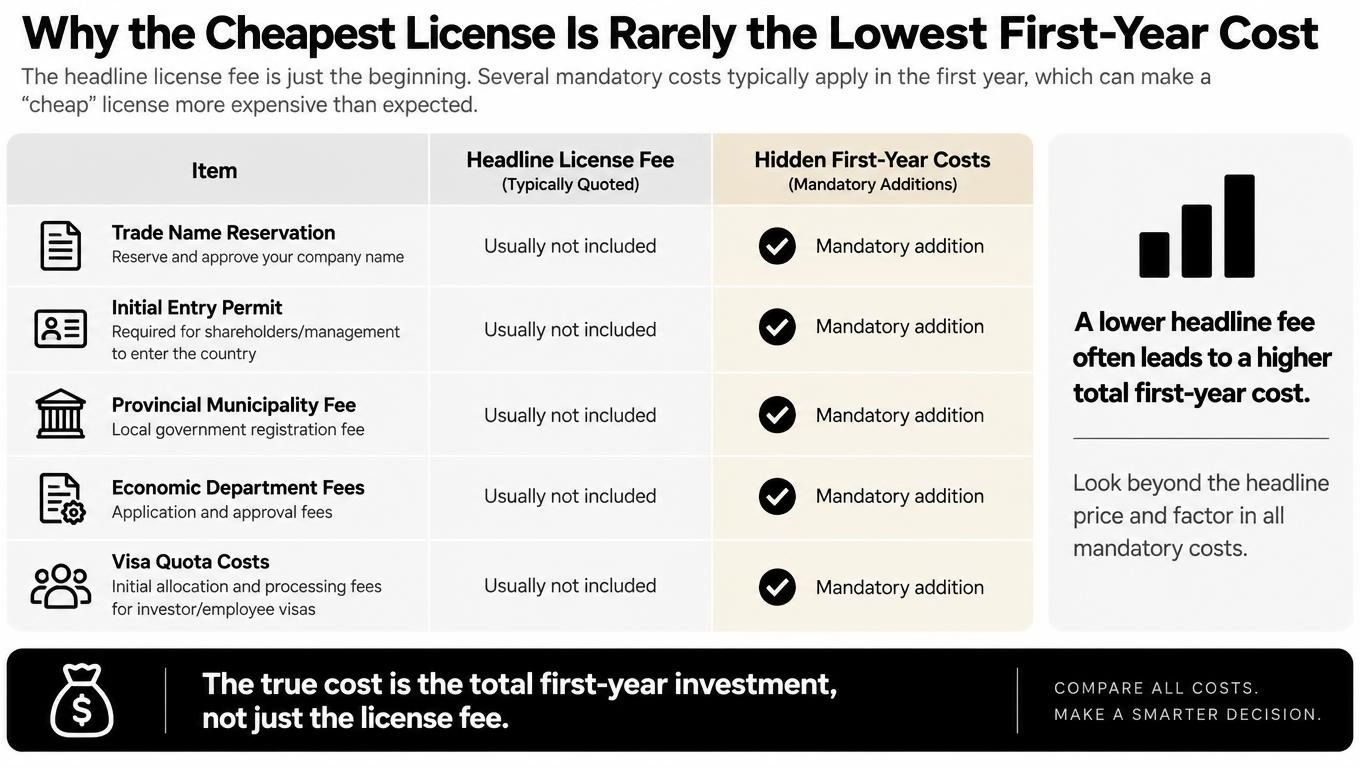
Which line items belong in the model?
A transparent calculator should classify every expense:
- Mandatory: Licence issuance, required approvals, renewal, registered office, establishment card, and compulsory records.
- Conditional: Visas, medical tests, Emirates IDs, document attestations, translation, warehouse space, and activity-specific permits.
- Optional: Extra office capacity, additional accounting support, advisory work, and upgraded workspace.
The year-one view should include every item needed to start operating. The annual view should remove one-time formation charges while retaining renewals and recurring administration. A three-year view should make renewal timing visible rather than assuming that the initial quote remains unchanged.
The cheapest licence is only the cheapest option when the business needs nothing beyond the licence.
This video offers another visual explanation of why the base quote doesn't represent total ownership cost.
Visa pathways and how they change the total
Visa planning can change a founder's budget more than the difference between two comparable licensing packages. The calculator should separate investor or partner visas, employee visas, and long-term residency routes instead of placing every applicant in one visa field.
Employee visas involve immigration processing and, where relevant, the Ministry of Human Resources and Emiratisation, known as MOHRE. Investor and partner visas connect more directly to the company's ownership and licence records. HR teams should enter the number of employees, their role, and the required visa timing so the first-year total reflects actual staffing rather than a founder-only setup.
A Golden Visa is a long-term residency route with eligibility rules distinct from ordinary company formation. For the real-estate investor route, the United Arab Emirates Federal Authority for Identity, Citizenship, Customs and Port Security identifies ownership of qualifying property valued at not less than AED 2 million as a requirement, as stated on its Golden Visa information page.
That AED 2 million threshold concerns the qualifying property, not the cost of incorporating a company or obtaining a trade licence. Keep it in a separate relocation or investment scenario so the calculator doesn't double-count it as a formation expense.
How to read the calculator's output without being misled
Read the result in three passes. First, check one-time formation costs, such as incorporation documents, initial licence issuance, and setup administration. Second, review the year-one total, which should include the first renewal cycle where relevant, visas, premises, and compliance work. Third, inspect the annualised three-year view to see whether a low starting price becomes a higher ownership cost after recurring charges.
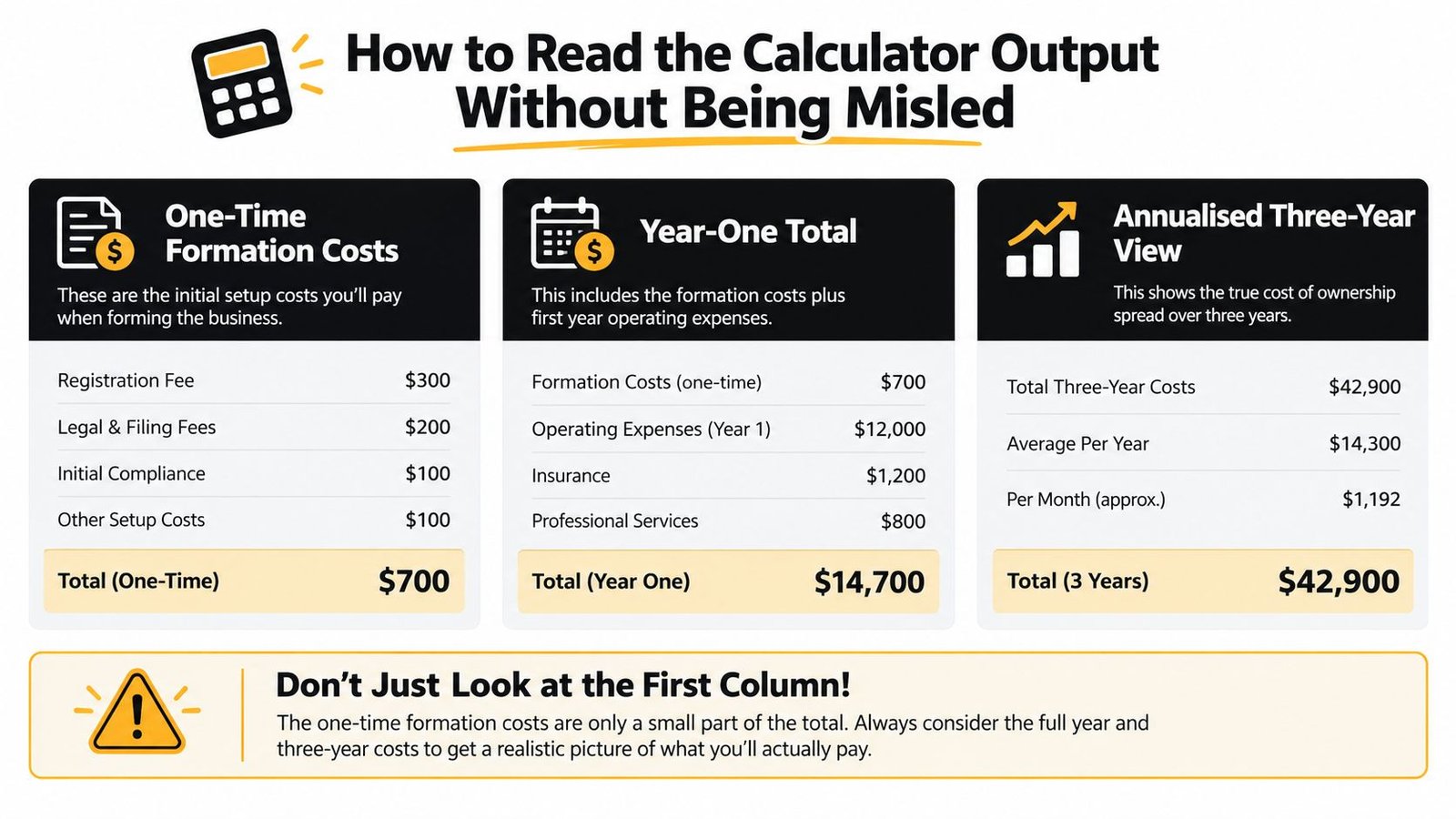
Don't compare two outputs until you confirm that they use the same cost bucket. One quote may include a flexi-desk and one visa, while another shows only the licence. One may include accounting, while the other assumes the founder handles every filing.
What warnings should you look for?
A trustworthy result should show:
- Tax payable: The projected Corporate Tax amount based on taxable income and the relevant scenario.
- Compliance workload: Registration, bookkeeping, record-keeping, return preparation, and payment administration.
- VAT position: Mandatory, voluntary, or not currently triggered, with the timing assumption shown.
- Jurisdiction status: Mainland, Free Zone, or Offshore, including market-access limitations.
- Recurring costs: Renewal, premises, visas, accounting, and support shown separately.
Treat these as warning signs: a single all-in figure with no breakdown, a promise that every Free Zone company pays 0% Corporate Tax, or no line for accounting and audit support. A zero-tax result can still carry meaningful administration.
Practical next steps after you have your estimate
Start by checking the activity and customer plan, not the cheapest number. Confirm whether Mainland, a Dubai or Abu Dhabi Free Zone, Sharjah, or an Offshore structure matches the way you intend to sell, employ people, hold assets, and maintain premises.
Then work through the application sequence:
- Confirm the structure: Match the activity, ownership, office, and market-access requirements to the jurisdiction.
- Reserve the trade name: Check the name and activity before spending on documents or premises.
- Open the licensing application: Use the Department of Economy and Tourism, ADGM, or the relevant Free Zone authority.
- Prepare immigration steps: Process investor, partner, or employee visas, using MOHRE where employee arrangements require it.
- Register for tax when required: Track VAT thresholds, Corporate Tax registration, Small Business Relief eligibility, and filing deadlines separately.
- Prepare banking documents: Assemble incorporation records, identity documents, business evidence, and a clear explanation of expected transactions for the corporate bank account.
- Set up accounting controls: Keep records from the first invoice, even if the initial tax calculation shows no payable amount.
Save the estimate with its assumptions. If your visa count, premises, customer location, revenue, or activity changes, rerun the model rather than relying on the original quote.
Inpro helps founders compare Mainland, Free Zone, and Offshore structures, arrange licences and visas, prepare tax and VAT registrations, and support corporate bank-account applications. Visit Inpro for a personalised UAE setup estimate that separates formation costs from recurring compliance and operating costs.