


If you're looking at a folder of invoices and wondering where to start, VAT return filing in the UAE means reconciling your transactions, reporting them online, and confirming both submission and payment by your assigned deadline. Start with the evidence behind each transaction, not the portal screens, because a small business with overseas customers can need more tax review than a larger local trader.
Table of Contents
- When Your VAT Return and Payment Are Due
- Who Must File and When Registration Applies
- How to Prepare Your VAT Records Step by Step
- Submitting Your Return and Paying on the FTA Portal
- Common Filing Errors and What They Cost
- Set Your Next VAT Filing Date Today
When Your VAT Return and Payment Are Due
Your UAE VAT return and any related payment are both due 28 days after the end of your tax period, according to the Federal Tax Authority's filing guidance. For example, a calendar quarter ending 31 March generally has a filing and payment deadline of 28 April.
The Federal Tax Authority (FTA) is the UAE federal body that administers value added tax (VAT). Your tax period is the stretch of months the FTA assigns to your business after registration, rather than a reporting cycle you choose for convenience.
How long is my tax period?
Businesses with annual taxable turnover below AED 150 million generally file quarterly, while those at or above AED 150 million generally file monthly, according to the UAE Government's VAT return guidance. AED is the currency code for the UAE dirham. Check your assigned period rather than assuming your return follows your financial year or another company's calendar.
VAT return deadlines by tax period
| Tax period type | Annual taxable turnover | How often you file | Deadline for return and payment |
|---|---|---|---|
| Quarterly | Below AED 150 million | Every three months | 28 days after the quarter ends, for example 28 April for the quarter ending 31 March |
| Monthly | AED 150 million or more | Every month | 28 days after the month ends |
| Nil return | Any turnover, no VAT due | Same as your tax period | Same deadline; the return is still required |
| Weekend or public holiday deadline | Any | Any | Moves to the next business day |
What if the deadline falls on a weekend or holiday?
A deadline falling on a Saturday, Sunday or UAE national holiday moves to the first following business day, as confirmed in the FTA's VAT guidance. The return must be received by the deadline, and payment is due on that same date. Leave time to check that both have been recorded rather than relying only on a bank transfer instruction.
Is a nil return still due?
A nil return is a VAT return showing no VAT payable, and it must still be filed by the applicable deadline. Paying early doesn't replace filing on time, and submitting a return doesn't settle the liability.
Build your calendar around the actual registration record. EmaraTax is the FTA's online tax system, where you can read the period end date assigned to your registration and check the return awaiting submission.
Who Must File and When Registration Applies
The filing duty follows VAT registration and taxable activity, not your company's address, licence type or incorporation date. A founder, freelancer or overseas entrepreneur should assess the transactions the business makes before deciding whether registration is required.
Under the FTA's VAT registration rules, UAE-resident businesses must register when taxable supplies and imports exceed AED 375,000 over the previous 12 months, or are expected to exceed that amount within the next 30 days. Voluntary registration is available when taxable supplies, imports or taxable expenses exceed AED 187,500 over the applicable measurement periods.
Who must register and file
| Business situation | Registration rule | Filing duty |
|---|---|---|
| UAE-resident, taxable supplies and imports above AED 375,000 in the past 12 months | Mandatory | Return for every tax period |
| UAE-resident, expects to exceed AED 375,000 within 30 days | Mandatory | Return for every tax period |
| UAE-resident, between AED 187,500 and AED 375,000 | Voluntary, subject to qualifying activity | Return only after registering |
| Non-resident making taxable supplies in the UAE | May be required regardless of turnover when no other person is responsible for paying the tax | Return once registered |
| Free Zone company making taxable UAE supplies | Determined by taxable activity, not zone status alone | Return once registered |
Should I register voluntarily?
Voluntary registration can make sense when a business has substantial recoverable input VAT, meaning eligible VAT paid on business purchases. The trade-off is recurring administration: claiming eligible tax also means maintaining evidence and filing returns. Review the UAE VAT registration threshold against both your sales forecast and purchase records before applying.
Non-resident businesses making taxable supplies in the United Arab Emirates may need to register regardless of turnover when no other person is responsible for the tax. Don't assume the resident-business threshold protects an overseas entity.
Does a Free Zone licence change the filing duty?
A Free Zone is a designated licensing area, such as the free zones in Dubai or Sharjah, while a Mainland company is a company licensed to trade directly in the UAE market. Free Zone status doesn't by itself mean zero VAT or exemption from filing.
For the same legal entity under the same VAT registration, Free Zone and Mainland taxable activity belongs in the same return, not separate returns for each licence or emirate. Keep separately incorporated entities distinct when organising the records.
This is a routine government process: the FTA's annual report announcement reported 98,000 VAT registration applications completed in the UAE during 2025.
How to Prepare Your VAT Records Step by Step
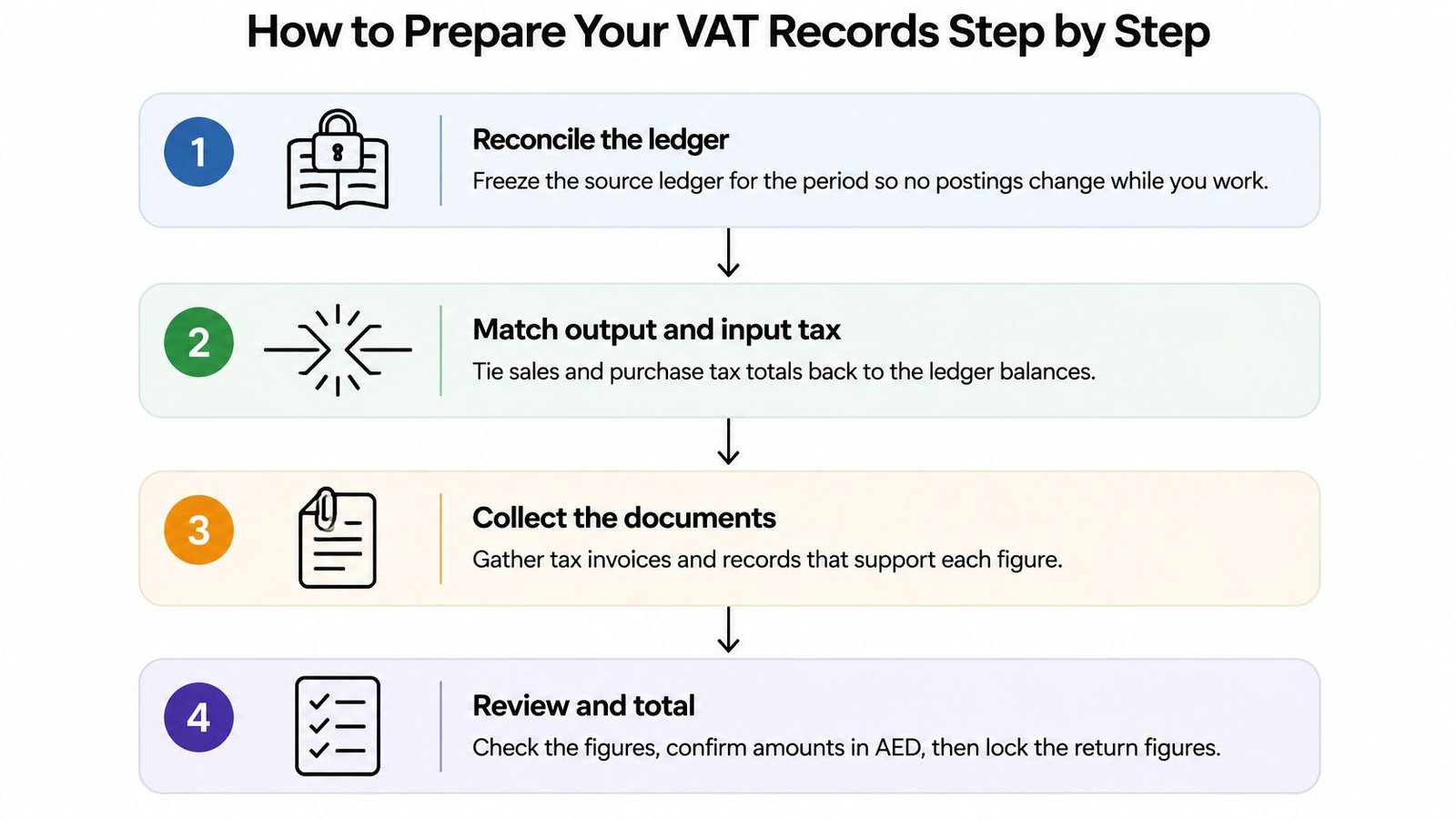
Before opening the portal, prepare the period's records through reconciliation, classification, entry and independent review. The FTA's filing workflow requires VAT-exclusive values and corresponding tax amounts in AED, with the return supporting two decimal places.
How do I turn transactions into return figures?
Use the ledger as your starting point, but don't treat its tax codes as proof that every transaction is correct. Work through the supporting documents and resolve differences before transferring totals into the return.
Reconcile the ledger.
Freeze the source ledger for the period so postings don't change during review. Match sales invoices and credit notes to the sales report, then reconcile that report to the ledger. Record any approved changes in an adjustment log so the reviewer can follow what changed and why.Classify supplies and purchases.
Separate standard-rated, zero-rated, exempt and reverse-charge transactions because they belong in different return fields. Tag standard-rated sales by the appropriate Emirate, whether Dubai, Abu Dhabi, Sharjah or another, using the applicable reporting rules rather than the customer's mailing address. Review credit notes alongside the original transactions so their treatment stays consistent.Enter the supported values.
VAT201 is the FTA's VAT return form. Transfer net values excluding VAT and their matching tax amounts, and reconcile recoverable input VAT to valid tax invoices rather than supplier statements alone. Check imports and overseas services for reverse-charge treatment, where the recipient accounts for VAT instead of relying on a supplier's UAE VAT charge.Review and preserve the working papers.
Have another person check the figures against the sales, purchase and VAT control reports. Save the supporting invoices, reconciliations and adjustment calculations with the approved return figures. A reviewer should be able to trace a reported amount back to its source without asking the preparer to reconstruct the calculation.
Which transactions deserve extra attention?
Start with anything that doesn't fit your usual sales or purchase pattern. Overseas software subscriptions, imported goods, refunds and supplies without VAT need a documented classification decision, not a guess based on the invoice total.
Say a Dubai consultancy bills overseas customers and buys software from abroad. The team needs to assess the customer supplies and overseas purchases separately, rather than treating everything cross-border as tax-free. A domestic trader with more invoices may have fewer classification decisions if its transactions follow a consistent pattern.
Practical rule: A small turnover doesn't make an unsupported tax treatment safe.
Use the guide to calculating VAT in the UAE when checking whether your accounting export contains VAT-inclusive or VAT-exclusive values.
Slip-check: Before approving the figures, check for gross entries, incorrect Emirate coding, missing adjustments and unsupported recovery.
The control worth setting up before your next cycle is a tax-code exception report. Run it before closing the books and investigate blank codes, unusual treatments and transactions posted directly to VAT accounts.
Submitting Your Return and Paying on the FTA Portal
VAT returns are submitted online through the FTA's e-Services system using VAT201, including when the business has no transactions to report. The FTA's VAT Returns User Guide sets out that electronic filing process and the 5% standard VAT rate.

How do I file the VAT201?
Log in to EmaraTax and select the correct taxable person and reporting period before entering anything. Use the approved reconciliation pack as your input, not a fresh spreadsheet assembled while you're on the portal.
- Open the correct return. Check the registration details and period against your working papers.
- Enter the reviewed amounts. Populate the relevant fields with net values and VAT amounts, then inspect the calculated payable or refundable balance.
- Upload if using the offline facility. Complete the applicable template and upload it through the FTA portal; a saved spreadsheet isn't a submitted return.
- Submit and download. Complete the submission and save the acknowledgement with a copy of the return.
- Pay and confirm. Settle any liability by the shared deadline and check that payment is recorded against the correct registration.
What each VAT201 entry holds
| VAT201 entry | What it covers | Value to enter |
|---|---|---|
| Standard-rated sales | Sales at the 5% rate, split by Emirate | Net value excluding VAT, with output VAT |
| Zero-rated and exempt sales | Separate categories of supplies reported without VAT | Net value only |
| Reverse-charge transactions | Imports and services where you account for VAT yourself | Value and VAT as the form requires |
| Recoverable input VAT | Eligible VAT on valid purchase invoices | VAT amount supported by a valid tax invoice |
| Net payable or refundable | Output VAT less recoverable input VAT | Calculated by the portal after inputs |
Output VAT is tax accounted for on your taxable sales. The calculated balance is useful, but it doesn't confirm that your underlying classifications or recovery claims are correct.
What if I had no transactions?
File a nil return rather than leaving the period open. Check first for overlooked purchases, banked credit notes, imports or overseas subscriptions, since no customer sales doesn't necessarily mean no reportable activity.
A draft, an uploaded template and a submitted return are different stages. Keep the submission acknowledgement as evidence that you completed the process.
Before pressing submit, compare the return with the control reports and investigate differences. Don't change a return figure merely to make the portal balance match your expectation.
Common Filing Errors and What They Cost
An overdue VAT return attracts an AED 1,000 penalty for the first occurrence, while late filing or late payment can bring further penalties, according to the FTA's VAT Returns User Guide. But avoiding lateness isn't enough: an on-time return can still contain unsupported claims or incorrect classifications.
What does a late return cost?
Treat the filing window as a period for closing, reviewing and confirming, not permission to begin bookkeeping on the final day. Close the books promptly, run the tax-code exception report and reserve time for an authorised reviewer to approve the figures. Keep submission and payment as separate completion checks.
A practical internal target is to finish before the legal deadline. If a reviewer identifies a missing invoice or unresolved import entry, that buffer gives the preparer time to investigate rather than force through an uncertain treatment.
Which VAT errors cost the most?
The most consequential mistakes affect the tax payable, input-tax recovery or the evidence supporting the return. Use the table as a pre-submission check, not as a substitute for assessing the transaction.
Common VAT filing errors, consequences and fixes
| Error | What it causes | Fix |
|---|---|---|
| Gross amounts entered instead of values excluding VAT | Overstated output VAT | Re-enter net amounts from the ledger |
| Standard-rated sales coded to the wrong Emirate | Incorrect Emirate reporting | Re-tag each sale using the applicable supply-location rules and recheck |
| Input VAT claimed without a valid tax invoice | Recovery may be reversed later | Hold the claim until the invoice is valid |
| Reverse-charge transactions left out | Understated liability | Review all imports and overseas services for the period |
| Payment sent late after an on-time submission | Late payment penalty | As an internal buffer, schedule payment at least two days before the deadline |
| Acknowledgement not saved | Missing readily available proof of filing | Download and archive the acknowledgement with the return |
Compare VAT201 totals with the sales/output-VAT report, purchase/input-VAT report and general-ledger VAT control accounts. Investigate every difference, including small differences that could reveal a repeated coding problem.
Check supplier details as part of your invoice review. The FTA tax registration number verification guide explains how to check a Tax Registration Number (TRN), but a valid number alone doesn't establish that a purchase qualifies for recovery.
Evidence standard: Keep enough documentation for someone other than the preparer to explain the return.
Require sign-off from the preparer and an authorised reviewer, supported by a dated evidence pack containing invoices, reconciliations, adjustment calculations, the submission acknowledgement and proof of payment. When working with us, customers must provide accurate, complete and updated documentation, comply with UAE laws, and pay service fees and government deposits on time.
This guide is general information, not legal or audited financial advice. Inpro isn't a law firm and doesn't provide official legal or audited financial advice; complex or disputed cases need a qualified adviser, and educational information shouldn't replace professional legal counsel.
Set Your Next VAT Filing Date Today
Set the next cycle from transactions backwards: first the sales and purchase evidence, then the reconciliations, then the portal date. A reminder that appears on the due date is too late if an invoice is missing, a TRN still needs checking, or an adjustment has no calculation behind it.
- Confirm the assigned period. Open EmaraTax, verify the period end, and record both the return and payment deadline, allowing for the applicable weekend or public-holiday adjustment.
- Book the reconciliation review. Set an internal target ten days before filing is due and name the preparer and reviewer. Give them the ledger, invoices, exception report and prior-period adjustments so classification questions surface while there is still time to correct coding.
- Open the evidence folder. Keep invoices, reconciliations, adjustment calculations, the submission acknowledgement and payment proof together under the reporting period so the file explains the return without relying on memory.
A clean cycle becomes a reusable routine, so the next return usually needs less reconstruction. The same discipline holds for a founder in Dubai, Abu Dhabi or Sharjah when customers, suppliers and team members are overseas.
Keep tax dates beside other government obligations, with different owners clearly marked. Inpro prepares and submits PRO applications to GDRFA, ICP, MOHRE and licensing authorities, and tracks deadlines for visas, work permits, Emirates IDs, renewals and document attestation.
Inpro provides VAT registration and filing alongside UAE company administration. Not sure your filing calendar is right? Visit Inpro to ask our team how your VAT filing dates fit your business setup.