


Sharjah recorded 66,365 issued and renewed economic licences in 2023, according to the Sharjah Economic Development Department, but business setup in Sharjah starts with your exact activity, not a generic company package. Choose the licence around what you'll sell, where your customers are and the premises you need, then organise approvals, residency and tax as separate workstreams.
Table of Contents
- Which Sharjah Setup Matches Your Customers
- Documents and Premises for Your Activity
- How to Licence a Sharjah Company in Order
- Corporate Tax Once the Licence Is Issued
- Costs and the Golden Visa Capital Test
- Book the Sharjah Path That Fits Your Sales
Which Sharjah Setup Matches Your Customers
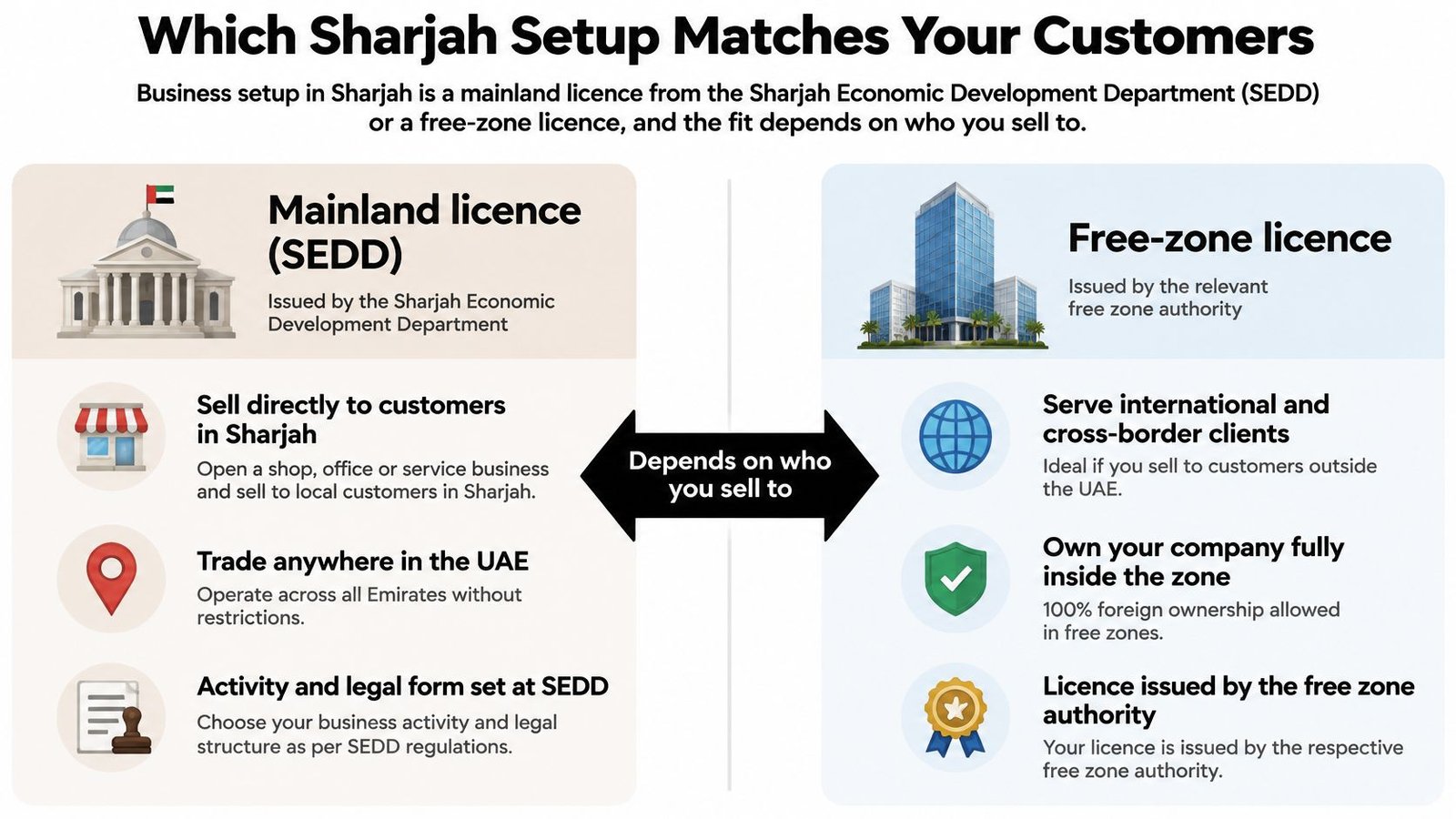
Business setup in Sharjah usually means a mainland licence from the Sharjah Economic Development Department (SEDD) or a free-zone licence. The right fit depends on who you sell to and how you deliver your goods or services.
During the first half of 2024, SEDD recorded 34,662 licences issued or renewed, 3% higher year on year, including 3,752 newly issued licences, according to Aletihad's report of SEDD figures. The same report states that foreign-ownership licences represented 13% of total licences in 2023, linked to capital of AED 3.23 billion.
What is a Sharjah mainland company?
A mainland company is a business licensed by SEDD to carry out its approved activities, with a physical office. It can trade across the United Arab Emirates and abroad, pursue local and government contracts, and open locations in other emirates, subject to any branch, premises or sector approvals needed. Foreign ownership is available for most activities, although strategically restricted activities need separate checking.
How does a free zone differ?
A free-zone company is a business licensed by a free-zone authority, with full foreign ownership and permission to trade within its zone and internationally. Its licence doesn't itself grant unrestricted mainland operating rights, and office or flexi-desk arrangements must suit the activity. When considering Sharjah Media City as a free-zone option, check the permitted activity, workspace and visa allocation together.
Who should look offshore?
An offshore company is an international holding or trading vehicle, rather than a licence for running a local UAE business. It has no UAE office and doesn't provide UAE residence visas. It may suit an international ownership structure, but it isn't a substitute for an operating company when you need local premises, staff or mainland sales rights.
Sharjah setup paths compared
| Path | Where you can sell | Office | Visas | Tax position |
|---|---|---|---|---|
| Mainland via SEDD | Across the UAE and abroad, including local contracts | Physical office required | Investor and employee visas available, subject to approval | Standard federal taxable-income bands apply |
| Sharjah free zone | Inside the zone and internationally; mainland operations need the appropriate permission | Office or flexi-desk, activity permitting | Visas subject to quota and approval | Preferential treatment applies only when qualifying conditions are met |
| Offshore | International trade and holding only | No UAE office | No UAE visas | Assess UAE taxable nexus before assuming no UAE tax |
Ownership isn't the same as market access. Being able to own a company fully doesn't mean every licence gives you identical rights to sell, store goods or employ people.
Say you're moving an overseas consultancy to Sharjah. Test whether the proposed free-zone operation has the staff, premises and actual business activity needed for its intended tax treatment, rather than assuming overseas clients make it tax-free.
A trader supplying shops in Sharjah or Dubai has a different starting point. Plan the mainland premises, goods handling and customer contracts together, instead of choosing an international-facing licence and trying to repair the sales permissions afterwards.
Documents and Premises for Your Activity
SEDD doesn't use one universal file for every business. Its licence-issuance guidance identifies documents and approvals according to the activity, investor's status and premises, including identification, tenancy evidence, technical evaluation and external clearances.
A trade-name certificate is approval of the proposed business name, not permission to begin operating. A no-objection letter is a document confirming that the relevant party has no objection to the proposed arrangement, and it's required only where the applicable process calls for it.
What does a consultancy need?
A consultancy should begin with a precise description of its services, such as management advice or software consulting, rather than a broad label that conceals regulated work. A smaller office may be suitable if the approved activity and licensing authority allow it. A consultant providing advice remotely still needs to distinguish ordinary business advice from services requiring professional or sector approval.
What changes for trading?
A trading company needs activity wording that matches the goods it buys and sells. Shop, warehouse or storage evidence should reflect how the business handles those goods, rather than providing an address alone. If you'll use a separate storage operator, establish what evidence the licensing authority needs before committing to the arrangement.
What about industry?
An industrial operation can require technical evaluation and inspections before the premises are accepted. Manufacturing, processing and machinery installation need a site assessment, not just an office quotation. Customer-facing businesses such as clinics, salons and food outlets should also plan for municipal or relevant sector approvals, so a virtual desk isn't equivalent to an approved operating site.
Sharjah licence papers by situation
| Document or approval | When it applies |
|---|---|
| Trade-name certificate | Before the licence application |
| Passport and ID copies | Foreign investors |
| Residency and foreigners affairs approval | When immigration status is part of the file |
| Certified lease and title deed | When the activity requires premises |
| Technical evaluation | Activities SEDD flags for technical review |
| Approvals from other authorities | Regulated or externally supervised activities |
| No-objection letter | Foreign investor employed by a UAE governmental or federal body |
Can I finish this from abroad?
Some government steps can be completed through a legal representative, but remote incorporation doesn't mean every residency step is remote. SEDD's public guidance allows for processes requiring the concerned parties or their legal representatives to attend. We act for owners based outside the UAE on government matters, while clients attend steps requiring their own presence, including biometrics and medicals.
Before signing a lease: Put the exact activity, proposed premises and signatory's location on the same page. Resolve any disagreement between those details before paying a non-refundable tenancy commitment.
For an owner abroad, that page should also identify who can sign and which authority will accept their authorisation. This makes the travel plan a response to actual requirements, rather than a guess based on a package description.
How to Licence a Sharjah Company in Order
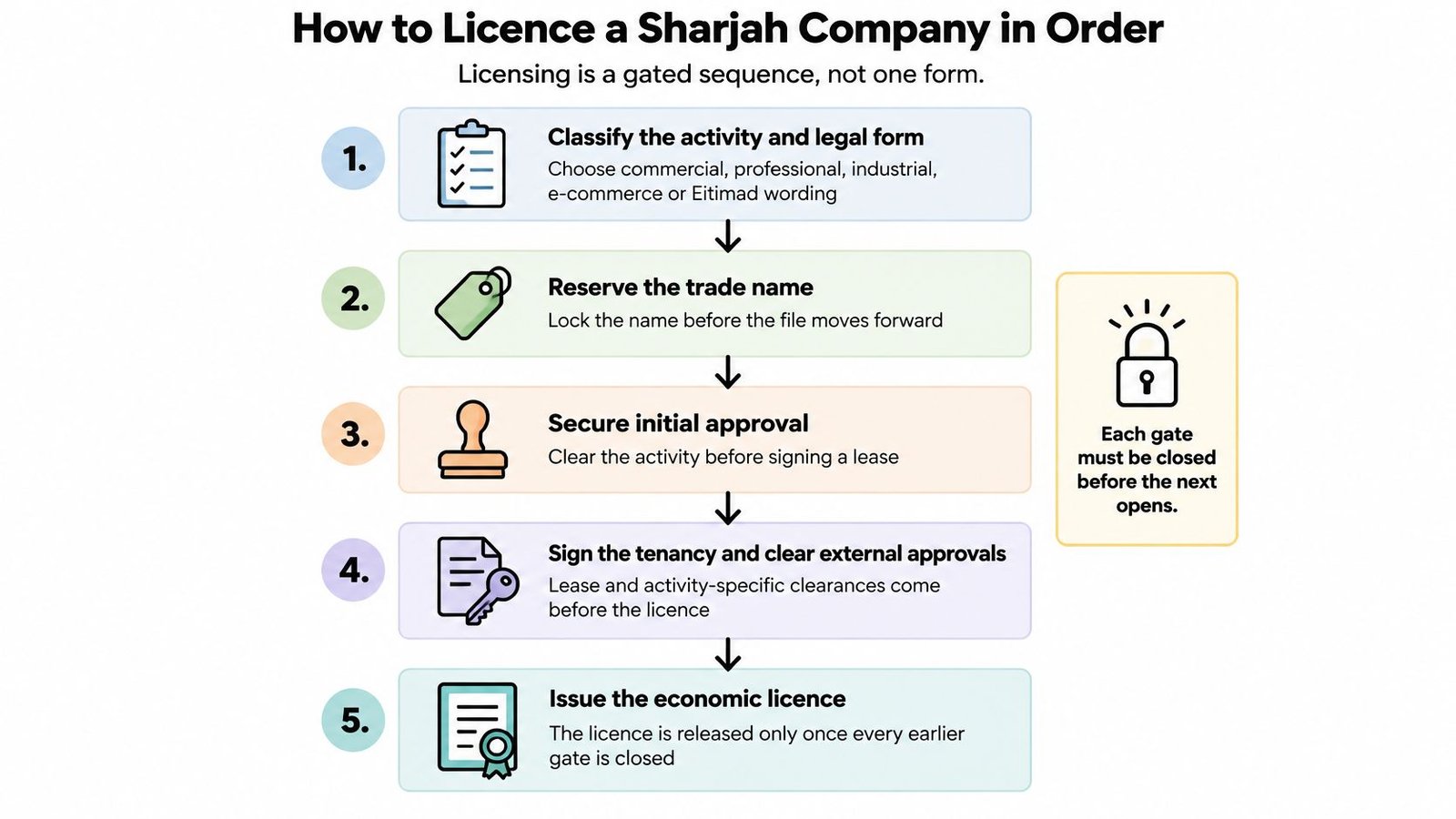
Licensing in Sharjah works like a relay: each approval hands information to the next stage, so a detail fixed late can send you back several legs. Changing the activity after securing premises can mean revisiting the tenancy, the constitutional documents and any external permissions already obtained.
The Sharjah Chamber's new-membership checklist identifies the licence, lease and commercial or constitutional documents as core evidence, together with an attested no-objection certificate where relevant. Its membership service covers commercial, industrial, agricultural and vocational activities, with fees set by activity and legal form.
Classify the activity and legal form. The licence is written for specific activities, so choose commercial, professional, industrial, e-commerce or Eitimad wording only where you meet the relevant eligibility conditions. The legal form is the company's legal structure, and it should reflect the owners, liability arrangements and intended operation.
Reserve the trade name and obtain initial approvals. Match names, passport details and proposed activities across the application. Initial approval is a preliminary clearance, so hold off serving customers until the economic licence itself is issued.
Secure a compliant lease. Check the permitted use before signing. An administrative office won't necessarily satisfy an activity involving retail customers, food preparation or machinery.
Execute and attest the constitutional documents. A memorandum of association sets out the company's ownership and operating framework. Complete the partnership or other constitutional papers required for the legal form, including a duly attested no-objection certificate where the file calls for one.
Apply to SEDD for the economic licence. Submit the completed application with the premises evidence and activity-specific approvals. Read the issued licence straight away and check the spelling, ownership and activity lines for errors.
Register with the Sharjah Chamber of Commerce and Industry. Assemble the licence, lease and constitutional papers into one consistent membership file. Licence issuance does not automatically complete every related registration.
Start the tax, immigration and banking workstreams. Reconcile the licence wording, lease use, constitutional documents and the business description in your bank application. A consultancy licence paired with a bank application describing goods distribution is the sort of mismatch that prompts clarification and rework. Tax is its own workstream from day one: a free-zone label does not settle the outcome by itself, and elections such as Small Business Relief still require a filed Corporate Tax return.
How long does SEDD take?
We say most UAE trade licences can be issued within 3 to 5 working days, depending on the jurisdiction and business activity, once the file is complete. That window is neither a guaranteed SEDD turnaround nor a promise that residency and banking finish within the same period. External approvals, technical review and government decisions can extend the schedule, so tie your launch date to confirmed approvals rather than the application date.
When do visas start?
An establishment card is the company's immigration registration record, and it sits separate from the economic licence. For newly licensed companies, we handle the establishment card, first investor visa and Emirates ID as distinct files. An Emirates ID is the UAE identity card held by the individual, while the licence belongs to the company.
For a free-zone company, keep the zone licence, lease and constitutional documents ready. Confirm whether Chamber membership or additional mainland permission is needed for the intended customer-facing activity before accepting work that requires it.
Corporate Tax Once the Licence Is Issued
UAE Corporate Tax is a federal tax, so a Sharjah company's obligations aren't determined solely by whether its customers are in Sharjah, Dubai, Abu Dhabi or abroad. The UAE Government's Corporate Tax guidance sets the standard rates at 0% on taxable income up to and including AED 375,000 and 9% above that amount, for financial years beginning on or after 1 June 2023.
UAE Corporate Tax checkpoints for a Sharjah company
| Item | What applies |
|---|---|
| Taxable income up to AED 375,000 | 0% |
| Taxable income above AED 375,000 | 9% |
| Start date | Financial years beginning on or after 1 June 2023 |
| Small Business Relief | Optional election in the return; filing still required |
| Who cannot use the relief | Qualifying Free Zone Persons and multinational group members |
| Free-zone qualifying income | 0% only when qualifying-income rules are met |
A Qualifying Free Zone Person is a free-zone business that satisfies the federal conditions for the special tax regime. Preferential treatment applies to qualifying income, not automatically to every receipt, and non-qualifying taxable income is subject to the applicable standard treatment.
If I qualify for Small Business Relief, do I still file?
Yes, relief doesn't remove the return requirement. The Federal Tax Authority's Small Business Relief guidance explains that eligible resident businesses elect relief in their return and are treated as having no taxable income for the relevant period; the AED 3 million revenue threshold isn't a blanket exemption, and Qualifying Free Zone Persons and multinational enterprise group members cannot use the relief. Registration, eligibility assessment and filing therefore remain separate tasks.
No tax payable doesn't mean no tax return. A relief election belongs in the filing process, not in place of it.
Revenue and taxable income aren't interchangeable. Revenue is the business's income from sales and services before the relevant expense and tax adjustments, while taxable income is the amount calculated under the tax rules.
How do I stay ready?
Build the accounting file when the company starts, not when a return is nearly due. For a practical explanation of the wider obligations, use our guide to Corporate Tax in the UAE.
- Register and define the year. Confirm the applicable registration requirements and financial year.
- Keep usable books. Map activities to revenue and retain invoices, contracts and expense evidence.
- Separate owner and company funds. Record shareholder payments clearly and document related-party pricing.
- Assess relief before electing it. Check revenue, tax status, ownership and the relevant period, then submit the required return.
- Review changes promptly. Reassess eligibility when revenue grows or the business model changes.
The Ministry of Finance's Sharjah awareness-session guidance highlights accounting, relief and related-party issues. As an internal management target, aim to close the books within 10 business days each month and review the tax position quarterly, not as statutory deadlines.
Costs and the Golden Visa Capital Test
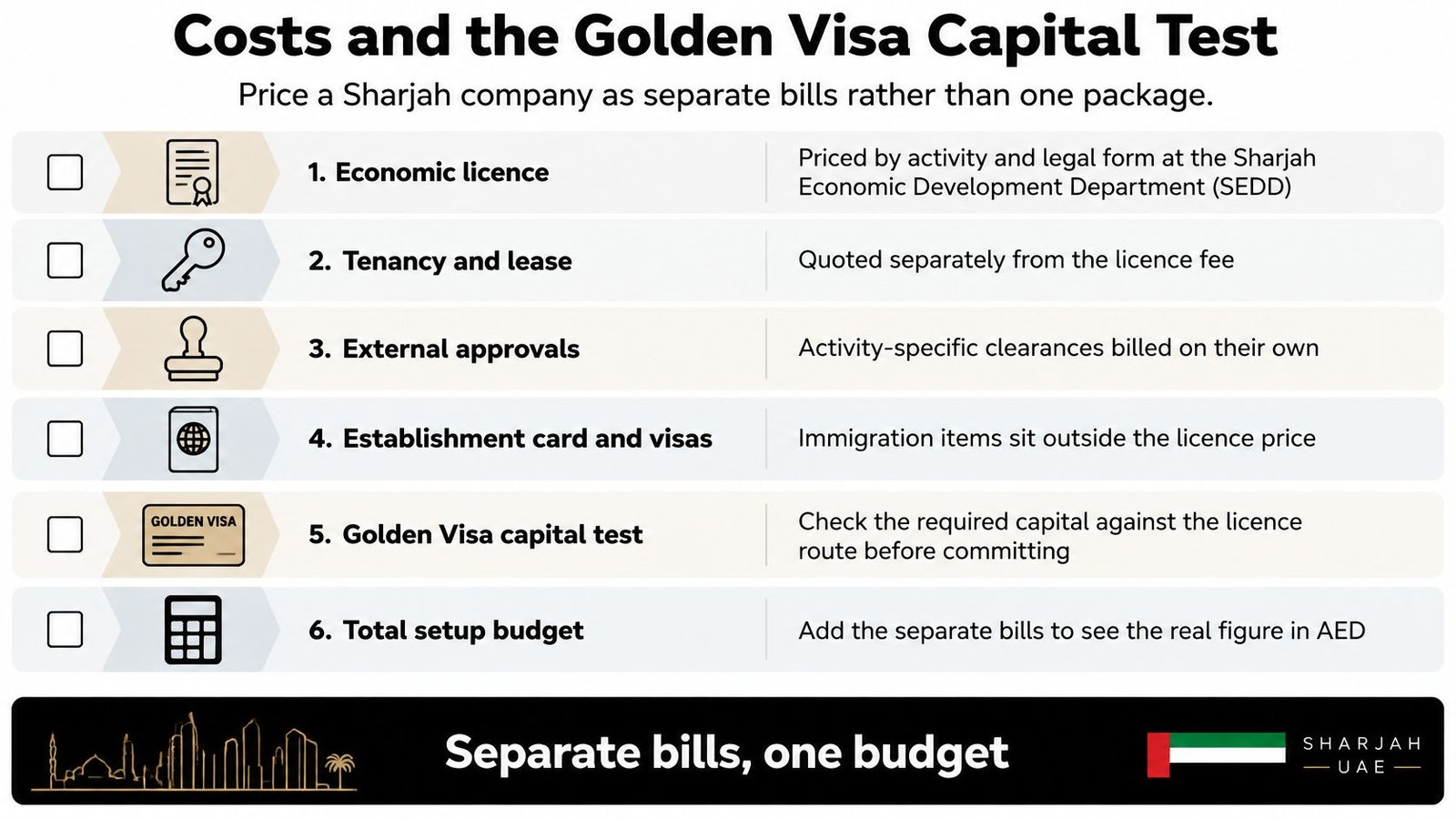
Price a Sharjah company as separate bills, not a single headline package. A useful budget distinguishes government charges, premises, professional work and immigration costs, then identifies which items recur at renewal.
The economic licence is priced according to the activity and legal form. Chamber membership is another bill for the activities within its membership scope, while tenancy can materially change the overall budget. Confirm whether the quoted premises are acceptable for your activity before comparing offers.
What should a setup quotation separate?
Ask for an itemised written scope rather than a total with unclear exclusions. The quotation should distinguish initial formation from the costs of operating and renewing the company.
- Licensing and registration. Separate the economic licence, name-related charges and Chamber membership.
- Premises. Identify rent, tenancy-related charges and any fit-out or inspection requirements.
- External approvals. Show activity-specific clearances separately, including any supporting document work.
- Immigration. List the establishment card, investor visa, medical and Emirates ID charges.
- Ongoing administration. Separate renewal, accounting and tax work from incorporation.
A low workspace price doesn't help if the selected activity needs a shop, warehouse or inspected site. Equally, paying for formation doesn't mean the owner's residence application has been completed or approved.
Does registering a company qualify me for a Golden Visa?
No, a trade licence alone isn't a Golden Visa qualification. The Federal Authority for Identity, Citizenship, Customs and Port Security identifies an investment route involving a UAE company with capital of at least AED 2 million, or a deposit of at least AED 2 million with an investment fund or national bank operating in the United Arab Emirates. The authority requires fully owned, non-borrowed invested capital, evidence of its source and ownership, and valid health insurance for the investor and family members.
A Golden Visa is a residence route with its own eligibility and evidence requirements, separate from permission to operate a business. Review the relevant Golden Visa eligibility criteria before choosing a structure around a residency objective.
Investment capital isn't the same thing as a setup fee. Paying incorporation, rent and visa charges doesn't by itself prove that you satisfy an investment route.
Keep source-of-funds records and capital evidence separate from your operating budget. That distinction helps you assess the residence application without confusing money spent establishing the business with qualifying investment.
Book the Sharjah Path That Fits Your Sales
Start with a short account of what the company will do, who will pay it and what the owner needs from the UAE arrangement. That description determines whether the route runs through the Sharjah Economic Development Department (SEDD), a Sharjah free zone authority or an offshore registrar.
Bring these facts into focus before committing to government fees. A founder, freelancer or HR manager should be able to explain the commercial operation and the residency requirements in plain terms, without leaning on package names.
What should I bring to a planning call?
Bring the activity in plain English, the locations of your first customers, whether you need a residence visa this year and the amount of fully owned investment capital available. Include an example contract or proposed invoice description if you have one. For an existing overseas business, explain whether the UAE company will deliver the work itself or support another group company.
- Activity. Describe what customers buy, not the sector you work in.
- Customers. Identify whether they are in Sharjah, Dubai, Abu Dhabi or outside the United Arab Emirates.
- People. List the owner and employees who need immigration processing. Each visa applicant attends their own biometrics and medical, and free-zone visa numbers are limited by quota.
- Capital. Distinguish business operating funds from money available for an investment-based residence application.
Which route should I test first?
If direct local trading and customer-facing operations are central to the business, test the mainland SEDD route first, including premises, because a mainland company requires a physical office. If the business mainly serves international clients, assess a Sharjah free zone against its actual activity, workspace needs and visa quota. Choose offshore only for international trade without UAE premises or visas; residence sponsorship and local trading both point back to the other two routes.
Keep the tax position separate from the licence label. A free-zone company can still carry Corporate Tax obligations, and Small Business Relief reduces the bill rather than removing the requirement to file a return.
A sound decision also assigns what happens after incorporation: who prepares the bank file, who maintains the accounts and who tracks immigration and licence renewals, so none of those responsibilities stays unassigned.
Inpro supports mainland, free-zone and offshore formation, including trade licences, Emirates IDs, visas, PRO services for government administration, corporate bank-account support, accounting and tax. Most UAE trade licences can be issued within 3 to 5 working days, depending on the jurisdiction and business activity. Before paying government fees, book a strategy call with our team or use our cost estimator to compare UAE setup paths.
Inpro matches your Sharjah activity to the right licence, premises and approval sequence, then coordinates the company and immigration files. Visit Inpro to book a strategy call or use the cost estimator, and bring your activity description, customer locations and visa requirements so the team can assess a practical starting route.