


The most repeated line in UAE business setup advice is that a free zone company pays no corporate tax. That's wrong as a blanket statement: a free zone company pays 0% only on qualifying income, and 9% on income that doesn't qualify, so the licence you hold matters far less than the invoices you raise.
I'd treat UAE free zone corporate tax as a classification exercise before it's a registration exercise. Two companies in the same Dubai free zone, with the same licence category and the same accountant, can end up with different tax outcomes because one sells to customers outside the country and the other bills clients on the mainland. The rules are federal, they're published, and they're manageable once you sort your revenue.
Table of Contents
- Which Free Zone Income Qualifies for 0% Tax
- How UAE Free Zone Tax Rules Actually Work
- The Four Conditions for Qualifying Free Zone Person Status
- How to Sort Each Revenue Stream Before You Invoice
- When Mainland Operations Pull Profit Into 9% Tax
- Registration, Filing and Records Each Year
- Common Pitfalls and Your Next Steps
Which Free Zone Income Qualifies for 0% Tax
A UAE free zone company pays 0% on qualifying income and 9% on income that does not qualify. The practical test is transaction by transaction: who is buying, where the sale is treated as taking place, what activity produced the income, and what evidence the company can produce.
Tax treatment of common free zone revenue types
| Income type | Usual rate | Condition to confirm |
|---|---|---|
| Sales to other free zone persons | 0% | Counterparty is the beneficial recipient and no excluded activity applies |
| Qualifying activities sold to customers outside the UAE | 0% | Activity is on the qualifying activities list |
| Qualifying intellectual property income | 0% | Qualifying IP conditions are met and records exist |
| Sales to UAE mainland customers | 9% | Incidental mainland sales within the de minimis limit set in the regulations may be treated as qualifying income; anything above that limit is taxed at 9% |
| Profits of a mainland branch or foreign permanent establishment | 9% | Profits are attributable to that establishment |
| Excluded activities such as banking or insurance | 9% | Activity is listed as excluded in the UAE regulations |
| Any non-qualifying income of a Qualifying Free Zone Person | 9% | No AED 375,000 small-business relief applies to this income |
The rate follows the income. A free zone licence creates the possibility of the preferential rate, but the invoice determines whether the income falls inside or outside it. That is why two revenue streams in the same company can produce different tax results. A service fee for a qualifying activity sold outside the UAE may sit at 0%, while mainland consulting income may sit at 9% unless it stays within the relevant de minimis limit and the other conditions are met.
In 2024 the UAE Ministry of Finance stated that the standard corporate tax rate is 9% on taxable income above AED 375,000, while qualifying free zone businesses can access a 0% rate on qualifying income. A Qualifying Free Zone Person (QFZP) is the free zone company that meets the statutory conditions and derives that qualifying income.
The AED 375,000 threshold does not give a QFZP a tax-free slice of non-qualifying income. The Federal Tax Authority's guide on free zone persons confirms that the AED 375,000 small-business threshold does not apply to non-qualifying income of a QFZP. In practice, that means the first dirham of that income can be taxable.
Practical rule: classify the transaction before you raise the invoice, not when you prepare the return.
Start with a revenue schedule for the last twelve months. Include subscription fees, mainland consulting, agency commissions, royalties, intra-group charges and rent, even where the amount is small or recorded as miscellaneous. Put each line against a row in the table, then mark the evidence you hold: contract, invoice, customer address, activity code, payment record and any IP documentation.
The gaps matter as much as the classifications. If a line is mapped to 0% but the activity, counterparty or de minimis position is not documented, treat it as exposed until the file supports the treatment. Then price, renew and invoice the next transaction with that answer already settled.
How UAE Free Zone Tax Rules Actually Work
The legal foundation is Federal Decree-Law No. 47 of 2022, which introduced the federal Corporate Tax framework. According to the Federal Tax Authority's free zone FAQ, the law was issued on 3 October 2022 and published in the UAE Official Gazette on 10 October 2022, and for qualifying free zone companies it preserves a 0% rate on qualifying income rather than exempting all profits.
That last distinction is the one that matters in practice. The regime doesn't ask where your company is registered. It asks what each dirham of revenue is.
The Federal Tax Authority (FTA) is the UAE's tax regulator: it registers taxpayers, issues guidance and decisions, and receives returns. Its guidance defines a Qualifying Free Zone Person as a free zone entity that satisfies the statutory conditions and derives qualifying income. The two-rate structure that results, 0% on qualifying income and the standard 9% on taxable income that doesn't qualify, is set out in Article 3(2) of the Decree-Law and applied transaction by transaction in the FTA's guide on free zone persons.
What counts as qualifying income under the guidance?
The FTA's guidance sets out four broad routes: transactions with other free zone persons where the required conditions are met, income from specified qualifying activities with non-free zone persons, qualifying intellectual-property income, and certain other income subject to the applicable de minimis requirements. Each route has its own boundary, which is why a single company can sit in two categories at once.
A free zone entity can run both outcomes in the same quarter. Fees that fall inside a qualifying route are taxed at 0%, while fees that fall outside every route are taxed at 9%, and the same profit and loss statement carries both lines. Location alone doesn't decide which line a transaction lands on. The regime combines a preferential rate with activity-based and compliance-based limits, so it functions as a conditional rate rather than a tax holiday you switch on at incorporation.
This is why the planning work starts with the revenue itself. Before anything else, every income stream the business expects to earn gets mapped against the four routes, because the classification determines the pricing, the contracts and sometimes the structure of the business. A company that discovers after invoicing that its largest revenue line never qualified has no mechanism to retrofit the 0% rate onto it.
Does the choice of free zone change the analysis?
No. Dubai, Abu Dhabi, Sharjah and the northern emirates all sit under the same federal corporate tax rules, so the zone name on your licence doesn't change the tax treatment of a sale. Zones differ on cost, facilities, visa quotas and permitted activities, and those are real commercial decisions. They're just not tax decisions.
A free zone licence creates the possibility of the 0% rate. What each revenue stream actually pays is settled by the nature of the income, tested line by line, and the rate applies from the first dirham of anything that fails the test.
The Four Conditions for Qualifying Free Zone Person Status
QFZP status isn't a certificate you collect with your licence. The FTA's corporate tax rate FAQ for free zone entities sets out what a company must do to earn the 0% treatment: maintain adequate UAE substance, derive qualifying income, comply with transfer pricing rules and documentation requirements, and not elect into the ordinary corporate tax regime.
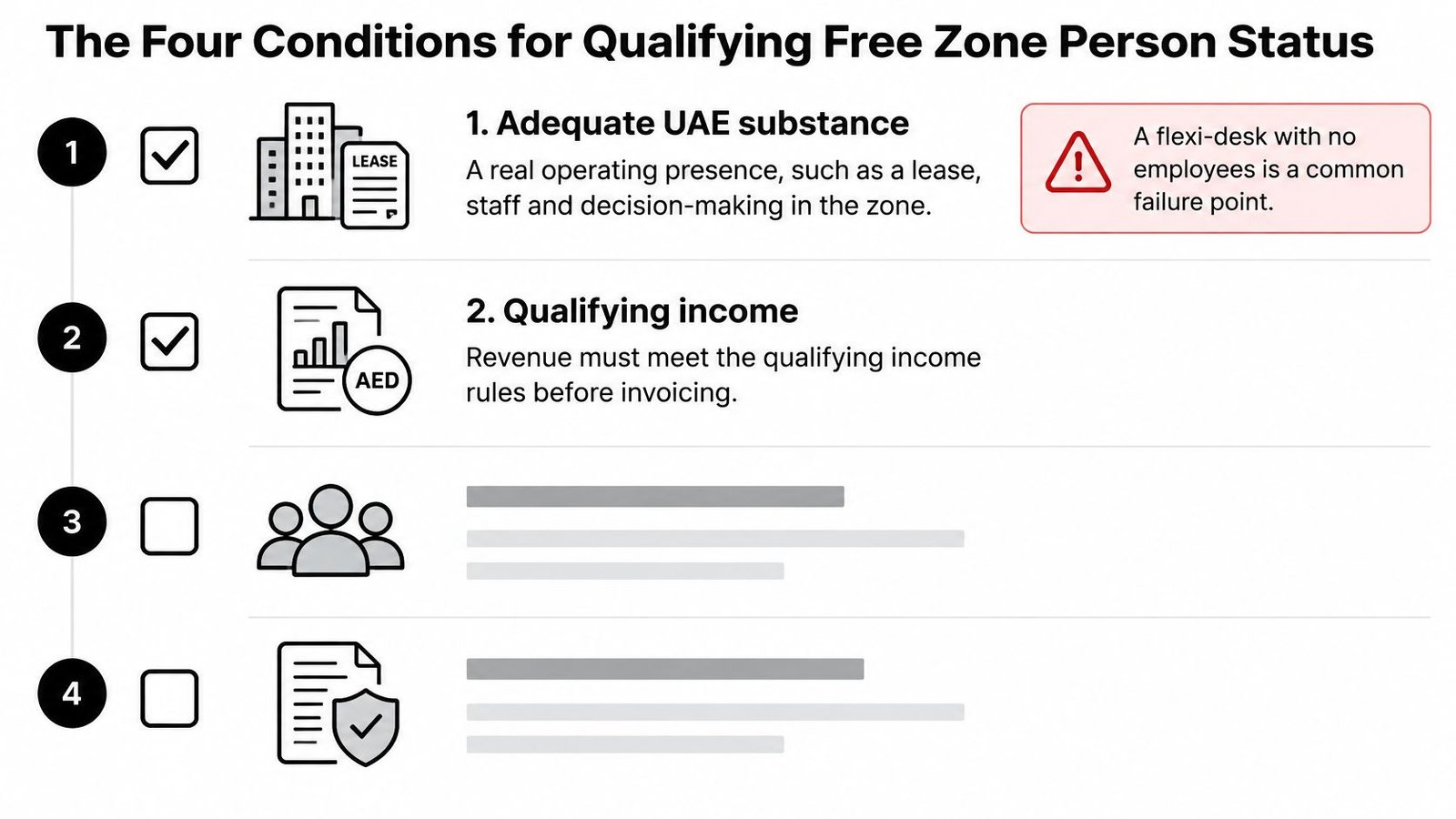
1. Adequate UAE substance
Substance is a real operating presence: premises appropriate to the activity, people doing the work, and decisions taken here. A Dubai consultancy billing from a flexi-desk with no employees and a director who visits twice a year is the classic weak case. A Jebel Ali Free Zone (JAFZA) trading company in Dubai with a leased warehouse, two staff on UAE visas and management decisions made locally is in a much stronger position. Keep the tenancy contract, the establishment card, employment contracts and salary transfer records.
2. Qualifying income
The revenue itself has to fall inside the defined categories, and the classification has to hold up transaction by transaction. A company with excellent substance and a warehouse full of stock still fails on income earned from an excluded activity. Keep signed customer contracts, purchase orders and the invoices that match them.
3. Transfer pricing compliance
Related-party transactions must be priced at arm's length, with documentation to support the price. Say a free zone company charges its mainland sister company a management fee: the fee needs a basis, such as hours logged or a documented cost-plus calculation, not a round number chosen at year end. Keep the intercompany agreements, the pricing policy and the workings behind each charge.
4. No election into the ordinary regime
A free zone company can elect to be taxed under the standard rules, and that election closes off the 0% treatment. Founders sometimes make it deliberately for a specific commercial reason, and sometimes drift into it through a filing decision nobody reviewed. Keep the board resolution or written note recording the position you've taken.
How often is the test applied?
Every tax period, not once at incorporation. Substance that was adequate in your first year can thin out when a manager relocates, and a customer mix that was entirely overseas can shift towards mainland clients within a quarter. Gather the evidence file now: lease or office contract, staff contracts, board or management minutes, customer contracts, and the group's pricing policy.
A free zone licence proves where you're registered. Your evidence file proves what you're entitled to.
How to Sort Each Revenue Stream Before You Invoice
Classification works best as a fixed routine your finance person runs before an invoice leaves the system. Seven checks, in this order, each ending with a record you keep.
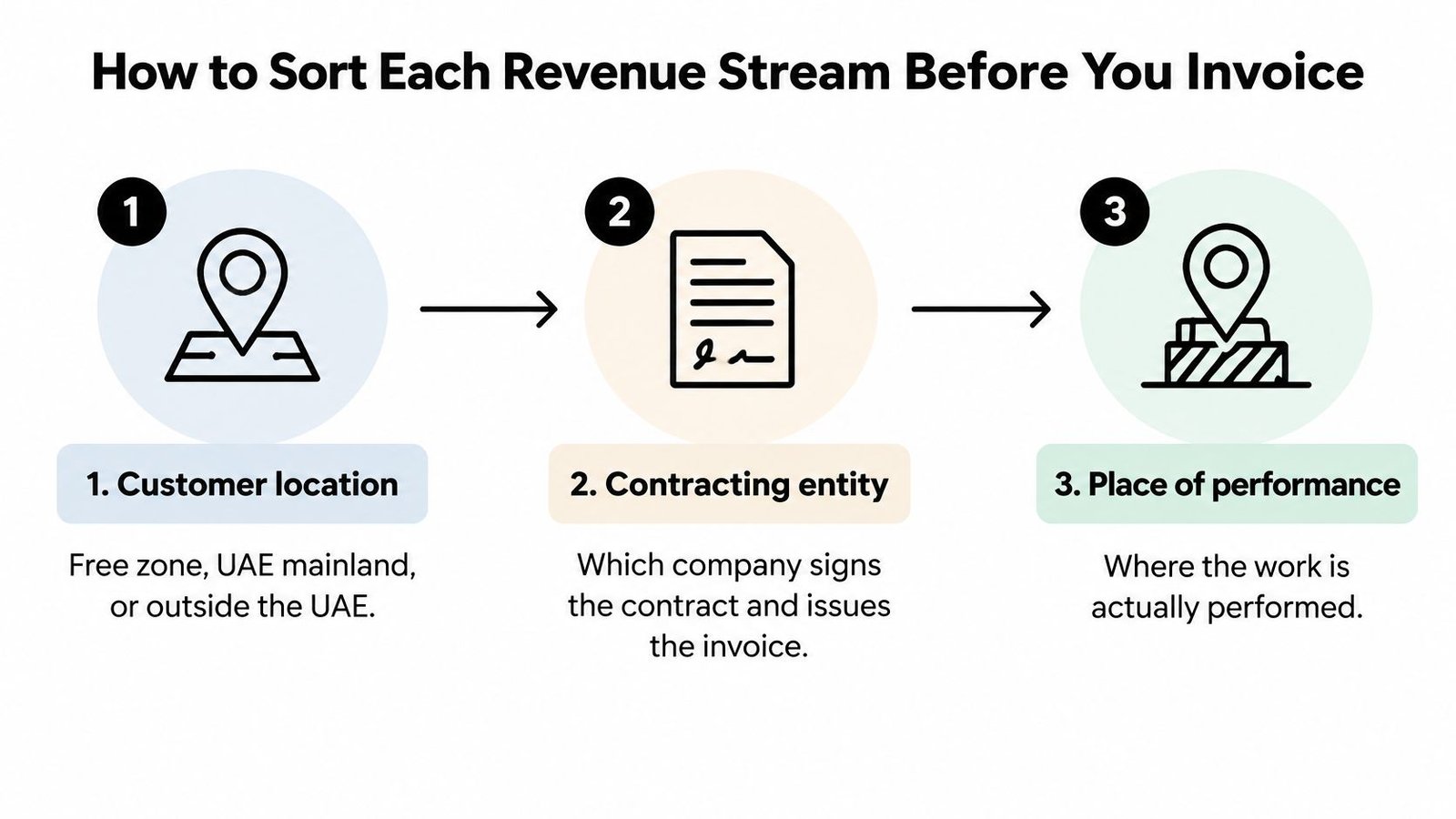
1. Customer location. Is the customer in a free zone, on the UAE mainland, or outside the country? Ask for the trade licence copy and registered address at onboarding rather than trusting the billing address on a purchase order. Record: licence copy and registered address.
2. Contracting entity. Which of your companies signs the contract and issues the invoice? Groups often have a free zone entity and a mainland entity, and the paperwork drifts to whichever template was open. Record: the signed contract naming the entity.
3. Place of performance. Where is the work done? A project delivered by staff sitting in a mainland office isn't the same fact pattern as one delivered from your free zone premises. Record: delivery location, timesheets or site notes.
4. Activity classification. Does the activity sit on the qualifying activities list, or is it outside it? Compare what you delivered against the list, not against the broad wording on your licence. Record: the activity code and your written reasoning.
5. Beneficial recipient. Who benefits from the transaction? A free zone customer that immediately resells into the mainland isn't the beneficial recipient of your supply, and treating it as one is a common misreading. Record: the end-customer details or the reseller's declaration.
6. Excluded activity check. Run the transaction against the excluded list in the regulations before you accept the work. Certain financial and property-related activities sit outside the preferential treatment regardless of where you're registered. Record: the check result and the date you ran it.
7. De minimis test. Whatever remains non-qualifying gets measured against the applicable de minimis requirements for the period. Track it cumulatively through the year rather than discovering the position in month eleven. Record: a running schedule of non-qualifying revenue against total revenue.
The video below walks through how the classification questions apply in practice.
What does this look like for a software business?
Say a free zone SaaS company sells subscriptions to a bank headquartered on the Dubai mainland. That revenue is non-qualifying, even though the product is delivered from free zone servers and the contract was signed there. The same product sold to a customer outside the UAE can qualify, provided the activity itself is on the qualifying list. One product, two treatments, and the difference is the customer.
Consulting works the same way. A free zone entity earning fees for work delivered to mainland clients is taxed at 9% on that income unless the activity fits a qualifying category. Free zone companies can trade freely within their zone and internationally, but selling directly to the UAE mainland usually requires a local distributor or an additional licence, and doing it without either creates both a licensing problem and a tax one.
Build the transaction log with those seven fields before your first invoice goes out. A spreadsheet is enough at the start, as long as every row is completed at the point of sale.
When Mainland Operations Pull Profit Into 9% Tax
Say a Dubai free zone company keeps three consultants in a rented office on the Sharjah mainland. They meet clients there, deliver projects there, and the fees are invoiced from the free zone entity. The profits linked to that office are taxed at 9%, even though the rest of the company's income qualifies for 0%.
What is a permanent establishment?
A permanent establishment (PE) is a fixed place of business that creates a taxable presence in a location other than the one where the company is registered. An office, a branch, a warehouse or a project site can all create one. The Federal Tax Authority's corporate tax guide on free zone persons explains that where a Qualifying Free Zone Person operates through a permanent establishment in the UAE outside a free zone, or through a foreign permanent establishment, the profits attributable to that establishment are subject to 9% corporate tax.
The point founders miss is that this applies alongside qualifying income, not instead of it. You don't lose the whole 0% position because you opened a mainland office. You carve out the profit that belongs to it.
How do you separate the profits?
Work in three layers, in this order:
- Separate ledgers. Give each establishment its own revenue and cost records inside your accounting software, using a branch or cost-centre dimension in Xero or QuickBooks rather than a second set of books nobody reconciles.
- Documented cost allocation. Write down how you apportion staff time, rent, software and management overhead, then apply the same method every period. A one-page allocation memo signed by management is worth more than a spreadsheet formula nobody can explain.
- Intercompany charges that reflect real activity. If the free zone entity provides services to the mainland branch, charge for what was delivered, with an agreement behind it.
Before you accept a mainland contract, check the licensing side too. Our guide to the difference between mainland and free zone companies in the UAE sets out where a distributor arrangement, a branch or a separate licence is the cleaner route.
Which places should you review?
Offices, rented desks, warehouses, storage units and staff who habitually work from another emirate or another country. A single employee running operations from a fixed overseas location can create a foreign permanent establishment, and that profit needs the same treatment. List every physical location your people work from, then ask which ones generate revenue.
Registration, Filing and Records Each Year
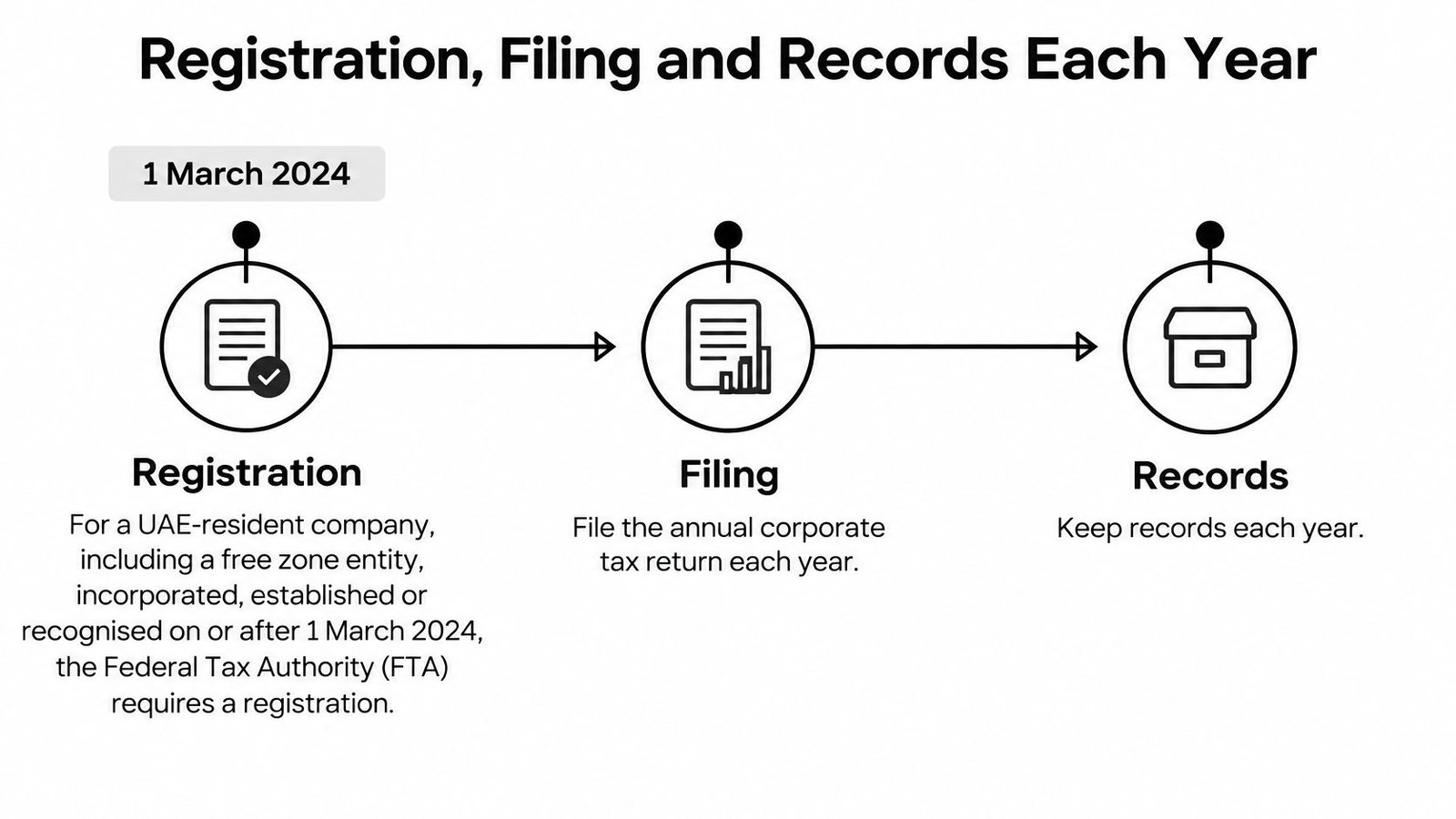
Registration comes first, and it's independent of your tax rate. For a UAE-resident juridical person, including a free zone entity, incorporated, established or otherwise recognised on or after 1 March 2024, the Federal Tax Authority's decision on registration timeframes requires a corporate tax registration application within three months of the incorporation, establishment or recognition date. A trade licence doesn't register you for tax, and expecting all your income to qualify doesn't excuse the application.
Corporate tax deadlines and records for free zone companies
| Item | Deadline or period | Why it matters |
|---|---|---|
| Corporate tax registration for a company incorporated on or after 1 March 2024 | Within 3 months of incorporation or recognition | Separate from the trade licence and required even if income qualifies |
| Corporate tax return for each tax period | 9 months after the end of the tax period | Reports qualifying and non-qualifying income separately |
| Designated zone distribution records | For tax periods beginning on or after 1 January 2026 | Supports the claim that distribution activity is qualifying |
| Transfer pricing documentation | Kept for each tax period | Supports market-value pricing between related companies |
| Financial and transaction records | Kept for at least 5 years | Lets the FTA verify the split between income types |
What changes for distribution businesses in a designated zone?
A designated zone is a free zone area listed for the purposes of the distribution rules, and distribution in or from one is treated differently from ordinary free zone trading. FTA Decision No. 6 of 2026 introduces additional compliance procedures for Qualifying Free Zone Persons distributing goods or materials in or from a designated zone, applying to tax periods beginning on or after 1 January 2026.
The evidence burden is operational, not theoretical. Distributors, ecommerce operators and logistics businesses should be keeping inventory and goods-movement records, customer and supplier classifications, signed contracts, transfer pricing support and customs documentation that shows the activity took place inside the relevant designated-zone framework. If you can't produce the movement records for a period, the position is hard to defend. Our breakdown of UAE corporate tax filing deadlines covers how the return cycle fits around your financial year.
What should you set up this week?
- Record the incorporation date exactly as it appears on the licence.
- Diary the registration deadline against that date.
- Diary the return deadline against your tax period end.
- Open an evidence file for each tax period, with subfolders for substance, customers and pricing.
Mainland and free zone companies both carry an ongoing UAE tax and compliance requirement, while offshore companies don't. We keep up with current rules across Dubai mainland and the free zones so that the filings we prepare meet them.
Common Pitfalls and Your Next Steps
The costliest mistake is treating the whole company as 0% and never splitting the income. Once you've filed on that basis, every dirham that fails the test sits at 9%, and unpicking a submitted return is slower and more expensive than classifying correctly at the outset. The companies that get into trouble rarely have exotic structures. They have ordinary mainland sales recorded as if they were exports.
What are the symptoms worth checking today?
- A mainland office or staff member with no separate profit record. Open a separate ledger for each establishment and allocate costs on a documented basis.
- Mainland customers invoiced from the free zone entity with no distributor or licence in place. Classify each sale before invoicing, and fix the licensing route in parallel.
- Assuming small-business relief covers the non-qualifying income of a QFZP. It doesn't. Calculate that income at 9% from the first dirham.
- A missed three-month registration window for a newly incorporated company. Record the incorporation date the day the licence is issued and apply on time.
- Designated zone distribution with no inventory or movement records. Rebuild the evidence trail for each tax period, starting with customs and warehouse documents.
- Contracts or the business model changed mid-year without a review. Rerun the revenue mapping whenever the customer mix or delivery location shifts.
If your accounting system can't produce a qualifying versus non-qualifying revenue split on demand, you don't have a tax position, you have an assumption.
Does small business relief change the picture?
Only for companies that aren't claiming QFZP treatment, and only within the conditions that apply to them. Revenue size interacts with the relief rules in ways that catch growing businesses out, and our piece on the small business countdown to the 2026 tax cliff explains where the pressure points sit as turnover climbs. Read it alongside your own revenue map, not instead of it.
What order should you work in?
- Map each revenue stream against the treatment table and mark the ones you can't evidence.
- Confirm the four QFZP conditions with documents, not recollections.
- Confirm your registration date and the return deadline for the current tax period.
- Set a quarterly review of customer mix, locations and related-party charges.
I'd run that review on a fixed date each quarter rather than waiting for year end, because a customer added in month two can change the answer for the whole period. The 0% position is only as strong as the records behind it, and records are cheap to keep contemporaneously and painful to reconstruct.
Setup speed isn't the constraint here. Most UAE trade licences can be issued within 3 to 5 working days, depending on the jurisdiction and business activity, while the classification work takes longer and deserves the attention. We handle company formation and licensing across UAE mainland, free zone and offshore entities, including legal and government permits, fast-track registration and regulatory compliance, and we facilitate corporate tax registration and banking introductions so the tax side starts on the right footing.
Not sure which of your revenue streams qualifies? The team at Inpro handles UAE company formation, corporate tax registration and the filing calendar, and can review your customer mix before you commit to a structure. Book a free strategy call and bring your last twelve months of invoices, so you leave with a clear view of what sits at 0% and what doesn't.