


If you're comparing licence packages and wondering what happens after payment, business setup in a Dubai free zone starts with matching your activity, customers, office and visa needs to the right authority. The licence is only the beginning: you also need a workable plan for banking, tax and any business you intend to conduct on the mainland.
Table of Contents
- Choosing Between Free Zone, Mainland and Offshore
- How to Set Up a Free Zone Company in Dubai, Step by Step
- Documents and Ownership Rules Before You Apply
- Where the 0% Tax Benefit Stops and Mainland Access Starts
- Visas, PRO Support and Your Corporate Bank Account
- Keeping Your Free Zone Company Compliant After Launch
- Confirm Your Zone and Licence Before You Apply
Choosing Between Free Zone, Mainland and Offshore
A Dubai free zone company often suits founders serving international customers who want full foreign ownership, while a mainland company generally suits businesses needing direct local operations and access to government tenders. UAE is the abbreviation for United Arab Emirates, and official material uses both names interchangeably.
A free zone is a designated economic jurisdiction with its own licensing authority. A mainland company is licensed for onshore operations, while an offshore company is a separate structure intended for international business or holding purposes rather than local premises and employment.
Free zone, mainland and offshore compared
| Criteria | Free Zone | Mainland | Offshore |
|---|---|---|---|
| Foreign ownership | 100% for most activities; some restricted activities | 100% for most activities; some restricted activities | 100% for most activities |
| Where you can trade | Within the zone and internationally; mainland access needs an approved route | Throughout the UAE and globally | International trade only |
| Physical office | Generally required; flexi-desk options available | Required | No UAE operating office required |
| UAE visas | Subject to quota | Available through applicable approvals | Not available |
| Government contracts | Check tender eligibility and mainland permissions | Can bid for government contracts | Not a local operating route for government work |
| Tax position | Conditional qualifying treatment, not blanket exemption | Standard Corporate Tax framework | Inpro's offshore comparison describes no UAE tax or compliance requirement; confirm the proposed entity's actual treatment before relying on this |
Don't choose offshore solely on a tax label. Establish where the company will be managed, what it will own and what transactions it will undertake before accepting any exemption claim.
Which free zone fits your business?
A UAE government statement published in 2024 reported 44 multi-specialised free zones that had attracted more than 60,000 companies since 2021. That breadth makes sector fit more useful than choosing a familiar name.
Financial firms may need the Dubai International Financial Centre (DIFC), subject to their proposed activities and regulatory requirements. Trading and logistics businesses often consider Jebel Ali Free Zone (JAFZA), while technology founders may prefer an innovation-focused environment.
Which structure suits a service business?
A remote consultancy with overseas customers has different requirements from a business sending staff to client premises in Dubai. Our mainland and free zone comparison helps separate ownership from operating permissions, which aren't the same thing.
Before comparing packages, identify who your customers are, whether you need a private office or shared workspace, and your first-year visa requirement. A flexi-desk is shared workspace offered through an approved office arrangement, not permission to ignore premises requirements.
How to Set Up a Free Zone Company in Dubai, Step by Step
Treat formation as a sequence of approvals, not a single purchase. Keep an application tracker with the responsible person, outstanding documents, payment status and next action for each stage.
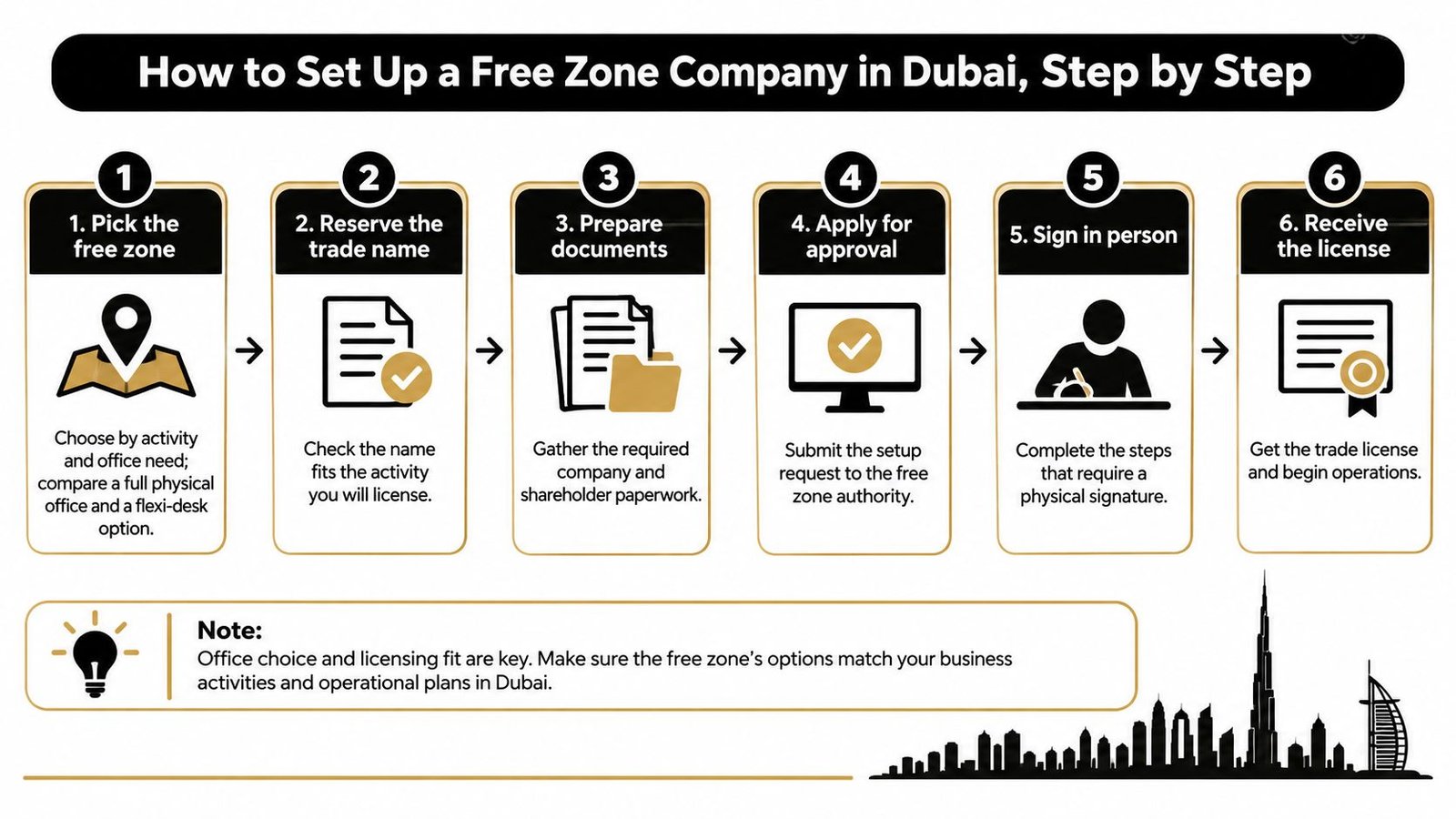
The infographic gives the licensing overview; the checks below extend through operational readiness.
What should you complete before the licence is issued?
Pick the free zone by activity and office need. Ask the authority to confirm that the activity code covers what you'll sell, then compare a physical office with an approved flexi-desk arrangement. Common slip: choosing the cheapest package before checking premises, staffing or external approvals.
Reserve the trade name. Make sure the proposed name fits the licensed activity and the authority's naming requirements before using it on contracts or branding. Common slip: treating a name reservation as approval to trade.
Submit incorporation and ownership documents. A UBO, or ultimate beneficial owner, is the person who ultimately owns or controls the company, including through corporate shareholders. Common slip: providing the immediate shareholder's details without explaining the people behind that shareholder.
Obtain initial approval and the trade licence. We advise that most UAE trade licences can be issued within 3 to 5 working days, depending on the jurisdiction and business activity. Common slip: treating that licensing estimate as the timeline for banking, residency and the entire launch.
Initial approval means the application can progress; it isn't a substitute for the final licence. Licence and visa processing times remain subject to UAE government approvals and can change.
What happens after incorporation?
Secure the establishment or immigration card. An establishment card is the company's immigration registration record, used for relevant company-sponsored immigration transactions. Common slip: booking an owner's relocation around licence issuance without allowing for this stage.
Process residence documents. Arrange the owner's investor visa and Emirates ID, then employee applications within the approved allocation. Common slip: promising staff a start date before confirming quota and the required approvals.
Complete regulated-sector permissions. Confirm whether your activity needs consent from a regulator or another government authority before accepting work. Common slip: assuming a broad consultancy, trading or technology licence authorises every specialised service.
Activate tax and accounting controls. Register for Corporate Tax within the applicable Federal Tax Authority timeline, review VAT, or value added tax, registration against taxable supplies and imports, and begin bookkeeping immediately. Common slip: postponing records until renewal or assuming free zone status establishes tax eligibility.
The Federal Tax Authority (FTA) is the UAE authority administering federal taxes. Its guidance on free zone persons makes qualifying tax treatment conditional on matters including eligible income, audited financial statements and transfer-pricing compliance.
Launch check: You're ready for your intended transactions when the licence, establishment card, suitable bank account and relevant approvals are in place, not simply when incorporation is complete.
Put licence renewal and audit deliverables in a shared calendar. Assign a named owner to each deadline so a travelling founder or departing administrator doesn't leave the company without follow-up.
Documents and Ownership Rules Before You Apply
Both mainland and free zone companies allow 100% foreign ownership for most activities, while a small number of strategically important activities remain restricted. Check the exact activity code before choosing the jurisdiction, particularly if your description includes regulated services.
Ownership eligibility doesn't settle document requirements. An individual shareholder, an overseas holding company and a multi-level corporate group won't necessarily submit the same application pack.
What documents should you prepare?
Most applications start with the following documents, although the authority confirms the final list for the zone, legal form and activity.
- Identity: A clear passport copy for every owner and manager.
- Photographs: Passport-size photographs meeting the application specifications.
- Address: Proof of each applicant's residential address.
- Activity: A short description of the business and planned operations.
- Corporate shareholder: Its incorporation certificate and current register extract.
- Authority to proceed: A board resolution authorising the company setup.
- Ownership chain: Documents identifying the people who ultimately own or control corporate shareholders.
Use consistent spelling across passports, application forms, resolutions and company records. If a document shows an old address or previous company name, resolve the mismatch rather than hoping the reviewer will infer the connection.
How should you handle documents issued abroad?
Foreign-issued corporate documents may need translation and attestation before the authority accepts them. Confirm the required sequence and accepted language before ordering either service, because translating an incomplete or incorrectly certified document can create avoidable rework.
Keep original files separate from working copies, and use filenames that identify the shareholder, document type and issue date. Send legible copies with all pages included, rather than cropped phone images that omit certification stamps.
Collect corporate documents for every shareholder first. Obtaining approvals, signatures and attestations across countries is often harder to coordinate than preparing an individual's identification documents.
Customers must provide accurate, complete and updated documentation, comply with UAE laws, and pay service fees and government deposits on time. Tell the application handler immediately if ownership, contact details or passport information changes while approval is pending.
Where the 0% Tax Benefit Stops and Mainland Access Starts
A free zone licence doesn't make every sale tax-free. Under the FTA's Free Zone Person bulletin, a Qualifying Free Zone Person receives 0% Corporate Tax on Qualifying Income, while other income is generally subject to 9%, and all free zone persons must register for Corporate Tax.
A Qualifying Free Zone Person is a free zone entity that meets the applicable tax conditions. Qualifying Income is income meeting the statutory categories and requirements, not revenue invoiced from a free zone address.
How do different business models change the answer?
An overseas subscription software business should classify subscription revenue, any intellectual-property income and implementation services separately. Overseas customers alone don't establish qualifying treatment; the activity, contractual rights, customer status and place of performance need review.
A consultant serving mainland clients should examine both tax classification and permission to perform the work. Remote advice, repeated onsite delivery and a staffed client location can raise different operating questions, so the contract should describe where and how services will be performed.
A distributor selling into the mainland needs to map the goods, importer, storage location and delivery route. A Designated Zone is a zone with a specific tax designation, not a synonym for every free zone, and the distributor must test the relevant rules rather than assume its warehouse location settles the position.
For each model, prepare a transaction map before setting prices. Our guide to Corporate Tax in the UAE provides context for the tax workstream, which should remain separate from licensing approval.
Can a free zone company serve mainland customers?
Dubai Executive Council Decision No. 11 of 2025 introduced a route for certain Dubai free zone entities to operate on the mainland through an appropriate licence or permit, as explained in the Chambers practice guide. The relevant authority is Dubai's Department of Economy and Tourism (DET), formerly known in many references as the Department of Economic Development.
That route isn't automatic mainland equivalence. Match the permission to the operating model:
- Remote business-to-business services: Confirm whether the proposed delivery arrangement requires additional permission.
- Onsite consulting: Check the permission covering staff performing services outside the zone.
- Retail: Resolve premises and sales permissions before committing to a shop.
- Logistics: Check goods movement, customs arrangements and operational approvals.
- Regulated financial technology: Obtain the relevant financial-services permissions, not just a technology activity.
- Government contracting: Check tender eligibility and the operating licence required by the purchasing authority.
The common failures are practical, not theoretical:
- Untested tax marketing: Pricing contracts around an assumed exemption.
- Premature mainland commitments: Promising onsite delivery before confirming the necessary permit.
- Late restructuring: Adding a mainland route without updating contracts, invoicing, premises arrangements and tax documentation.
Visas, PRO Support and Your Corporate Bank Account
Say you're based abroad and want the company established before relocating. You can coordinate much of the paperwork remotely, but you'll still need to plan travel around steps that require your presence.
Document signing is one point to confirm before booking that trip.

What can a PRO handle while you're abroad?
A PRO, or Public Relations Officer, is a person or service that handles government transactions for a company on its behalf. We act for owners based outside the UAE on government matters, but clients must attend steps requiring their presence, including their own biometrics or medical checks.
For newly licensed companies, we handle the establishment card, the first investor visa and the Emirates ID. Emirates ID is the UAE identity card used for identification and many resident transactions.
Employee applications follow the company's approved immigration arrangements. Before signing a lease or confirming recruitment dates, obtain written confirmation of the visa allocation attached to the chosen package and premises.
Travel planning: Ask which appointments require you personally, which documents must be original, and whether any signature must be completed in person before booking flights.
A founder's residence application and an employee onboarding plan need separate trackers. If you're also considering a Golden Visa, don't assume the company licence itself establishes eligibility for that residence route.
The following video provides additional context for the setup process.
What will the bank need to understand?
Banks review the ownership structure, source of funds, business activity and supporting documents. Incorporation doesn't guarantee account approval, and an introduction doesn't replace the bank's independent compliance decision.
We facilitate the corporate bank account opening process through relationships with UAE banks and help clients meet compliance and documentation requirements. The practical preparation in our company bank account guide can help you assemble a coherent application.
Prepare a one-page activity description explaining what you sell, who pays you, where customers are located and how you deliver. Add a source-of-funds summary supported by relevant records, and ensure both match the company's ownership documents and proposed transactions.
A clear explanation is more useful than a lengthy presentation. If the bank asks about expected payments, answer with the commercial reason and supporting contract rather than a broad description such as international consulting.
Keeping Your Free Zone Company Compliant After Launch
Recurring obligations and when they apply
| Obligation | Timing | What It Involves |
|---|---|---|
| Trade licence renewal | Every year | Renew before expiry and keep the activity list current |
| Corporate Tax registration | Within the FTA timeline after incorporation | Register even when qualifying treatment is expected |
| VAT registration review | Ongoing, based on taxable supplies and imports | Check applicable thresholds and register when required |
| Revenue-by-activity review | Monthly | Test non-qualifying revenue against the qualifying framework |
| Audited financial statements | Where required | Arrange the statements required under the qualifying framework |
| Transfer-pricing documentation | Ongoing, for each related-party transaction | Support pricing between related parties |
| Bookkeeping | From the start of operations | Separate Qualifying Income from other income in the ledgers |
Why does the revenue split need active monitoring?
Under the FTA Corporate Tax General Guide, the de minimis requirement limits non-qualifying revenue to the lower of AED 5 million or 5% of total revenue. Apply the prescribed calculation and exclusions rather than treating every accounting receipt as part of the same test.
A de minimis requirement is a limit on the amount of non-qualifying revenue permitted within the qualifying framework. It isn't permission to ignore other conditions, such as adequate substance, eligible activities or supporting documentation.
Use a monthly dashboard that separates revenue by activity, customer location and counterparty status. Have the accountant review contracts that introduce a new service, property-related income or a permanent-establishment question before the commercial team signs them.
What records should stay connected?
Maintain a document matrix linking each licensed activity to its contracts, invoices, premises evidence, accounting codes and approval requirements. This lets the person preparing a return trace the classification to actual business documents rather than reconstructing it from bank statements.
- Approve changes early: Review new activities and customer arrangements before invoicing.
- Keep substance evidence: Retain records showing the people, premises and operations supporting the business.
- Support related-party pricing: Keep agreements and explanations for transactions within the group.
- Assign deadlines: Give renewal, registration, return and audit tasks a named owner.
A licence proves that an authority approved specified activities. It doesn't prove that every transaction, tax position or employment arrangement remains compliant as the business grows.
Confirm Your Zone and Licence Before You Apply
The best jurisdiction is the one that supports the business you'll run, not just the lowest advertised entry price. A package that leaves you without the required workspace, staffing capacity or mainland permissions can mean changing the setup before you've properly started.
What should you settle before submitting an application?
- Customers: Write down where they are and whether they're businesses, individuals or government bodies.
- Activity: Describe the exact service or goods, then confirm the activity code and restrictions.
- Premises: Decide whether a flexi-desk, private office, shop or warehouse matches the operation.
- Visas: List the owner and employee residence applications you expect during the first year.
- Mainland work: Identify any direct sales, onsite services or premises outside the free zone.
- Banking: Name the person responsible for the application and supporting commercial evidence.
How should you compare the final options?
Compare the whole operating arrangement, including renewal, immigration, premises, banking preparation and accounting responsibilities. Ask for exclusions and unresolved approvals in writing, rather than interpreting a package name as a promise that everything is included.
We are licensed by Dubai's Department of Economy and Tourism under Trade License No. 1546374, which you can verify before sharing documents. Keep control of your application records and make sure you understand which authority issues each approval.
Write down the answers to the checklist and bring them to your first call. That gives the discussion a clear starting point and helps separate decisions you can make immediately from permissions that still need confirmation.
Not sure where to start? Book a free strategy call with the Inpro team to discuss your free zone licence, visa requirements and post-incorporation responsibilities. You can also use our cost estimator to compare what your UAE setup might cost before committing to a jurisdiction.