

You can set up a Sharjah free zone company cleanly, but only if you pick the right zone, the right legal form, and the right licence for what you do. If you get the structure wrong, the problems show up later in mainland sales, visa processing, bank account opening, and Corporate Tax treatment.
Table of Contents
- Setting Up a Sharjah Free Zone Company Without the Guesswork
- What Sharjah Free Zones Are and How They Actually Work
- Legal Structures Available to Sharjah Free Zone Companies
- Licence Types and What Each One Permits
- Setup Timeline From Application to First Visa
- Why 0% Corporate Tax Is Conditional, Not Automatic
- How Sharjah Free Zones Compare to Dubai, Abu Dhabi, and Sharjah Mainland
- Compliance, Banking, and When a PRO Partner Pays for Itself
Setting Up a Sharjah Free Zone Company Without the Guesswork
A founder at the kitchen table has a passport scan open, a trade name idea, and three Sharjah free zone quotes that do not line up. That is the point where the central question changes from price to risk: which setup will keep the business clean when it starts invoicing, hiring, and dealing with banks?
Sharjah free zone companies work well for UAE founders who match the licence to the activity, the legal form, and the actual customer base. Get those three wrong and the problems show up later in visa processing, mainland sales, bank account opening, and Corporate Tax treatment. Get them right and the setup is usually straightforward.
Practical rule: decide the business model first, then pick the package.
That order matters because the zone you choose shapes what you can do after incorporation. A founder exporting goods, holding assets, or running logistics needs a different setup from a consultant who only wants a small office and a few visas. A company that needs direct UAE customers from day one has to check the mainland-access limits before signing anything.
Hamriyah Free Zone is a good example of why Sharjah attracts serious operators. Established in 1995, it has grown into a large business community with activity drawn from many countries, and the source material points to more than 6,500 investors and over 163 countries represented (Hamriyah Free Zone overview).
What Sharjah Free Zones Are and How They Actually Work
A free zone in the United Arab Emirates is a defined business district with its own licensing authority, ownership rules, and customs treatment. You are not just registering a company. You are entering a zone with its own paperwork flow, permitted activities, and facility options.
Sharjah gives founders several distinct choices, and the right one depends on the activity. SAIF Zone fits trading and general business activity well. Hamriyah Free Zone is the clearer fit for industrial and heavy-duty operations. Sharjah Publishing City Free Zone is the sensible choice for publishing, media, and related work. Sharjah Research Technology and Innovation Park suits research-driven and knowledge-based activity. For a closer look at Shams Free Zone in Sharjah, this overview is a useful starting point.
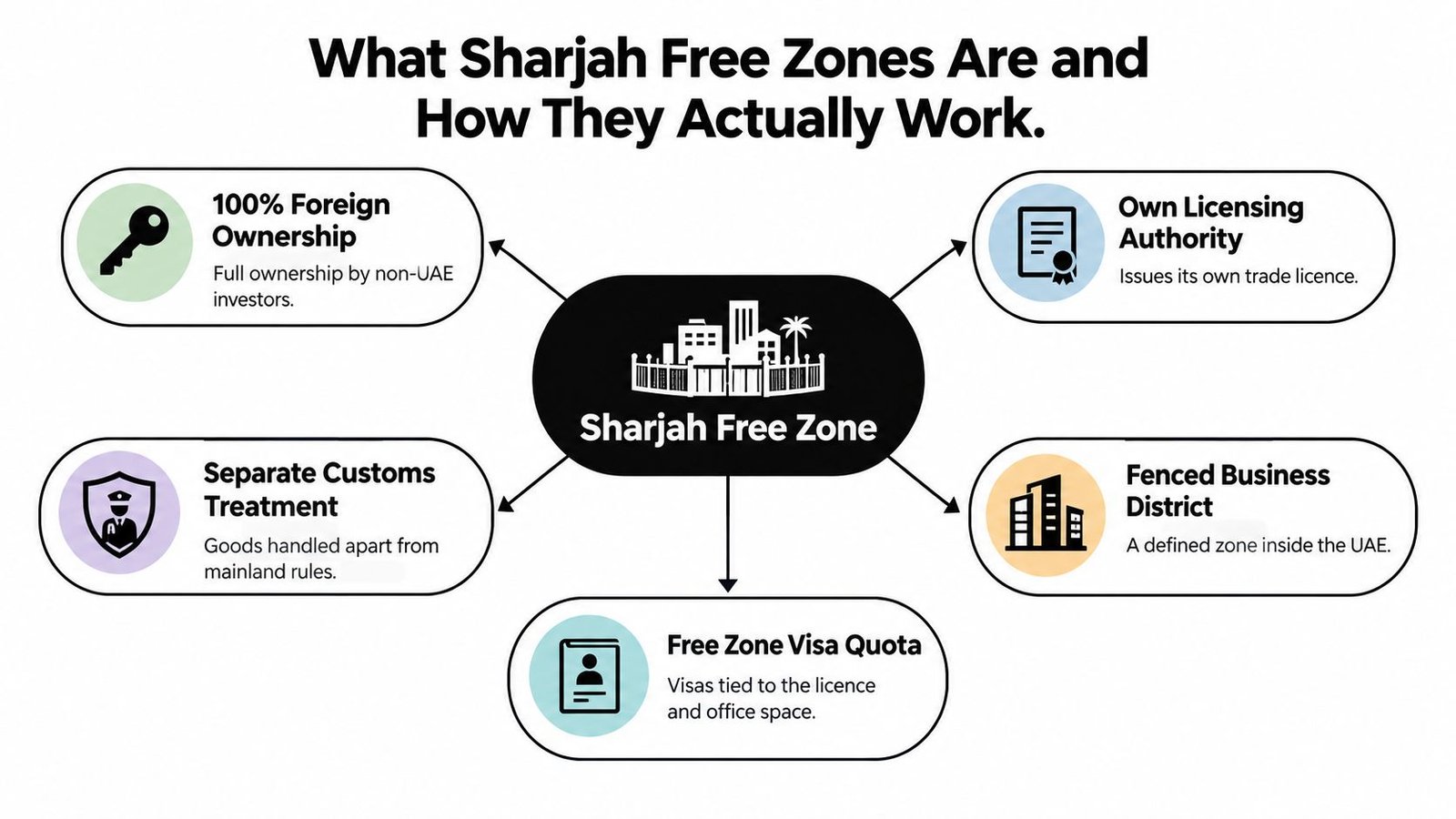
The apartment-compound analogy works here. A Sharjah free zone gives you a controlled setup, shared infrastructure, and a faster route than building everything on the mainland, but it also comes with its own boundaries. Those boundaries matter. They affect where you can trade, what premises you need, and how much room you have to sell directly into the mainland.
That is why the headline offer is only half the story. Some founders see the low entry cost and stop there. The sharper move is to ask whether the zone fits the business model itself, especially if mainland sales are part of the plan or if the activity needs a warehouse, office, or production space. Free zone licences are specific, not universal.
Zone choice also changes the operational feel. SAIF Zone is generally the pragmatic route for traders who want speed and simple licensing. HFZA fits companies that need industrial land, storage, or manufacturing-oriented premises. SPC Free Zone works best for publishing and content-led companies, where the licence scope lines up with the activity. If the business is more digital or service-led, Shams is often part of the shortlist because it keeps the setup lean while still giving founders a proper Sharjah base.
Legal Structures Available to Sharjah Free Zone Companies
A Sharjah free zone company usually takes one of three forms, FZE, FZC, or a branch. The right structure depends on whether you are setting up alone, sharing ownership, or extending an existing business into the United Arab Emirates.
An FZE, or Free Zone Establishment, is a limited-liability entity owned by one natural person or one corporate person. It suits solo founders who want clear ownership and no later dispute about control.
An FZC, or Free Zone Company, is a limited-liability company with multiple shareholders. It fits founders who want the equity split documented from day one and want the shareholder position clear before money moves.
A branch works differently. It is an extension of an existing UAE or foreign company, so it does not stand on its own in the same way as an FZE or FZC, and the paperwork is heavier. SAIF Zone's published FAQ states a minimum capital of AED 150,000 for an FZE or FZC, while branches of UAE or foreign companies have no stated minimum capital requirement (SAIF Zone FAQ).
| Structure | Best Fit | What It Gives You | Common Trap |
|---|---|---|---|
| FZE | Solo founder or single-owner holding structure | Separate legal personality with limited liability | Trying to use it like a multi-partner cap table later |
| FZC | Two or more founders | Shared ownership and limited liability | Picking it without clear shareholder terms |
| Branch | Existing UAE or foreign company | A UAE outpost tied to the parent | Slow document legalization and corporate approvals |
The branch route looks simple until the document chain starts. For foreign-company filings, the parent documents usually need notarisation, embassy attestation, and then UAE Ministry of Foreign Affairs attestation. That is often the slowest part of the file.
Pick the structure once and pick it properly. It affects your bank account opening, your visa file, and your tax registration. If you change it later, you will spend time rewriting documents that should have been right the first time.
Licence Types and What Each One Permits
The licence has to match the work, not the brochure. In Sharjah free zones, the practical split is between trade, service, and industrial licences, and each one gives you a different operating envelope.
A trade licence covers import, export, distribution, consolidation, storage, and warehousing. In SAIF Zone, it also caps the holder at three similar product lines, so a founder planning to move a long list of related SKUs needs to check whether the activity list is broad enough before signing the lease (SAIF Zone business set-up).
A service licence only authorises the specific approved service. Consultants, agencies, and software providers often assume any commercial licence will do. It usually will not, especially when the bank or the zone asks what the company invoices for.
An industrial licence covers importing raw materials, manufacturing, processing, assembling, packaging, and exporting finished goods. Industrial projects in SAIF Zone also need clearance from the Health and Environment Department, which is why a factory setup is never just a paperwork exercise.
Write your activity in one sentence, your product lines in one sentence, and your facility type in one sentence. If those three sentences do not line up, the application probably does not either.
| Licence Type in Sharjah Free Zones | Permitted Activities | Typical Founder Fit | Common Catch to Plan For |
|---|---|---|---|
| Trade | Import, export, distribution, consolidation, storage, warehousing | Traders, distributors, e-commerce operators | Product-line limits and customs scope |
| Service | Approved professional or digital service activity | Consultants, agencies, software and SaaS firms | Assuming a general commercial licence covers everything |
| Industrial | Manufacturing, processing, assembling, packaging, export of finished goods | Manufacturers and processors | Clearance and facility requirements |
If you are even slightly unsure, do not start with “general trading” as a catch-all. Start with the actual revenue stream, because the zone and the bank will both ask for the same answer, just in different words.
Setup Timeline From Application to First Visa
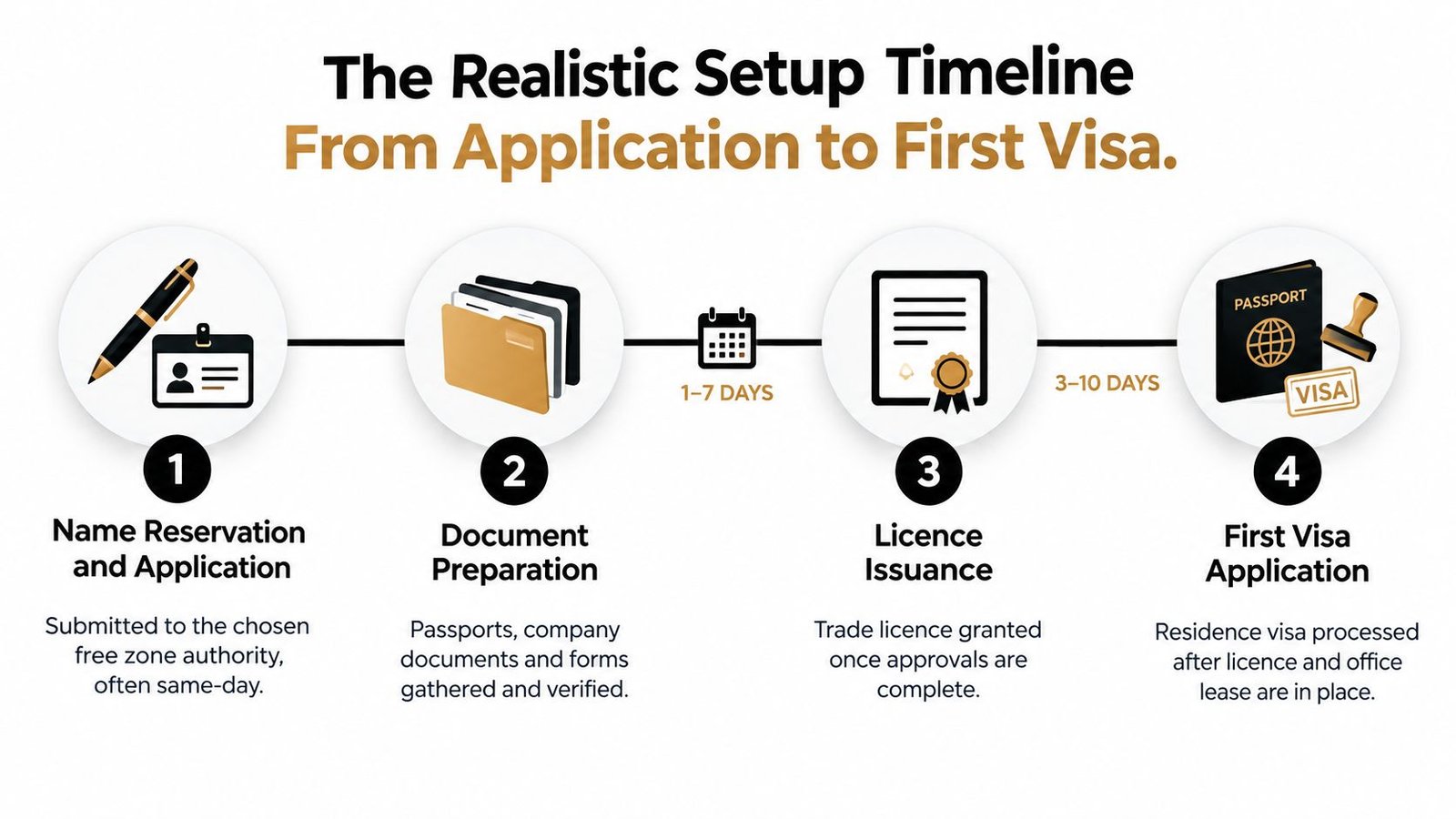
Most delays happen before the licence is issued, not after. Founders who prepare properly move fast. The ones who improvise lose days to missing signatures, attestation, or vague activity wording.
What happens first
Name reservation and the initial application are often same-day tasks with the chosen authority. After that, you gather passports, photos, CVs, and, for branches or FZCs, the attested corporate papers that usually slow self-filing down.
What actually takes time
SAIF Zone says licences and permits can be issued within one hour once the application and documents are complete, but that is the licence window, not the whole setup window (SAIF Zone business set-up). Facility allocation, the establishment card, and the immigration file still need to move before the first visa is processed.
The visa step itself usually takes a few weeks under normal government processing. After that, the corporate bank account often becomes the longest remaining task because the bank wants clean ownership records, a real operating story, and a paper trail that makes sense.
A realistic timeline looks like this:
- Reservation and application, often same day.
- Document gathering and checking, which is where many founders stall.
- Licence issuance, fast once the file is complete.
- Visa and banking work, which can stretch longer than the licence.
A clean solo-founder FZE with a matched activity can be operational in roughly two to four weeks. A multi-shareholder FZC or a branch with attested foreign documents usually needs more like six to ten weeks, because the chain of approvals is longer.
The shortest path is the boring path. Clean documents, correct activity wording, and the right legal structure save more time than chasing a faster quote ever will.
Why 0% Corporate Tax Is Conditional, Not Automatic
The biggest mistake I see is founders treating a Sharjah free zone licence as a free pass to 0% Corporate Tax. It is not. The UAE Ministry of Finance classifies a legal person established in a free zone as a Taxable Person, and the 0% rate only applies if the company qualifies as a Qualifying Free Zone Person and earns Qualifying Income (UAE Ministry of Finance corporate tax guidance).
Qualifying income can include certain transactions with other free-zone persons and income from qualifying activities. The official free-zone regime also covers activities such as manufacturing and processing goods or materials, holding shares and securities, ownership and operation of ships, reinsurance, and certain regulated fund, wealth, and investment-management services (UAE Ministry of Finance free-zone decisions).
That list is narrower than most sales pages admit. A company doing consulting, marketing, software, mixed trading, or local UAE work cannot assume all revenue sits in the 0% bucket just because the licence sits in a free zone. The de-minimis rule and the substance requirements still matter, so the company needs real records, real premises or operating substance, and a clean view of each revenue stream.
Sharjah's growth makes this more relevant, not less. The emirate reported 74 new projects and about $1.5 billion in capital investment in the first half of 2025, up 57% and 361% respectively from the comparable prior-year figures (Sharjah 24).
If your company mixes holding, consulting, software, and trading in one licence, model each line separately. Don't wait until filing season to find out which revenue is qualifying and which isn't.
For founders who want the tax position checked properly, Inpro's UAE Corporate Tax service is one route, but the core work remains the same either way: accounting records, revenue mapping, and a clear read on whether the company meets the qualifying conditions.
How Sharjah Free Zones Compare to Dubai, Abu Dhabi, and Sharjah Mainland
Sharjah free zones are usually the cost-conscious choice, but price is only one part of the decision. The true comparison is between setup cost, mainland access, ownership, and how much regulatory depth you need.
Sharjah free zones tend to suit international trade, holding, logistics, and lean operating companies that don't need direct mainland customer access on day one. Dubai free zones such as DMCC, JAFZA, and DIFC generally offer deeper ecosystem density and more mature service-provider layers, but founders usually pay for that privilege. Abu Dhabi free zones such as ADGM, Masdar, twofour54, and KIZAD often suit regulated activity, holding structures, and certain government-facing models.
Sharjah mainland, licensed through the Sharjah Department of Economic Development, has one clear advantage, direct access to UAE domestic customers. A mainland company can sell to UAE customers without the same dependency on a mainland distributor, agent, branch, or subsidiary that a free-zone company may need, depending on the zone and activity (Sharjah free-zone access note).
If more than half your revenue is cross-border, Sharjah free zone is usually the cleaner base. If most of it is UAE mainland sales, treat mainland seriously from the start.
| Jurisdiction | Setup Cost | Mainland Access | Ownership | Best Fit |
|---|---|---|---|---|
| Sharjah Free Zone | Usually lower than many Dubai free zones | Limited for direct mainland trading | 100% foreign ownership | Cross-border trade, holding, logistics, lean setups |
| Dubai Free Zone | Typically higher | Limited unless structured for mainland access | 100% foreign ownership | Ecosystem-heavy, premium-service, scaling brands |
| Abu Dhabi Free Zone | Varies by zone, often premium for regulated activity | Limited unless structured for mainland access | 100% foreign ownership | Regulated and holding structures |
| Sharjah Mainland | Depends on activity and licensing route | Direct UAE customer access | Ownership depends on activity and structure | Domestic sales and local contracting |
A lot of growing firms end up with two entities, one free-zone company for international work and one mainland company for local sales. That sounds more complex, but for many businesses it's cleaner than forcing one licence to do two different jobs.
Compliance, Banking, and When a PRO Partner Pays for Itself
The workload starts after the licence lands. You still need annual licence renewal, facility lease renewal, establishment card renewal, and later, visa and Emirates ID renewals on the employee cycle.
The accounting side is not optional either. A free-zone company still needs bookkeeping, tax filings even when tax payable is zero, and VAT registration if turnover crosses the relevant threshold. Banking adds another layer, because UAE banks ask for KYC, beneficial ownership details, and evidence that the company has a real footprint rather than just a licence and a mailbox.
A virtual office with one person and no clear operating story often gets rejected by a bank. That's not bureaucracy for sport, it's the bank checking whether the company is real enough to hold an account, move funds, and survive audits.
That is where a PRO partner can save time, especially for founders juggling formation, attestation, visas, and banking at once. Inpro's PRO services in the UAE cover the kind of workflow that usually slows people down, document attestation chains, visa processing, and coordination with government channels.
Use a PRO partner when the file crosses more than one system. Free zone, immigration, bank, and tax teams rarely move in the same rhythm.
You can self-file a simple solo setup if you have time, patience, and clean documents. You should bring in support when the setup includes foreign-parent attestation, multiple shareholders, employee visas, or a tax position that needs to be handled carefully from day one.
For founders who want a straight answer on zone choice, documents, and tax positioning, the team at Inpro handles UAE company formation, PRO work, visa processing, and banking support. Book a call with Inpro and get the setup mapped properly before you file.