


You're comparing quotes from Dubai, Sharjah and Ajman late at night, and Ajman looks almost too cheap to be real. A standard Ajman Free Zone company formation can be completed in 2 to 4 working days once your documents are in order, with entry level packages historically starting around AED 5,000.
That speed is real if your file is clean. Where founders get caught is choosing a licence on price alone, then discovering the activity, premises and tax treatment don't match how the business will earn money. Get those decisions right before you pay, and Ajman is a calm, sensible route into the United Arab Emirates.
Table of Contents
- Why Founders Choose Ajman Free Zone in 2026
- Choosing the Right Legal Form and Licence
- Documents and Application Steps From Start to Licence
- Realistic Costs and What Changes the Final Number
- Visas, Establishment Card, and the PRO Workflow
- The Tax Question Most Formation Guides Skip
- Post-Formation Compliance and Your First 12 Months
Why Founders Choose Ajman Free Zone in 2026
Most founders I speak to aren't chasing prestige. They want a UAE company, a bank account, a residency visa if needed, and a renewal bill they can plan for. Ajman Free Zone Authority, shortened to AFZ, appeals because it keeps that starting point low without forcing you into a narrow niche.
What is Ajman Free Zone?
Ajman Free Zone is a free zone jurisdiction in the emirate of Ajman where foreign founders can form a company for approved activities. AFZ was established in 1988, making it one of the UAE's earliest free zone jurisdictions, and by 2021 its ecosystem served more than 9,000 companies from over 165 countries, according to the official AFZ history and development record. That history matters when a bank or client checks whether you're dealing with an established authority.
Demand has also held up in difficult years. AFZ reported 1,717 newly registered companies during 2020, a 23 percent increase compared with 2019, with longer term company data tracked in the Ajman Statistics Centre company dataset. People kept forming companies there when travel was disrupted, largely because the process suits remote and light footprint businesses.
Who is Ajman a good fit for?
Choose Ajman if you're running global services, consultancy, e-commerce, light trading or freelance work, and your clients don't need you on site in Dubai or Abu Dhabi every day. It's also a sensible first UAE base if you're testing demand before hiring a larger team.
Think harder before choosing Ajman if your model depends on selling directly to mainland customers across the UAE, holding large stock, or hosting frequent client visits and inspections. A mainland licence or a larger Dubai free zone may cost more, but it can remove friction you'll otherwise pay for later in distributor arrangements, premises upgrades and bank questions.
Pick Ajman for the business you'll run in year one and year two, not just the cheapest licence you can buy this week.
Ask three questions before you commit. Where are your customers, where will work physically happen, and how many visas and how much space will you need once trading starts? If the honest answers point to a lean, international operation, Ajman Free Zone company formation is usually the right trade off.
Choosing the Right Legal Form and Licence
Your legal form decides who owns the company. Your licence decides what it can legally do. Don't treat them as paperwork details, because changing them later costs time and can interrupt banking and visas.
What is the difference between an FZE and an FZC?
A Free Zone Establishment is an independent corporate entity formed for a single shareholder, shortened to FZE. A Free Zone Company is an entity that can be formed by corporate or individual shareholders, shortened to FZC, and it suits co founders and joint ventures. AFZ explains these forms and the document rules for each in its guide to types of business in Ajman Free Zone.
If you're a solo founder with no plan to add a partner soon, an FZE keeps ownership simple. If two or more people are investing, or a parent company will hold shares, use an FZC from the start. Don't form as a sole owner and promise a partner shares informally. Banks and future investors will work from the licence and constitutional documents, not from side agreements.
How do you match your activity to the licence?
The activity on your licence must match the activity you perform. AFZ guidance states you must obtain a licence for your chosen activities, secure any required official approvals, rent suitable premises, and not operate an activity that doesn't appear on the licence, as set out in the AFZ general licensing guidelines. Each workplace also needs its own licence, and another workplace needs the necessary permits.
AFZ's official cost calculator lists more than 3,500 licensed activities and combines licensing, office space and residency visas, which you can check through the AFZ cost calculator and activity search. Use that breadth carefully. Pick activities you can describe in one clear sentence to a bank.
| Business profile | Recommended legal form | Common AFZ licence category |
|---|---|---|
| Solo consultant or freelancer | FZE | Service or freelancer |
| Two founders selling services abroad | FZC | Service |
| Online seller with overseas suppliers | FZE or FZC | E-commerce |
| Import and export trading business | FZC | Commercial or general trading |
| Light manufacturing or assembly | FZC | Industrial |
100 percent foreign ownership doesn't remove the mainland sales rule. If you need to sell goods directly inside the UAE mainland market, plan for a UAE registered agent or distributor, or choose a mainland structure instead.
Documents and Application Steps From Start to Licence
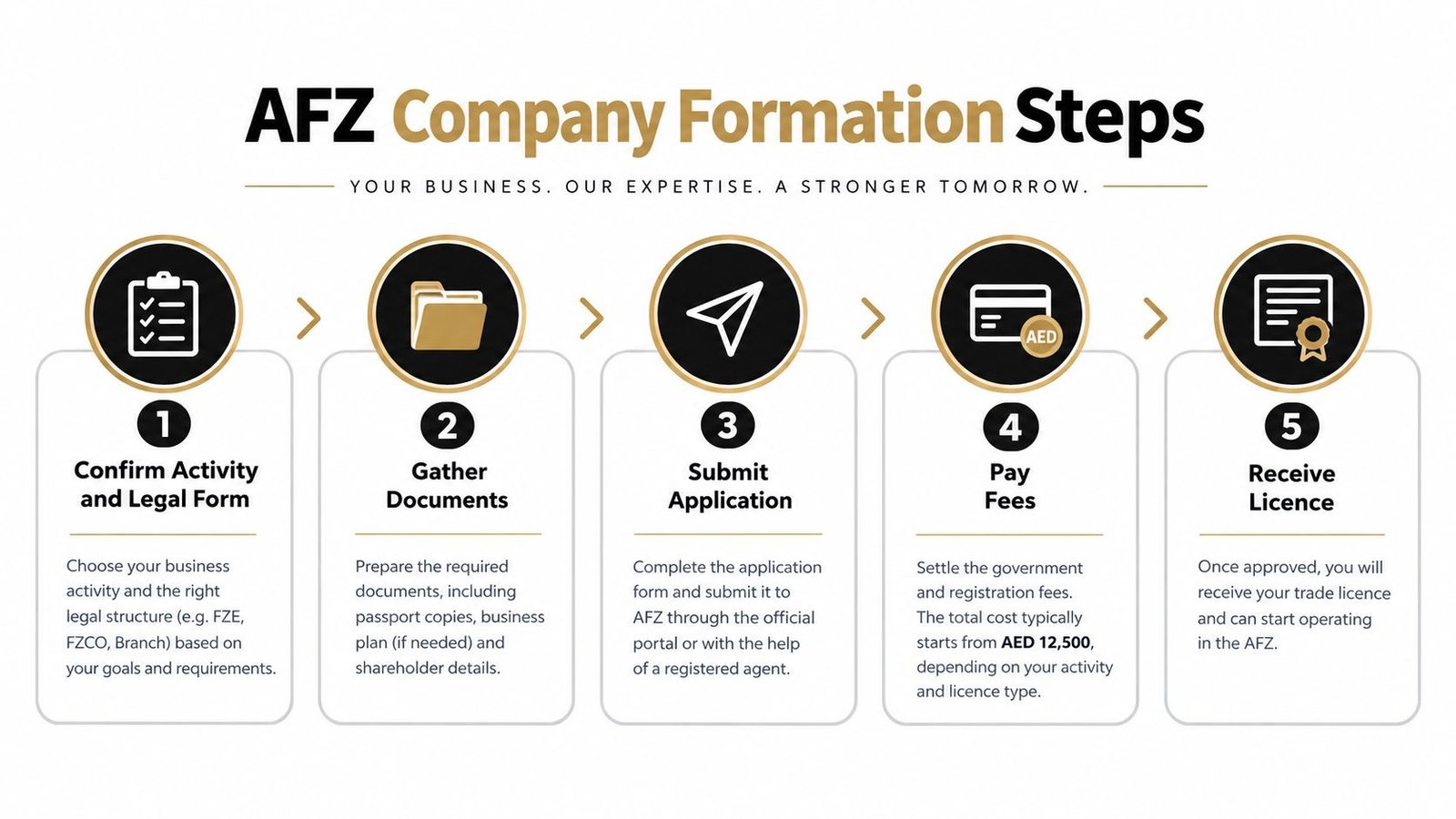
Treat formation as a controlled sequence, not a race. The authority can move quickly, but only after your activity, legal form and documents line up.
What documents will you need?
For individual founders, expect passport copies valid for at least six months and photographs. If you already live in the UAE, you may also need a sponsor's No Objection Letter, your visa copy, or your Unified Identification number, shortened to UID. Those resident cases catch people out because a current employer or sponsor may need time to issue the letter.
Corporate shareholders need more. Prepare identification for the company manager, the parent entity's trade licence, its constitutional documents and a board resolution approving the new company. If those documents come from outside the UAE, ask early whether attestation is required for your case. Don't wait until payment day to learn that a board member is travelling and can't sign.
How does the application move forward?
Work in this order.
- Confirm activity and legal form: Write down exactly what you'll sell, who you'll sell to and where those customers sit.
- Reconcile the licence category: Check the proposed activity against the licence before you pay anyone.
- Gather and check documents: Verify passport expiry dates, name spellings and shareholder details across every document.
- Secure external approvals first: Regulated sectors may need approval from another UAE authority before AFZ can finish the file.
- Submit, pay and receive the licence: Only pay once the activity wording and visa allocation in the quote match your plan.
Standard applications can generally be completed in 2 to 4 days, but that timeframe varies with activity, document completeness and required external approvals, according to the official Ajman Free Zone application portal. There's no published official success rate you can rely on, so judge readiness by document completeness, not by a sales promise.
Quality control gate: If you can't explain your activity, customer location and first expected transactions in plain language, you're not ready to submit.
Once the licence issues, your establishment card, visa and banking work starts straight away. Keep digital copies of the licence, constitutional documents and lease or facility papers in one folder. You'll send the same pack repeatedly.
Realistic Costs and What Changes the Final Number
The headline price is only the licence. Your real year one cost is the licence plus visas, premises, government charges, insurance and the admin needed to keep the company usable. Budget for the full setup or you'll approve a cheap package and then stall at the bank.
What did published AFZ packages cost?
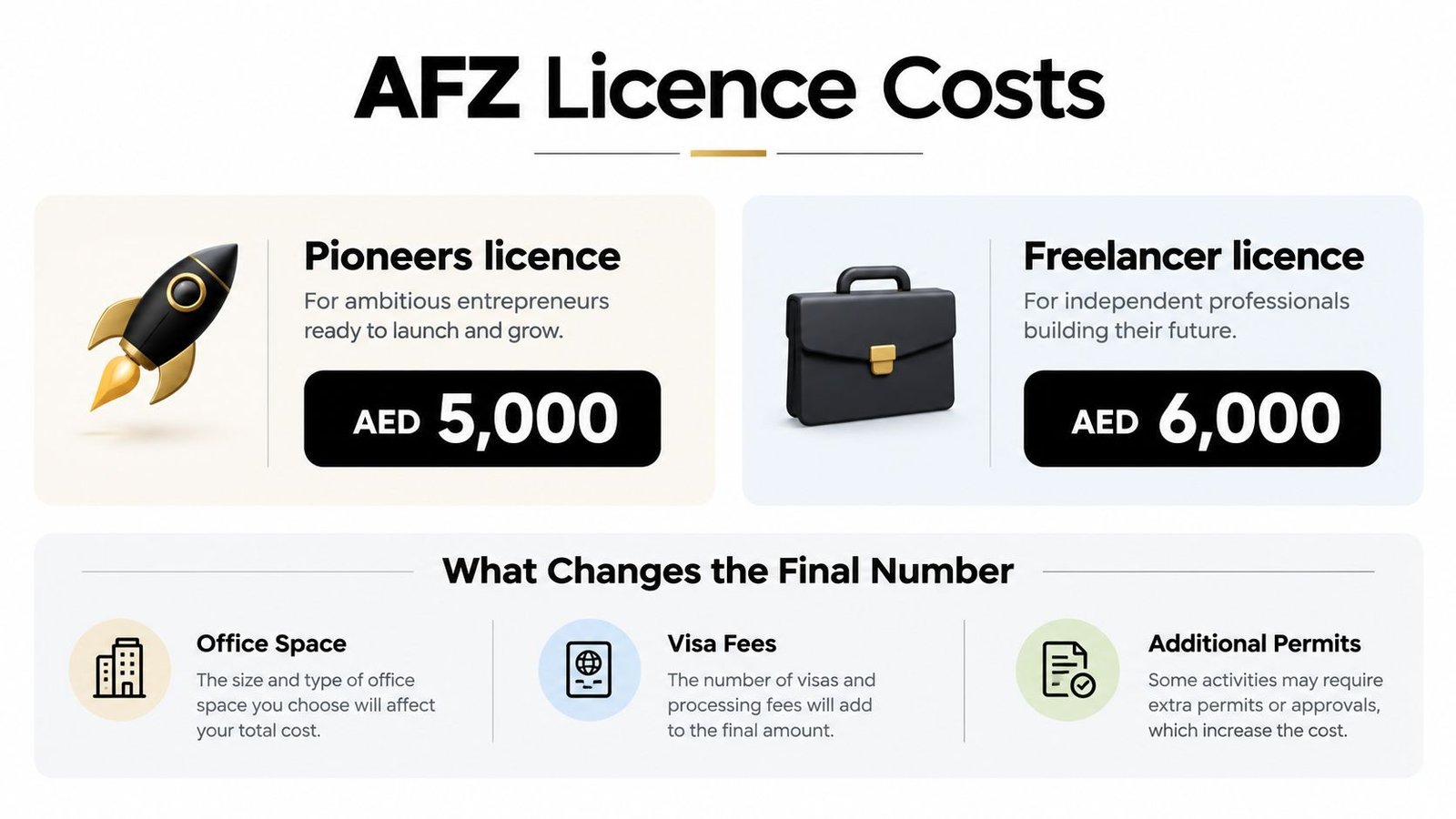
Published AFZ information from 2020 listed the Pioneers licence at AED 5,000 for entrepreneurs aged 20 to 30, the Freelancer licence at AED 6,000, the Trading licence at AED 13,535, and the Service licence at AED 16,135, with trading and service packages eligible for up to five visas subject to customer needs, as shown in published AFZ package information. Treat those figures as historical reference points, not as a current quote.
Use them to understand relative pricing. Freelancer and youth entry routes sat at the low end. Trading and service licences with visa capacity sat higher. That pattern still helps you sanity check a quote, even though you must confirm today's package and inclusions before budgeting.
What changes the final number?
AFZ states final amounts can depend on legal form, number of shareholders or employees, visa quota, premises or lease, processing speed, government charges, deposits, penalties, insurance and applicable taxes. In practice, these items move most quotes.
- Visa quota: Each person you plan to sponsor adds immigration, medical, Emirates Identity Authority and insurance steps.
- Premises choice: A shared facility is cheaper, while a dedicated office, warehouse or industrial unit changes both rent and what operations you can evidence.
- Shareholder structure: Corporate shareholders bring extra document preparation and possible attestation work.
- Activity approvals: Regulated activities can add third party approval time and fees.
- Speed and corrections: Urgent processing and fixing mismatched documents rarely save money.
Ask for an itemised quote that separates licence, facility, visa allocation, establishment card and government charges. Then ask what's excluded. If a seller can't itemise it, don't pay it.
My recommendation is simple. Don't buy the smallest package if you already know you'll need staff, stock or regular client meetings. Upgrading later is possible, but you'll revisit premises, visa capacity, bank evidence and tax substance at the same time. Buying the right size once is usually cheaper than rebuilding the setup within the first renewal cycle.
Visas, Establishment Card, and the PRO Workflow
A licence alone doesn't let you live and work from the UAE. You need the immigration file behind the company, and that file runs as one connected workflow. A Public Relations Officer is the person who submits and follows up government applications on your behalf, shortened to PRO. Good PRO work isn't glamorous. It's sequencing, checking dates and knowing which counter needs which document next.

What is an establishment card?
An establishment card is the immigration record for your company that allows it to sponsor residency visas. Without it, your licence exists but your visa process can't proceed properly. If you want background on how this card works in practice, read the guide to the establishment card process in Dubai and the wider UAE, then confirm the Ajman specific steps for your file.
Don't confuse visa allocation with an issued visa. Allocation means your package allows you to apply for a set number of visas. It doesn't mean those visas are approved, paid for or ready to use. Budget and plan for each person separately, including shareholders who'll act as signatories, employees you'll hire, and dependants you may sponsor later.
How does the founder visa sequence work?
The usual order is establishment card, entry permit, status change if you're already in the country, medical fitness test, Emirates ID biometrics, then residency issuance. Emirates ID is the federal identity card you'll use for banking, telecoms, tenancy and most government services. Keep your passport, photographs, entry permit and licence pack available through the whole sequence, because different steps ask for overlapping documents.
Delays usually appear at predictable points. Medical appointments fill up. Emirates ID biometrics need attendance in person. A name spelling that differs between your passport and an application can send a file backwards. Build buffer time into travel plans, and don't book non refundable flights on the assumption that residency will finish on a particular morning.
For employees, plan in batches once the company is operational. Confirm the role, salary, contract and insurance responsibilities before you start the entry permit. Human resources teams should also diarise renewal dates from day one. A visa that lapses creates problems far beyond a late renewal fee, including banking access and the employee's legal status.
Treat your own residency as a project with dependencies, not as a stamp you collect after the licence arrives.
Why should banking start in parallel?
Open the bank conversation while licensing is underway, not after your first client asks where to send payment. Your first account decides how easily you can invoice, pay suppliers, receive foreign currency and show a clean transaction trail. Banks will assess the business, not just register the account because AFZ issued a licence.
Prepare a bank pack before you approach anyone. Expect requests for the trade licence, memorandum and articles, board resolution where relevant, passport and visa copies for signatories, proof of address, and a clear description of your activity, customers, suppliers and expected transaction pattern. Beneficial owner disclosure must be complete and consistent. If a corporate shareholder sits above the company, be ready to explain the full ownership chain.
Banks also look for operating evidence that matches the licence. That can include your facility or lease papers, a working website, draft contracts, invoices, a UAE phone number and an explanation of where core work happens. A trading company with no storage plan, or a consultancy with no client pipeline and no explanation of services, invites extra questions. Neither example means refusal, but both mean slower onboarding.
Common causes of delay are avoidable. The activity on the licence doesn't match the transactions you describe. Signatories can't attend in person verification. Shareholder documents are incomplete. Your expected turnover sounds unrealistic for a new company with no staff or contracts. Fix those points in writing before the first meeting.
My practical advice is to request every AFZ issued document in final digital form as soon as it's available, then keep one controlled folder for immigration and banking. Send the same version everywhere. If you amend shareholders, activity or premises, update the pack immediately and tell both your PRO and your bank contact. Most frustration in this stage comes from version confusion, not from the rules themselves.
Plan the founder visa first, employee visas second, and dependants after the main residency and banking rails are working. That order keeps signatory access, payroll and client payments moving while family paperwork follows. If you're relocating from Sharjah, Dubai or Abu Dhabi, also check how your current sponsor, tenancy and driving licence records interact with the new residency before you cancel anything.
The Tax Question Most Formation Guides Skip
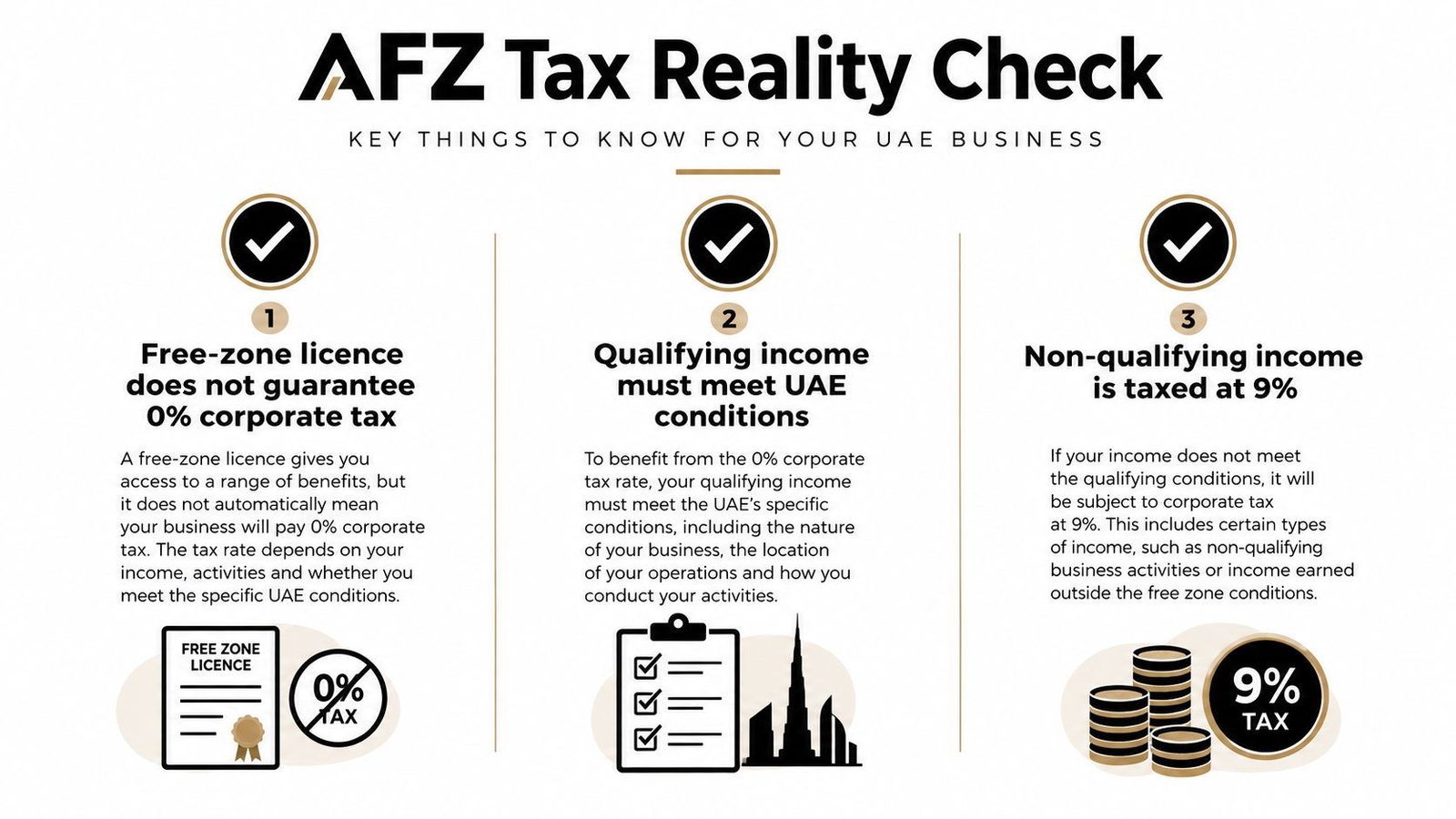
A free zone licence does not automatically mean 0 percent Corporate Tax. That's the point many sales pages blur, and it's the point that decides whether your Ajman company works as planned once revenue starts.
Does an Ajman Free Zone licence automatically mean 0 percent Corporate Tax?
No. Every UAE free zone entity must register for Corporate Tax and file returns, whether or not it qualifies for preferential treatment. The 0 percent rate applies only to a Qualifying Free Zone Person and only to Qualifying Income, and free zone juridical persons remain within the scope of Corporate Tax under the UAE Ministry of Finance Corporate Tax guidance.
A Qualifying Free Zone Person is a free zone entity that meets the prescribed conditions on substance, qualifying activities and income type, and hasn't elected into ordinary Corporate Tax treatment. In plain terms, you need actual and sufficient UAE substance, the right kind of income, proper records and a revenue mix that passes the de minimis test.
That test is strict. Non qualifying revenue must not exceed the lower of 5 percent of total revenue or AED 5 million. Cross that line and the expected treatment can be lost. This is why a company selling ordinary services directly to UAE mainland customers shouldn't assume all revenue receives the same treatment as income from qualifying free zone or overseas activity.
How does Value Added Tax fit in?
Value Added Tax is a consumption tax charged on taxable supplies, shortened to VAT, and it's separate from Corporate Tax. VAT registration becomes mandatory when UAE taxable supplies and imports exceed AED 375,000 over the preceding 12 months or are expected to exceed that amount in the next 30 days, while voluntary registration starts at AED 187,500, under the Federal Tax Authority registration guidance. A required application must generally be submitted within 30 days.
For broader background before you set prices or sign client contracts, read the explanation of Corporate Tax in the UAE for founders and companies. Then map your own revenue lines against the rules.
Run this screening before incorporation.
- Customer location: List whether each client sits in a free zone, on the mainland or outside the UAE.
- Activity match: Check whether each revenue stream fits a qualifying activity and your AFZ licence wording.
- Substance evidence: Identify who performs core work, where they sit, what premises they use and what records prove it.
- Revenue mix: Model non qualifying revenue against the de minimis limit before you chase mainland sales.
- Contracts and bookkeeping: Separate income, costs and intercompany charges by activity from the first invoice.
If that screening shows mainland revenue will dominate, get tax advice before you form in Ajman. It's cheaper to choose a different structure now than to rebuild contracts, banking narratives and accounting records after trading starts.
Post-Formation Compliance and Your First 12 Months
The licence date starts your compliance clock. Founders who stay calm in year one treat renewals, tax registration and bookkeeping as calendar items from the first week, not as problems to solve when a reminder lands.
What should happen in your first 12 months?
Start with bank activation, accounting software, invoice templates and a document folder that separates licence papers, contracts, receipts and payroll records. Register for Corporate Tax, set a filing calendar, and review whether your activity creates any Economic Substance Regulations obligations, shortened to ESR. Economic Substance Regulations are rules that can require certain relevant activities to show real UAE presence and reporting.
Monitor VAT on a rolling basis. If you cross the mandatory threshold covered in the earlier tax section, diarise the 30 day registration window immediately and adjust invoices and pricing before the next billing cycle. Don't wait for year end accounts to discover you crossed the line months ago.
Review substance each quarter. Check whether premises use, employees, decision making, contracts and spend still match the story you gave the bank and the tax position you intend to file. If you've outgrown a shared facility or hired staff who work from another location, update the plan before renewal.
Licence renewal should never be a surprise. Put the renewal date, facility expiry, establishment card dates and visa renewals in one shared calendar, and use the guide to trade licence renewal requirements and timing as a prompt to confirm the current AFZ steps for your company. Renewal is also the right moment to remove unused activities, add new ones properly and correct shareholder or manager details.
The habit that separates smooth setups from messy ones is simple. Owners review compliance quarterly while there's still time to fix gaps.
Ajman works best when licence, premises, banking and tax are designed together. Keep records by activity, keep contracts signed and stored, and ask for advice before a new revenue line changes your tax mix. That discipline protects the low cost advantage you chose Ajman for in the first place.
Not sure whether Ajman fits your activity, visa needs and tax position, or what your real first year cost will look like? Book a free strategy call with the team at Inpro and we'll map your Ajman Free Zone company formation, establishment card, visas, banking pack and compliance calendar before you pay for a licence.