


VAT registration is not mandatory for every business in the UAE. It becomes compulsory once taxable supplies and imports exceed AED 375,000 in the previous 12 months, or are expected to exceed that figure within the next 30 days.
Most explanations stop at that ceiling and treat it like a year-end total. What if a contract you sign this month already takes you over, before a single invoice goes out? A Free Zone licence in Dubai, or a Mainland licence in Abu Dhabi, doesn't switch the obligation on by itself. An overseas supplier can be pulled in even when sales sit well under the resident figure. If you're asking whether VAT registration is mandatory in the UAE, the useful test is the nature and timing of your supplies, not the date on your trade licence.
Table of Contents
- Who Must Register for VAT in the UAE
- How the AED 375,000 Test Works and Where It Stops
- Voluntary VAT Registration and When It Pays Off
- How to Register for VAT Step by Step
- Filing Returns and Keeping VAT Records
- Penalties for Late Registration and Missed Filings
- What to Do This Week
Who Must Register for VAT in the UAE
Not every company in the United Arab Emirates has to register. VAT (value added tax) is a federal tax introduced on 1 January 2018 and administered by the Federal Tax Authority (FTA), the federal tax regulator. The FTA registration guidance makes registration compulsory for a UAE-resident business when taxable supplies and imports exceed AED 375,000 over the previous 12 months, or when the business expects to pass that figure within the next 30 days. The same guidance opens voluntary registration once taxable supplies, imports, or VAT-taxable expenses exceed AED 187,500.
The threshold tracks taxable commercial activity. It doesn't follow incorporation, a trade licence, or total gross income. A Free Zone company (a business zone with its own licensing rules) or a Mainland company (licensed to trade across the UAE) in Dubai, Abu Dhabi, or Sharjah doesn't need VAT registration solely because it was formed.
Which situation fits your business
| Business situation | Turnover test | VAT registration status |
|---|---|---|
| UAE-resident business with taxable supplies and imports above AED 375,000 in the previous 12 months | Above AED 375,000 | Mandatory |
| UAE-resident business expecting to pass AED 375,000 within the next 30 days | Expected above AED 375,000 | Mandatory |
| UAE-resident business with taxable supplies between AED 187,500 and AED 375,000 | AED 187,500 to AED 375,000 | Voluntary |
| UAE-resident business below AED 187,500 | Below AED 187,500 | Not required; voluntary registration not available |
| Non-resident business making taxable supplies in the UAE | Any value | Mandatory where no other person accounts for the tax |
| Newly formed company with no taxable activity yet | Threshold not yet met | Not required solely because the company was formed |
Pick the row that matches how you trade today, not the row you hope to grow into. Once the AED 375,000 test is met, you must charge VAT where it applies, keep records, and file returns. The count itself is narrower than most founders expect.
How the AED 375,000 Test Works and Where It Stops
The test counts taxable supplies and imports. Gross turnover, licence activity, and share capital sit outside it. A taxable supply is a sale of goods or services that carries VAT, including a zero-rated sale at 0%. An exempt supply is one the law excludes from VAT.
The 12-month window rolls forward every month. When a new month closes, the oldest month leaves the calculation and the newest month joins it, so a business can cross AED 375,000 before its annual accounts show a full year at that level.

What counts toward the total
| Item | Counts toward AED 375,000? | Why it matters |
|---|---|---|
| Standard-rated sales at 5% | Yes | Full taxable supplies that carry VAT |
| Zero-rated sales at 0%, such as qualifying exports | Yes | Still taxable supplies, even though the rate is 0% |
| Imports of goods into the UAE | Yes | Import value counts toward the total |
| Exempt supplies, such as certain residential property leases and certain financial services | No | Exempt supplies are not taxable supplies |
| Shareholder capital injections and loans | No | Not a supply of goods or services |
Keep a rolling schedule that splits standard-rated, zero-rated, exempt, and out-of-scope items. Use invoice dates for supplies and import dates for goods, then subtotal each category monthly. One combined revenue line hides the month that tips you over.
Say a Dubai consultancy signs an AED 400,000 contract in March and has not issued an invoice yet. If the firm expects to bill within the next 30 days, the expected value already meets the forward test. It should apply within 30 days of that expectation, rather than waiting for the first bill.
Where the resident ceiling stops
For non-residents, the ceiling falls away. The FTA's VAT registration FAQ states that a non-resident making taxable supplies in the UAE must register regardless of value when no other person is responsible for paying the tax. That can pull in overseas software firms, consultants, marketplaces, and other foreign suppliers below the resident threshold. Checking VAT before you contract is now part of entering this market.
Reverse charge is the rule under which the customer accounts for the VAT instead of the supplier. Before you sign, ask one question: who accounts for the VAT on this supply, you or the UAE customer?
Voluntary VAT Registration and When It Pays Off
You can register voluntarily when taxable supplies, imports, or VAT-taxable expenses exceed AED 187,500 over the previous 12 months, or are expected to exceed that amount within the next 30 days. Below that band, voluntary registration isn't available.
Input VAT is the VAT charged on business costs such as rent, equipment, software, and professional fees. A registered business can reclaim it, subject to the normal rules on what the cost was for.
Say a design studio in Sharjah earns AED 240,000 a year from VAT-registered clients in Dubai, and pays AED 30,000 of VAT on fit-out and software. Registering lets the studio reclaim that input VAT and issue the tax invoices those clients want. The studio must then add 5% VAT to its prices, unless it absorbs the charge and cuts its margin. A plain walk-through of the 5% arithmetic sits in our guide on how to calculate VAT in the UAE.
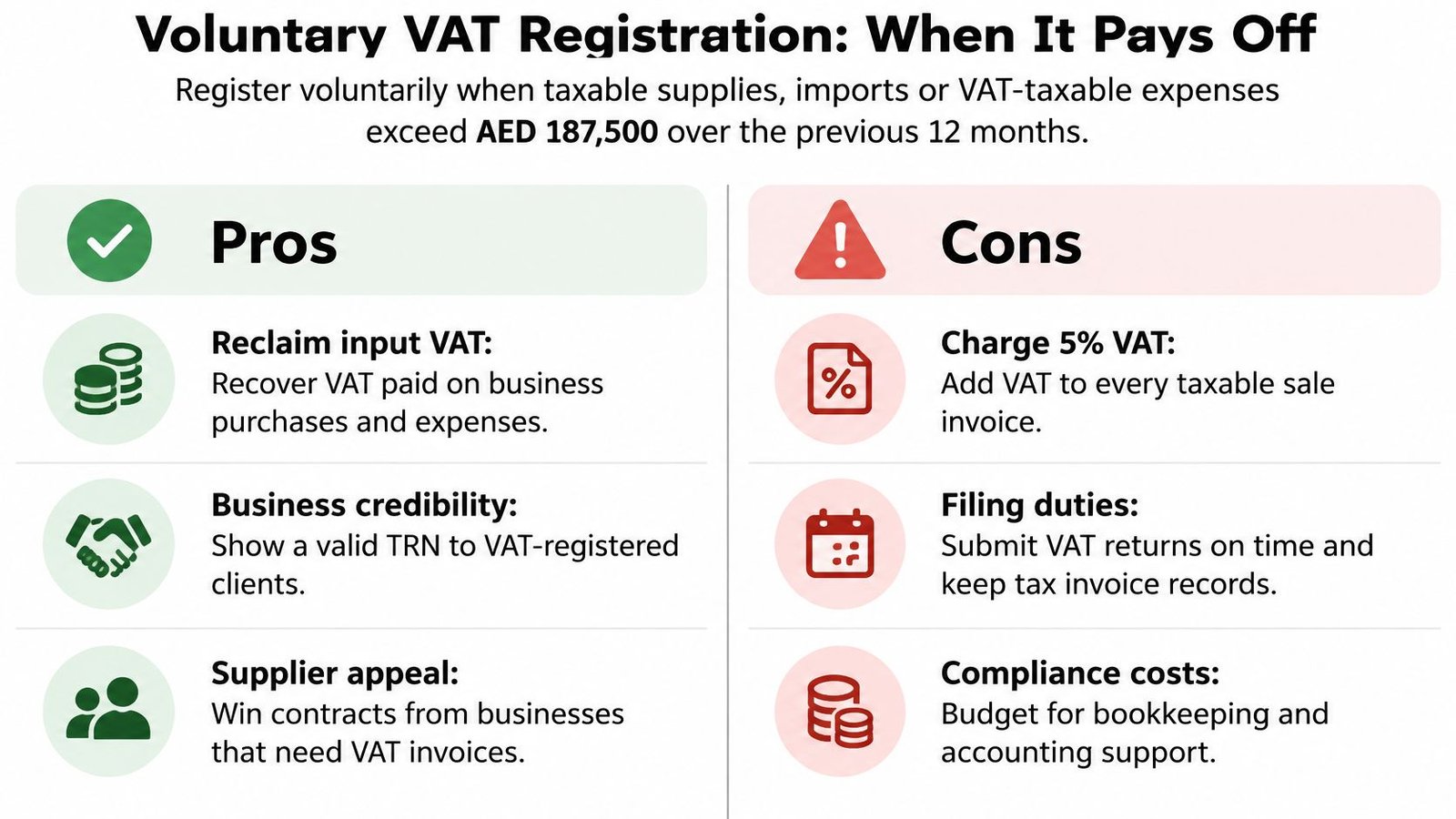
What you gain and what it costs
Pros
- Reclaim input VAT: Recover VAT paid on setup and running costs, which matters most in the first year of fit-out and software.
- Credibility with business clients: A valid tax invoice is what many VAT-registered buyers expect before they pay.
- Tender fit: Bids that ask for a tax invoice are easier to answer once you're registered.
Cons
- Prices rise by 5% unless you absorb it, which hurts if you sell mostly to consumers who can't reclaim the charge.
- Extra filing: Returns, tax invoices, and a ledger you can defend.
- Cash set aside: VAT you collect isn't yours to spend.
- Reversing the choice isn't simple: Check the cancellation rules with the FTA or an adviser before you apply.
Practical rule: Register voluntarily when the input VAT you can reclaim, plus what your clients need on invoices, outweighs the price rise and the admin.
How to Register for VAT Step by Step
Once you're required to register, the clock is short. The FTA VAT registration service requires the business to submit its application within 30 days. Waiting until invoices go out can already put you late, because a credible expectation of crossing the line is enough. Write down the date the test was first met, or the date you chose voluntary registration, and work back from that.
Free Zone incorporation doesn't remove the duty. A Free Zone or Mainland company in Dubai, Abu Dhabi, or Sharjah follows the same federal route. The question is your UAE VAT status and the nature and value of your supplies.
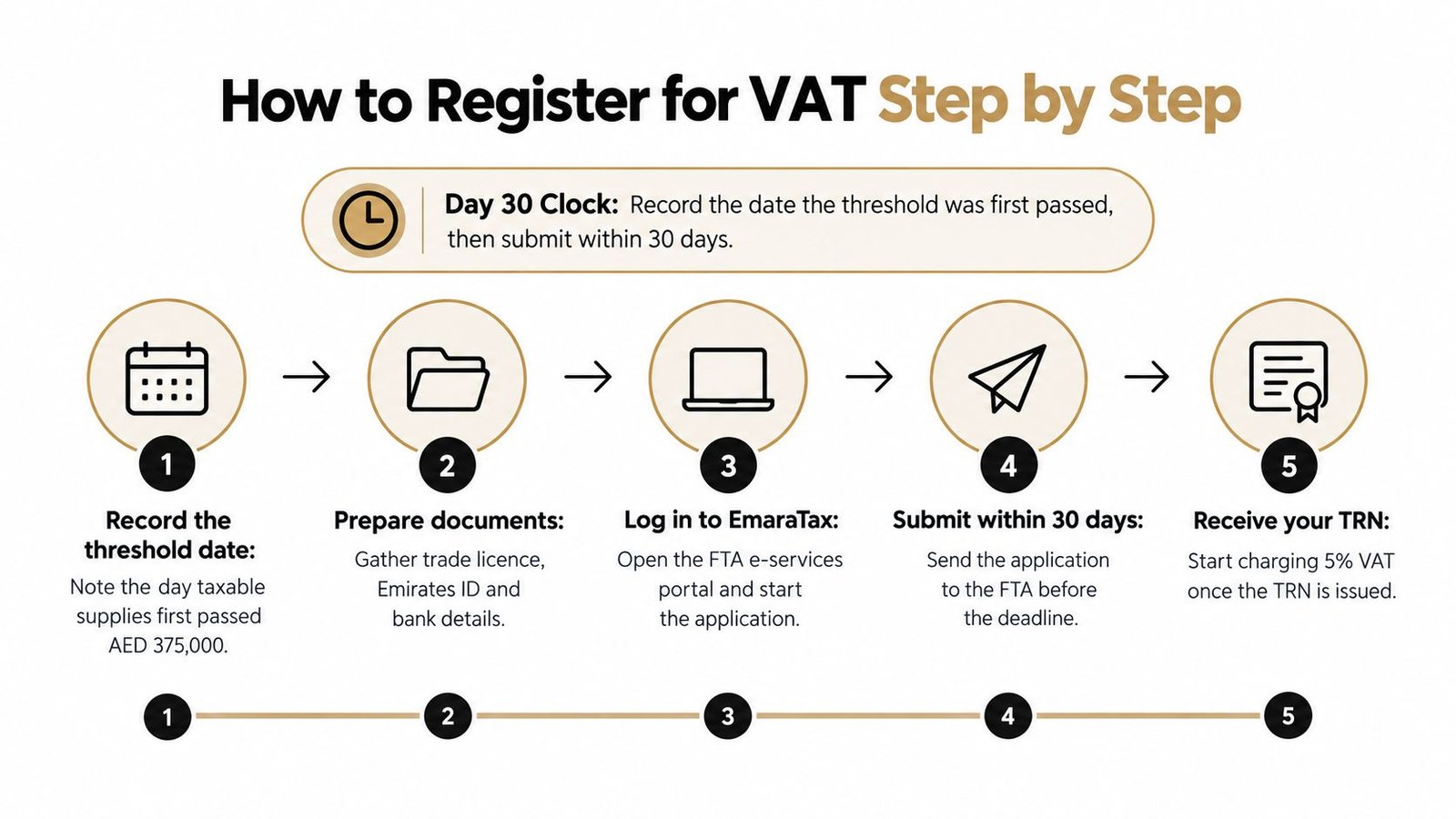
The sequence that keeps you inside the deadline
- Record the trigger date. You need a fixed start for the 30-day window, whether the look-back total tipped over or a signed contract created the expectation.
- Gather the file. Trade licence, Emirates ID or passport of the owner or authorised signatory, incorporation documents, bank details, and a turnover schedule for the previous 12 months and the next 30 days, split by rate. You must give accurate, complete, and updated documents, and the FTA may ask for more.
- Open EmaraTax and file. EmaraTax is the FTA's online portal. The form asks you to declare taxable supplies and imports, so the schedule from step 2 is what you type from, not a guess.
- Allow for review. Licence and visa processing times depend on UAE government approvals and may vary, and VAT registration review is the same kind of wait. Plan for several weeks, not a few days.
- Take the Tax Registration Number. The TRN is the 15-digit Tax Registration Number on your registration certificate. From the effective date on that certificate, charge VAT and put the TRN on invoice templates.
If the 30 days have already passed, apply now rather than waiting for a cleaner month. Our page on how to register for VAT in the UAE sets the document list out in more detail.
The FTA's own walk-through of the portal is worth ten minutes before you start the form.
Filing Returns and Keeping VAT Records
VAT filing starts with the tax period, the set stretch, usually a month or a quarter, covered by each return. The VAT return reports taxable sales, taxable purchases, and the net VAT due or reclaimable. A registered business submits a return for every tax period by the deadline the FTA sets.
A Dubai trading company with a quarter ending 31 March should close its sales and purchase ledgers for that quarter, reconcile the VAT amounts, and submit the return by the assigned deadline. Treat the return as the final step in regular recordkeeping. The process is easier when invoices, supplier documents, and ledger entries are already organised. For the filing sequence, see our guide on how to file a VAT return in the UAE.
What you file and what you keep
| Obligation | Timing | What to keep or do |
|---|---|---|
| VAT return | Each tax period, by the deadline the FTA sets | Filed return and the ledger workings behind it |
| Tax invoices | At the time of each taxable supply | Compliant invoices showing the TRN and a copy of every invoice issued |
| Input VAT claims | In the return for the period the VAT was incurred | Supplier tax invoices for every cost claimed |
| Record retention | Keep records for the period the FTA requires | Contracts, invoices, bank statements, and ledgers in an accessible form |
| Changes to business details | Within the period the FTA sets | Updated trade licence, address, and bank details |
A compliant tax invoice shows the TRN, supplier and buyer details, a description of the supply, and the VAT amount. For each return, the filed figures should trace back to invoices and ledger entries without manual reconstruction. Contracts, invoices, bank statements, and ledgers form the audit trail behind the net VAT figure.
Store filed returns with their supporting workings so the same period can be reviewed later. Digital records are acceptable when they remain accessible and readable for inspection.
Reconcile the ledger every month. Quarter-end then becomes a check, rather than a rebuild.
Many owners hand filing dates and document collection to an accountant or a PRO adviser. PRO services is the UAE term for firms that handle government paperwork for businesses, such as registrations, licence renewals, and filings. Whoever prepares the return, the business should retain access to the filed return and the records supporting every figure.
Penalties for Late Registration and Missed Filings
The costly part is timing. Because the registration test can be triggered by supplies in the coming 30 days, a business can owe a penalty before the quarter that made the breach obvious has even closed.
| Breach | How the penalty is applied | What increases exposure |
|---|---|---|
| Failure to register on time | Fixed administrative penalty under the FTA schedule | The clock runs from the date registration was due, so a longer gap leaves more taxable supplies uncharged and undocumented |
| Late VAT return | Fixed administrative penalty, with repeat offences treated more severely | A second miss inside the FTA lookback period costs more than a first one |
| Late payment of VAT | Percentage charge on unpaid tax that steps up after the due date and then accrues monthly until it reaches the FTA cap | Each additional week leaves more tax unpaid while the add-on keeps running |
| Failure to keep required records | Fixed administrative penalty under the FTA schedule | More missing records and repeat findings raise exposure |
| Incorrect VAT return | Based on the tax underpaid | Larger error and correction after FTA contact rather than voluntarily |
Late payment grows in stages. The first charge follows the due date, a further charge follows soon after, and the balance then picks up a monthly add-on until the statutory cap is reached. The practical lesson is simple: paying the principal late does not freeze the penalty while you assemble invoices.
Late registration is measured from the day registration was due, not the day someone notices the threshold was crossed. Rebuild the timeline from contracts, invoices, bank receipts and import records so you can show when the rolling 12-month window and the forward 30-day test first pointed to registration.
Register, file any overdue return, and pay what can be calculated now. Where the amount is disputed, put the workings in order before the FTA asks for them; a clean chronology usually preserves more options than a late apology.
What to Do This Week
Pull taxable supplies and imports for the previous 12 months and the coming 30 days, split the way the threshold counts them. The 12-month window moves every month, so a figure that sat under AED 375,000 last month can cross it the next. If you are already over the line, or a signed contract takes you over within the next 30 days, start the application now rather than waiting for invoices.
If you sit between AED 187,500 and AED 375,000, weigh the input tax reclaim and your clients' need for tax invoices against the 5% on your prices and the filing load. Supplies from overseas suppliers can trigger registration below the threshold, so settle who accounts for the tax before you sign. Put the 28th-day filing date and the five-year record rule on a calendar you open regularly.
Inpro is a UAE-based PRO services company that has operated since 2025 and served more than 850 founders setting up and running businesses in the UAE. The team handles UAE company formation, trade licences, Emirates IDs and visas, PRO services, corporate bank accounts, accounting, and tax services, including VAT registration and returns. Clients supply accurate, complete records; Inpro prepares the registration and manages the filing calendar.
If the threshold, a new contract, or an overseas supply is the part you are unsure about, visit Inpro to talk through your turnover position and VAT registration timeline.