


You have a shortlist of United Arab Emirates free zones, a product that sells mostly outside the country, and a quote that treats a free zone business license as the cheaper option. That quote starts in the wrong place. A free zone business licence is the permit that lets a company trade from a designated free zone, and the choice turns on where your customers are and which income can stay at 0%.
Say you run a two-person software firm from London. An agent sent three Dubai packages this week. One promises full foreign ownership and “tax free” status. Another says you cannot sell straight to local buyers. A founder wants to move next month, a client contract is waiting, and nobody has written down which revenue is qualifying. That is the decision in front of you.
Table of Contents
- What a Free Zone Business Licence Is and Why It Exists
- Licence Types Across Major UAE Free Zones
- Who Can Own a Free Zone Company and Which Structure Fits
- Tax, VAT and Mainland Sales Limits
- Decide Your Structure Before You Apply
- How to Apply for a Free Zone Licence Step by Step
- What a Free Zone Licence Costs and Who Sets Each Fee
What a Free Zone Business Licence Is and Why It Exists
A free zone business licence is the permit that lets a company trade from a designated free zone. A designated free zone is a business area in the United Arab Emirates (UAE) with its own customs treatment, ownership rules, and administration.
Three licensing routes sit side by side. A free zone company trades from one of those areas. A mainland company is licensed for the rest of the country, in Dubai by the Department of Economy and Tourism (DET). An offshore company is a vehicle for holding assets and international trade, with no UAE office.
Think of a free zone as a private shopping arcade inside a city. City laws still apply. The arcade sets house rules on space, rent, and who may trade.
The UAE Ministry of Economy counts more than 40 free zones nationwide. Free zones sit across the UAE, spread between Dubai, Abu Dhabi, Sharjah, and other Emirates. The model traces to Jebel Ali Free Zone, established in 1980 in Dubai. Ministry data records 16,037 registered entities there across several legal categories. Demand has not slowed. Dubai Media Office reported that Dubai World Trade Centre Free Zone issued 850 new business licences in 2025, a 41% year-on-year increase.
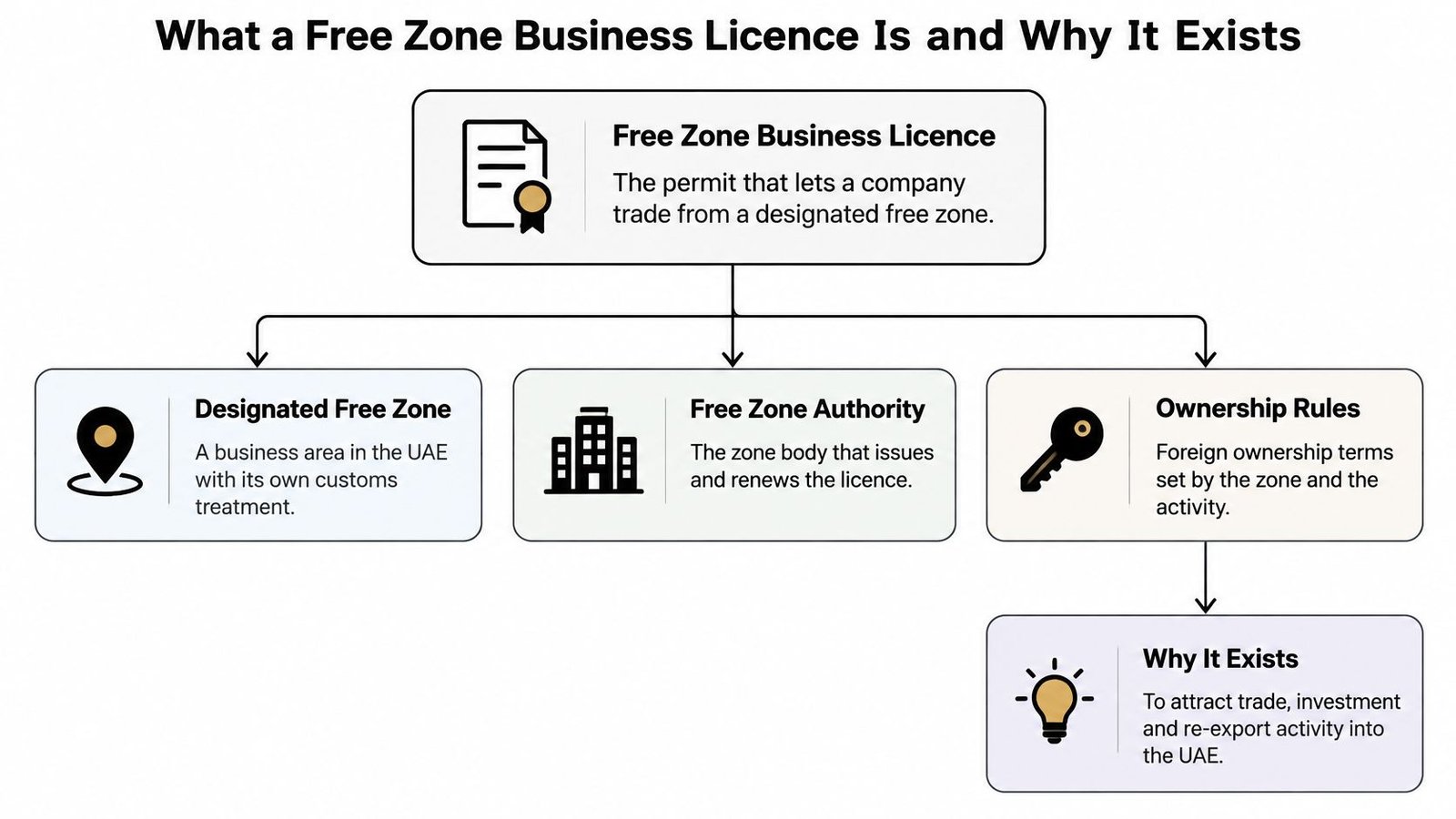
Two myths cause most early mistakes. A free zone is not a tax-free country. A licence is not one standard product. The activity and the customer's location decide which licence fits.
Licence Types Across Major UAE Free Zones
The licence type follows the activity, not the other way around. Zones publish their own menus, but the categories below are the ones founders most often choose between.
| Licence type | What it allows | Typical activities | Physical office |
|---|---|---|---|
| Commercial | Buy, sell and trade goods and services within the zone and internationally | Trading, distribution, import and export | Usually required; flexi-desk may be accepted |
| General trading | Trade in a broad list of goods | Wholesale, reselling, supply | Usually required |
| Service | Provide professional or technical services | Consulting, IT, design, marketing | Usually required; flexi-desk may be accepted |
| Industrial | Manufacture, assemble or package goods | Light manufacturing, processing, packaging | Required, with production space |
| E-commerce | Sell goods online | Online retail, marketplace sales | Confirm with the zone before you lease |
| Freelancer | Self-employed individual permit | Freelance design, writing, consulting | Often not required; check zone rules |
| Branch of a foreign company | Regional branch of an existing overseas company | Regional offices, sales hubs | Required |
| Holding or investment | Hold shares and assets in other companies | Holding and investment vehicles | Confirm with the zone before you lease |
How a real zone splits those categories
Ajman Free Zone shows why the label matters. The Ministry of Economy's Ajman Free Zone profile recorded 2,546 commercial licences, 2,280 general-trading licences, 1,110 service licences, 1,092 freelancer licences, 130 industrial licences, and 56 e-commerce licences among its active onshore licences. Commercial and general trading dominate because most applicants are moving goods. Service and freelancer permits are a large second group. Industrial and e-commerce stay smaller because they need production space or zone-specific online rules.
Names you will meet first include Jebel Ali Free Zone Authority (JAFZA) in Dubai, International Free Zone Authority (IFZA), Ras Al Khaimah Economic Zone (RAKEZ), Ajman Free Zone, and Umm Al Quwain Free Trade Zone. Financial free zones run a different rulebook. Abu Dhabi Global Market (ADGM) and the Dubai International Financial Centre (DIFC) suit regulated financial firms, not a standard trading or consulting setup. A map of designated free zones in the UAE helps you see which areas carry special customs status before you pick a name.
Practical rule: Write the activity in one sentence that matches a real contract. If that sentence is “we invoice UAE shops,” a general-trading label will not fix the market-access problem.
Choose the activity first. The licence type follows it, and the authority will reject a code that does not match the work.
Who Can Own a Free Zone Company and Which Structure Fits
A free zone company can generally be 100% owned by a foreign investor. The UAE Government states that free zone companies can be fully owned by foreign investors, and that goods imported into a free zone or stored there for re-export generally attract 0% customs duty. Duty becomes relevant when goods enter the mainland. A small set of strategically important activities stays restricted on both mainland and free zone routes, so read the activity list before you pick a zone.
Three roles get mixed up on the forms. The shareholder owns the company. The manager runs it day to day and can be the same person. The activity code is the legal description of what the company may do. A code that says “software consultancy” does not cover hardware resale.
Who this route actually fits
Individual founders use it for a new company. A foreign firm uses it for a UAE subsidiary. A freelancer uses an individual permit when the zone offers one and a full company is more structure than the work needs. An overseas firm that already exists uses a branch when it wants a regional office rather than a new legal person.
A free zone company generally needs a registered office. Many zones accept a flexi-desk instead of a fitted unit. Visa availability is subject to a quota the zone sets, so plan headcount before you sign a lease. A two-founder software firm that wants three hires in Dubai should ask for the visa quota in writing before it pays for space. If the quota is two, the third hire waits or the zone choice changes.
| Feature | Free Zone | Mainland | Offshore |
|---|---|---|---|
| Foreign ownership | Up to 100% for most activities | Up to 100% for most activities | 100% |
| Trade scope | Within the zone and internationally; direct UAE sales restricted | Throughout the UAE, globally, any Emirate, government bids | International trade only |
| Physical office | Generally required; flexi-desk possible | Required | No UAE office |
| UAE visas | Available, subject to zone quota | Available | None |
| Corporate tax | 0% on qualifying income only; other income at 9% | 9% above AED 375,000 of taxable income | No UAE tax or compliance requirement; confirm first |
| Customs | Goods stored or re-exported generally 0% duty | Duty applies when goods enter the mainland | Not designed for UAE goods flows |
| Best for | Exporters and service firms working outside the UAE market | Businesses selling to UAE customers or bidding for government work | Holding and asset structures |
Where are the customers
If most buyers sit outside the UAE, a free zone often fits. You trade inside the zone and internationally, with foreign ownership and a registered address. If you sell to UAE buyers or bid for government work, look at mainland, or at a licensed mainland distributor. Direct local sales are generally not open to a free zone company on its own.
Offshore is for holding shares and assets, and for trade that never touches the UAE market. It gives no UAE office and no UAE visas. Its tax position has to be confirmed with an adviser before anyone relies on it. Do not use it as a shortcut for a team that will live in Dubai.
Tax, VAT and Mainland Sales Limits
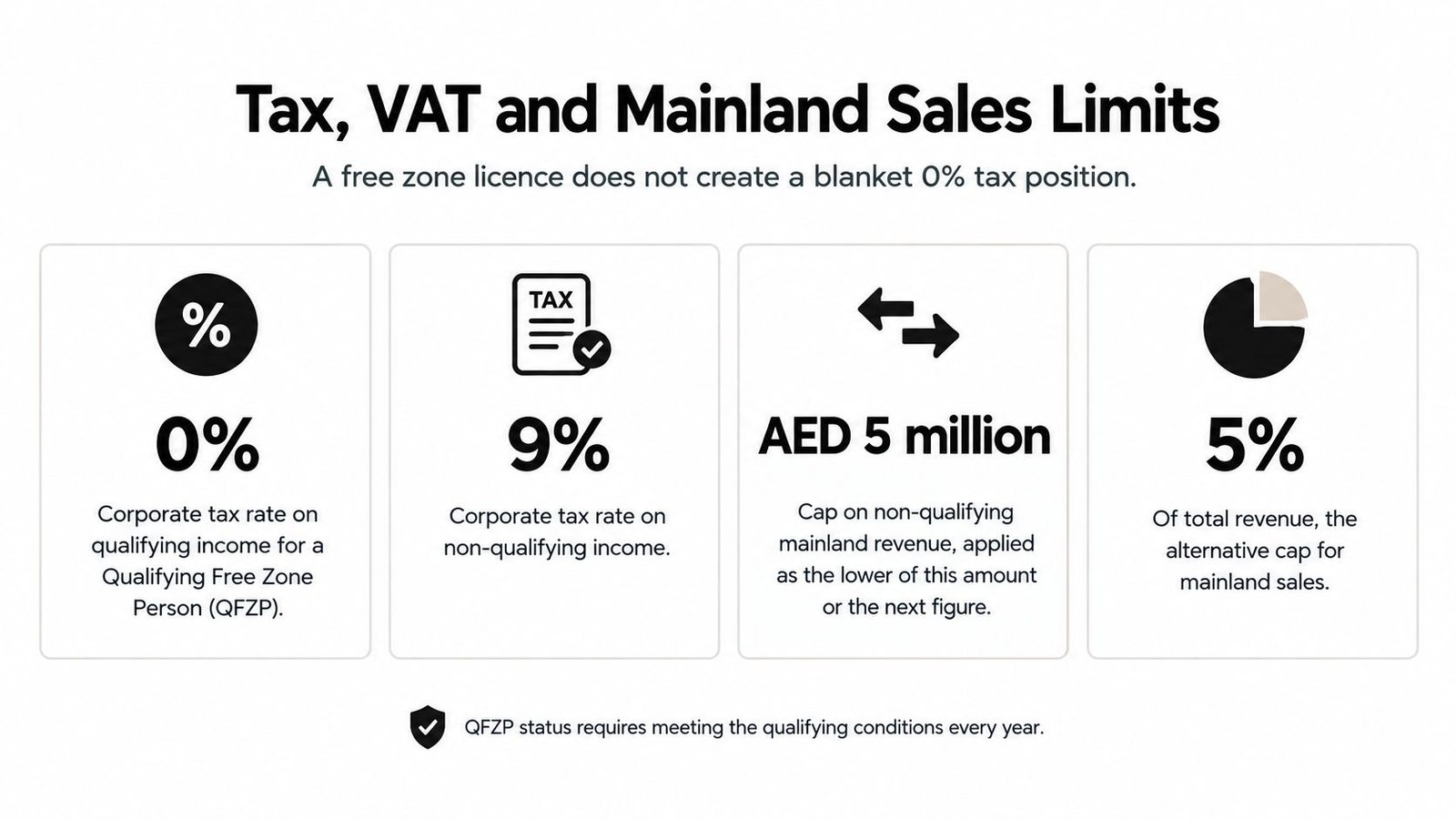
A free zone licence does not create a blanket 0% tax position. The Ministry of Finance limits that rate to a qualifying free zone person that meets prescribed conditions. Fail those conditions and the company can lose the preferential treatment for at least five years, then face the ordinary 9% rate on taxable income above AED 375,000.
A Qualifying Free Zone Person (QFZP) is the category that can keep 0% on qualifying income. The Federal Tax Authority (FTA) requires adequate UAE substance, qualifying income, transfer-pricing rules and documentation, audited financial statements, and no election into the ordinary regime. Substance means real staff and real spending in the zone, not a nameplate. Non-qualifying income is generally taxed at 9%, and a QFZP does not get the ordinary AED 375,000 buffer on that income. It is taxed from the first dirham.
Where the 0% rate stops
The FTA sets a de minimis cap. Non-qualifying revenue must not exceed the lower of AED 5 million or 5% of total revenue. The FTA free zone bulletin uses a clear case. On AED 20 million of revenue, 5% is AED 1 million, so non-qualifying revenue must stay at or below that figure. On AED 200 million, the AED 5 million cap is the lower number. The same bulletin states that the 0% regime applies to transactions performed from within the prescribed free zone geographic areas.
Say a consultancy bills AED 20 million. AED 1.4 million comes from mainland clients outside the qualifying categories. The cap is AED 1 million. The extra AED 400,000 puts the 0% position at risk, and the non-qualifying slice can be taxed at 9%. Keep separate ledgers for qualifying and non-qualifying streams, and get each stream classified in writing before you incorporate. Our note on corporate tax in the UAE is the place to line those streams up against the current rules.
VAT is a separate test
Value added tax (VAT) is charged at 5%. The UAE Government VAT guidance says mandatory registration generally applies once taxable supplies and imports exceed AED 375,000 in 12 months, or are expected to exceed that in the next 30 days. Some free zones are designated zones for VAT, with special rules on particular supplies. A designated zone does not cancel registration once the threshold is met, and it is not the same thing as QFZP status.
Direct mainland sales generally need a mainland licence, a licensed distributor, or an eligible mainland branch. The licence activity and the client's location should match the contract before the authority issues the paper.
Decide Your Structure Before You Apply
Five checks belong on paper before you reserve a name or sign a lease. Each one should end with a written answer a public relations officer (PRO) provider or a tax adviser can review.
- Activity code. Match the code to real contracts and to the restricted-activity list for that zone. A pretty brand name does not fix a wrong code.
- Revenue map. Mark each stream against the QFZP conditions and the lower of AED 5 million or 5% of total revenue. Flag every mainland client.
- People and visas. List who will live in the UAE and how many residence visas you need. Confirm the zone still has quota for that number.
- Customer location. This is the split between free zone, mainland, and offshore. The difference between mainland and free zone is a market question first.
- Full-year budget. Include renewals, yearly office fees, and a visa cost for each person. The first licence invoice is not the yearly cost.
A two-founder software firm with Dubai clients and three planned hires should finish the quota check, the office rule, and the mainland-revenue test before it chooses a zone. If the Dubai clients push non-qualifying revenue over the cap, the free zone quote is the expensive one.
Do not file until those five answers exist in writing. Changing activity, office, or visa count after submission means new fees and a new clock.
How to Apply for a Free Zone Licence Step by Step
The licence itself can move quickly. Visas, medical checks, and the bank do not. Plan for weeks once people are involved, not a single afternoon.
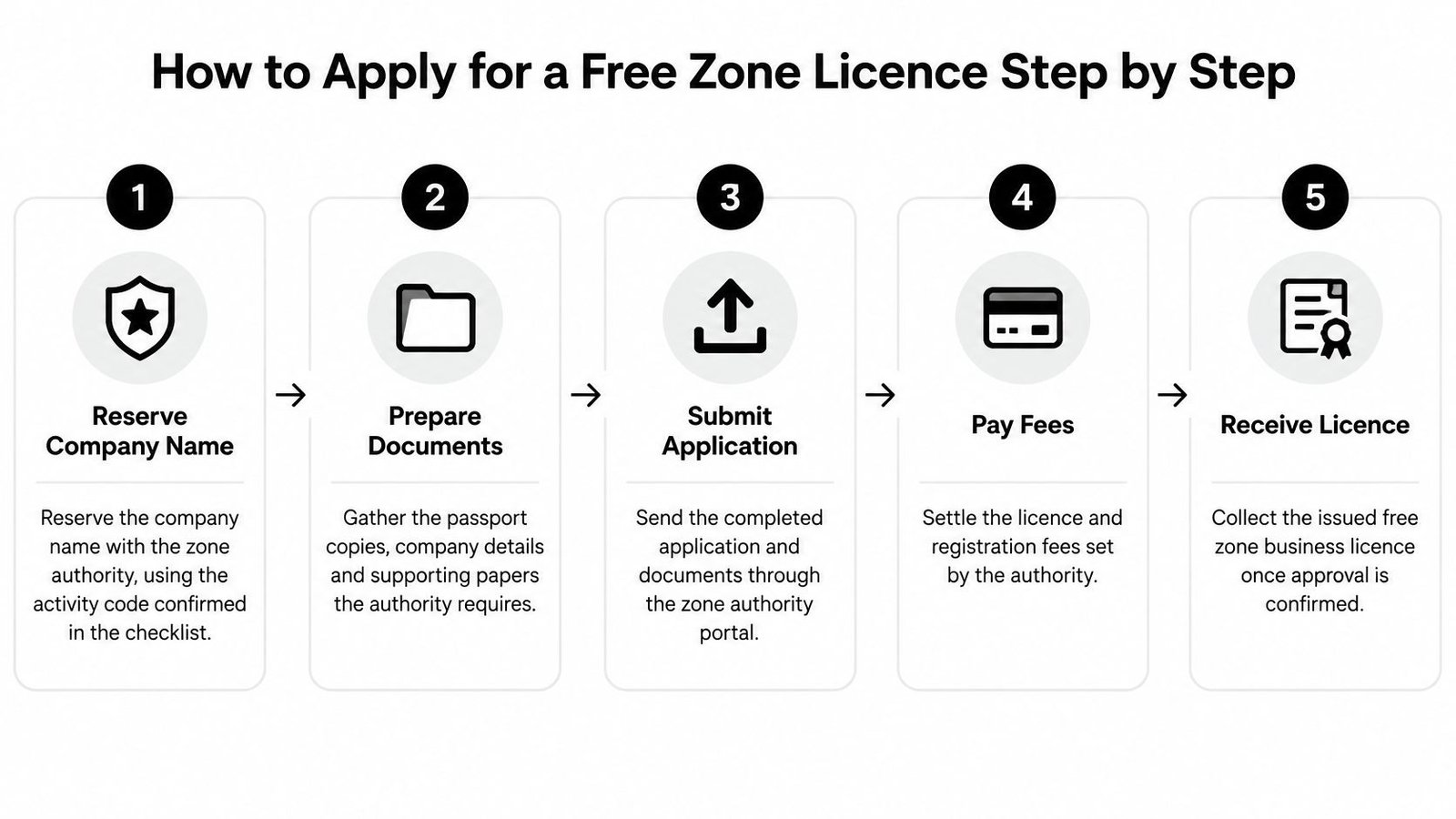
The short version is name, papers, submission, fees, and the issued licence. The full sequence has a few more gates that people skip.
- Reserve the company name with the zone authority, using the activity code from your checklist. A rejected name sends you back to the start, so have two backups ready.
- Prepare documents. You need passport copies for each shareholder and manager, passport-size photos, and proof of address. Every document must be accurate, complete, and up to date. Anything not in Arabic or English needs attestation or legal translation. A missing stamp here is the most common reason a file sits still.
- Secure the office with a lease or a flexi-desk agreement. The authority will not issue the licence against an address you do not control.
- Submit the application and pay the licence fee plus any government deposit. Deposits and service fees are due on time. Late payment pauses the file.
- Receive the trade licence. Most UAE trade licences can be issued within 3 to 5 working days, depending on the jurisdiction and the activity. Government review can run longer, so do not promise a client a start date off the best case.
- Obtain the establishment card. That card is the company's registration document. Banks and visa desks ask for it. Without it, the licence is only half the file.
- Apply for residence visas. In Dubai this runs through the General Directorate of Residency and Foreigners Affairs (GDRFA). Elsewhere it runs through the Federal Authority for Identity, Citizenship, Customs and Port Security (ICP). Each person needs a medical fitness test, health insurance, and an Emirates ID, the national identity card. Employee work permits go through the Ministry of Human Resources and Emiratisation (MOHRE). Licence and visa times depend on government approvals and can shift.
- Open the corporate bank account and register for VAT and corporate tax where the thresholds require it. Banks run their own checks. A licence in hand does not guarantee an account the same week.
Watch the sequence once if the order of name, office, licence, and visa still feels abstract. Then go back to the checklist and tick only the steps you have documents for.
What a Free Zone Licence Costs and Who Sets Each Fee
No single price list covers every zone. Each authority or provider sets its own amount. Confirm the figure on the current price list before you budget, and treat the first invoice as a deposit on a yearly cost.
| Cost item | What it covers | Who sets the amount | When it is paid |
|---|---|---|---|
| Free zone licence fee | Licence for the chosen activity | Zone authority | At application and each renewal |
| Office or flexi-desk | Registered space required by most zones | Zone or landlord | At signing, then yearly |
| Establishment card | Company registration document | Government authority | At issuance |
| Residence visas | Residence permit for each person | Government authority | After licence issuance |
| Emirates ID | National identity card for each visa holder | Government authority | With the visa |
| Medical test and health insurance | Required for residence visa | Clinics and insurers | Before visa stamping |
| Attestation and legal translation | Official recognition of foreign documents | Government and translators | During document preparation |
| PRO professional fees | Government-facing paperwork and tracking | Provider quote | As agreed in the quote |
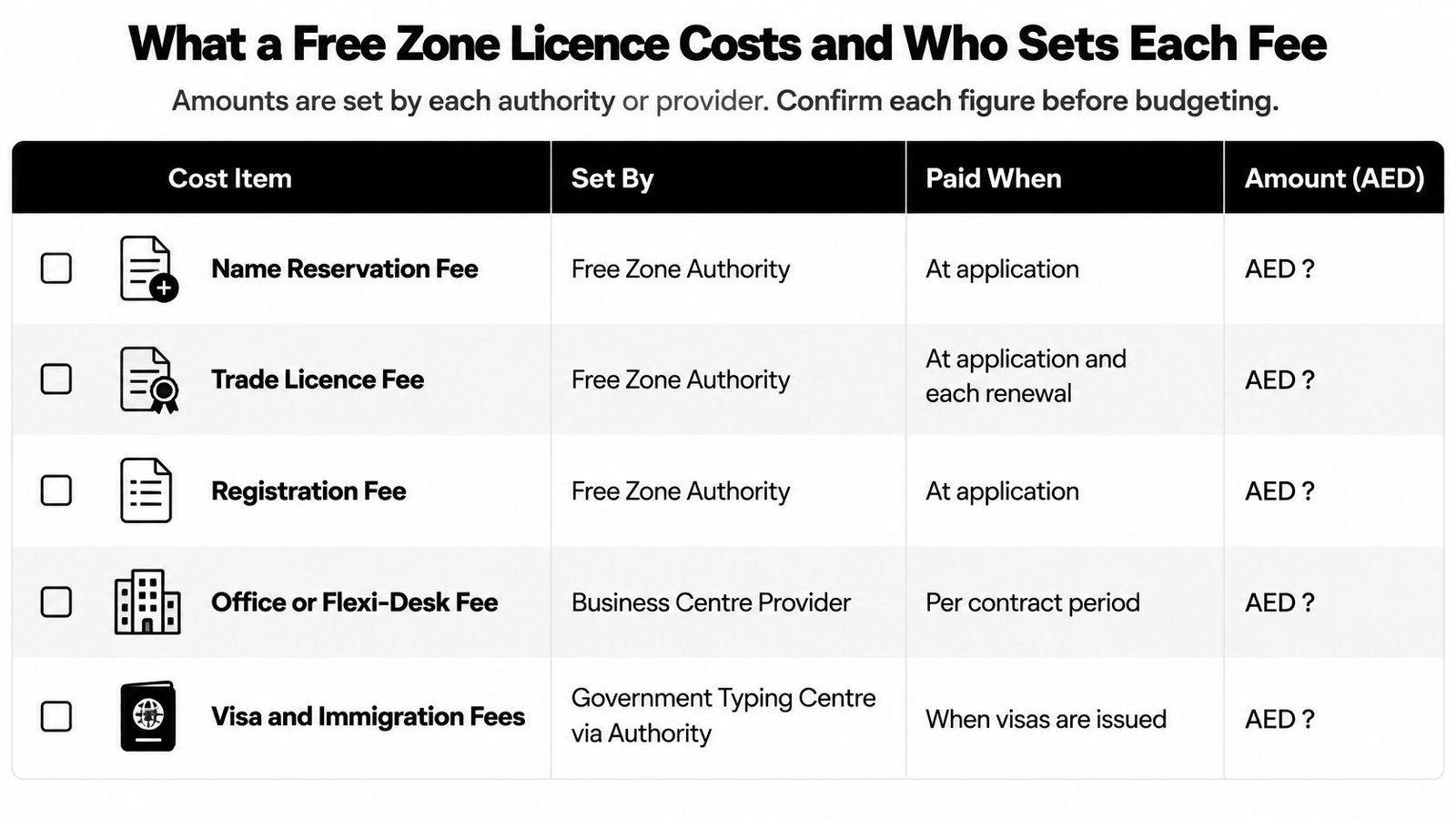
Who you pay, and what you cannot claw back
A PRO, or public relations officer, is the UAE term for a provider who files government-facing paperwork and tracks deadlines for a company. Government filing, licence, and visa charges are set by the authorities and sit apart from professional fees. A quote should show both lines. Fees for completed work or for government submissions are generally non-refundable, so a wrong activity code is not a free retry.
Renewal is yearly. Start gathering the licence copy, identity papers, and activity confirmation well before the expiry date. An expired licence slows visas, banking, and contracts even when the team is still at their desks.
Not sure where to start? Use our cost estimator to see what your UAE setup might cost, or book a free strategy call with the inpro.me team before you sign a lease.
Inpro sets up free zone, mainland, and offshore companies, then handles the licence, visas, and the tax registrations that follow. If you are weighing a free zone business licence against mainland sales and the 0% conditions, we can map the activity, the visa quota, and the yearly fees before you commit. Visit Inpro to book a free strategy call or run the cost estimator for your setup.