


If you're comparing setup quotes and trying to work out what you can sell, DAFZA company registration requires an approved business activity, the right legal structure, incorporation documents and premises accepted by Dubai Airport Freezone. Settle your customer-access and tax position before paying for the licence, because those decisions determine whether the setup will work for your business.
Table of Contents
- DAFZA Requirements by Company Structure
- Choose the Licence and Check Your Tax Position
- Documents to Prepare Before You Apply
- How to Register Your DAFZA Company Step by Step
- Budgeting for Fees, Visas and Bank Account Setup
- Next Steps After Your Licence and Scaling
DAFZA Requirements by Company Structure
A DAFZA company is a company incorporated in Dubai Airport Freezone (DAFZ), the free zone in the United Arab Emirates (UAE) formerly known as Dubai Airport Freezone Authority. It can be fully owned by foreign shareholders.
A free zone is a designated area with its own licensing rules, separate from the mainland licensing system. The Registrar is the official who approves incorporation, while an ultimate beneficial owner (UBO) is the individual who ultimately owns or controls the company, including through other companies.
In its 2025 corporate overview, DAFZ reports more than 3,400 registered businesses across more than 20 sectors, supported by over 20,000 professionals. That breadth matters: you don't need to run an aviation business to consider the zone.
Which company structure fits your plans?
A Free Zone Company is an incorporated business with its own shareholders, while a branch is an extension of an existing foreign company. Choose based on who should own the operation and which entity should enter customer contracts, not which application looks shorter.
Registration requirements by company structure
| Requirement | Free Zone Company | Branch of a Foreign Company |
|---|---|---|
| Shareholders | 1–50 individual or corporate shareholders | Existing foreign parent company, rather than separate branch shareholders |
| Minimum share capital | AED 1 | No share-capital requirement |
| Premises | Lease accepted by DAFZ after incorporation is approved | Lease accepted by DAFZ after incorporation is approved |
| Ownership disclosure | UBO declaration and supporting ownership documents | Parent ownership chain and supporting UBO documents |
For a founder launching a new venture, the company route gives a clearer separation from other business interests. For an established overseas business, a branch may better match contracts and management arrangements already held by the parent.
If you're still comparing ownership models, our sole proprietor versus limited liability company guide explains the wider distinction. A limited liability company is a company structure that separates the business's obligations from its owners, subject to the applicable law.
What premises should you plan for?
A physical office is generally required for a free-zone company, although flexi-desk options are available for smaller teams. Don't assume that any shared-workspace package will satisfy DAFZ for your activity and hiring plans.
Ask for written confirmation of the acceptable premises before committing to a package. Find the structure that matches your ownership, then settle what the business will sell and to whom before ordering certified documents.
Choose the Licence and Check Your Tax Position
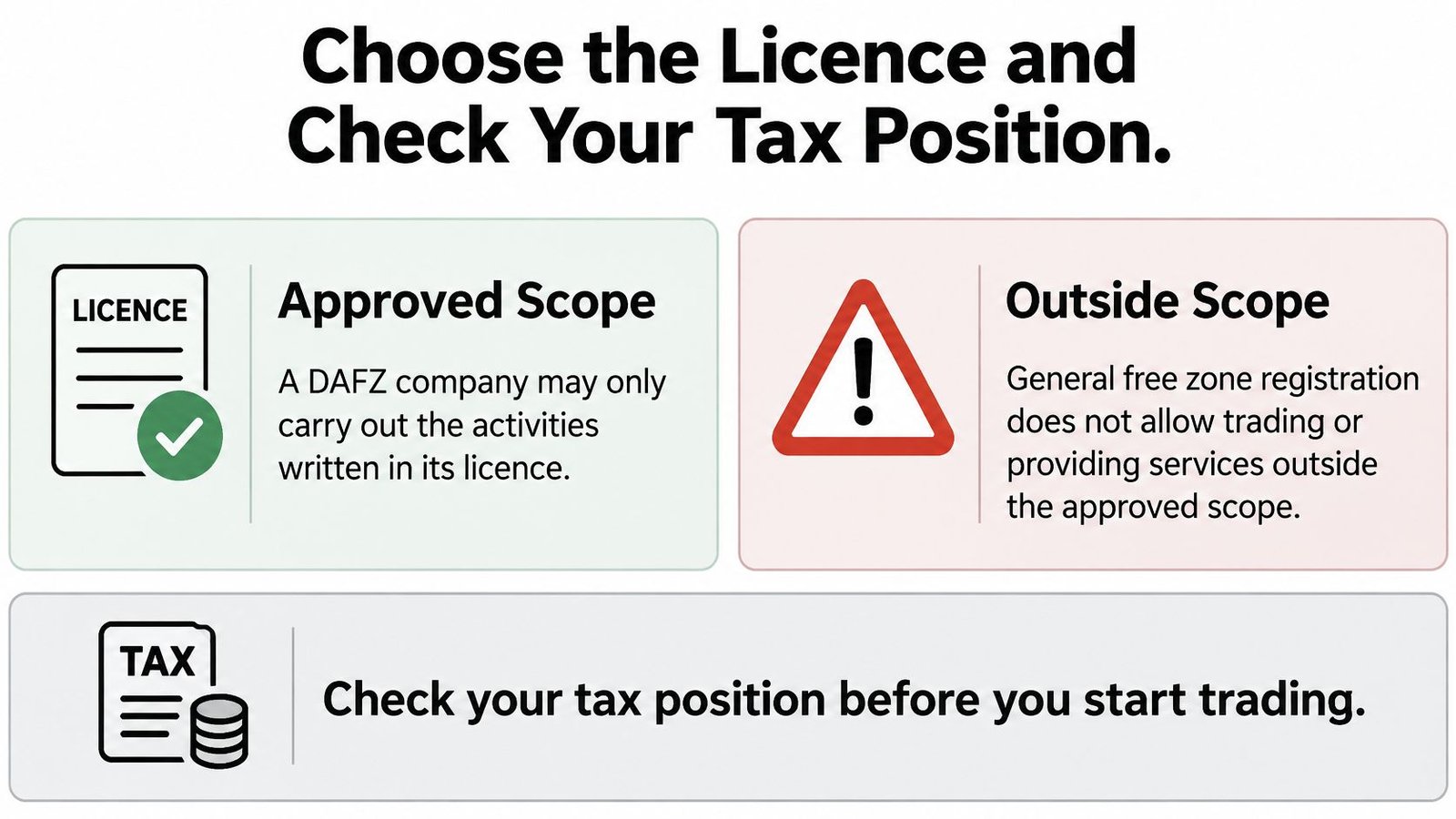
The licence defines what your company may do. General free-zone registration doesn't authorise trading or services outside the approved scope, so describe your actual deliverables rather than using a broad label such as technology or consulting.
This distinction is the starting point for choosing your activities.
Which licence matches what you sell?
A licence class is the category of permission covering your approved business activities. The DAFZ business setup process distinguishes trade, service and industrial permissions, so match each proposed revenue stream to its permitted activity before filing.
DAFZ licence categories and what they permit
| Licence | What It Covers | Typical Fit | Limit to Check |
|---|---|---|---|
| Trade | Import, export, re-export, distribution and storage of specified products | Importers, distributors and traders | Only the products named on the licence |
| Service | Only the services stated in the licence | Consultancies, agencies and professional firms | Services not listed cannot be offered |
| Industrial | Light manufacturing, packaging and assembly | Small producers and assembly operations | Activity-specific approvals may apply |
| General trading or e-commerce | Classes listed in DAFZ filing guidance | Online sellers and general traders | Confirm the class with DAFZ in writing |
For example, selling equipment and charging customers to install or maintain it aren't necessarily the same licensed activity. Send DAFZ a plain-English description of each contract deliverable and request written activity confirmation.
Does free-zone registration mean you pay no corporate tax?
No. A free-zone juridical person is a legal entity registered in a free zone, and the UAE Ministry of Finance corporate-tax guidance places these entities within corporate tax and requires registration for a Corporate Tax Registration Number; 0% applies only to a Qualifying Free Zone Person on qualifying income, while other taxable income may be taxed at 9%.
A Qualifying Free Zone Person (QFZP) is a free-zone entity that meets the conditions for qualifying tax treatment. Those conditions generally include adequate business substance, transfer-pricing compliance, audited financial statements and records supporting income classification.
Under the same Ministry guidance, non-qualifying revenue must remain within the lower of 5% of total revenue or AED 5 million. Staying within that limit alone doesn't establish eligibility, because the remaining conditions must also be met.
Practical rule: Choose a tax position your contracts, staffing, premises and accounting records can support. Don't build your budget around a tax-free promise.
How should you classify your customers and income?
Create a revenue worksheet before incorporation and give your tax adviser the proposed contracts. The Ministry of Finance's free-zone decisions distinguish transactions with free-zone persons from those with non-free-zone persons, with treatment affected by qualifying activities and exclusions.
Use separate worksheet categories:
- Free-zone customers: Record the customer's legal entity and the activity performed.
- Mainland customers: Identify where you'll deliver the work or goods and whether further operating permissions are needed.
- Foreign customers: Record the actual service or product, rather than assuming overseas revenue qualifies.
- Related parties: Flag transactions with connected businesses for transfer-pricing review.
- Intellectual-property income: Separate licensing income from implementation, support and other services.
A software business, for example, should distinguish subscription receipts, consultancy and intellectual-property licensing. A customer's address alone doesn't settle the tax result.
The video below provides another format for reviewing the setup topic.
When does mainland access change the decision?
Compare operating from DAFZ for overseas clients, contracting with mainland customers, and using a separate mainland presence or permitted intermediary. Confirm whether your model needs a branch, dual-licence arrangement, customs setup or sector approval rather than assuming universal market access.
A mainland company can trade throughout the UAE and globally, open locations in any Emirate and bid for government contracts, but it requires a physical office. That may better fit a business planning delivery teams or locations in Dubai, Abu Dhabi or Sharjah.
We support mainland, free-zone and offshore setup and compliance. Use our UAE corporate-tax guide to prepare your questions, then confirm the proposed treatment with a licensed tax adviser before relying on the preferential regime.
Documents to Prepare Before You Apply
A DAFZ file moves faster when you sort it into three piles from the start: individual owners, corporate shareholders, and the company file itself. That split shows who signs what, which pages need certification, and which approvals come from an outside regulator.
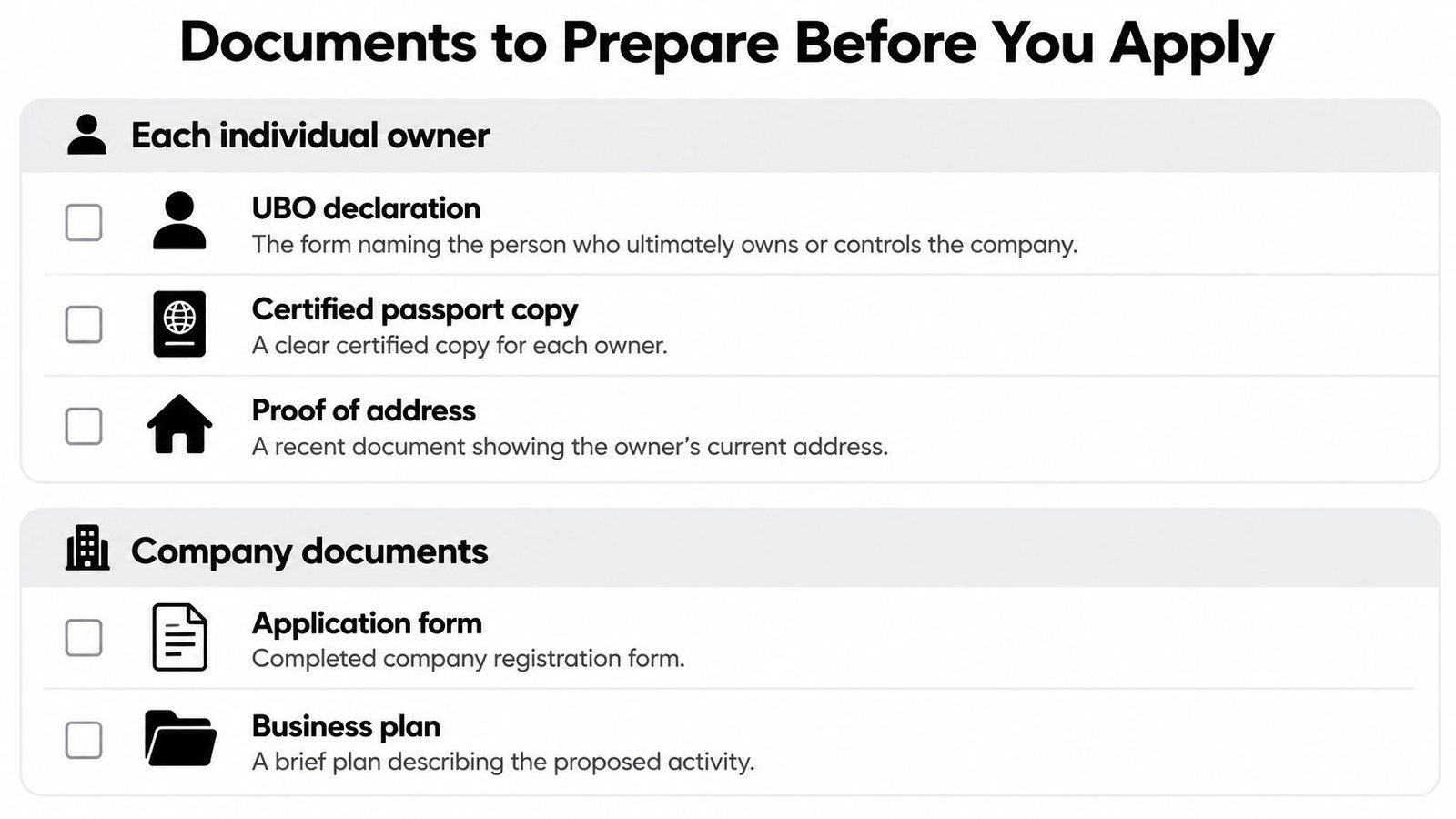
The checklist below is a preparation aid. Obtain the current structure-specific filing list before commissioning legalisation.
What should individual owners provide?
Prepare identification and address evidence together with the ownership declaration. Under the DAFZ document requirements, proof of residential address must be dated no more than three months before submission.
- UBO declaration: Complete the form identifying the person who ultimately owns or controls the company. Trace indirect ownership rather than stopping at a holding company.
- Certified identification: Supply a certified passport or national identity copy in the form DAFZ accepts. Check that the certification stamp and the document image are both readable.
- Residential address evidence: Use a document showing the owner's current address. Measure its date against the planned submission date, not the date you started the file.
What changes when a company is a shareholder?
Corporate ownership needs a clear trail from the applicant up to the ultimate parent or holding company. Draw the structure chart before you pay for certification, so gaps get fixed early.
- Group structure chart: Show each ownership layer and identify the ultimate parent or holding company.
- Ownership records: Provide a notarised and attested shareholder register, or an equivalent recent audited report identifying relevant senior management.
- Signing authority: Confirm what evidence is required for the person who signs for the shareholder. Ask DAFZ to confirm the wording before legalisation.
Notarisation is formal certification by a notary, while attestation is authentication through the relevant authorities. Start these two steps first. Coordinating foreign documents, appointments and authentication often takes longer than the application itself, and one expired attestation can stall the whole submission.
Which documents belong in the company file?
Keep the commercial activity description beside the application forms so they can be checked together. A no-objection certificate is a letter from a regulator confirming that it has no objection to the proposed activity or arrangement.
- Activity confirmation: Retain DAFZ's written response confirming the proposed licensed activities.
- Capital evidence: Prepare a bank share-capital letter where the declared capital triggers that requirement.
- External approvals: Obtain activity-specific approvals and no-objection certificates before treating the file as complete.
- Application documents: Complete the required forms and prepare a business plan where requested.
Free zone entities such as FZEs and FZCOs generally need audited annual financial statements, so ask your accountant early which audit obligations apply to your entity type. That choice affects your ongoing accounting cost, not just the setup file.
You are responsible for accurate, complete and updated documents, compliance with UAE laws, and timely payment of service fees and government deposits. Match every name to the passport spelling exactly before signing.
How to Register Your DAFZA Company Step by Step
The safest sequence is to settle the activity, ownership and premises plan before submitting the incorporation file. An incorporation approval isn't permission to start operating, and an incomplete external approval can hold up an otherwise organised application.
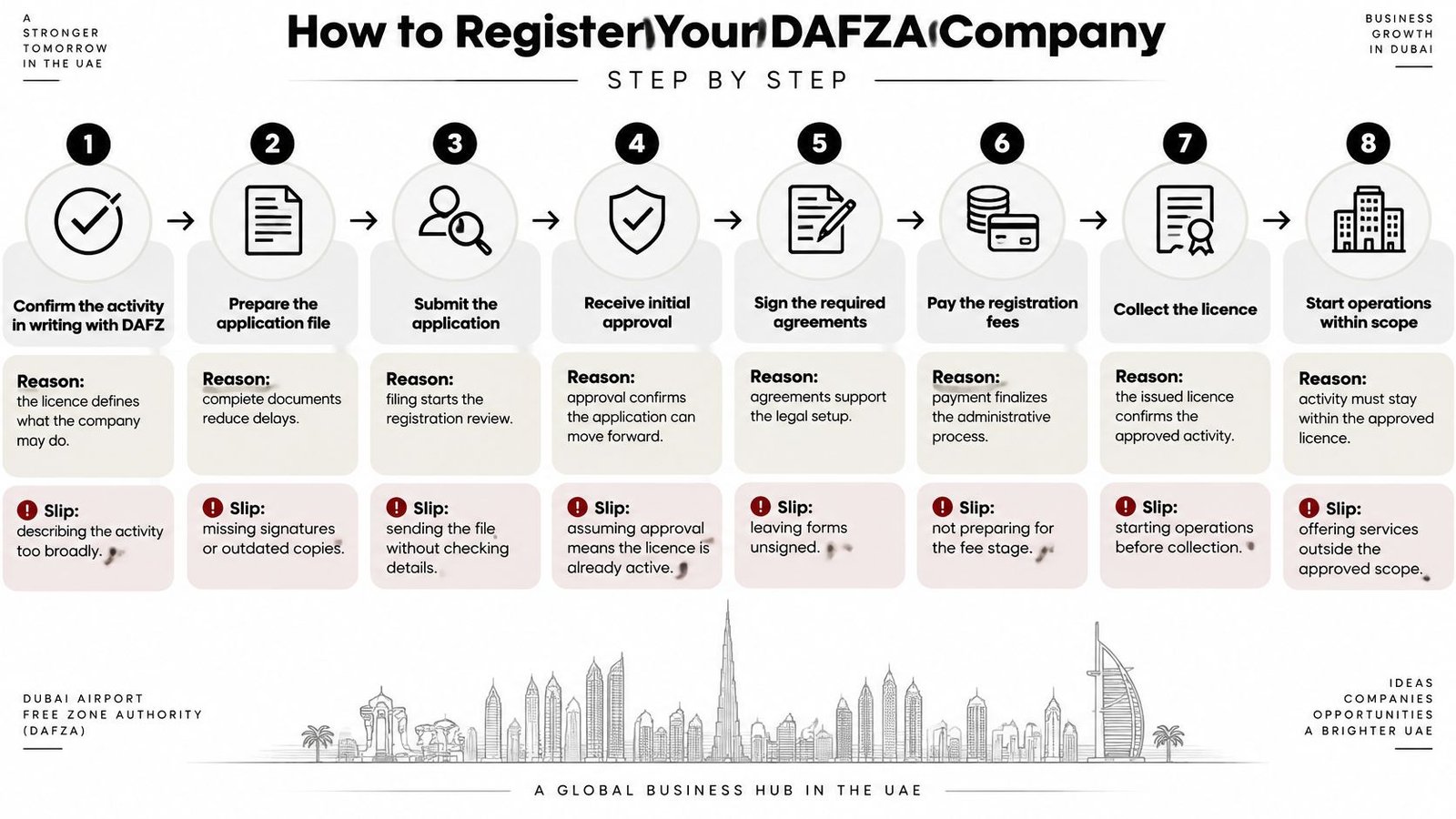
Use this process visual to keep the administrative stages visible while preparing the detailed file.
What order should you follow?
Follow the filing sequence while keeping the future lease and staffing requirements in view. The DAFZ frequently asked questions describe a Free Zone Company with 1–50 individual or corporate shareholders and minimum share capital of AED 1, and require a bank share-capital letter where stated capital exceeds AED 150,000.
Confirm the activity in writing. Explain what customers will buy, how you'll deliver it and whether goods are involved. The usual slip is describing the business broadly and receiving permission narrower than the intended contracts.
Settle ownership, then reserve the trade name. Confirm the shareholders and signing arrangements before checking the proposed name. Changing owners after reservation can create avoidable revisions across the application.
Choose the legal form. Decide whether you need a new FZCO or a branch of the existing overseas business. Don't choose solely on nominal capital, since liability, contracts and parent-company paperwork matter more.
Assemble and certify the documents. Check signatures, certification, address evidence and ownership records against the filing list. A complete-looking folder can still contain an expired address document or an unsigned declaration.
Submit the incorporation application. The Registrar reviews the file before approving incorporation. A missing regulator's no-objection certificate can prevent progress even when the ownership documents are ready.
Lease premises DAFZ accepts. Plan the space earlier, then complete the lease at the required stage after approval. Treating the setup as virtual-office-only can create a compliance problem, so align premises, activities and immigration capacity.
Collect and check the issued documents. Under the DAFZ implementing regulations, the completed application and accepted lease support issue of the licence, certificate of incorporation, and registered memorandum and articles of association. These constitutional documents set out the company's governing arrangements, so check names and activities immediately.
Start the immigration and banking work. Prepare the owner's residence and bank application files once the licence is available. Don't promise a hiring date or payment collection date based solely on incorporation approval.
How long should you allow?
We estimate that most UAE trade licences can be issued within 3 to 5 working days, depending on the jurisdiction and business activity, once the file is complete. That isn't a DAFZ processing guarantee or an end-to-end setup timetable, so confirm the expected licence date with DAFZ after accounting for the lease and external approvals.
Registration timeline by stage
| Stage | What Happens | What Can Extend It |
|---|---|---|
| Activity confirmation | Licence activity confirmed in writing with DAFZ | Unclear activity list or disputed licence class |
| Name and ownership check | Trade name checked once shareholders are settled | Ownership changes after the name is reserved |
| Document preparation | Notarisation, attestation and translation | Notarisation and attestation, usually the longest step |
| Incorporation approval | Registrar reviews the complete file | Missing external approvals or no-objection certificates |
| Premises lease | Lease on terms DAFZ accepts | Lease negotiation and landlord paperwork |
| Licence issue | Licence, certificate of incorporation and memorandum issued | Unresolved items from earlier stages |
Book travel around appointments that require your presence, not an assumed licence completion date.
A Public Relations Officer (PRO) is a professional who handles government paperwork and liaison. We coordinate with free-zone authorities and the Dubai Economic Department and can act on government matters for owners abroad, but you must attend steps requiring your presence, including your own biometrics and medical examination.
Budgeting for Fees, Visas and Bank Account Setup
There's no single setup fee that suits every DAFZA application. Your budget needs the licence class, activities, premises, visa requirements and document work, with authority charges separated from professional service fees.
Request an itemised quotation before committing, including the renewal position. A low incorporation figure isn't a useful comparison if it excludes the office or immigration work your business needs.
What should your setup budget include?
Use the table as a cash-planning checklist rather than a fixed price list. Confirm payment dates against the actual quotation, particularly where registration and lease payments are staged.
Setup costs and post-licence tasks by timing
| Cost or Task | What It Covers | When It Falls Due |
|---|---|---|
| Licence and registration fee | DAFZ fee for the chosen licence class and activity | At application, according to the payment notice |
| Share capital | Minimum FZCO capital and bank evidence where the declared amount triggers it | Before incorporation, as required |
| Premises lease | Lease accepted by DAFZ | Before the licence is issued |
| Document costs | Attestation, notarisation and translation where required | During document preparation |
| Establishment card and first investor visa | Immigration file and owner residence processing | After the licence |
| Emirates ID | National identity card issued through the residence process | During residence processing, following the applicable sequence |
| Employee visas | Applications within the approved free-zone quota | When hiring |
| Corporate bank account | Account-opening documents and bank fees | After the licence; charges follow the selected bank's terms |
Nominal share capital isn't a realistic operating budget. You still need funds for the lease, immigration, accounting, supplier payments and the bank's account conditions.
How do visas and banking affect readiness?
An establishment card is the company's immigration registration document, used for its residence-related applications. An Emirates ID is the UAE national identity card issued through the residence process; we handle the establishment card, first investor visa and Emirates ID for newly licensed companies.
Employee visa availability is subject to free-zone quota. Confirm capacity before issuing employment offers, especially if the premises package was chosen for a small founding team.
We support bank selection, document preparation and follow-up until the corporate account is active, including applications with Wio, Emirates NBD and Mashreq NEO Biz. The bank makes the approval decision, and its fees and minimum-balance conditions need separate review.
Our company bank account guide helps you prepare the banking file. Keep the licence activity, anticipated transactions, customer contracts and source-of-funds explanation consistent.
Budget check: Put each cost category in a spreadsheet with its quote, due date and responsible person. Leave a contingency for translation and attestation rather than treating them as incidental expenses.
Next Steps After Your Licence and Scaling
Once the licence arrives, assign responsibility for the bank account, establishment card, investor residence and Emirates ID. Keep the annual audit on the same compliance calendar as licence and lease renewals, with an authority-approved auditor appointed early enough to review the records.
Someone should own that calendar, even if different people handle finance, immigration and operations. Store issued documents, applications and approval correspondence in a shared folder with controlled access.
What should you put in place before the first invoice?
Set up bookkeeping categories that distinguish your revenue streams and customer types. Give the accountant the actual contracts and operating model, not just the licence copy.
- Contract checks: Make sure the contracting entity and deliverables match the issued permission.
- Payment controls: Keep company receipts and expenses separate from the founder's personal transactions.
- Employment planning: Confirm immigration capacity and required employment paperwork before agreeing start dates.
- Document ownership: Assign a person to update ownership records and retain supporting evidence when circumstances change.
A founder relocating to the UAE should also separate business readiness from personal residence arrangements. An existing residence or Golden Visa doesn't replace the company's operating permissions or employee requirements.
Which growth route fits the next stage?
Adding an activity can work when the same entity, premises and customer model remain suitable. Amend the licence before selling the new products or services rather than waiting for renewal.
A mainland presence may fit when customer delivery requires a local operating location or broader permissions. Price the premises, staffing and compliance work alongside the commercial benefit, rather than treating it as a simple licence add-on.
A second entity may make sense when a new business line has different customers, risks or tax treatment. It also creates separate accounting, contracts and administration, so separation should solve a defined problem rather than merely look tidy on an ownership chart.
Before signing a new customer channel or premises agreement, test the proposed activity, delivery location and tax treatment together.
Growth decisions often arrive with a customer deadline attached. Prepare a short decision note naming the new activity, expected customers, delivery location, staffing needs and intended contracting entity, then obtain the necessary confirmations before committing.
We offer a free PRO consultation to help you assess DAFZA registration, government paperwork and post-licence requirements. Visit Inpro to book a consultation, or use our cost estimator to compare UAE setup paths before committing to a licence and lease.