

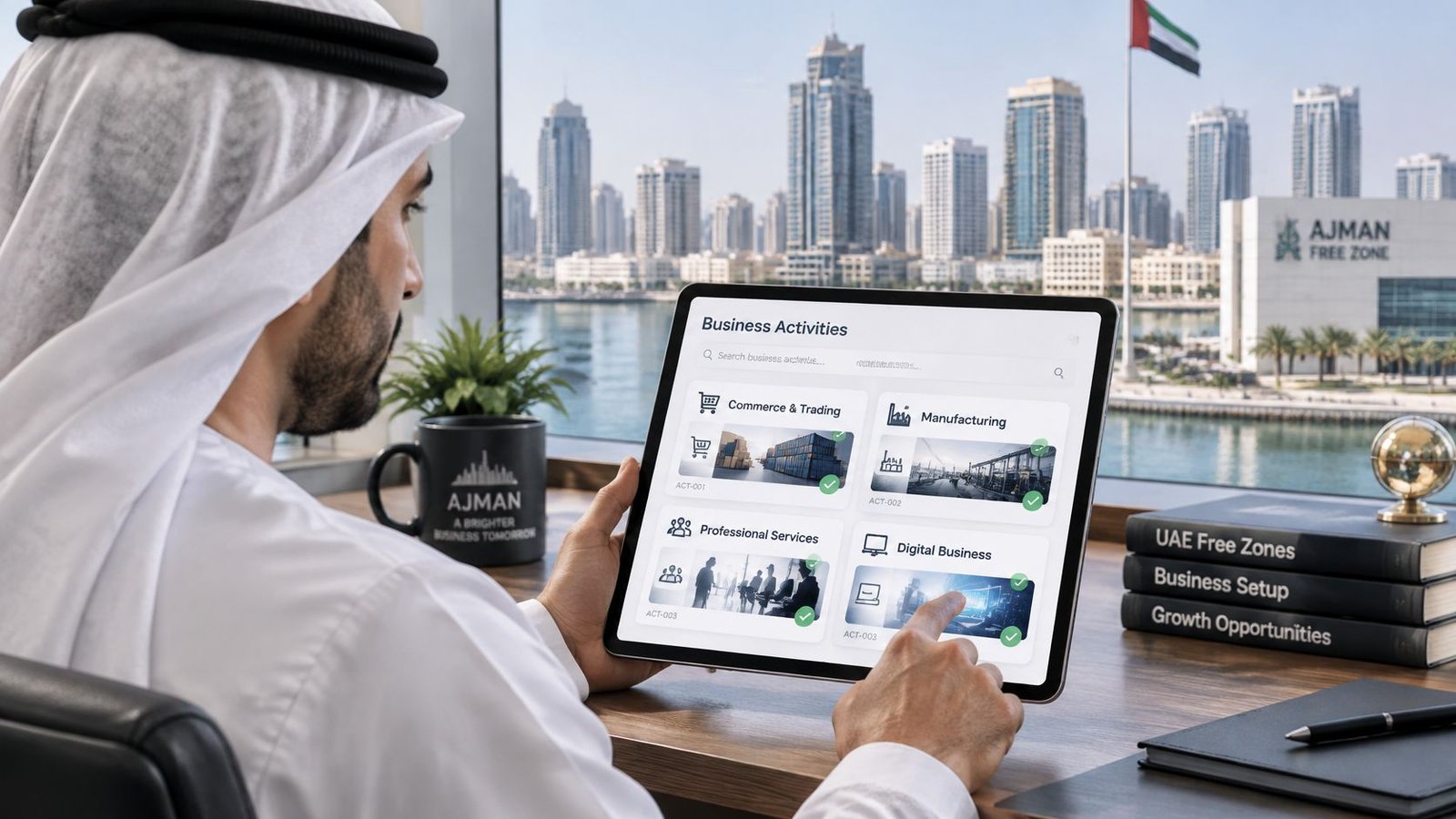
Ajman Free Zone lists more than 3,500 business activities, and every entry in that catalogue carries an activity number, an ISIC code and a licence type that together define what your company may legally do. A licence covers only the activities written on it, so the entry you choose is the outer edge of your business, not a starting package you can widen as you trade.
Which raises the question most pages about the list never answer. If the catalogue is that broad, why do applications still stall? Because breadth is not permission. The list tells you what can be licensed in Ajman. It doesn't tell you which approvals your particular operation needs, what premises it has to run from, or which legal form can hold it. Read the right way, the Ajman Free Zone activity list is a set of controls, and they follow a fixed order: category, entry, approvals, premises, legal form, then any changes you make later. Get that order right and the filing is straightforward. Get it wrong and you'll be back at the counter with an amendment.
Table of Contents
- Ajman Free Zone Activity Categories at a Glance
- How to Read an Activity Entry Before You Choose
- Why Listed Activities Still Need Approvals
- Matching Your Premises to the Licensed Activity
- Worked Examples from Common Business Models
- Choosing Between an FZE, FZC or Branch
- Changing Your Activities After Licensing
- Next Steps Before You File
Ajman Free Zone Activity Categories at a Glance
AFZ publishes more than 3,500 business activities in its business-activity directory, and it lists them in a fixed order: activity number, ISIC code, licence type, activity name and description. That order is the point. It lets an applicant see the permitted scope of a proposed operation before committing to anything, rather than discovering the limits after the licence is issued.
The spread of entries tells you who the zone is built for. Alongside general trading you'll find freight air transport, statistical-services consultancy, and jewellery and precious-metal trading. Professional, transport and specialised commercial services sit on the same list as physical trade, so the catalogue isn't a manufacturers' register with a few service lines bolted on.
Three licence families hold almost everything. AFZ groups activities as commercial, industrial or services, and the family decides what the paperwork will let you do.
| Activity family | Licence type | What the licence covers |
|---|---|---|
| Commercial trading | Commercial licence | Importing, exporting, distributing and storing specified products |
| Industrial and manufacturing | Industrial licence | Manufacturing listed goods, importing raw materials, exporting finished goods |
| Professional and consultancy services | Services licence | Consultancy and comparable professional services |
| Digital trading | E-commerce licence, confirmed with AFZ at application | Online trading within the scope of the licence |
| Freelance professionals | Sole professional licence | Freelancers across 40 categories |
Freelancers get their own track rather than a stripped-down company licence. AFZ's permits and licence service page sets out the sole professional licence covering 40 categories, plus permits for commercial, property, operational, health-and-safety-and-environment (HSE), vehicle, event and temporary activities within its areas.
The working rule is to pick the family first, then search inside it, then read the full description before you commit to a code. Starting with a keyword search across 3,500 entries is how founders end up with a licence that sounds right and authorises the wrong thing.
How to Read an Activity Entry Before You Choose
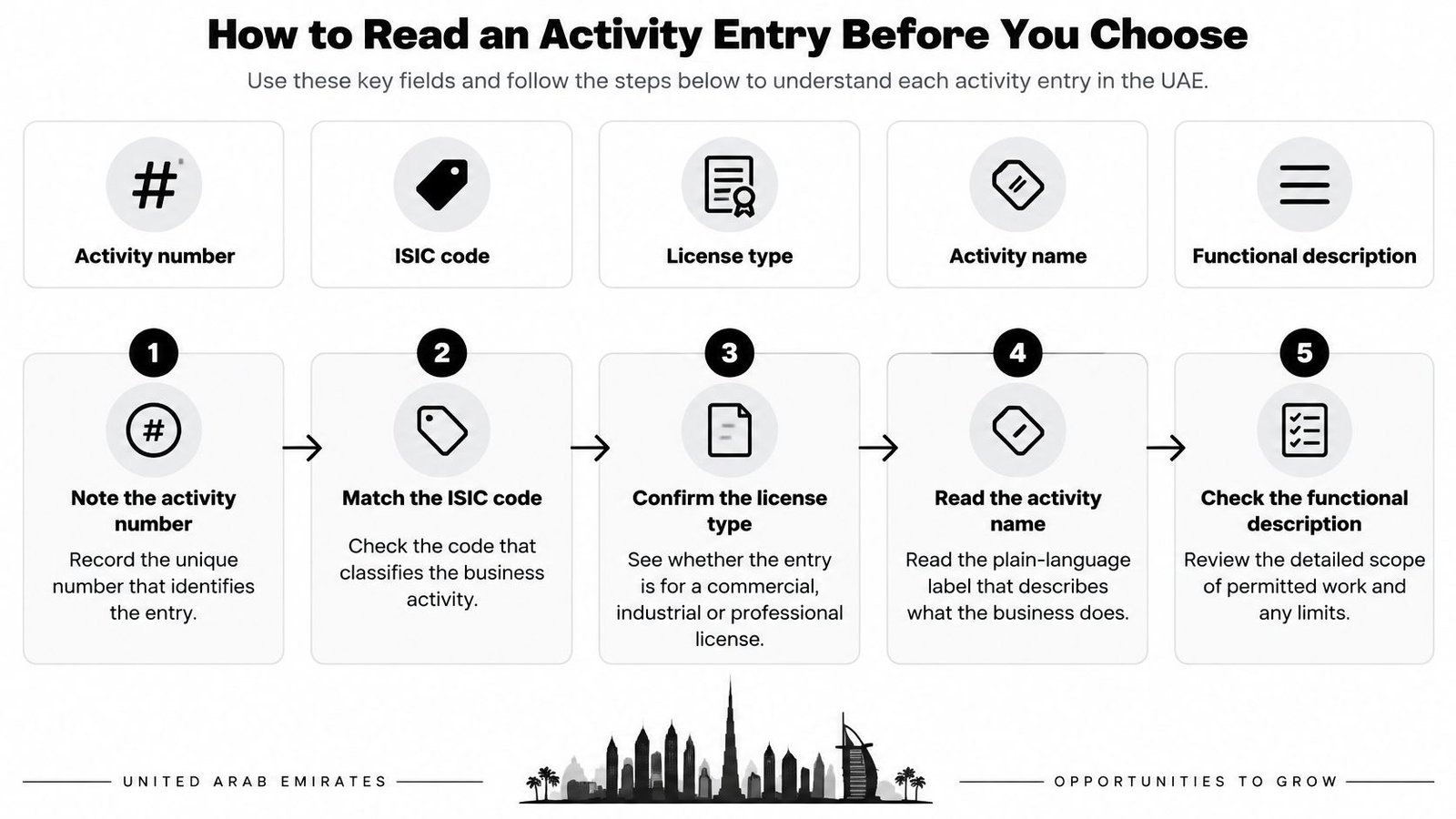
An entry isn't a job title. AFZ's activity list identifies each of its more than 3,500 activities through an activity number, an ISIC code, a licence type, an activity name and a functional description, which keeps an auditable link between what your company sells and how the classification system records it. Read all five fields, in that order, and the choice becomes a checklist rather than a gamble.
- Note the activity number and the ISIC code. The number is the handle you'll quote on forms, amendment requests and correspondence with the authority. The ISIC code is what a bank, an auditor or another government body reads when checking what the company does.
- Check the licence type next. Commercial, industrial, services or e-commerce, each carries different premises expectations and permitted functions. A services entry chosen for revenue that comes from buying and reselling stock creates a mismatch you'll fix with a second licence.
- Read the functional description, not just the name. Near-identical entries differ in key ways. Some distinguish wholesale from import and export, manufacturing from consultancy, and content production from operational support. The description, not the title, is what gets compared against your actual work.
- Put two candidate entries side by side. Take the two closest matches to your business model and note which description covers the revenue you plan to earn in year one. If neither does, the answer is usually two codes rather than one stretched code.
- Record the code beside each revenue stream. One document, one line per income line, each with its activity number, description and licence type. You'll reuse that file at renewal, amendment and when a bank asks what the company does.
Here's the same sequence laid out visually, from field to filed decision.
Why does the description matter more than the title
Take a software business. One founder sells development hours and advisory work. Another sells a subscription product with hosting and support. Broadly similar titles, different descriptions, and often different licence types. The consultancy entry fits the first founder. The second needs an entry whose scope covers the product and the ongoing service behind it. Licence the first and sell the second, and you have a revenue line the certificate doesn't cover.
The list is explicitly subject to change, and certain activities may require a no-objection certificate or another external approval. A no-objection certificate (NOC) is a written confirmation from an official body that it has no objection to the activity being licensed. If your shortlist includes an entry carrying that requirement, the NOC is a task with a lead time attached, not a formality at the counter.
Working test: every revenue stream should map to one activity code before incorporation, and that code should be checked against the current version of the list, not a printout from last year.
Why Listed Activities Still Need Approvals
Being on the list is not the same as being cleared to trade. AFZ's published activity list and the guidance around it state that investors must obtain the relevant official approvals and rent premises suitable for the activity, and that a company may not conduct activities outside those written on its licence. The list defines what can be licensed. Your approvals define what you may do.
The trap is that similar-sounding entries carry different approval paths. The activity name alone won't tell you whether a municipality, health, education, environmental, customs or telecommunications approval sits behind it. Founders in software-as-a-service, fintech, health, education, food, logistics and industrial manufacturing meet the heaviest checks, so they should start earliest rather than last.
There's a second dependency that catches people. AFZ recognises several legal forms, and the form available to you is connected to your ownership structure and to the activity being licensed, as its business type guide sets out. Decide whether you're forming a new entity or registering a branch of an existing company before you submit, because that answer changes the documents and can change the codes you're able to hold.
Three checks, run once per planned activity:
- Read the description for named approvals. If the entry mentions an authority or a certificate, it becomes a task with an owner.
- Confirm each approval with the issuing body before filing. A requirement that reads as routine can carry a site inspection or a review you didn't budget time for.
- Log the outcome beside the activity code. At renewal or amendment you'll want that record in one place rather than reconstructed from emails.
If your activity is a trading one, the licence family and the goods you handle drive most of the approval work, and our guide to the Ajman trade licence breaks that down by product type.
Matching Your Premises to the Licensed Activity
AFZ's published rules tie the activity and the address together. A company must hold a licence for the activities it intends to conduct, secure any required official approvals, and operate from space suitable for those activities, according to the zone's rules and regulations. Read that as a sequence rather than a bundle. Codes first, premises that fit them second. Signing a lease before the codes are settled is how founders end up paying for space that can't support the licence they need.
- Match the space to the activity type. A commercial licence covering the storage of specified products needs storage. An industrial licence covering the manufacture of listed goods needs production space. A consultancy that never holds stock can work from a desk.
- Check business-district restrictions. Certain activities are limited to particular areas of the zone, so confirm the location you have in mind accepts your activity before you commit to it.
- Carry the external approvals into the facility check. If an approval in your description implies an inspection, ventilation, cold storage or a separate entrance, the premises have to meet it.
The space requirement applies to the whole licence, not only to the activity you care about most. One mismatched entry is enough to hold up the file.
Keep a copy of the lease in the same folder as your activity mapping. When the authority reviews the application, those two documents need to tell the same story, and having them side by side makes an easy question easy to answer. The logic also runs in reverse for a small start: a desk in a business centre suits a service licence, and you can move to larger premises when the activity or your team calls for it.
Worked Examples from Common Business Models
Few real businesses sit neatly under one title. The useful exercise is to test your model against the closest entries and see which one covers the work you'll invoice for in the first year.
| Activity example | Licence type | Check before filing |
|---|---|---|
| General trading | Commercial (trading) | Whether you import, export, distribute or store |
| Freight air transport | Transport or services classification, confirmed with AFZ | Operational requirements, premises and external approvals |
| Statistical-services consultancy | Services | Deliverables named in the description |
| Jewellery and precious-metal trading | Commercial (trading) | Named products and storage arrangements |
| Software-related services | Services | Scope of the service description |
| Online retail | E-commerce, confirmed with AFZ | Licence type and the online scope |
Trading entries turn on function, not product category. A commercial licence covers importing, exporting, distributing and storing specified products, so the first question is which of those four you do. A founder who buys from a supplier abroad and ships to buyers in Europe is doing something different from one who holds stock in Ajman and distributes it locally, even when both describe themselves as traders.
Transport entries are the ones to slow down on. Freight air transport appears in the directory as an example of the list's breadth, and entries of that kind can carry operational requirements that reach into premises and external approvals. Settle the space and the approvals first, then pick the code.
Consultancy is judged on deliverables. Statistical-services consultancy tells you what the output is, and the description should cover the exact analysis or reporting you sell. If your offer is advisory work plus a tool you've built, check whether the description reaches the tool.
Where a second code beats a broader one
Product-specific trade, such as jewellery and precious-metal trading, is decided by the named products and by how you store them. General trading isn't a catch-all that absorbs it.
The most common mistake is one broad code stretched across two different income lines. A founder who runs a software product and also sells consulting hours is better served by two activity codes, one per revenue stream, than by a single entry that arguably covers both. If the second line is selling to consumers online, look at the e-commerce licence route before assuming the trading code carries it.
A sample entry in the directory doesn't authorise your business by itself. The activity you run has to match the licence written on your certificate, and that match is exactly what gets tested at renewal.
Choosing Between an FZE, FZC or Branch
The legal form is a separate decision from the activity, and it's the one founders most often leave until a form asks for it. AFZ recognises four routes, and each one suits a different ownership picture.
- Free Zone Establishment (FZE). An independent corporate entity with a single owner, which suits a solo founder who wants a structure that stands on its own.
- Free Zone Company (FZC). The form for founders setting up together. It may be formed by corporate individuals and may conduct industrial or manufacturing, commercial, or service activities.
- Branch of a local company. Built for a parent that already holds a valid licence from another licensing authority in the United Arab Emirates and wants a presence in Ajman.
- Branch of a foreign company. Lets an overseas parent operate in the zone without creating a new legal entity.
Three questions decide it, and I'd answer them in writing before touching the application:
- Who owns the business, and is the owner a person or a company? Individual ownership points toward an FZE, or an FZC with individual partners. A corporate parent often points toward a branch.
- Does your activity fall inside the types an FZC may conduct? Industrial or manufacturing, commercial, or service, so check that your shortlisted entry sits in one of those families before you assume the form works.
- Do you need a separate entity or an extension of one you already run? A branch mirrors the parent and inherits its history. A new entity creates a new company with its own documents, its own bank file and its own compliance.
Your answers fix the form, and the form then shapes which activity codes you can hold. Decide it before you draft the application, not after.
Changing Your Activities After Licensing
Licences aren't frozen. AFZ runs a formal amendment route through which a registered company may add, remove or replace activities, subject to eligibility, facility and business-district restrictions, any required external approvals and the applicable fee schedule, as its guidelines for licensing describe. What the route doesn't do is approve a change automatically.
Run the same checks you ran at setup, in this order:
- Read the new entry in full. The title that prompted the request is rarely the entry that covers the work.
- Identify the approvals the new activity needs. If a NOC or an external approval is in scope, it has to land before the amendment can be granted.
- Confirm the space still suits every activity on the licence. The whole list has to fit, new line included.
- Check the fee schedule for the amendment. Price it into the new revenue line, not the old one.
Then wait. Trading the new activity before the amendment appears on your licence puts you in the position the rules specifically prohibit, and the fact that the new line looks commercially related to the old one doesn't change that. A bakery adding a coffee counter feels like an extension. On paper it's a second activity until it's licensed as one.
The amendment also gives you a useful review point. If you're removing an activity you never used, that's a sign the original mapping carried a spare code. A tighter list is easier to defend at renewal and easier for your bank to understand.
Next Steps Before You File
Four questions, answered in writing, mean the application is ready.
- Which activity code covers each revenue stream? One line per income line, with the code and its description beside it.
- Which licence type does each code sit under? Commercial, industrial, services, e-commerce or sole professional.
- Which approvals and which premises does it need? Named approvals, confirmed with the issuing body, and space that supports them.
- Which legal form suits your ownership? FZE, FZC, branch of a local company, or branch of a foreign company.
If one of the four is still open, pause and close it. A licence that doesn't cover the company's activities is harder to correct than a short delay, because the fix is an amendment, a fee and a stretch where the new line isn't authorised.
The order that works is fixed. Choose the family, read each shortlisted entry in full, confirm the approvals, match the premises, then choose the form. Reversing any two of those steps is what turns a straightforward filing into a round of corrections.
If you'd rather have the mapping reviewed before anything goes in, our team handles Ajman Free Zone company formation and can check your activity codes, licence type and legal form together. Not sure where to start? Book a free strategy call with the Inpro team and we'll map your planned revenue streams to Ajman Free Zone activity codes before you apply.
Inpro works with founders on Ajman Free Zone and other UAE free zone setups, starting with the activity itself: which code covers each revenue line, which licence family holds it, and what the premises and approvals look like before anything is filed. The team works directly with free zone authorities and the Dubai Economic Department, so the activity on your application is the activity on your certificate, and the establishment card, visas and tax registration follow without a second round. Visit Inpro to compare your options and begin with the licensing question rather than the package.