


A change of manager means removing, replacing, or appointing the person named on your trade licence as authorised to act for the company, and you must update every record that relies on that authority. File it in the wrong order and the company can keep trading on paper while nobody can sign, pay, or access its portals in practice.
Table of Contents
- Why a Change of Manager Is More Than a Form
- Mainland vs Free Zone vs Offshore at a Glance
- Changing a Manager on a UAE Mainland Licence
- Changing a Manager Inside a UAE Free Zone
- The Operational Gap Most Guides Miss
- Changing a Manager in a UAE Offshore Company
- Timelines, Costs, and Common Pitfalls
Why a Change of Manager Is More Than a Form
You're probably not reading this for fun. Your founding manager is stepping back, your expatriate general manager is leaving the United Arab Emirates, or a disagreement has made the current arrangement untenable and you need a clean legal handover before the next contract, visa, or bank transaction lands.
What is a change of manager in the UAE?
A change of manager is the formal removal, replacement, or appointment of the person named on the trade licence and commercial register as the company's authorised officer. That person is usually the one banks, landlords, immigration officers, and government portals recognise as able to bind the company. Change the name in one place but not the others and third parties will keep seeing the old authority.
Why does this affect more than the licence?
The UAE treats this as a corporate governance event and, often, an immigration event at the same time. The manager may hold the establishment card role, appear on the bank mandate, control the Federal Tax Authority login, and hold a residence visa sponsored by the company. If that person also signed the Memorandum of Association in the UAE, the change may require an amendment to that document, not just a portal update.
The people risk is real too. In a 2010 study of 300 employees across UAE government entities, leadership behaviour was significantly connected with organisational conflict, and both leadership related conflict and interpersonal conflict were associated with turnover, as recorded in the 2010 UAE study of leadership, conflict, and turnover. That sample was limited to government entities, so it doesn't prove every handover causes departures. It does support clear communication of new expectations and early conflict resolution during a transition.
Research on executive succession in UAE public sector organisations, based on 40 interviews with top executives and five criteria with 29 sub-criteria, found succession planning strategy, organisational culture, and leadership development opportunities were the most significant factors for effective succession, according to research on executive succession in UAE public sector organisations. Treat that as a planning lesson, not a private sector statistic.
Working principle: A manager change is an authority migration first and a licence amendment second. Plan who can act at every stage, then file the paperwork to match.
Three routes follow. Mainland companies are licensed by an emirate level Department of Economic Development, often shortened to DED. Free Zone companies answer to a zone authority in Dubai, Abu Dhabi, Sharjah, Ajman, or another emirate. Offshore companies usually work through a registered agent. Your licence type decides which route applies.
Mainland vs Free Zone vs Offshore at a Glance
Founders often use the word manager loosely, but each UAE jurisdiction gives that role a different filing home. Get the jurisdiction wrong and you'll prepare documents for an authority that can't accept them.
What is a UAE mainland company?
A mainland company is a business licensed to trade directly in the UAE market by the economic department of an emirate. In Dubai that's the Dubai Department of Economy and Tourism, shortened to DET and formerly known as DED. Abu Dhabi, Sharjah, and the other emirates have their own departments with similar licensing functions.
What is a UAE free zone company?
A free zone company is a business licensed by a specific free zone authority rather than an emirate economic department. Examples include Dubai Multi Commodities Centre, shortened to DMCC, Dubai Airport Freezone Authority, shortened to DAFZA, Ajman Free Zone Authority, shortened to AFZ, and Dubai World Trade Centre, shortened to DWTC. The Abu Dhabi Global Market, shortened to ADGM, and the Dubai International Financial Centre, shortened to DIFC, are financial free zones with their own regulators and company registries.
Each free zone runs its own portal, forms, and service codes. A resolution template accepted in one zone may be rejected in another because the wording, signatory, or attestation route differs.
What is a UAE offshore company?
An offshore company is a company registered in a designated offshore jurisdiction that isn't permitted to trade inside the UAE. Common registries are JAFZA Offshore, RAK International Corporate Centre, shortened to RAK ICC, and Ajman Offshore, where JAFZA means Jebel Ali Free Zone Authority and RAK means Ras Al Khaimah. A registered agent normally handles filings, so there's rarely a direct government licence amendment in the mainland sense.
Where to file a manager change in the UAE
| Jurisdiction | Regulator or Filing Body | Typical Process |
|---|---|---|
| Mainland | Emirate Department of Economic Development, including Dubai DET | Partners' resolution, possible Memorandum of Association amendment and notarisation, commercial register and licence update |
| Free Zone | The relevant zone authority, such as DMCC, AFZ, DWTC, ADGM, or DIFC | Authority prescribed resolution and forms through the zone portal, followed by establishment card and immigration updates |
| Offshore | Offshore registry through the registered agent | Internal resolution, register update, and agent filing, usually without UAE immigration steps |
The practical difference is accountability. Mainland filing centres on constitutional documents and the commercial register. Free zone filing centres on the authority's checklist. Offshore filing centres on the corporate register held by your agent.
Changing a Manager on a UAE Mainland Licence
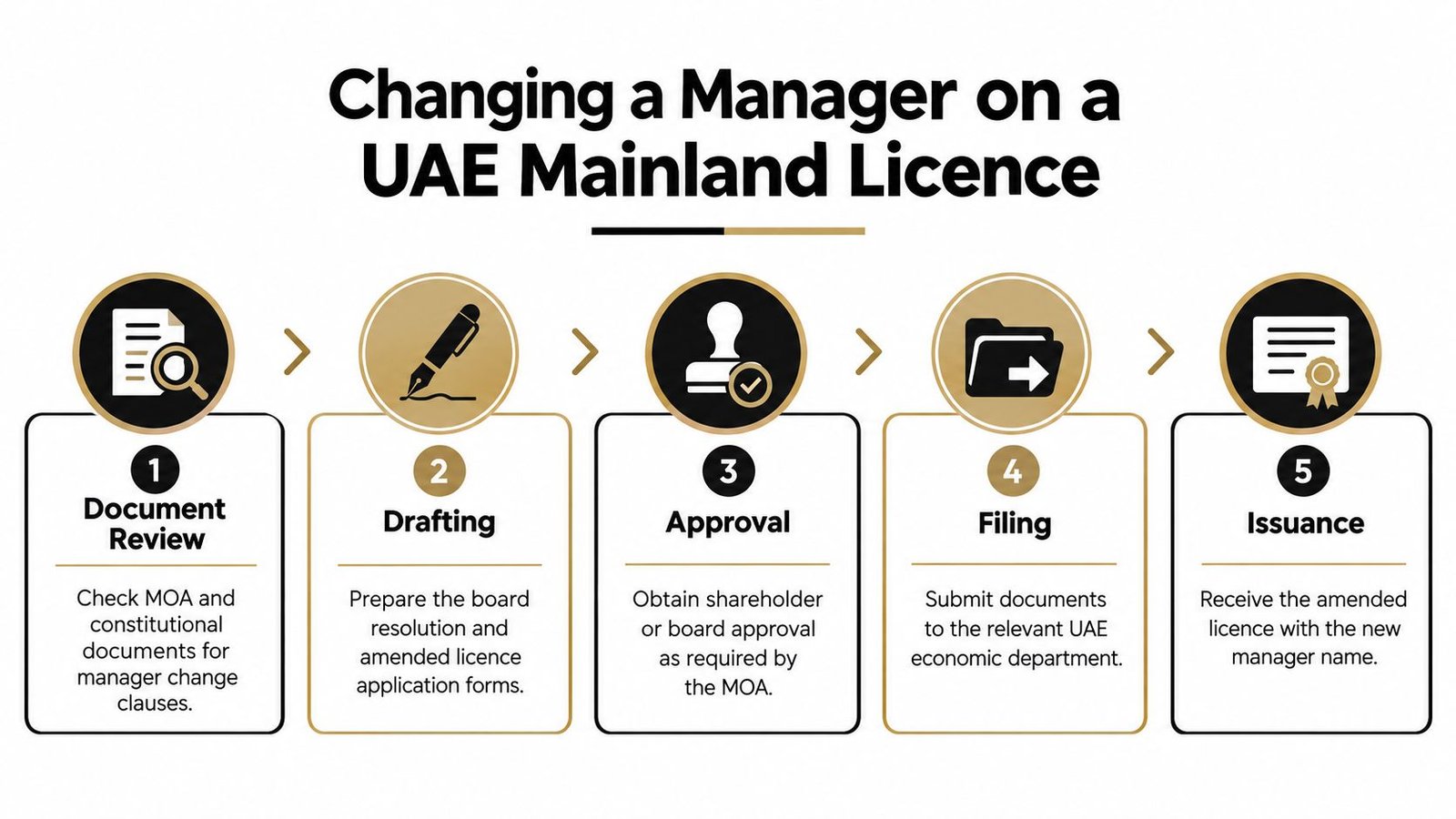
Start with the documents that created the manager's authority, not with the online application. If you file first and read later, you'll often learn mid process that the wrong people signed or that notarisation was required.
Where was the manager appointed?
Check whether the outgoing manager was appointed in the Memorandum of Association, shortened to MOA, in a separate agreement, or by shareholders' resolution. That source decides whether the MOA must be amended and notarised. The MOA is the company's founding contract between its partners, and a manager named inside it can't normally be replaced by a simple letter.
Also check any shareholders' agreement for consent rights, notice periods, or limits on signing powers. Those private terms don't replace the government filing, but breaching them can create a dispute even if the licence is updated.
How do you approve and file the mainland change?
Prepare a partners' or general assembly resolution that removes the outgoing manager, appoints the incoming manager, and states the term, signing powers, and effective date. Keep that date consistent across every later filing. Then submit the application to update the commercial register and trade licence with the competent authority.
Your application pack commonly includes:
- Identity documents: Passport copy for the incoming manager, plus Emirates ID and visa copy if available
- Corporate approval: Signed appointment and removal resolution, amended MOA where required
- Declarations and consent: Manager declaration where the authority asks for one, and a no objection certificate, shortened to NOC, from the outgoing manager where required
- Current company records: Existing trade licence, MOA, and application form for the relevant DET or DED portal
A company must notify the competent authority when a manager's service ends within a maximum of 30 days from the termination date, and appoint a replacement within that period where the manager has resigned, as explained in guidance on the 30 day manager notification duty. Don't let a former manager remain on public records while you debate the successor.
Resignations have a second clock. The general assembly has 40 days to decide on a resignation, and absent a contrary MOA or appointment contract, it's deemed accepted after that period, as set out in the CMS guide for directors of companies in the UAE. UAE law doesn't require a limited liability company manager to be a UAE resident, but banks, immigration systems, regulated activities, and establishment card records may still impose operational checks.
Finish with authority cleanup. Separately revoke any power of attorney, shortened to POA, held by the outgoing manager, because a POA can remain effective in the register after the manager has left. Then update bank mandates, immigration files, and beneficial owner records so they match the amended licence.
Changing a Manager Inside a UAE Free Zone
A free zone change is a document gated workflow. The authority checks corporate validity first, then its own compliance points, and approval doesn't move forward if either side is incomplete.
What should you check before you apply?
Confirm the licence is active before preparing the pack. An inactive licence can block the request, so you may need to process renewal with the amendment or instead of it. Confirm too whether you're a local free zone company, a branch of a UAE company, or a branch of a foreign company, because that decides the attestation route.
Prepare the authority's prescribed company or branch resolution, the new manager's passport, UAE visa if available, photograph, signed manager declaration, and specimen signature, following the Ajman Free Zone change manager in licence service requirements. Submit digitally, pay the applicable fee, and monitor review until the amended licence or registry extract is issued.
Which zone specific requirements catch people out?
Dubai Development Authority, shortened to DDA, requires a director or shareholder resolution, the new manager's passport, a manager declaration in relevant cases, and a Registration and Licensing form known as an RIC form, as described in DDA guidance on changing a general manager. Corporate member and branch resolutions may also need notarisation and UAE Embassy attestation.
- DWTC: Expect a board resolution, passport, visa where applicable, and an NOC for a UAE resident manager employed under another sponsor
- Foreign branches: Parent company documents may need notarisation and UAE Embassy attestation in the parent company's country
- Local branches: UAE notary notarisation may apply instead of overseas attestation
- AFZ: Security approval, establishment card amendment, and e-channel renewal may be required depending on the case
Don't copy a DMCC pack into DWTC, or a DWTC pack into DDA. The business facts are the same, but the prescribed form, declaration wording, and security route belong to the zone.
Getting the amended licence back isn't the finish line. The change counts when linked records stop naming the old manager.
After approval, propagate the change to the establishment card, e-channel, immigration records, bank signatories, tax and value added tax access, and sector approvals. The establishment card is the company record used for immigration transactions, and e-channel is the immigration system used for visa related services. If those stay unchanged, visa applications and renewals can fail even though the licence looks correct.
The Operational Gap Most Guides Miss
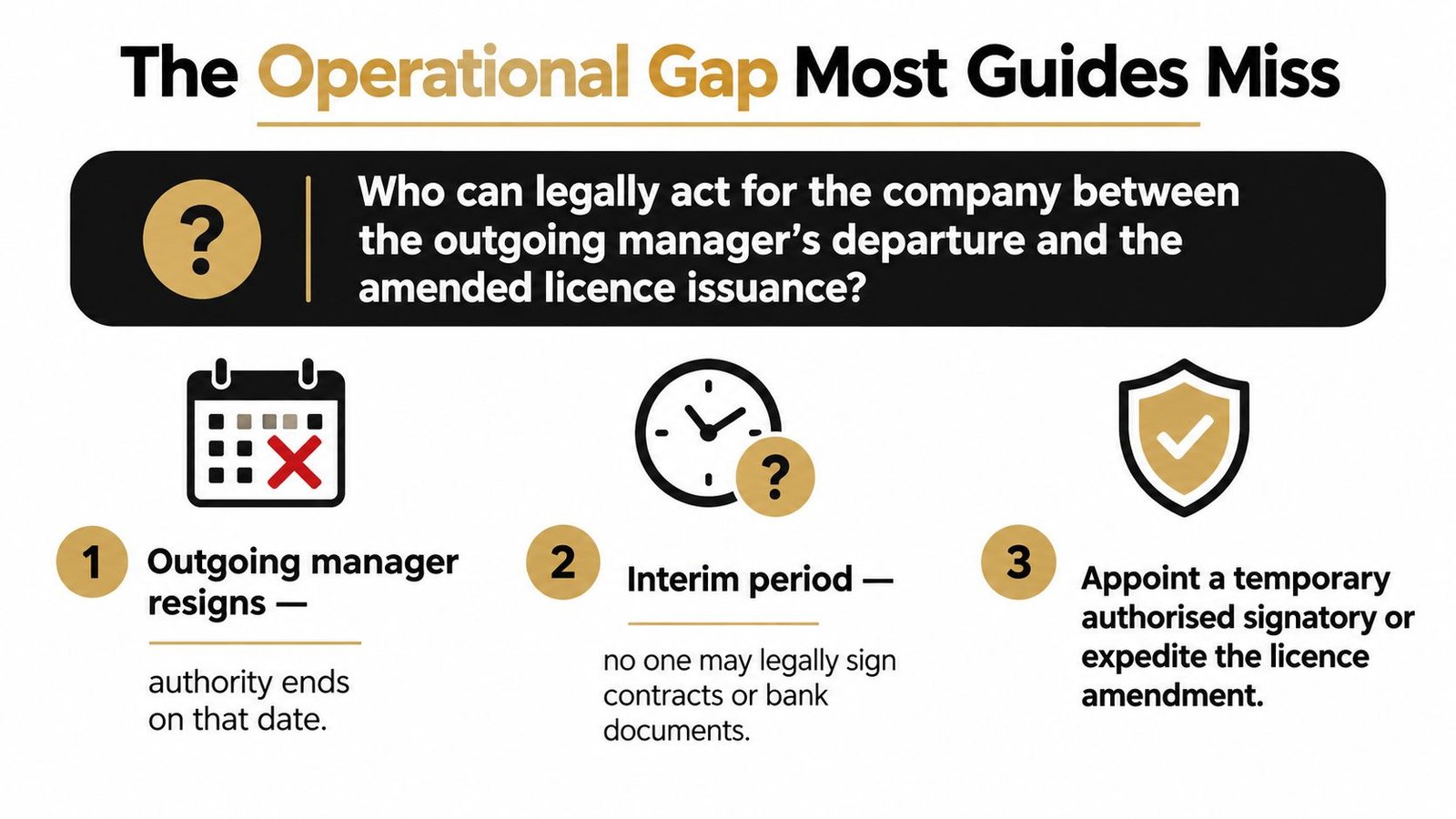
The risky period sits between the outgoing manager's last day and the date the amended licence is issued. During that window, contracts still need signing, suppliers still need paying, and staff visas don't pause because your amendment is under review.
Who can act while the amendment is pending?
List every place the outgoing manager appears before you revoke anything. That list should cover the bank mandate, Federal Tax Authority portal, immigration e-channel, Public Relations Officer service account, e-signature certificates, lease, supplier contracts, and corporate records. A Public Relations Officer, shortened to PRO, is the person who handles government transactions for the company.
If the outgoing manager is leaving on good terms, a staged handover is often lower risk than immediate revocation. Keep them formally authorised until the amended licence is in hand, subject to the authority's rules and your constitutional documents. If that's impossible, consider a narrow POA for a remaining director or your PRO so defined tasks can continue without giving open ended authority.
What happens if the manager is unavailable?
An absent, uncooperative, or overseas manager changes the plan. You may need shareholder action without their signature, proof of resignation or removal, and attested documents from abroad. You should also decide early whether their company sponsored visa will be cancelled, transferred, or left to expire, and align that decision with the visa cancellation process rather than treating immigration as an afterthought.
Build a pre change authority checklist:
- Banking: Who can approve payments today, and who will do so tomorrow
- Government access: Immigration, labour, tax, and licensing logins tied to the manager
- Signing rights: Active contracts, proposals, leases, and POAs that name the manager
- Records: MOA, licence, commercial register, beneficial owner file, and establishment card
The control benchmark is zero unresolved authority records after completion. That means MOA, licence, commercial register, POAs, bank mandates, immigration files, and beneficial owner records reconcile to the same effective date. The lowest risk change is usually the most carefully sequenced one, not the fastest filing.
Changing a Manager in a UAE Offshore Company
Offshore companies feel different because there's no local trade to protect and usually no local workforce attached to the entity. That removes much of the immigration chain, but it doesn't remove the need for a clean corporate record.

Why don't offshore companies file like mainland companies?
An offshore company is registered in JAFZA Offshore, RAK ICC, or Ajman Offshore and can't trade inside the United Arab Emirates or open a branch office here in its own right. Its manager usually has no UAE residence visa or establishment card through the offshore entity. The mainland and free zone immigration steps therefore don't apply.
How is an offshore manager change handled?
Work through your registered agent, which is the licensed corporate service provider that maintains the company's relationship with the offshore registry. Pass the internal resolution appointing the new manager, update the internal registers, and amend the Memorandum and Articles of Association if the manager is named there. The agent then files the change with the relevant registry.
Check linked compliance records before you close the file. If the company has an active Economic Substance Regulation filing, shortened to ESR, or other regulated substance records, update the manager details there too. ESR is the UAE regime that asks certain entities to show real activity and management in line with their reported income.
Offshore and onshore records do meet in a few places. A UAE bank may ask an offshore owner to prove who manages the entity, and an ESR filing may rely on current management information. Keep the internal record current even though no economic department is issuing an amended local trade licence.
Practical rule for offshore entities: If a bank, buyer, or regulator asked tomorrow who manages the company, your register, resolution, and constitutional documents should give the same answer.
Ask your agent for written confirmation once the registry reflects the change. Store it with the resolution and updated registers, not in a separate email thread that nobody can find during due diligence.
Timelines, Costs, and Common Pitfalls
Timelines depend less on the portal and more on document readiness. A clean free zone pack moves faster than a mainland file that needs MOA amendment, notarisation, or overseas attestation. Offshore timing depends on the registered agent and registry review.
Fees also vary by authority and case type. A simple amendment costs less than a file that needs attestation, security approval, establishment card changes, e-channel renewal, or POA revocation. Ask for the government fee, notary or attestation cost, and service fee as separate lines before you approve the work.
What should you verify before you sign?
Run this short check before submission and again after issuance:
- Authority: Old POAs revoked and any new POA limited to what is needed
- Immigration: Establishment card and e-channel updated to the new manager
- Banking: Signatory card and online banking users changed, old access removed
- Dates: Effective date matches across the resolution, licence, and register
- Compliance: Beneficial owner records and ESR details updated where they apply
The common failure pattern is simple. The licence is amended, everyone relaxes, and months later a bank, immigration officer, or counterparty finds the former manager still sitting in a connected record. If you'd rather have that sequence managed for you, review what experienced PRO services in the UAE should cover before you hand over the file.
Not sure where to start with your manager change? Book a free strategy call with the team at Inpro and we'll map your mainland, free zone, or offshore filing route, the documents your authority will require, and the banking and immigration updates that must follow.