

The UAE federal financial year runs from 1 January to 31 December, while companies can often choose their own accounting year-end where permitted. Your Corporate Tax period generally follows that accounting year, so your chosen year-end sets when your first return and payment fall due.
You're likely reading this in the middle of company setup in Dubai, Abu Dhabi or Sharjah, with a licence date, a bank form and a visa timeline already on your desk. The year-end question can feel like one more detail, but it sets several later deadlines behind the scenes. Once you see how the calendars fit together, you can choose with confidence and get on with building the business.
Table of Contents
- Understanding the Financial Year in the UAE
- How Corporate Tax Links to Your Chosen Year-End
- Corporate Tax Filing Deadlines by Year-End Date
- How VAT Filing Periods Differ from Your Year-End
- Practical Impact on Setup, Banking and Visa Timelines
- Common Year-End Choices and How to Compare Them
- Next Steps for Setting Your UAE Financial Year
Understanding the Financial Year in the UAE
A founder incorporates a company in Dubai in October and assumes the books must close in December because that's what happened at home. The accountant then asks a simple question. What year-end do you want to use? That pause is common, and it's the right moment to slow down.
A financial year is the 12-month period a company uses to close its books, prepare accounts and measure profit or loss. It doesn't have to match the date you incorporated. It also doesn't have to start in January, even though many companies choose January for simplicity.
What is the federal financial year in the United Arab Emirates?
The federal government follows a standard calendar cycle from 1 January to 31 December for budget planning, financial statements and closing government accounts. The Ministry of Finance (MOF) is the federal body that manages that budget process. The Federal Tax Authority (FTA) is the federal body that manages tax registration and filing.
That federal calendar matters because it shapes how public money is planned and reported each year. The UAE federal budget grew from AED 200 million in 1972 to AED 71.5 billion in the 2025 federal budget, a 358-fold rise, according to the UAE Ministry of Finance. The current five-year federal budgeting framework covers 2022 to 2026 and uses zero-based budgeting on the same source. For a founder, those figures show the scale of planning behind the calendar you're aligning with.
Does your company have to follow the federal calendar?
No, not always. A company can often choose its own year-end where permitted, and the FTA gives the example of a business whose financial year runs from 1 July to 30 June. Your choice should suit your reporting, your investors and your ability to close the books cleanly.
Practical rule: Confirm your year-end at setup and write it in one shared calendar with your tax, banking and visa dates.
That single decision affects your Corporate Tax start date, your filing deadline and your year-end workload. It doesn't control every other date, though. Value Added Tax, licence renewal, banking reviews and visa steps each follow their own timetable, which is why you need one operational calendar rather than one date in isolation.
How Corporate Tax Links to Your Chosen Year-End
Corporate Tax is an annual tax on business profit, calculated on a self-assessment basis. That means you prepare the figures, work out the tax due and file the return yourself, usually with your accountant. The system depends on your accounting period, so the year-end you pick at setup matters from day one.
How does your accounting period become your Tax Period?
A Tax Period is generally the accounting period used in your company's financial statements. The regime doesn't impose one universal financial year on every entity. Your books, your year-end and your first Tax Period need to line up before you file.
This applies whether you're in a Free Zone, which is a business zone with its own licensing rules, or on Mainland, which is a company licensed under the wider UAE commercial system. A new entity in either place should confirm its accounting period early. If you leave it vague, your first close and your first return become harder than they need to be.
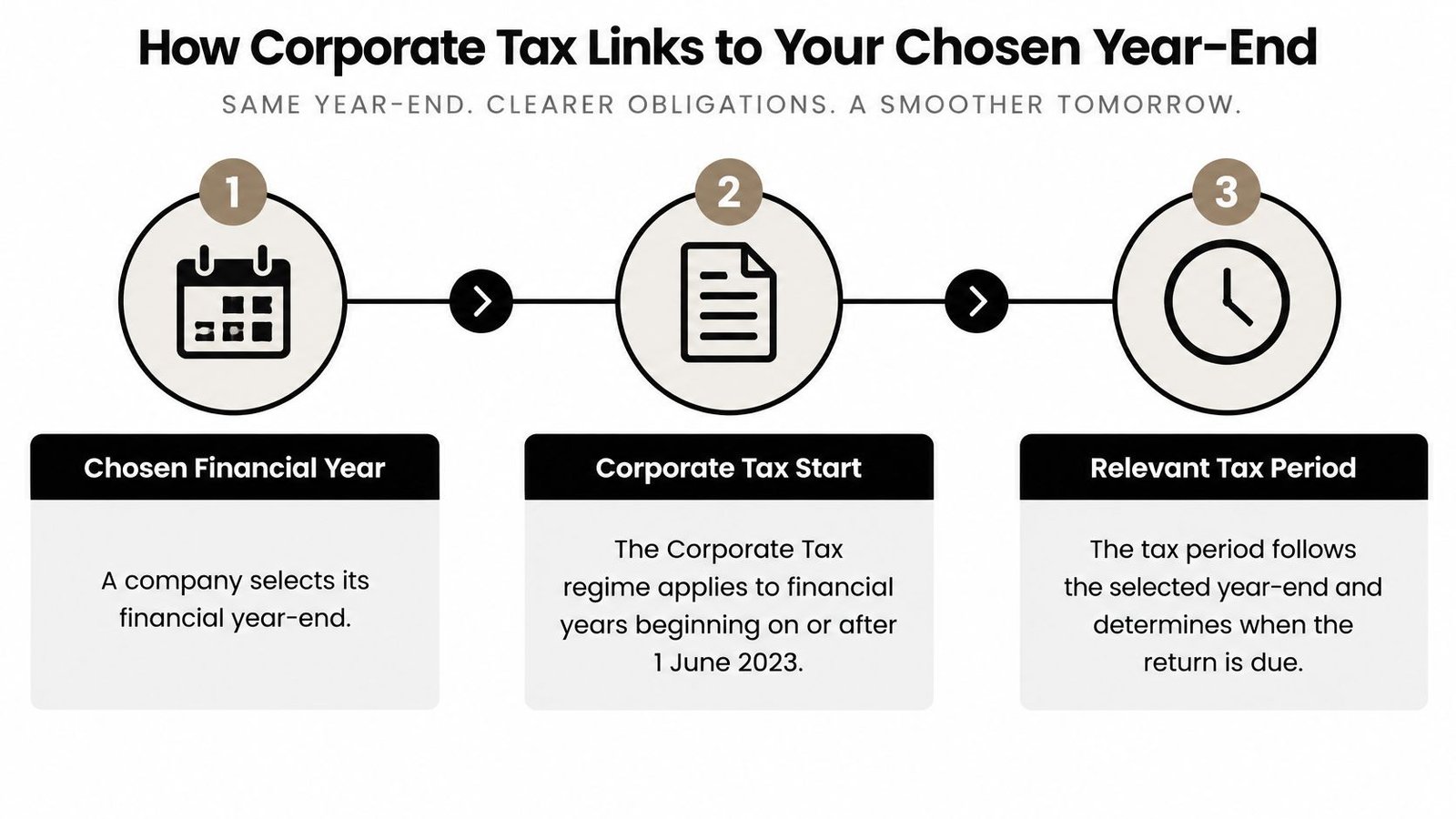
The timeline below shows how that link works in practice, from choosing a year-end to fixing your return date.
When does Corporate Tax start for your company?
Corporate Tax applies to financial years beginning on or after 1 June 2023, so a business with a 1 July 2023 to 30 June 2024 financial year becomes subject to it from 1 July 2023, while a calendar-year business first becomes subject to it on 1 January 2024, as the Federal Tax Authority explains. That's the key point many founders miss. Two companies formed in the same month can enter the regime on different dates because their financial years start on different dates.
Take the July company first. Its financial year begins after the 1 June 2023 threshold, so that whole year falls inside Corporate Tax. The calendar-year company waits until its next financial year begins on 1 January 2024. You can read more on Corporate Tax in the UAE and how registration fits your setup before you lock in your first period.
Your year-end doesn't just close your accounts. It sets the date your tax exposure starts.
Once that start date is clear, you can plan bookkeeping, tax adjustments and any transfer pricing documents for related-party deals. Transfer pricing is the set of rules for pricing transactions between connected companies. You don't need to master it today, but you do need to know whether it applies before year-end arrives.
Corporate Tax Filing Deadlines by Year-End Date
Deadlines feel less stressful when you can see the arithmetic. There's one main rule, and every example below comes from it. Work through your own date as you read, and you'll have your deadline in less than a minute.
How does the nine-month rule work?
The Ministry of Finance states that a Corporate Tax return and payment are generally due within nine months after the end of the Tax Period, so a 31 December year-end produces a 30 September deadline and a 31 May year-end produces a 28 February deadline. The deadline covers both filing and payment. It's the last date, not the date you should start work.
Count forward nine months from your year-end and you land on your deadline month. A December year-end gives you January through September to close, review and file. A May year-end gives you June through February, which can suit a group that reports mid-year but puts filing in a quieter part of the calendar.
| Financial year-end | Return and payment due | Reader takeaway |
|---|---|---|
| 31 December | 30 September the following year | Matches the federal calendar and many parent companies |
| 31 May | 28 February the following year | Filing falls early in the calendar year |
| 31 March | 31 December the same year | Filing falls at calendar year-end, so plan staff cover |
What should you do inside that nine-month window?
Use the early months to close ledgers and reconcile bank, sales and expense records. Then classify deductible and non-deductible expenditure, document related-party transactions and calculate taxable income. If you spread that work across the window, the final month becomes a check rather than a rush.
- Month one to three: Close the ledgers, chase missing invoices and reconcile bank accounts.
- Month four to six: Prepare financial statements, review tax adjustments and document related-party deals.
- Month seven to nine: Finalise the return, agree the payment amount and file with time to spare.
Cash flow needs the same planning. Put the payment date in your forecast as soon as you know your year-end, even if the amount isn't final. A predictable date helps you avoid promising the same cash to rent, payroll and tax in the same month.
What if you trade as an individual?
For natural persons, which means individuals trading in their own name, the FTA has identified calendar year 2024 as the first potential Tax Period where UAE business revenue exceeds AED 1 million. Registration is required by 31 March of the following year, with the return generally due by 30 September, on the FTA source cited later in this guide. If you're a freelancer or sole proprietor, track revenue through the year and test that threshold well before March. Don't wait until year-end to find out you've crossed it.
How VAT Filing Periods Differ from Your Year-End
Many founders assume one year-end sets every tax deadline. VAT breaks that assumption, and understanding the split early saves confusion later. The image below shows the kind of monthly review routine that keeps both taxes on track.

Value Added Tax (VAT) is a tax on most goods and services, charged at each stage of the supply chain and reported in a VAT return. It follows its own assigned tax periods. A business registered for VAT must deal with VAT and Corporate Tax as separate obligations, and a business that isn't VAT-registered may still need to register for Corporate Tax.
How often do you file VAT returns?
Standard VAT periods are quarterly for businesses with annual turnover below AED 150 million and monthly at or above AED 150 million, with returns and payment generally due within 28 days after the period ends. Quarterly filing suits most new and growing firms. Monthly filing brings a faster rhythm and tighter cash planning.
The FTA may assign a different VAT period in specific cases, so check your assigned period in EmaraTax, which is the FTA's online tax system. Don't rely only on the turnover threshold. Your profile shows the period you must use, and that's the date your finance calendar should follow.
Does changing your year-end change your VAT cycle?
No, not automatically. You can move your accounting year-end and still keep the same VAT reporting cycle. A company can file monthly VAT returns while preparing one annual set of Corporate Tax accounts, which is common for larger trading firms.
The short video below walks through the filing steps in EmaraTax, so you can see how a VAT period closes in practice.
Keep the two calendars side by side in one document, with different colours if that helps your team. When you need the filing steps, follow the process for how to file a VAT return in the UAE and then record the submitted figures for your year-end reconciliation. That habit links your VAT records to your annual accounts without mixing up the deadlines.
Practical Impact on Setup, Banking and Visa Timelines
Your financial year in the UAE becomes real when it meets bank applications, licence renewals and visa files. A founder doesn't experience these as separate topics. They arrive in the same inbox, often in the same week, and they compete for the same documents.
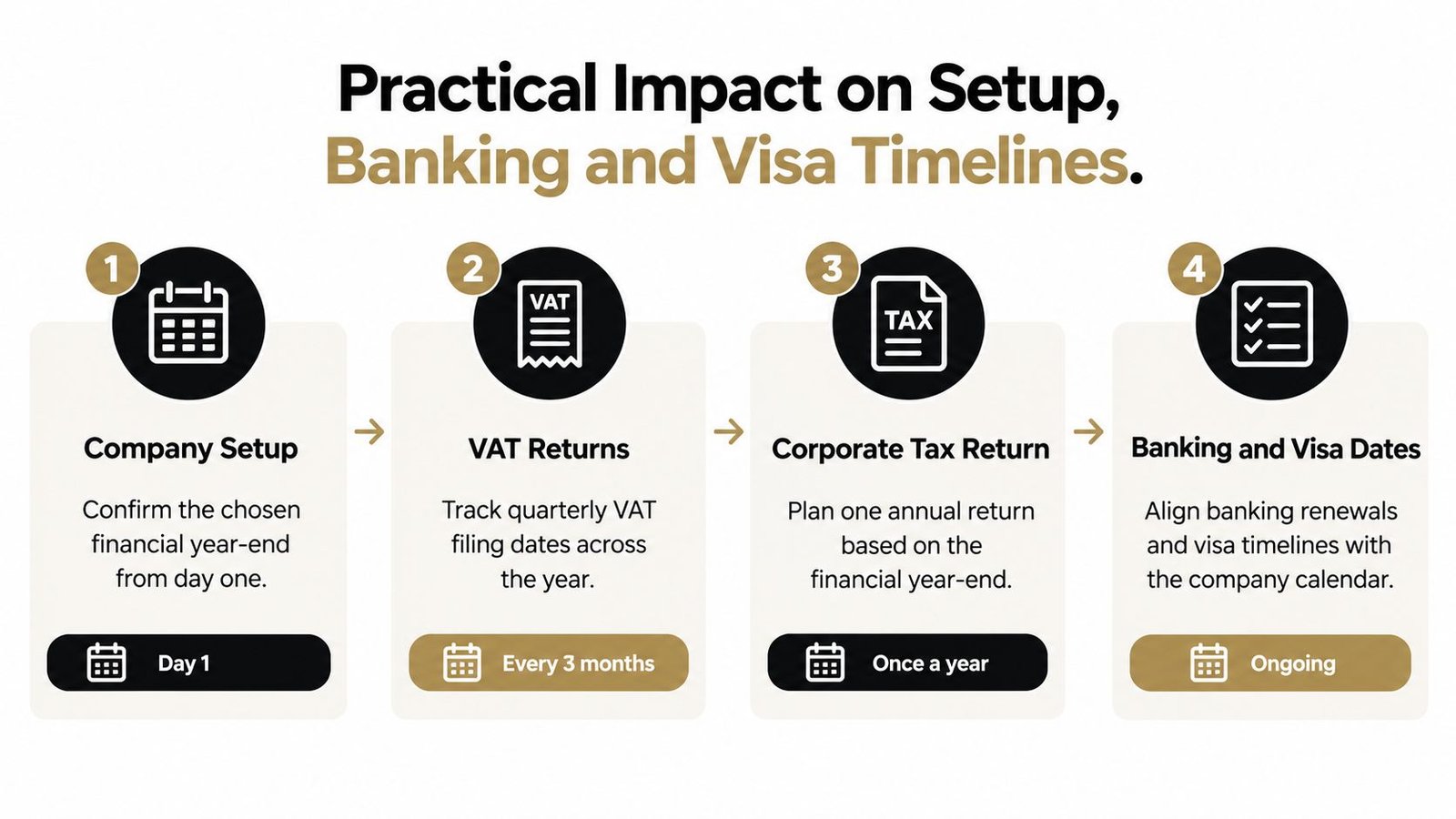
Take a company with a 30 June year-end, quarterly VAT returns and one annual Corporate Tax return. VAT periods close four times a year, each with a 28-day filing window after the period ends. The annual accounts close once, at the end of June, followed by the nine-month Corporate Tax window. The finance task is to reconcile VAT records to management accounts through the year, so the June close confirms figures you've already checked.
How does one operational calendar help?
For a financial year ending 31 December 2025, the Federal Tax Authority states a Corporate Tax deadline of 30 September 2026, which gives a nine-month window to close ledgers, reconcile records and calculate taxable income. That window is your control period. If a bank asks for updated financial statements in August, you'll know whether draft or final figures are ready.
The checklist below maps setup, VAT, Corporate Tax and banking or visa dates onto one timetable you can adapt for your company.
What should you schedule around the close?
Bank account opening often needs licence documents, shareholder details and proof of business activity. If that request lands during your close, the same founder signatures and statements may be needed for both files. Plan the bank submission either before the close starts or after draft accounts are ready, so you're not recreating the same pack under pressure.
Visa work follows a similar pattern for founders, employees and Golden Visa applicants. A Public Relations Officer (PRO) is the person or service that handles government paperwork for licences and visas. Give your PRO your year-end and filing dates, because passport, Emirates ID and entry permit steps still need founder time even when the accounts are closing.
- Before year-end: Confirm licence renewal dates, bank document expiry and upcoming visa renewals.
- During the close: Keep one folder for statements, invoices and contracts that banks and accountants both request.
- After filing: Share final accounts with your bank and update your calendar for the next VAT period.
Founder habit: Review the combined calendar once a month for 15 minutes. Small checks prevent deadline clashes.
HR teams benefit from the same view. If several employee visas renew in your busiest finance month, start those files early. A calm timetable protects both compliance and day-to-day trading.
Common Year-End Choices and How to Compare Them
There's no single right year-end for every company in the United Arab Emirates. The best choice depends on your parent company, your audit timing, your trading pattern and the months when your team can close the books well. Compare the options against your real workload, not against habit.
Which year-end dates do founders choose most often?
A 31 December year-end matches the federal calendar and suits a parent company that reports on the calendar year. It feels familiar to banks, investors and overseas finance teams. The trade-off is that filing work builds toward September, which may clash with your busiest sales period.
A 30 June year-end follows the FTA example of a July to June financial year and can align with a parent company outside the UAE. It spreads your close away from the December holiday period. You still need to fit quarterly or monthly VAT periods around the June close, so June needs enough finance cover.
A 31 March year-end produces a 31 December Corporate Tax deadline, as shown in the table above. That can suit groups with a March reporting cycle, but filing at calendar year-end needs early preparation. A 31 May year-end gives a February deadline, which moves filing away from both summer and December pressures.
How should you weigh the trade-offs?
- Group reporting: Match your parent company's year-end if consolidated accounts matter to you.
- Audit timing: Choose a date when auditors and your own team have capacity to answer queries.
- Trading pattern: Avoid closing the books in your peak sales month if stock counts or invoicing will suffer.
- VAT rhythm: Mark VAT periods first, then check whether your annual close lands on top of a VAT deadline.
If you need support choosing and then running that calendar, accounting and bookkeeping services in Dubai can cover monthly bookkeeping, VAT filing and year-end accounts in one workflow. Inpro handles company formation across Mainland, Free Zone and Offshore jurisdictions, where Offshore structures are typically used for holding and asset arrangements. The team also manages accounting, tax and VAT registration and filing, opens corporate bank accounts and coordinates PRO and visa workflows, with simple pricing and clear timelines from day one.
Choose the date you can repeat reliably every year. A neat date on paper won't help if your records, people and cash flow can't support the close.
Next Steps for Setting Your UAE Financial Year
You don't need to solve every finance question this week. You need a short sequence you can finish, record and revisit as the company grows. Your first close is a repeatable process, not a single emergency.
What should you confirm first?
Start with your incorporation date and your first financial year. Confirm the year-end stated in your formation and accounting records, then check that your bookkeeping system uses the same dates. If those records disagree, fix them now while the transaction history is still short.
Next, record two dates in one shared calendar. Write down your Corporate Tax deadline, which is nine months after your Tax Period ends, and your assigned VAT period from EmaraTax. Add licence renewal, bank review and visa dates to the same calendar so clashes are visible early.
What records should you gather through the year?
Keep sales invoices, purchase invoices, bank statements, contracts and payroll records in a clear monthly folder structure. Reconcile VAT figures to your management accounts each period rather than once a year. That monthly habit gives your accountant clean records at year-end and gives you better numbers for pricing and hiring decisions.
- Confirm the year-end: Check formation documents, accounting software and your first Tax Period.
- Check EmaraTax: Record your assigned VAT period and each 28-day filing date.
- Set the close plan: Agree who closes ledgers, who reviews tax adjustments and who approves payment.
- Add people dates: Put visa, Emirates ID and licence renewals beside finance deadlines.
The decision that matters most is the year-end choice, because it sets your Tax Period and filing deadline. Detailed tax adjustments, audit queries and final payment calculations can wait until later in the year, as long as your records stay current. If revenue is growing, also watch the thresholds covered above so a change in VAT frequency or individual registration doesn't catch you off guard.
Not sure where to start? Book a free strategy call with the inpro.me team, who can map your year-end, VAT period and visa timetable onto one calendar. You'll leave with clear dates, named owners for each task and a first close that feels planned rather than rushed.
If you're setting your financial year alongside company formation, banking or visa work, Inpro can align your accounting period, Corporate Tax and VAT dates, bank account file and PRO steps from day one. Visit the team to compare your options and book a free strategy call that turns those dates into one clear operating calendar for your UAE company.