


The most common advice about UAE Corporate Tax is wrong: zero tax does not mean zero registration. If your business is a taxable person in the United Arab Emirates, you generally need a Corporate Tax Registration Number through the Federal Tax Authority's EmaraTax portal, even if you expect no tax to be payable.
Registration, tax liability, and return filing are separate obligations. The practical process is electronic, but the deadline depends on your entity type, licence history, residency status, and business activity. This guide explains how to register for corporate tax in UAE, what to prepare, and what must happen after the application is submitted.
Table of Contents
- Why Zero Tax Does Not Mean Zero Registration
- Who Must Register and When Your Deadline Is
- The EmaraTax Registration Workflow Step by Step
- From Registration to Filing What Comes Next
- Common Mistakes That Trigger Penalties and Delays
- How Inpro Handles Corporate Tax Registration and Ongoing Compliance
Why Zero Tax Does Not Mean Zero Registration
The costliest mistake I see is simple. Founders assume no tax payable means no action needed. In the UAE, that is the wrong test.
A Free Zone company may qualify for 0% Corporate Tax on Qualifying Income, and an eligible resident small business may be able to elect Small Business Relief. Neither position cancels the need to register. Registration, tax liability, and return filing are separate obligations. The Federal Tax Authority's Corporate Tax registration guidance makes clear that registration is handled through EmaraTax and applies across multiple categories of UAE and foreign businesses.
That distinction matters in practice because many owners start with the wrong question. They ask whether the company will owe tax, when they should first confirm whether the business is a taxable person that must register. A company can expect no immediate tax charge and still need a Corporate Tax Registration Number, review whether a return must be filed, and keep its compliance position clean from day one.
Practical rule: Treat Corporate Tax registration as an identity and compliance step, not as proof that your company already owes tax.
The penalty point is where the misconception becomes expensive. The FTA's official registration service information states that late Corporate Tax registration can lead to an AED 10,000 administrative penalty. That risk is not limited to mainland businesses. It can affect Free Zone entities and other taxable persons as well, which is why assuming “zero tax” often creates a compliance problem instead of avoiding one.

What does Corporate Tax registration give you?
A Corporate Tax registration application creates the taxable person profile the FTA uses to identify your business in EmaraTax. Once approved, the FTA issues a Corporate Tax Registration Number, commonly called a TRN. That number is separate from a VAT registration number, even if both appear under the same EmaraTax account.
The obligation can extend to UAE incorporated juridical persons, UAE managed entities, foreign juridical persons with a UAE permanent establishment, and other taxable persons. A juridical person is a legally recognised entity, such as a company, rather than an individual carrying on business personally.
For a wider explanation of how registration fits into the regime, see Corporate Tax in the UAE.
Who Must Register and When Your Deadline Is
Founders often make the wrong call. Registration is not reserved for companies expecting a tax payment. The FTA looks first at whether the person or entity falls within the Corporate Tax rules, then at the deadline that applies to that category. Those deadlines are not uniform, and using the wrong test is one of the easiest ways to miss one.
The starting point is the FTA's timetable in Federal Tax Authority Decision No. 3 of 2024. It separates natural persons from juridical persons and distinguishes between resident and non-resident cases. In practice, that means two businesses with similar turnover can still face different registration dates because their legal form is different.
Which businesses fall within the registration requirement?
The main categories include:
- UAE-incorporated juridical persons: A company incorporated or recognised in Dubai, Abu Dhabi, Sharjah, or another UAE emirate will generally need to register.
- UAE-managed entities: Where management and control sit in the UAE, the position can still bring an entity into scope, even if the structure needs closer review.
- Foreign juridical persons: A foreign company with a UAE permanent establishment may need to register.
- Natural persons conducting business: An individual carrying on business in the UAE must register when annual business revenue exceeds AED 1 million in a calendar year, as set out in the registration FAQ.
- Free Zone persons: A Free Zone licence does not remove the filing obligation. Free Zone companies still register first, even where they may later assess whether separate Qualifying Free Zone Person treatment applies.
That last point catches people out. I regularly see founders assume a Free Zone company with no expected tax due can wait. The FTA does not treat that assumption as a valid reason for missing registration.
How did the staged deadlines work?
For resident juridical persons incorporated or recognised before 1 March 2024, the schedule used the month of trade licence issuance. The licence year did not matter.
| Licence Issued | Registration Deadline |
|---|---|
| January or February | 31 May 2024 |
| March or April | 30 June 2024 |
| May | 31 July 2024 |
| June | 31 August 2024 |
| July | 30 September 2024 |
| August or September | 31 October 2024 |
| October or November | 30 November 2024 |
| December | 31 December 2024 |
Entities that had no licence on 1 March 2024 generally had three months, until 31 May 2024, to apply. For resident juridical persons incorporated, established, or recognised on or after 1 March 2024, the application is generally due within three months of incorporation, establishment, or recognition. Many Free Zone companies fall into that rule.
Do not use your VAT timing as a proxy. Corporate Tax registration follows its own logic. Check the legal form, incorporation date, licence details, and residency status separately. If the classification is not clear, start with this UAE Corporate Tax registration deadline guide, then confirm the final position against current FTA guidance.
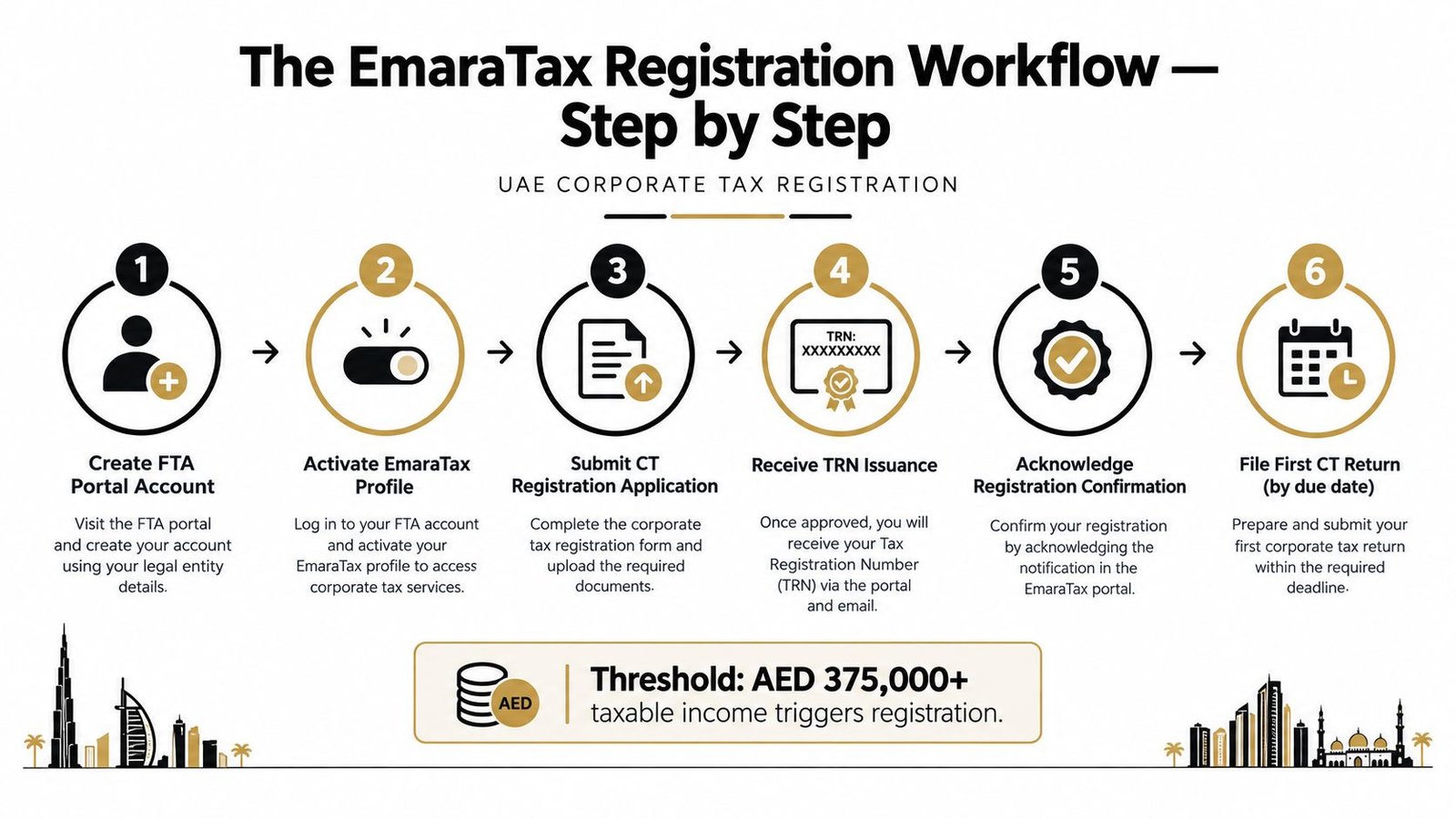
The EmaraTax Registration Workflow Step by Step
The application is completed electronically through EmaraTax, the FTA's online tax services portal. You'll need an EmaraTax account, a taxable-person profile, and reliable company information before you start. A VAT login or personal government account isn't a substitute for completing the Corporate Tax registration workflow.
What should you prepare before opening the form?
Keep the company's core records available. The exact fields can vary according to the entity, but the application will require information that identifies the business and its tax position, including:
- Trade licence details: Use the legal name and licence information exactly as issued by the relevant authority.
- Entity classification: Confirm whether the applicant is a UAE juridical person, a Free Zone company, a foreign entity, or another taxable person.
- Business information: Prepare the registered address, contact details, ownership or management information requested by the portal, and the authorised signatory's details.
- Financial year information: Check the company's accounting year-end before entering it. This affects later filing planning.
- Supporting documents: Have the trade licence and requested identity or authorisation documents in a readable electronic format.
Small discrepancies can lead to clarification requests. The name on the application should match the licence, and the person submitting the form should have authority to act for the company.
Which buttons and screens should you use?
Follow this sequence:
- Create an EmaraTax account. Register with an email address and mobile number that the business can maintain access to. Complete the activation process.
- Activate the account. Follow the confirmation instructions before attempting to start the tax registration. An unactivated account won't take you to a usable dashboard.
- Open the dashboard. Sign in and locate the area for creating a taxable-person profile.
- Create a taxable-person profile. Enter the legal details for the business, not a casual trading name. Save the profile and check the information before continuing.
- Access the taxable-person profile. Select the profile you created so EmaraTax displays the available tax services.
- Select Corporate Tax. Choose the Corporate Tax option, then select Register.
- Complete the application. Work through the entity, licence, financial year, contact, and document fields. Don't guess at classification questions.
- Review and submit. Check every declaration and attachment, then submit the application for FTA review.
What happens after submission?
The FTA reviews the application and may request clarification or additional documents. Monitor the email address and mobile number connected to the EmaraTax account, because a missed request can delay completion.
VAT registration doesn't complete this process. A business already registered for VAT must still register separately for Corporate Tax, using the Corporate Tax service within EmaraTax.
From Registration to Filing What Comes Next
A Corporate Tax Registration Number only gets you onto the FTA's system. The real compliance work starts after that. The business still has to determine its tax position, keep records that support it, and file the return for the correct tax period.
The filing timeline also runs on a different clock from registration. Under the FTA Corporate Tax bulletin, Corporate Tax returns are generally due within nine months of the end of the relevant tax period. In practice, that catches founders off guard. A company may have to register soon after setup, then file much later based on its financial year end. If you do not map both dates early, one of them gets missed.
How does Small Business Relief fit into the process?
Small Business Relief can apply to eligible resident businesses where revenue is within the AED 3 million threshold. The threshold must be checked for the relevant period and all prior tax periods ending on or before 31 December 2026, under current FTA bulletin guidance, so the position for periods ending after that date should be confirmed against the latest FTA treatment.
The common mistake is assuming relief replaces registration. It does not. The company must register first, then claim the relief in its Corporate Tax return if it qualifies.
A company can qualify to pay no Corporate Tax and still need an accurate return showing how that position was reached.
That point matters most for founders who assume zero tax due means nothing else is required. The FTA process does not work that way. If the entity is within scope, registration comes first, and the return still has to show the basis for the outcome.
Historical records also matter more than many finance teams expect. If a group has restructured, changed legal form, or shifted between Free Zone and Mainland operations, the revenue review may need to cover earlier periods. A new trade name or updated licence does not automatically wipe the history used to assess relief.
What should the finance team track?
Use a working compliance calendar, not a reminder stuck in one person's inbox. At minimum, track:
- Tax period end: Record the financial year end the company uses.
- Return deadline: Count forward from that period end and leave time for review, approvals, and corrections.
- Revenue history: Keep support for the current period and earlier periods relevant to Small Business Relief.
- Structural changes: Record mergers, reorganisations, licence amendments, and any move between Free Zone and Mainland operations.
- FTA correspondence: Store submissions, acknowledgements, requests, and approvals in one controlled location.
For practical deadline mapping, use this Corporate Tax filing deadlines guide. Calendar alerts help, but they do not fix late bookkeeping or unsupported figures.
Common Mistakes That Trigger Penalties and Delays
Most problems come from an incorrect assumption made before the form is opened. The following comparisons show what fails and what works better.
Which shortcuts cause trouble?
| Common mistake | Likely consequence | Practical correction |
|---|---|---|
| Treating VAT registration as Corporate Tax registration | The business remains unregistered for Corporate Tax | Open the Corporate Tax service in EmaraTax and submit a separate application |
| Assuming a Free Zone licence removes the obligation | The company may miss its applicable registration deadline | Register first, then assess Qualifying Free Zone Person treatment and taxable income |
| Using the financial year instead of the licence month | An existing entity may apply against the wrong staged deadline | Check the trade licence issuance month and the relevant FTA decision |
| Applying Small Business Relief without historical checks | The relief assessment may be incomplete | Review the relevant period and prior tax periods before selecting the relief |
| Submitting an incomplete taxable-person profile | The FTA may request clarification or hold the application for review | Match legal names, licence details, classification, contacts, and documents before submission |
The VAT shortcut is particularly common among companies that already use EmaraTax. Having one tax service active doesn't activate another. The portal account is shared, but the registrations are distinct.
How can founders prevent avoidable delays?
Start with the licence and incorporation documents, not a generic online checklist. Confirm the entity's legal form, issue date, financial year-end, and whether the business has UAE management or a UAE permanent establishment. Then nominate someone to monitor the EmaraTax account after submission.
Don't select Small Business Relief just because current revenue feels low. Check the relevant history and filing position first. Likewise, don't assume an offshore, Mainland, or Free Zone label answers every tax question by itself. The FTA registration obligation concerns the taxable person and its activities, while tax treatment is assessed afterwards.
How Inpro Handles Corporate Tax Registration and Ongoing Compliance
A specialist PRO and compliance team can remove the administrative gaps between incorporation, registration, and filing. Inpro handles the EmaraTax workflow by checking entity classification, calculating the applicable deadline, preparing the required information, and submitting the Corporate Tax registration application for UAE businesses.
That support is useful when the founder is overseas, the company has several shareholders, or the business operates across Dubai, Abu Dhabi, Sharjah, or a Free Zone. It also helps HR and operations teams keep tax work separate from employee visa, Golden Visa, and other government workflows.
After registration, Inpro can support Corporate Tax return preparation, deadline monitoring, Small Business Relief assessment where eligible, and compliance administration for Mainland, Free Zone, and Offshore structures. The practical benefit is a joined-up record of the company's licence, tax period, revenue history, and FTA correspondence rather than a one-off portal submission.
For founders setting up or expanding in the UAE, the sensible choice is to decide whether the application can be managed internally or whether a specialist should verify the deadline and classification before submission. Either way, don't leave the registration question until the first return is due.
Inpro can check your UAE entity type, EmaraTax registration position, applicable deadline, and next filing steps before you submit. Visit Inpro to discuss Corporate Tax registration and ongoing compliance support for Mainland, Free Zone, or Offshore structures.