

There is no single UAE employee visa cost, and a standard two-year private-sector visa is employer-sponsored, with the work-permit piece alone at AED 250, AED 1,200 or AED 3,450 by employer category before medical, Emirates ID, insurance and PRO fees. That's why one round number on a quote can mislead you.
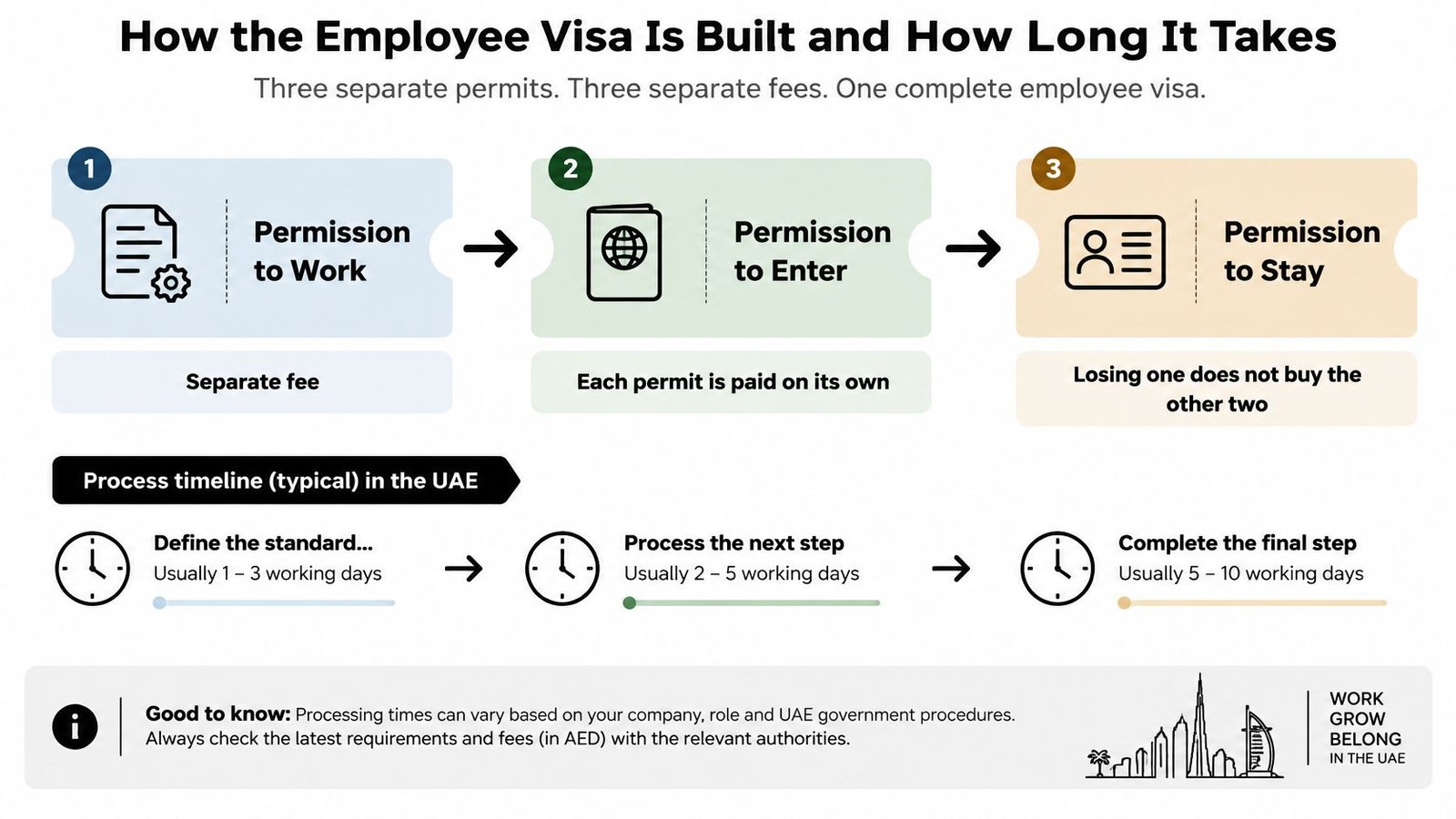
Think of the visa as three tickets clipped together, not one ticket. There's permission to work, permission to enter, and permission to stay, and each one is paid for on its own. Once you can see which ticket a charge belongs to, and who pays for it, the bill for a hire in Dubai, Abu Dhabi or Sharjah gets much easier to check.
Table of Contents
- What a Two-Year Employee Visa Usually Costs
- How the Employee Visa Is Built and How Long It Takes
- Which Costs Sit with the Employer
- Mainland and Free Zone Price Gaps
- What You Pay Again at Renewal
- Build the Budget Before You File
What a Two-Year Employee Visa Usually Costs
There is no single UAE employee visa cost in the United Arab Emirates. A normal private-sector employment visa is filed by the employer and is usually valid for two years. The Ministry of Human Resources and Emiratisation (MOHRE) is the federal body for private-sector work permits. The UAE Government portal on work permits reports an issuance or renewal range of AED 250 to AED 3,450, with AED 250 for Category 1, AED 1,200 for Category 2 and AED 3,450 for Category 3 under Cabinet Resolution No. 37 of 2022, plus a AED 50 work-permit application fee.
That means the federal work-permit slice can be AED 300, AED 1,250 or AED 3,500 before immigration. Category 1, 2 and 3 reflect how the establishment is classified, so two firms hiring the same role can pay different permit fees. A quote that assumes Category 1 will be wrong for a Category 3 company.
The Federal Authority for Identity, Citizenship, Customs and Port Security (ICP) is the federal identity and residence authority. The ICP visa issuance service lists an AED 100 application fee and an AED 20 financial-guarantee deposit fee. The ICP residence-permit service lists AED 100 for the application, AED 100 per year for issuance, AED 20 for the security deposit fee, AED 500 for status adjustment where it applies, and AED 100 for smart-service fees.
| Charge | Amount (AED) | Usually paid by | When it applies |
|---|---|---|---|
| MOHRE two-year work permit, Category 1 | 250 | Employer | MOHRE establishment, new or renewal |
| MOHRE two-year work permit, Category 2 | 1,200 | Employer | MOHRE establishment, new or renewal |
| MOHRE two-year work permit, Category 3 | 3,450 | Employer | MOHRE establishment, new or renewal |
| MOHRE work-permit application | 50 | Employer | Added to the category amount |
| ICP visa issuance application | 100 | Employer | Federal entry stage |
| ICP financial-guarantee deposit fee | 20 | Employer | Listed with ICP visa services |
| ICP residence application | 100 | Employer | Residence layer, separate from MOHRE |
| ICP residence issuance | 100 per year | Employer | AED 200 across a two-year permit |
| ICP smart-service fee | 100 | Employer | With the residence application |
| ICP status adjustment | 500 | Employer | Only if the person is already inside the UAE |
| Dubai GDRFA employment entry visa | 200 plus 5% VAT | Employer | Dubai channel instead of stacking ICP entry lines |
| Dubai GDRFA private-sector residence permit | 200 | Employer | Two-year Dubai residence permit |
| Knowledge Dirham and Innovation Dirham | 10 + 10 | Employer | Dubai GDRFA schedule |
| Dubai delivery | 20 | Employer | Dubai GDRFA schedule |
| Dubai inside-country status change | 500 | Employer | Sponsored person already in Dubai |
| Medical fitness test | Approved centre lists its rate at booking | Employer | Approved centre in the emirate, no flat federal fee listed |
| Emirates ID | Confirm current ICP card fee on filing day | Employer | Biometrics required |
| Basic health insurance | Insurer quote by plan, age and emirate | Employer | Get an insurer quote for the hire |
| Worker-entitlement insurance | 40 to 100 per year | Employer | By worker category or establishment risk |
| Involuntary Loss of Employment cover | 5 or 10 per month | Employee | AED 5 up to AED 16,000 basic salary, AED 10 above |
Which rows do I add?
Don't add every row. Pick MOHRE if the company is under MOHRE, and pick the General Directorate of Residency and Foreigners Affairs (GDRFA) rows when Dubai issues the residence file. Add the status adjustment only if the person is already inside the country, then add medical fitness, Emirates ID, health insurance and typing.
A PRO is a public relations officer, the person or firm that files government paperwork for a company. Emirates ID is the national identity card issued to residents after biometrics, and you can check the separate card picture in our guide to Emirates ID costs. Government filing, trade-licence and visa costs are set by the relevant authorities and are often charged separately from our professional fees, so a blended PRO quote should still show the government lines apart. All figures here are as listed in the cited government sources and must be confirmed on filing day.
How the Employee Visa Is Built and How Long It Takes
Start with the three tickets. Permission to work is the work permit, permission to enter is the entry permit or status change, and permission to stay is the residence permit. Each carries its own fee, and paying for one doesn't buy the other two.
The standard employment visa is the ordinary company-sponsored route for government and private-sector roles. The UAE Government Portal on residence visas for working in the UAE describes it as obtained through the employer, normally issued for two years and renewable on the issuing authority's conditions. A Green Visa works differently. It's a self-sponsored residence route for eligible skilled employees and freelancers, so it isn't priced here.
Who files the employee visa?
The employer does, usually through a PRO. The employee supplies documents, signs where needed, and attends in person for the medical and biometrics. The company opens the file and owns it, and the government fees attach to the company's side of the ledger.
Can someone start work on a visit visa?
No. A visit or tourist visa permits visiting, nothing more. The person needs the work permit route first, even if they're already in the country and ready to start.
Here's the normal path, in order.
- Confirm the licence and quota. The company checks its trade licence, its establishment or immigration card, and that it has visa quota room for the hire.
- Issue the offer or contract. The role, salary and skill level on this document set the worker's MOHRE category, and permit charges differ between categories. That gap is what a single round-number quote usually hides, so an error on this document costs money later.
- File the work permit. The employer files with MOHRE or with the free-zone authority that licensed the company.
- Get the entry permit. If the person is abroad, the entry permit gives them a limited validity window to travel in and begin residence steps.
- Enter and start residence steps. After entry, the sponsored person starts residence procedures before the entry permit expires.
- Attend medical and biometrics in person. The employee goes to the approved medical centre and the Emirates ID appointment themselves. Nobody can attend for them.
- Collect the residence permit. Once the residence permit is issued, the three tickets line up and the person can live and work under that sponsor.
How long does a clean file take?
A clean file for someone abroad is often a few weeks once papers are attested. Licence and visa processing times depend on UAE government approvals and can shift, so treat any date as an estimate until approvals land. Attestation of a degree, a repeat medical, or an in-country status change stretches the timeline.
We prepare and submit PRO applications to GDRFA, ICP, MOHRE and licensing authorities, and we track deadlines for visas, work permits, Emirates IDs, renewals and document attestation. We can also act for owners based outside the UAE on government matters, while the employee still attends steps that need their presence, such as their own biometrics or medicals.
A short passport validity, an unattested degree, a wrong skill category or the wrong emirate's medical centre can each create a repeat fee.
ICP and GDRFA are parallel doors for the same sequence: a file goes through one channel and pays that channel's fees once. Dubai files commonly run through GDRFA, while many Abu Dhabi and Sharjah files run through ICP channels. The emirate matters in practice because the medical appointment, the typing centre and the collection point are local. Book the medical in the emirate that matches the file, and keep the passport, photo and entry permit copies together so the centre doesn't turn the employee away.
If a step slips, fix the document first and rebook once. Paying for a second appointment before the underlying error is corrected usually buys the same refusal twice.
Which Costs Sit with the Employer
In a normal hire, the company sponsors the person. That puts the work permit, entry permit, residence charges, medical test, Emirates ID and mandatory health insurance on the employer's side of the ledger. If a quote calls only the immigration lines the visa fee, ask where the rest of that stack sits.
One small item is easy to miss. MOHRE's Awareness Guide for New Employers indicates that insurance protecting employee financial entitlements is a primary requirement for issuing a work permit, priced per year at AED 40 for an assistant worker, AED 55 for a skilled worker, AED 72 for a limited-skill worker and AED 100 for a high-risk establishment. The same guidance places the Involuntary Loss of Employment scheme at premiums capped at AED 5 monthly for basic salaries up to AED 16,000 and AED 10 monthly above that threshold, with the employee generally paying the subscription.
So the split isn't one pot. Health cover and work-permit protection sit with the company, while unemployment cover sits with the employee.
Employer-funded health cover and work-permit protection. Employee-funded unemployment cover.
Can visa fees be deducted from salary?
In ordinary practice, recruitment and government visa costs are treated as employer costs, and a contract shouldn't move those government lines onto the employee. Don't rely on a verbal assurance if a specific deduction is proposed. Check the current MOHRE rules for that exact deduction before payroll touches it, and read the company's paperwork duties alongside our explainer on the UAE labour card.
What can move the total for the same job title?
Nationality, skill classification, establishment risk, emirate, visa length and issuing authority can all change the final amount. Two hires with the same job title can land on different totals if one is classed as skilled and the other as limited-skill, or if one file runs in Dubai and the other in Sharjah. None of that means the quote is wrong. It means the quote needs to name its assumptions.
Ask whoever prices the hire for two totals for the same person, company cash out and employee cash out. Put basic salary next to the second total, because that's what sets the unemployment premium band. If the quoter can't separate the two, you don't yet have a budget you can approve. You have a headline.
Mainland and Free Zone Price Gaps
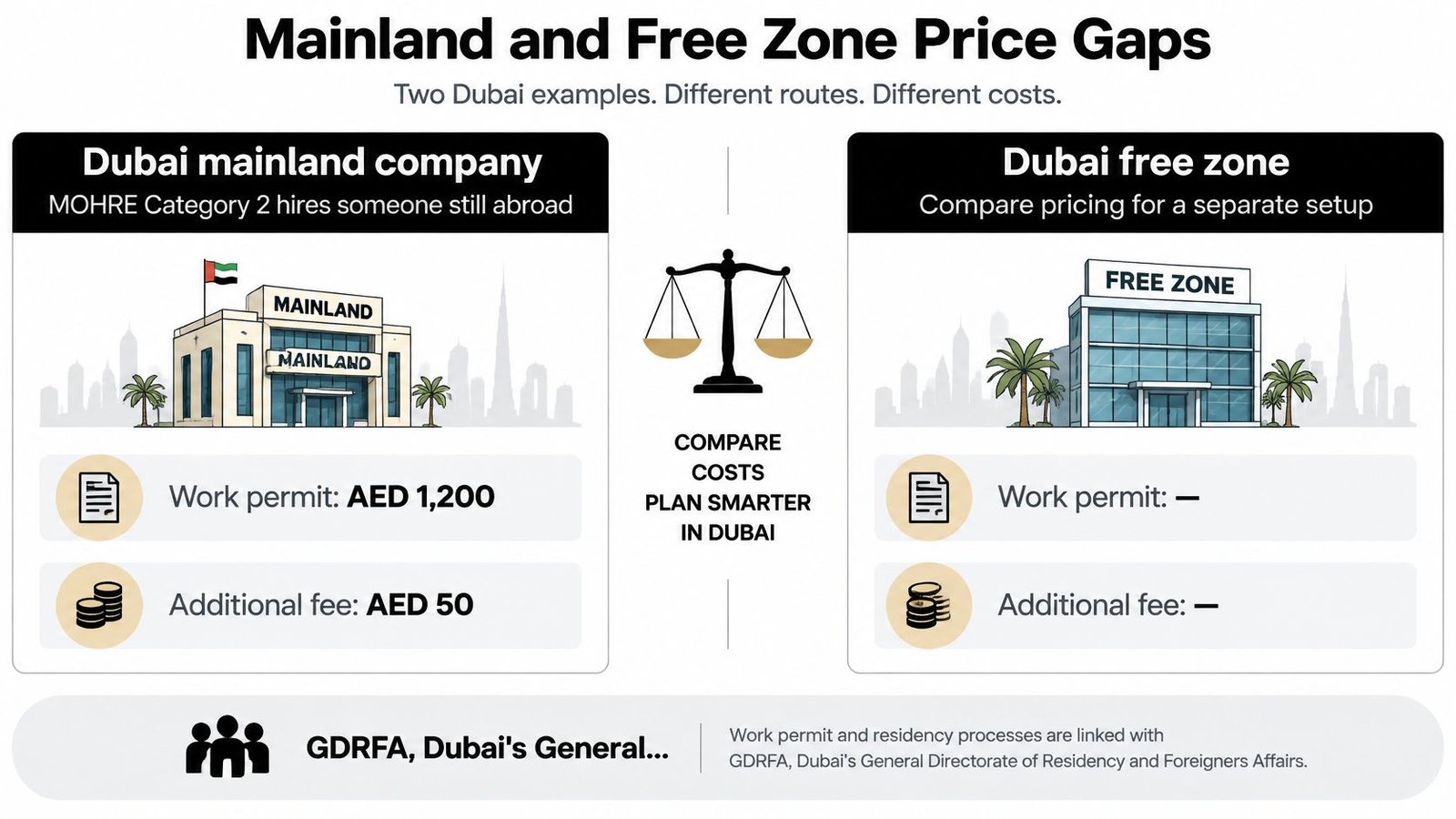
Take two Dubai pictures. In the first, a Dubai mainland company under MOHRE Category 2 hires someone who is still abroad. The work permit is AED 1,200 plus the AED 50 application fee. Dubai's GDRFA employment entry visa service lists a standard UAE employment entry visa at AED 200 plus 5% value-added tax (VAT), and says the entry visa allows the employee to remain in the UAE for 60 days while the employer completes residence requirements.
The GDRFA private-sector residence permit service lists that permit at AED 200, with AED 10 for the Knowledge Dirham, AED 10 for the Innovation Dirham and AED 20 for delivery. Medical, Emirates ID and insurance sit on top of those government lines. In the second picture, the same person is already in Dubai, so the GDRFA schedule adds AED 500 for changing status inside the country. Same hire, same company, one extra line because of where the person is standing on filing day.
What is a free zone?
A free zone is a jurisdiction with its own licensing and immigration desk, separate from mainland economic departments. We handle PRO work for Dubai mainland companies and free zone partners including IFZA in Dubai, RAKEZ in Ras Al Khaimah and Ajman. A free zone company's UAE visa availability is subject to quota, and a flexi-desk can meet the office rule in many zones. If the quota is full, the offer letter is ready but the visa slot isn't.
The Dubai International Financial Centre (DIFC) and Abu Dhabi Global Market (ADGM) are financial free zones with their own employment rules. Professional fees there are often higher, and the regulated setting is not a cheap flexi-desk assumption. Don't price a DIFC or ADGM hire from a general free-zone advertisement.
Does the zone name set the permit price?
Not on its own. MOHRE's published services and fees schedule shows skilled-worker work-permit fees ranging from AED 80 to AED 2,500 across the listed categories, while limited-skilled-worker fees range from AED 80 to AED 5,000. The category and skill class on the quote matter more than the zone name in the heading. For the wider licence choice behind the visa bill, read our comparison of mainland and free zone in the UAE.
| Setting | Work approval | Residence channel | Quota or office | What moves the bill |
|---|---|---|---|---|
| Dubai mainland | MOHRE by employer category | GDRFA Dubai | Physical office for mainland trade | Category 1 to 3 and an inside-country status change |
| Abu Dhabi or Sharjah mainland | MOHRE by employer category | Often ICP rather than GDRFA | Local licence and office | Emirate medical centre and typing |
| Free zone such as IFZA, RAKEZ or Ajman | Zone authority, not always a MOHRE fee card | Zone immigration desk, sometimes ICP | Visa quota, flexi-desk often allowed | Quota slot and whether the zone bundles PRO fees |
| DIFC or ADGM | That zone's employment rules | Zone or ICP route | Regulated presence, not a cheap flexi-desk assumption | Professional fees, government lines still itemised |
Abu Dhabi and Sharjah mainland files follow MOHRE for work approval too. What changes locally is the medical centre, the typing centre and the residence channel. Ask the quoter which channel they've priced before you compare two totals side by side.
What You Pay Again at Renewal
Renewal re-punches two of the three tickets: the work ticket and the stay ticket. The entry ticket, the status change paid when someone switches status inside the UAE, belongs to the first process, so an on-time renewal skips it. The bill at the end of year two is still closer to the original invoice than to a small admin fee.
For the work ticket, a two-year renewal is priced off the same MOHRE company category as the first permit, and the application fee is charged again. Same ladder, same rungs. A company that has moved category since the first permit pays at its new bracket, which is the gap a single round-number quote can hide.
For the stay ticket, the ICP residence-permit renewal service listed in 2024 an application fee of AED 100 and a residence-permit renewal fee of AED 100 per year. A two-year renewal of that layer comes to AED 100 plus AED 200 before any other ICP lines still current on filing day. Government fees are set by the authority and can change, so confirm the live page on the day the renewal is filed.
| Charge | On a new visa | On a two-year renewal | Notes |
|---|---|---|---|
| MOHRE work permit by category | AED 250, 1,200 or 3,450 | Same three amounts | Plus AED 50 application fee both times |
| ICP residence application and yearly issuance | Application plus AED 100 per year | 2024 list, AED 100 application and AED 100 per year | Confirm the live ICP page on filing day |
| Status change inside the UAE | About AED 500 when applicable | Not charged on an on-time renewal | Dubai adds Knowledge and Innovation Dirhams on the entry change |
| Medical and Emirates ID | Yes | Yes | Person attends again in person |
| Health insurance | Annual premium | Premium each year, so twice per visa term | Employer |
| Worker-entitlement insurance | AED 40 to AED 100 a year | Repeats yearly | Easy to leave out of a visa quote |
| Involuntary Loss of Employment | AED 5 or AED 10 a month | Continues monthly | Employee |
Medical fitness and the Emirates ID are done again at renewal, and the employee attends in person even when a PRO carries the paperwork. Health insurance is billed annually, so it is paid twice inside one two-year visa. Worker-entitlement insurance repeats yearly too, and the employee's unemployment subscription keeps running every month between renewals.
Is renewal cheaper than the first visa?
On immigration extras, often yes. The status adjustment is a conditional charge for a first process or a lapsed file, and a permit renewed while still valid never triggers it. On the work permit, the price is the same category ladder as before, and it climbs if the company has slid from Category 1 to Category 3.
Late renewal adds fines outside the fee card, so filing before expiry is the cheaper path. Diary four dates, not one: the visa, the Emirates ID, health insurance and the unemployment cover each run on a different clock, so they need four separate reminders in the HR calendar.
Build the Budget Before You File
One missing line is usually what separates an accurate quote from a low one. Run this check before a passport is scanned. It takes minutes and catches most surprise items.
- Confirm the category first. Pin down the MOHRE category, or the free-zone equivalent, so a Category 1 quote isn't accepted for a Category 3 company. This is the gap most round-number quotes hide.
- Ask where the person is. Outside the United Arab Emirates or already inside is the single fact that adds the status-change line.
- Demand four numbers. Government charges, medical and Emirates ID, health insurance, and the PRO or typing fee should each appear separately on the quote, because government fees are set by the authorities and often sit apart from professional fees.
- Check the documents. Passport validity, photo rules and whether certificates need attestation should be settled before the first payment, since you'll need to supply accurate and complete paperwork.
- Keep the insurance split clean. The unemployment subscription stays on the employee's side and the worker-protection policy stays on the company's side.
- Confirm free-zone quota. For a free zone in Dubai, Ras Al Khaimah or Ajman, confirm a visa quota before the offer goes out.
Two details deserve a second look even after the checklist passes. The insurance split matters because one subscription follows the person and the other follows the employer, so a combined figure blurs who pays what. And the quota question matters because a free-zone company can only sponsor as many visas as its allocation allows, regardless of what the quote says.
If you still have two plausible homes for the company, use Inpro's cost estimator for choosing between UAE setup paths, since the visa bill follows the licence. A free PRO consultation works if you'd rather talk the file through first. Either way, plan for the steps only the employee can do: medicals and biometrics need the person in the room.
The bill is knowable once the category, the emirate and the person's location are fixed. Bring those three facts, your licence type, your MOHRE category if you know it, and whether the employee is inside or outside the UAE, to a free PRO consultation with Inpro, and the rest is arithmetic.