

You're usually not looking for a mystery visa, you're looking for the cheapest legal path that still fits how you work. In the UAE and the wider United Arab Emirates, that path is usually a freelancer permit, but the right route changes fast once you start hiring, signing bigger contracts, or moving from solo income to a real business.
Table of Contents
- Who Qualifies and What the UAE Freelancer Visa Actually Is
- Comparing Free Zones and the Dubai GoFreelance Route
- Step-by-Step Application Walkthrough With Real Timelines
- Real Costs, Total Budget, and What Most Applicants Miss
- When the Freelance Visa Stops Being Enough
- Common Pitfalls, Rejections, and How to Avoid Them
- Your 90-Day Plan and Answers to the Questions Everyone Asks
Who Qualifies and What the UAE Freelancer Visa Actually Is
The framework is simple, approved applicants are usually people doing independent, project-based work with a clear professional activity and clean document trail. The UAE's federal framework treats freelance work as an independent arrangement where you earn income directly by providing a service, completing a task, or working for a limited period, and the client does not become your employer. The official UAE government portal says a freelance work permit is valid for two years and can be issued to individuals working independently, including foreign nationals holding self-sponsored residence visas. UAE government guidance on work permits
That same framework is the legal basis for self-sponsorship for expatriates. In plain English, that means you can hold residence tied to your freelance activity instead of a conventional employment contract, but the permit is still a work authorisation, while the residence visa is a separate immigration status. If you're a consultant, designer, developer, trainer, marketer, or creative professional, this is the lane that usually makes sense when you work with more than one client.
The four routes people confuse
There isn't just one freelancer visa. There's the federal freelance work permit, a free-zone freelance licence that often bundles licence and permit mechanics, the virtual-work residence for overseas employees, and the Green Residence for self-employment for people who qualify on income and education. The cleanest way to think about them is by work pattern, not by marketing label.
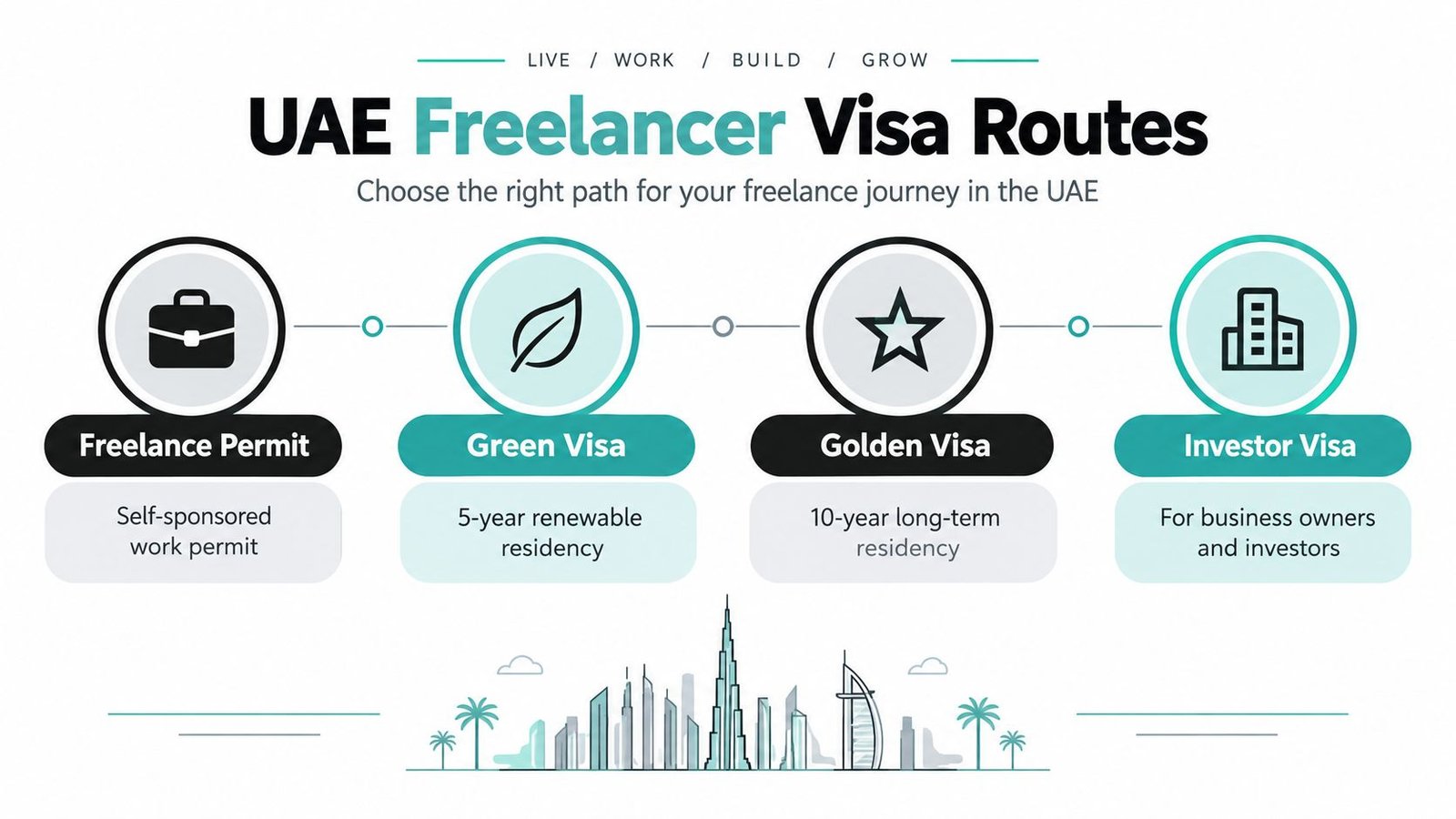
- Federal freelance permit: Best for independent professionals who want a legal work basis first and can pair it with the right residence channel.
- Free-zone freelance licence: Best when your emirate choice and activity category matter, especially in Dubai free zones.
- Virtual-work residence: Best for overseas employees who are paid abroad and want to live in the UAE while staying on that employer's payroll.
- Green Residence for self-employment: Best when your income is strong enough and you want a self-sponsored five-year route.
What the key government bodies do
MOHRE is the Ministry of Human Resources and Emiratisation, the federal labour authority. GDRFA is the General Directorate of Residency and Foreigners Affairs in Dubai, the office that handles residence matters there. ICP is the Federal Authority for Identity, Citizenship, Customs and Port Security, which handles identity and residency systems across the country. If your paperwork is wrong, one of those systems will slow you down.
The practical question is not “am I a freelancer.” It's whether your work is independent, whether your profession fits the permit category, and whether your income pattern matches the route you want. If you're only just starting, keep your evidence ready early, passport, portfolio, contracts, and proof of who pays you.
Comparing Free Zones and the Dubai GoFreelance Route
Dubai's GoFreelance route is the cleanest reference point because it shows how the UAE freelancer model works in practice. The official program lists AED 4,600 for a one-year visa and AED 5,042 for a two-year visa, with a freelance licence and an establishment card listed at AED 2,000 as prerequisites for the employment-visa process. It also says applicants need a UAE telephone number, valid medical insurance, passport, and passport photograph. Dubai GoFreelance official information
The bigger point is this, Dubai pricing is not a nationwide tariff. Free zones and emirates set their own licensing, establishment-card, and immigration charges, so someone in Abu Dhabi or Sharjah can see a very different bill from someone in Dubai. If you compare options blindly, you'll misread the total.
How to choose the right jurisdiction
Pick the zone by activity, emirate preference, and whether you want a licence that stays lightweight or one that can grow with your business. Media, design, technology, consulting, and education are common freelance categories across UAE free zones, but the activity code still matters more than the marketing brochure. If your work is regulated or client-heavy, don't choose on price alone.
| Authority | Visa Length | Setup Cost Range | Best For |
|---|---|---|---|
| Dubai GoFreelance | 1 or 2 years | AED 4,600 to AED 5,042 for the visa, plus AED 2,000 for the licence and establishment card prerequisite | Dubai-based independent professionals |
| Free-zone freelance permit | Varies by zone | Zone-specific | Professionals who want a free-zone structure |
| Sharjah route | Varies by zone | Zone-specific | Candidates prioritising Sharjah as an operating base |
| Abu Dhabi route | Varies by zone | Zone-specific | Professionals who need Abu Dhabi positioning |
Practical rule: if your work is still solo and your clients are overseas or mixed, a freelancer route is usually enough. If you already need staff, banking complexity, or a broader corporate presence, you're probably underbuilt.
One useful reference for comparing structure to company formation is Inpro's Dubai professional licence page, because many founders eventually discover that a simple freelance permit is only the starting point, not the end state. Keep that distinction clear before you pay for the wrong route.
Step-by-Step Application Walkthrough With Real Timelines
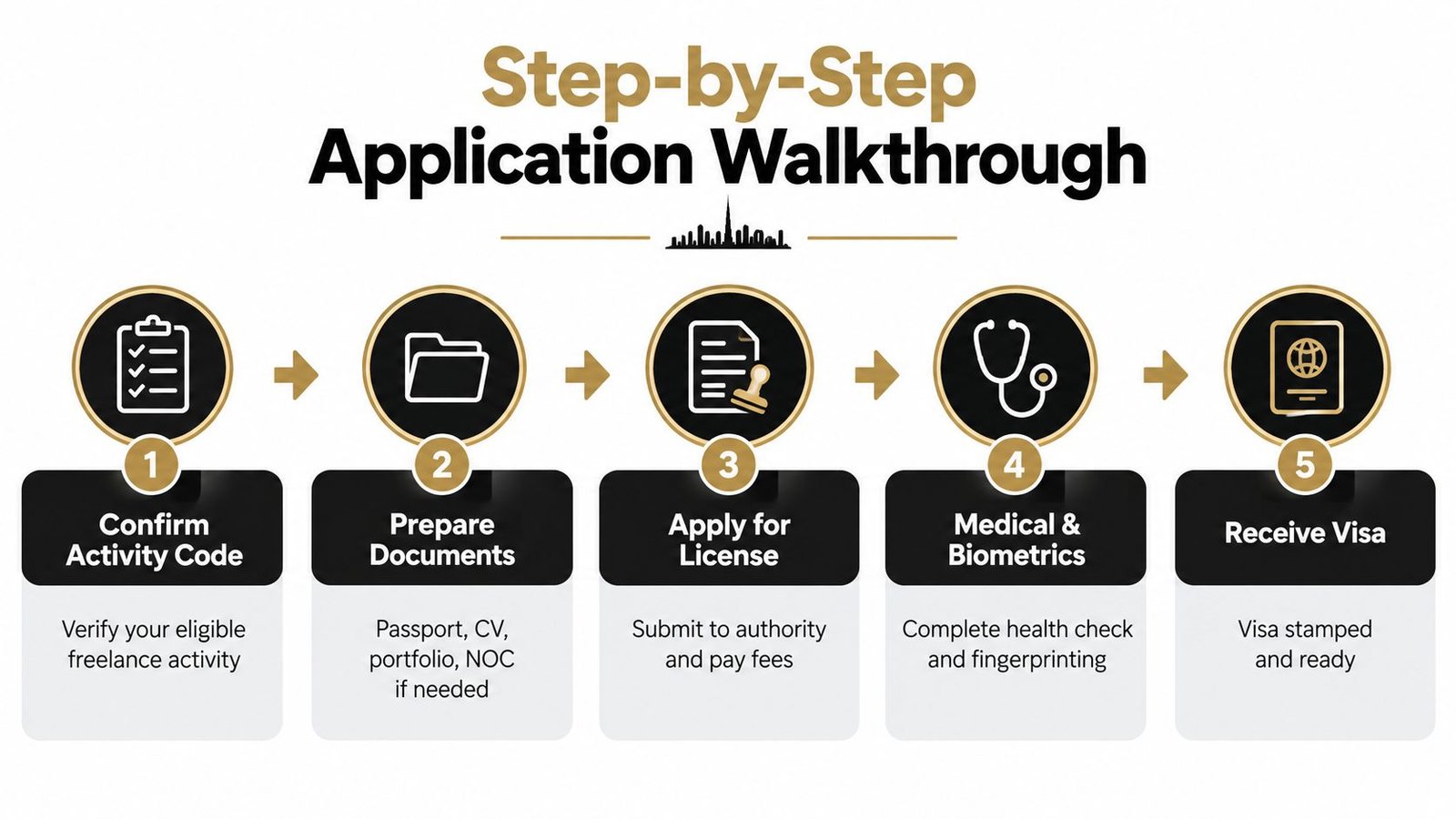
The fastest clean applications start with the activity code, not the visa form. Pick the wrong profession category and you waste time fixing a mismatch later, which usually hurts more than the fee itself. Once the code is right, gather the documents that prove you do this work for real, passport copy, CV, portfolio, and, if you're switching from a current UAE employer, the relevant approval letter or NOC where applicable.
The actual sequence is usually straightforward. You submit the freelance licence file, the authority issues the invoice, and then you move into residency steps, which include Emirates ID biometrics, medical fitness testing, and the visa stamping stage.
What actually slows people down
The document pack matters more than most applicants think. If your portfolio is thin, your job title doesn't fit the activity code, or your name differs across papers, the file gets parked until someone clears the mismatch. That's where people lose days, not in the stamping itself.
Practical rule: don't file with a half-ready set of supporting papers. A clean file moves faster than a rushed one every time.
Medical and identity steps also need planning, especially if you are changing status from inside the UAE. For that piece, the medical fitness certificate guidance is worth reviewing before you book anything, because a missed appointment or an expired passport can push the whole timeline back. If you're inside the country on a visit status, build in extra time for sequencing.
A realistic order of work
Start with the licence, then complete the resident steps, then wait for the visa result. Do not reverse that order because the immigration side depends on the underlying freelance authorisation. If you try to treat the visa as separate from the permit, you end up paying twice in time and corrections.
For most applicants, the practical timetable is short once the file is clean, but the delay points are predictable, weak documents, incorrect category selection, and avoidable resubmissions. Keep one version of your passport, CV, and evidence set, and don't scatter supporting files across different WhatsApp threads and email chains. That mistake causes more rework than the authorities do.
Real Costs, Total Budget, and What Most Applicants Miss
The headline fee is never the whole bill. In Dubai's virtual-work route, the government-published charges include AED 200 for the residence permit, AED 10 Knowledge Dirham, AED 10 Innovation Dirham, AED 500 if the applicant is already inside the UAE, and a virtual-work service fee of AED 200 plus 5% VAT, with possible delivery and processing charges. Those are published fees, not a guaranteed total cost. Dubai virtual-work residence service details
That fee structure matters because many applicants compare only the visa line item and then get surprised by the rest. The permit itself is one cost, the residence process is another, and the identity and medical steps sit beside both. If you budget badly, the application is still possible, but the stress goes up fast.
What people forget to include
A real budget should include the freelance licence, the establishment card where required, the residence visa fee, the Emirates ID process, the medical fitness test, health insurance, and the small government charges that appear near the end of the file. Then there are service charges from typing centres or PRO support, which vary by provider and case complexity. If you are changing status from inside the UAE, that process can add another layer of admin work.
- Licence fee: the core authorisation to work independently.
- Establishment card: needed on some routes before the residence step.
- Medical and identity steps: required to complete residency formalities.
- Insurance: needed to keep the residence file valid where applicable.
Health insurance is not something to wing with a travel policy if you want a residence file accepted, and the policy must fit the emirate and the residency route. You also need to budget for renewals, because the cost cycle returns every one or two years depending on the route.
For a simple comparison point on fee structure and route choice, Inpro's cheapest free zone guide is useful when you're deciding whether you're really looking for a freelance route or a wider company setup. A low upfront figure can still be the wrong fit if you'll outgrow it quickly.
When the Freelance Visa Stops Being Enough
A freelance permit works well while you're one person selling your own time or expertise. The moment you need employees, a more durable client setup, or a structure that can hold regulated commercial activity, the permit starts to feel tight. That's not a failure, it's a sign you've crossed into company territory.
The clean transition points are predictable. If your income is stable and you want a self-sponsored residence route with different screening, the Green Residence for self-employment becomes relevant, and the government guidance says freelancers and self-employed people can qualify for that five-year route if they meet the conditions. If you move from independent work into an agency model, the next step is usually company formation, either in a free zone or on the mainland through the DED, the Department of Economic Development.
What changes when you hire or expand
Hiring staff changes the legal shape of the business. A freelance permit is built for one person, not a team, so once you bring in employees you need a corporate structure that can sponsor them properly. The same logic applies if you want stronger banking separation, more formal contracting, or activities that no longer look like solo service delivery.
Practical rule: if you need to pay salaries, not just collect fees, you've probably outgrown the freelance lane.
Banking and tax also become less casual as the operation grows. A freelance permit can work for basic invoicing, but once the business expands, proper business banking, VAT registration, and corporate tax registration need to be looked at as part of the structure, not as afterthoughts. If you delay that decision, you create friction later when the work has already outgrown the permit.
The sensible move is to choose the smallest legal structure that matches your current business, not the cheapest one you can find. Cheap is useful only if it still lets you operate cleanly six months later.
Common Pitfalls, Rejections, and How to Avoid Them
Most bad files don't fail because the applicant is unqualified. They fail because the papers don't line up, the insurance is wrong, or the applicant assumes the process is looser than it really is. A wrong activity code is one of the fastest ways to create a problem, because it signals that your stated profession and your actual work don't match.
Another common issue is weak income evidence. If your bank statements don't show a clear trail, or your contracts don't prove who pays you and where that client is based, the file can stall. A residence route also becomes messy if you use insurance that doesn't fit the Dubai or Abu Dhabi requirements for the route you picked.
The mistakes that cause the most delay
- Wrong activity code: match the permit category to the work you do.
- Weak bank trail: show consistent payments and matching contracts.
- Insurance mismatch: use a policy accepted for the emirate and visa route.
- Missed medical slot: book early and keep passport validity clean.
- Active employment visa without permission: get the correct release or approval before switching.
The less obvious trap is timing. People sometimes overstay a visit status while waiting for documents, then discover they've created a second problem on top of the first. Others renew the licence too late and let the residence side expire first, which creates avoidable admin.
If you're already on a UAE employment visa, don't assume you can move to freelance status casually. The permit is not a blanket pass to work for someone else's mainland company, and it definitely isn't a shortcut around employment rules. File the right route, in the right order, and keep your passport, contracts, and insurance in one matching set.
Your 90-Day Plan and Answers to the Questions Everyone Asks
Start with week one, choose the free zone or permit route and confirm the activity code. Use weeks two to three to assemble the passport copy, CV, portfolio, and any release letter or NOC if you're changing status. By weeks four to five, get through medical, Emirates ID, and visa stamping, then use weeks six to twelve to open banking, issue invoices, and stabilise your client flow.
Can dependants be sponsored? On the virtual-work route, the holder may sponsor family members for the same period. On other routes, the answer depends on the residence status attached to your file, so check the exact visa type before you assume anything.
Can I open a bank account? Yes, but the account type depends on whether you're opening a personal account or a business account and on how the bank reads your residency and income profile. Keep your licence, visa, and contracts aligned.
What happens at renewal? At the end of year one or two, you renew the underlying permit and the residence side together if your route requires both. Don't leave renewal to the final week, because missing insurance or identity paperwork creates unnecessary delay.
Not sure which route fits your next stage? Inpro handles freelance permits, visa processing, and the paperwork that goes with UAE set-ups, so you can compare the right option before you file. Visit Inpro if you want a clean starting point and a practical cost check for your UAE move.
If you want the cleanest path through a UAE freelancer visa, talk to a team that handles the paperwork every day, not once in a while. Inpro can map your route, prepare the filing, and keep the residence side aligned with your freelance setup, so you don't pay twice for avoidable mistakes.