


UAE mainland company formation cost isn't a single fixed price. Depending on the emirate, business activity, licence type, office requirements and visa count, total first-year outlays can range from roughly AED 15,000 to over AED 50,000.
You may be comparing quotations that appear to cover the same thing, only to find that one includes a trade licence while another includes office space, immigration files or professional support. That difference matters. A mainland setup is a chain of government, premises, immigration and compliance decisions, not a single purchase.
Table of Contents
- Understanding UAE Mainland Company Formation Cost
- Breaking Down Government Licensing Fees
- Office Requirements and Premises Costs
- Visa and Establishment Card Expenses
- Recurring Tax and VAT Compliance Costs
- Sample First-Year Cost Scenarios
- Practical Tips to Estimate and Reduce Costs
- Next Steps for Your UAE Mainland Setup
Understanding UAE Mainland Company Formation Cost
A realistic UAE mainland company formation cost starts with the activity and jurisdiction. The relevant economic department, such as Dubai Department of Economy and Tourism or an equivalent department in another emirate, sets licensing charges according to the approved activity and legal form. The United Arab Emirates does not apply one universal mainland tariff. The Ministry of Economy and Tourism's company-formation guidance describes a process involving business-location and activity selection, trade-name reservation, initial approval, incorporation documents where required, premises documentation, payment of applicable fees and licence collection.
That's why a quotation showing only a licence price can be misleading. It may leave out tenancy documentation, external approvals, establishment-card charges, visas, document attestation, accounting and tax administration. A low entry price can become a different first-year budget once the company is ready to employ people and trade.
What makes mainland costs change?
The main variables are practical:
- Business activity: A consultancy, trading operation, restaurant and regulated professional practice can require different approvals and premises.
- Licence category: Commercial, professional and industrial activities follow different approval paths.
- Emirate: Dubai, Abu Dhabi and Sharjah have their own economic authorities and procedures.
- Office requirement: The premises must suit the activity and licensing authority.
- Visa count: Investor, employee and dependant applications add separate immigration work.
- Operating model: Accounting, tax registration and filing support continue after incorporation.
Dubai uses the Department of Economy and Tourism, commonly called DET, for mainland registration and licensing. Dubai recognises five main licence categories, and most activities now allow 100% foreign ownership, although strategic sectors and restricted activities can still require an Emirati partner. Dubai's official business portal explains why the exact activity and ownership structure should be checked before accepting a quotation.
Practical rule: Ask for two totals, the amount needed to obtain the licence and the amount needed to operate legally through the first year.
Breaking Down Government Licensing Fees
The licensing bill normally begins before the licence is issued. The authority first checks whether the proposed name and activity can proceed, then records the company's legal and premises details. Each stage can affect the final amount, particularly where the activity requires another government body's approval.
What are the main licence components?
| Fee Component | Nature | Variability Factor |
|---|---|---|
| Trade-name reservation | Government process | Name availability, language and naming rules |
| Initial approval | Government process | Activity, legal form and ownership |
| Incorporation documents | Required documentation | Legal structure and shareholder arrangements |
| External approvals | Sector-specific requirement | Regulated activity and supervising authority |
| Licence issuance | Core government charge | Emirate, activity and legal form |
| Document attestation | Supporting documentation | Origin of documents and required use |
The trade-name reservation confirms that the proposed name can be used. It doesn't authorise trading. Initial approval indicates that the authority has accepted the proposed establishment in principle, but it may not replace approvals needed for activities such as healthcare, education, food, transport or other regulated sectors.
The legal structure also matters. A limited liability company, sole establishment, branch or civil company can involve different incorporation documents and ownership considerations. The authority may require a Memorandum of Association, shareholder documents or evidence of authority from a parent company.
Why do similar quotations differ?
Two founders can ask for a mainland licence in the same emirate and receive different totals because their activities, legal forms and premises differ. A professional services firm may need a different approval route from a general trading company. An industrial activity can also require a facility that is more demanding than a small office.
Document attestation is another line item that founders often overlook. Foreign corporate or personal documents may need authentication before they can support the application. Treat government fees, professional service charges and attestation costs as separate lines rather than accepting one unexplained package total.
Office Requirements and Premises Costs
The office is often the largest variable after the licence itself. Mainland authorities may require an approved business address, tenancy documentation or a facility suited to the licensed activity. A shared desk can work for some activities where the authority permits it, but it shouldn't be assumed to satisfy every mainland application.

How should founders choose premises?
Start with the activity, not the cheapest available desk. A consultancy with limited staff may need a modest office arrangement, while a trading, retail or industrial business may need storage, customer access or a larger facility. Check whether the address matches the approved activity and whether the landlord's documents can support the licensing application.
Tenancy administration can add work and cost. In Dubai, Ejari is the tenancy registration system used to record eligible rental contracts. Utility deposits, connection charges, fit-out, furniture and service fees can sit outside the formation quotation, so ask whether the quoted premises cost includes only rent or also the related registration and setup items.
A practical comparison should show:
- Workspace type: Shared, serviced, dedicated office, shop or warehouse.
- Contract requirement: Minimum lease terms and registration documents.
- Capacity: Whether the premises supports the planned employee and visa requirement.
- Activity fit: Whether the authority accepts the location for the proposed business.
- Expansion impact: Whether additional staff or inventory will require more space.
A cheap flexi-desk may reduce launch costs but become unsuitable when you hire staff or add a regulated activity. A larger office may be wasteful before revenue begins. The sensible choice is the smallest premises that satisfies the authority and your immediate operating needs, with a clear plan for expansion.
The lease should also be reviewed for renewal terms, deposits, access, signage and early-exit conditions. These details affect cash flow even when they don't appear on the licence invoice.
Visa and Establishment Card Expenses
Immigration costs depend on who needs residency and what the company must sponsor. An establishment card is the immigration file that enables a company to apply for visas and manage sponsorship matters. It's separate from the trade licence, so a licence package without an establishment card may not be ready for employee onboarding.
What does each visa usually involve?
A visa budget can include application processing, entry status where relevant, medical fitness testing, Emirates identity-card processing and residence stamping or electronic issuance. The exact route depends on whether the applicant is an investor, employee or dependant, and whether the person is already inside the UAE.
The number of applications changes more than the headline company setup fee. One founder with an investor residence requirement has a different budget from a company hiring several employees. Dependants add another layer because their applications are linked to the sponsor's status but still require their own processing.
The company should also plan for:
- Establishment-card processing: Needed before the business can manage corporate sponsorship files.
- Employee quota and eligibility: The office and activity can affect the company's ability to sponsor staff.
- Medical and identity steps: Each applicant must complete the relevant government procedures.
- Renewal dates: Residence and company immigration documents expire on their own schedules.
- Late action risk: Missed validity dates can create penalties and urgent processing work.
Keep a simple visa register with each person's issue date, expiry date, passport details and renewal status. Apply in a planned sequence instead of waiting until an employee is due to start. HR teams can use Inpro's establishment card service to clarify the immigration file, supporting documents and next steps before submitting staff applications.
Golden Visa applicants should budget separately from ordinary employee sponsorship. Eligibility and supporting evidence depend on the applicant's category, so the company's formation package shouldn't be treated as a Golden Visa quotation.
Recurring Tax and VAT Compliance Costs
A mainland licence is only the starting point. Once the company trades, it may face Corporate Tax and VAT registration, record-keeping and filing work. These are separate systems, so a business can have Corporate Tax responsibilities without being registered for VAT.
How does Corporate Tax affect the budget?
UAE Corporate Tax was introduced under Federal Decree-Law No. 47 of 2022 and applies to relevant business profits for financial years beginning on or after 1 June 2023. The Federal Tax Authority applies a 0% rate to taxable income up to and including AED 375,000, with 9% applying to the portion above AED 375,000. The Federal Tax Authority's Corporate Tax guide clarifies that this threshold concerns taxable income rather than turnover.
For example, a company with AED 1,000,000 of taxable income would have the first AED 375,000 taxed at 0%. The remaining AED 625,000 would produce AED 56,250 of Corporate Tax at 9%, before applicable adjustments or relief. The tax is separate from formation charges, while accounting records, registration and return preparation still affect the first-year budget.
Corporate Tax registration is separate from the trade licence quotation. The Federal Tax Authority states that UAE-incorporated juridical persons, including mainland entities, must register within the prescribed timeframe. Registration applications may take up to 20 working days to review, according to the Federal Tax Authority's Corporate Tax FAQs. For registration steps and timelines, see Inpro's guide to corporate tax in the UAE.
How is VAT different?
VAT registration itself is free as an FTA service. A UAE-resident business must register when taxable supplies and imports exceed AED 375,000 in the previous 12 months or are expected to exceed that amount in the next 30 days. Voluntary registration starts above AED 187,500, based on applicable taxable supplies, imports or eligible taxable expenses. The FTA VAT registration guidance explains these thresholds.
| Tax Type | Mandatory Threshold | Voluntary Threshold |
|---|---|---|
| Corporate Tax | Taxable income above AED 375,000 is taxed at 9% | Not applicable as a VAT-style threshold |
| VAT | Taxable supplies and imports above AED 375,000 | Above AED 187,500 |
VAT creates recurring work through bookkeeping, invoice controls, return preparation and payment scheduling. VAT returns and related payments are generally due within 28 days after the tax period ends. Small Business Relief may apply where revenue is no more than AED 3 million in the relevant and preceding tax periods, for tax periods ending on or before 31 December 2026, where applicable under current FTA guidance. It does not remove Corporate Tax registration or VAT obligations. Check the FTA's Small Business Relief guidance before relying on the relief.
Sample First-Year Cost Scenarios
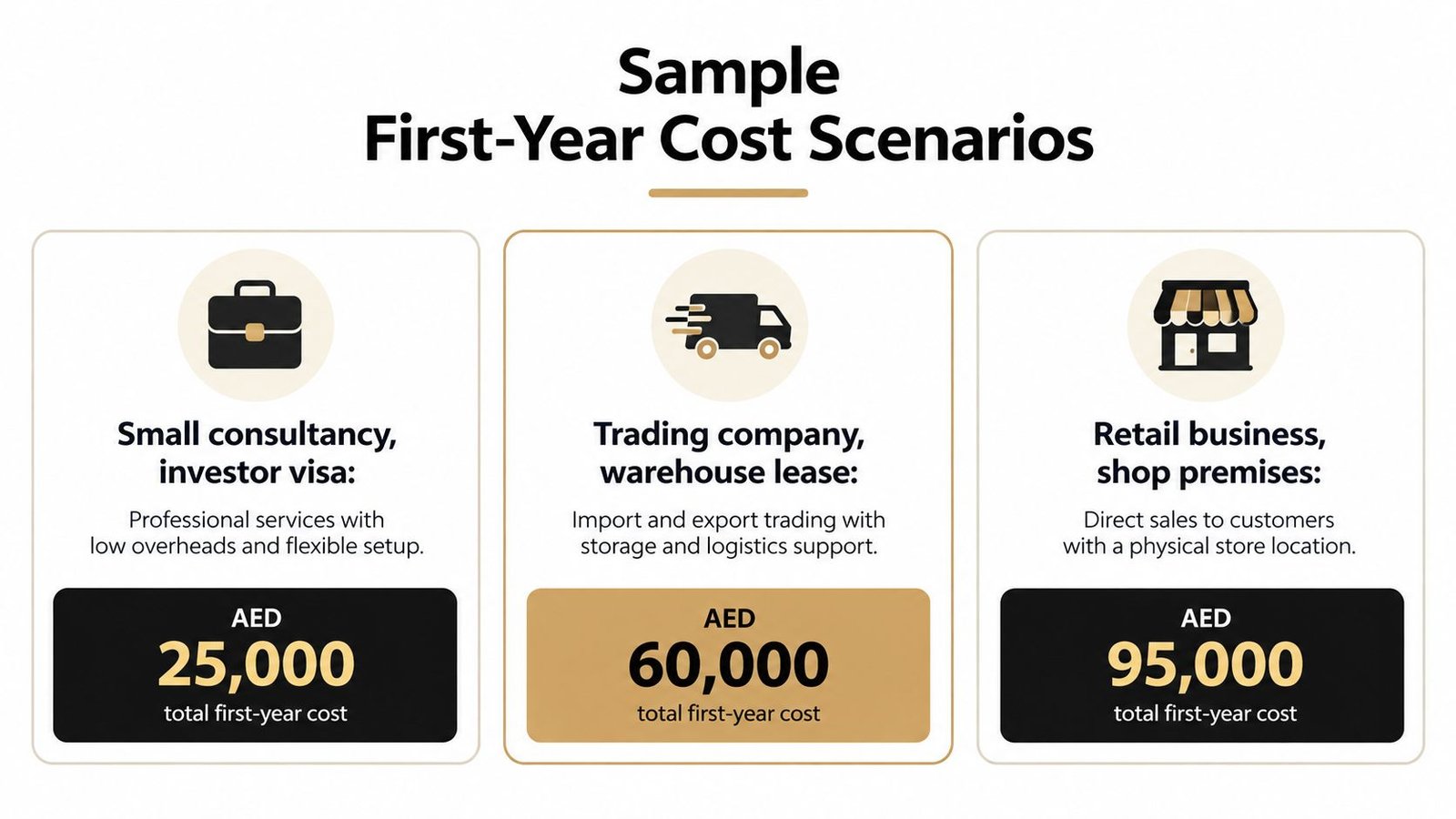
A useful budget doesn't pretend that every mainland company has the same cost. It shows how the activity, premises and visa plan alter the result. The figures below are illustrative planning scenarios, not official tariffs or quotations.
Scenario one for a small consultancy
A small consultancy with one investor visa may fit within a modest office arrangement where permitted. Its budget should include activity approval, trade-name and licence processing, premises documentation, establishment-card work, the investor's immigration process and basic accounting support.
A planning total of AED 25,000 for the first year can be used as an example for this lean profile. It isn't a guaranteed market price. A different emirate, regulated activity, document-attestation requirement or premises arrangement can move the figure.
Scenario two for a trading company
A trading company with a dedicated office, warehouse lease and two employee visas has a heavier operating footprint. The founder must consider premises, tenancy registration, inventory-related space, immigration files, employee processing, bookkeeping and tax administration.
A planning total of AED 60,000 for the first year illustrates how quickly the budget can rise when the company needs more space and staff. The warehouse and activity approvals should be priced before the licence application is finalised, not added after the quote is accepted.
Scenario three for a retail operation
A retail business with shop premises faces a different cost structure. Location, fit-out, signage, landlord requirements, customer access and sector approvals can matter as much as the licence. A business that chooses a prominent location may spend far more on premises than a professional office.
A planning total of AED 95,000 for the first year illustrates this model. Founders can compare these assumptions using the Inpro business setup cost calculator, then replace the illustrative inputs with an authority quotation and confirmed premises costs.
The useful lesson is not that one scenario is cheap or expensive. It's that visa count, physical space and activity approvals determine whether a package reflects your actual business.
Practical Tips to Estimate and Reduce Costs
Start by writing the budget in separate columns. Put government charges, premises, immigration, professional services, accounting and tax work on different lines. This makes it easier to see whether a quote is lower or excludes items another provider has included.
Which decisions reduce avoidable spending?
- Confirm the activity first: Changing the activity after approval can create more work and new premises questions.
- Compare emirates properly: Dubai, Abu Dhabi and Sharjah may suit different customer, office and cost requirements.
- Limit initial visas: Apply for the people the business needs now, while keeping future recruitment in the plan.
- Match the office to the activity: Don't rent a warehouse for a consultancy, and don't assume a desk satisfies a trading or retail model.
- Ask for exclusions: Check whether the quote includes Ejari, establishment-card work, attestation, medical testing, accounting and renewals.
- Price the second stage: Small Business Relief is temporary under the stated rules, so model the company's position after 31 December 2026 rather than budgeting only for launch.
Accounting support should match transaction volume and tax needs. A low monthly fee may not include VAT returns, Corporate Tax analysis, reconciliations or year-end work. Ask what records you must maintain, who prepares filings and what happens when revenue or employee numbers increase.
Before paying a deposit, request an itemised quotation with validity dates, assumptions, excluded government charges and renewal terms.
The lowest advertised licence price isn't always the lowest first-year cost. A compliant office, timely visa processing and organised tax records can prevent expensive changes later.
Next Steps for Your UAE Mainland Setup
Begin with four decisions: the emirate, business activity, legal form and initial visa count. Then ask the relevant economic department or an authorised adviser to confirm the approval route, premises requirement and licence charges for that exact combination.
Keep formation and operation separate in your forecast. Formation covers the application and licence process. Operation includes premises, immigration renewals, accounting, Corporate Tax administration, VAT where applicable and any sector-specific compliance.
Inpro supports mainland formation, PRO services, investor and employee visas, Golden Visa workflows, accounting, tax and VAT registration and filing. The team can help turn your activity, premises and staffing plan into an itemised budget rather than a headline package.
Use Inpro to compare your UAE mainland options, request a cost estimate and organise formation, PRO and compliance support. Book a free strategy call before committing to a licence so you can confirm the activity, office and visa assumptions and launch without unexpected bills.