


You've priced the licence, but have you checked whether it lets you invoice the clients you already have? You can work legally as a freelancer in Dubai once you hold the government permission that matches your activity, your residence status and your hiring plans, and those are three separate decisions rather than one purchase. Most stalled applications come down to a mismatch between those three, not to a missing document.
Table of Contents
- Freelancing in Dubai Starts With the Right Permit
- Freelance Permit Routes Compared by Situation
- What Freelancing in Dubai Really Costs
- Visa and Residence Rules That Shape Your Start
- How to Start Working Legally in Dubai Step by Step
- Mistakes That Stall Freelancers in Dubai
- Confirm Your Route Before You Apply
Freelancing in Dubai Starts With the Right Permit
A freelance work permit is a government authorisation for an individual to provide services independently, rather than as an employee of a sponsoring company. The UAE Government's work permit guidance confirms the permit can be issued to foreign nationals who hold self-sponsored residence visas, and that it doesn't require an active employment contract with a UAE employer. That's what lets you complete defined assignments for individuals or companies without being treated as their employee.
What is the Dubai Freelancer Licence?
The Dubai Freelancer Licence is a sole professional licence issued by the Dubai Development Authority (DDA), the licensing body behind Dubai's media and technology free zone clusters. It lets an independent professional trade under their own personal birth name rather than a commercial brand name. The United Arab Emirates separates individual professional activity from company formation, so holding this licence doesn't make you a company owner with staff and payroll.
A residence route is the immigration status that lets you live in the country while you work. It sits alongside your work permission, not inside it, which is why two freelancers with identical licences can hold completely different visas.
Who can hold a freelance permit?
The worker must be at least 18 years old, and where a profession requires a separate professional licence, the applicant must still meet those licensing conditions. A freelance permit authorises independent work in a defined activity. It doesn't replace sector-specific approvals, and it doesn't grant residence by itself.
A freelancer is an individual, not an employee, and every permit is tied to a specific activity rather than to you as a person.
The next decision is which row of the route table you belong in, and that depends on your clients, your current visa and whether you'll hire anyone.
Freelance Permit Routes Compared by Situation
Choose your route around your clients, residence status and hiring plans. A freelance licence, a work permit and a residence visa serve different purposes, so compare what each covers before paying application fees.
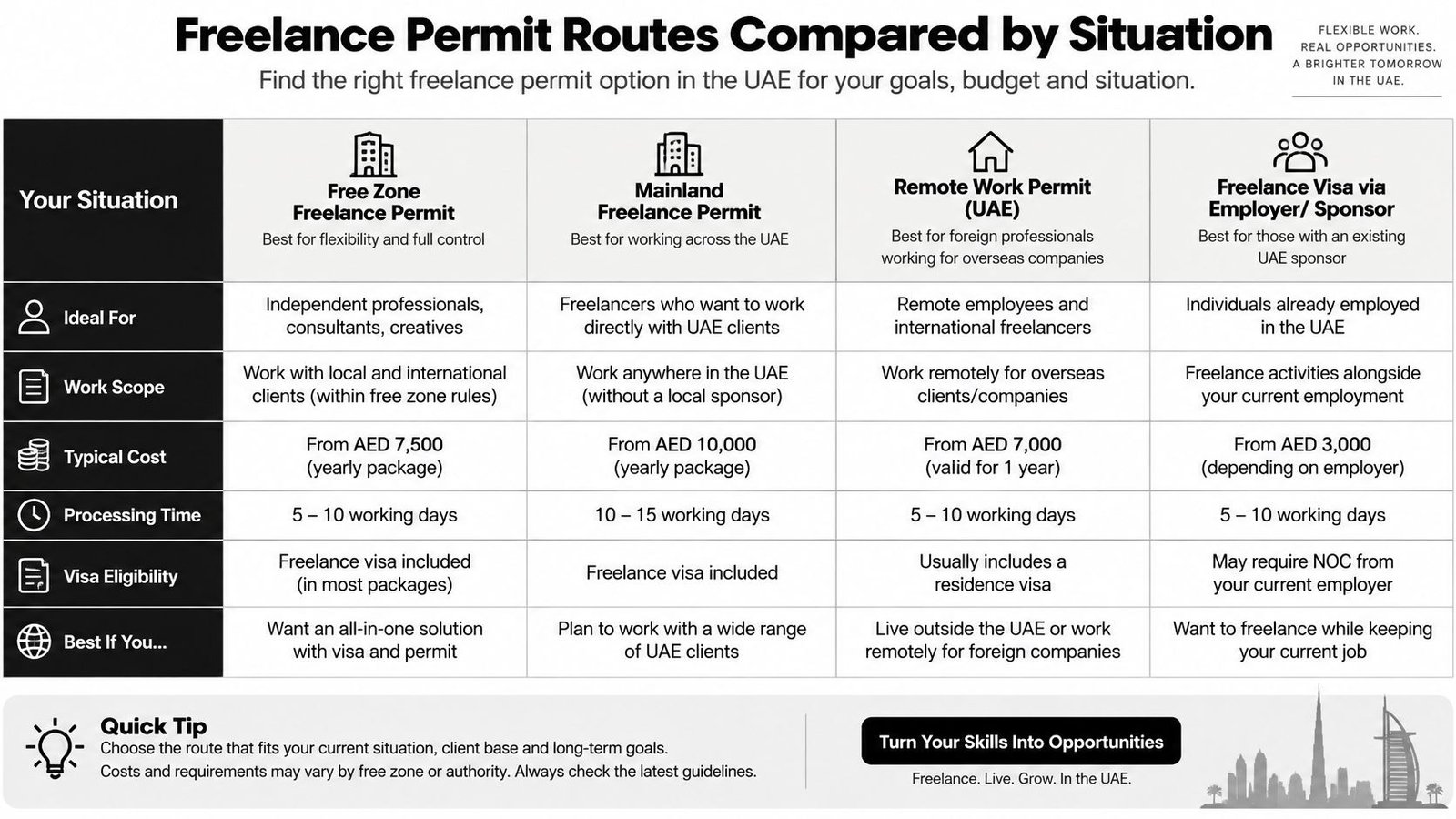
Freelance permit routes by situation
| Route | Best for | Issued by | Core requirement |
|---|---|---|---|
| Dubai Freelancer Licence (sole professional licence) | Solo professionals trading under their own name | Dubai Development Authority (DDA) | Passport and, where applicable, a no-objection certificate (NOC) |
| Freelance work permit | Foreign freelancers on a self-sponsored residence visa | Ministry of Human Resources and Emiratisation (MOHRE) | Meet age eligibility and any professional licensing requirements |
| Green Residence for self-employed people | Established freelancers seeking long-term self-sponsored residence | General Directorate of Residency and Foreigners Affairs (GDRFA), Dubai | Freelance permission and evidence meeting income or financial-solvency requirements |
| Remote working visa | Employees of an overseas company who live in the UAE | GDRFA in Dubai, or the federal identity and citizenship authority elsewhere | Employment with an overseas organisation; no local sponsor needed |
| Company licence (Mainland or Free Zone) | Founders planning to hire or build a business beyond solo work | Department of Economy and Tourism or a free zone authority | Company formation documents, trade licence and a registered office arrangement |
Which route matches your clients and visa?
Apply three questions in order. Where are your clients based? For local client work, compare the freelance licensing and work-permit options against your activity and residence status. Employment with an overseas organisation points towards the remote working visa. Having overseas clients alone does not make you an overseas employee.
What's your current visa status? If you're already employed in the UAE, establish whether your application needs a no-objection certificate (NOC). This is written permission from your sponsor. Resolve that document requirement before committing to an application timeline, rather than assuming your existing residence covers independent work.
Will you hire anyone in the next year? If hiring is part of your plan, compare company licences rather than relying on an individual freelance route. A consultant planning to add a designer and an account manager should account for that structure from the start.
Market access matters too. Mainland companies can trade directly across the UAE and bid for government contracts. Free zone companies can trade within their zone and internationally, but direct mainland sales usually require a local distributor or an additional licence.
Do you still need a local partner?
Most commercial and industrial mainland activities allow 100% foreign ownership, so most businesses do not need a local Emirati partner. Check the activity before choosing the company route.
For home-based online work, compare an e-trader licence with a full commercial licence. Match its permitted activity to what you sell before committing to an office arrangement or choosing solely on the headline fee.
What Freelancing in Dubai Really Costs
Legal freelancing has two kinds of cost: published government fees and supplier quotes that change with your case. Keep them separate. A cheap headline number can hide the total once residence, insurance, attestation and workspace needs are added.
The Dubai Development Authority's sole professional licence page lists a licence fee of AED 7,500 plus AED 20 in government charges, with an estimated two working days for delivery. That is the starting point for a Dubai sole professional licence. It does not cover every cost of working legally, and it does not answer whether the route fits your clients, visa status or hiring plans.
Freelancer setup costs to budget
| Cost item | Amount | Notes |
|---|---|---|
| Dubai Freelancer Licence | AED 7,500 plus AED 20 government charges | Estimated two working days |
| Freelance work permit, issue or renewal | Quoted by category | Depends on establishment classification |
| Residence visa and Emirates ID | Quoted per case | Confirm current GDRFA fees before you file |
| Medical test | Quoted by the approved centre | Required for residence |
| Health insurance | Quoted per plan | Required for residence; premium follows cover level |
| Attestation of foreign certificates | Quoted per document | Only if qualifications must be attested |
| Registered workspace or flexi-desk | Quoted per facility | Only if you need an address or meeting space |
Which fees are fixed and which need a quote?
Treat the licence fee as the fixed line in this budget. Work permit issuance or renewal sits on a separate federal scale that moves with establishment classification, so two freelancers doing similar work can pay different permit fees.
Everything below those two lines is a quote, not a published tariff. Insurance depends on the plan you choose. Attestation depends on how many certificates your activity requires and where they were issued. A flexi-desk depends on the facility. Our breakdown of Dubai free zone licence costs shows how those add-ons stack up against the licence itself.
The practical risk is budgeting for the permit and forgetting the file around it. Residence processing follows government approvals, so timing can vary. Medicals, biometrics and insurance can affect when you can start work on the ground. If your qualifications need attestation, that cost belongs in the first-year budget, not in a later surprise.
Budgeting habit: write the cost items down first, request a written quote for every unknown line, then set aside a renewal buffer. A first-year total that ignores renewal is a plan, not a budget.
Visa and Residence Rules That Shape Your Start
Your work permission and your right to live here are separate files, and the residence file is where most delays start.

What is the Green Residence for self-employed people?
The Green Residence is a long-term, self-sponsored residence route that includes freelancers and self-employed people among its eligible categories. The UAE Government's Green visa pages describe it as self-residence rather than a visa tied directly to one employer, part of a federal programme built to widen self-sponsored residence for freelancers, investors, entrepreneurs and skilled professionals. Calling yourself a freelancer isn't enough. You must satisfy the category conditions and submit the evidence through the competent authority.
Who qualifies on income?
The self-employment category needs a freelance or self-employment work permit issued through the Ministry of Human Resources and Emiratisation, plus proof of financial stability. Applicants must show self-employment income of at least AED 360,000 per year during the previous two years, or evidence of sufficient financial solvency during their stay. That's average documented income of AED 30,000 per month, and it's the number that decides whether this route is realistic for you.
If your documented income sits below that line, don't force the application. Look at other licensing and residence combinations, keep your invoices and bank records clean, and revisit the Green Residence when two years of statements support it. There's no guarantor and no employer required, which is the main advantage over a conventional employment visa.
Residence status also needs planning after cancellation or expiry. If your permit or residence file ends, deal with the status before starting new paid work. A self-employed resident needs a clear route to regularise the file or leave, rather than assuming the old status keeps working during a transition.
Which office handles your application?
In Dubai, the General Directorate of Residency and Foreigners Affairs (GDRFA) is the issuing authority. Other emirates generally use the Federal Authority for Identity, Citizenship, Customs and Port Security (ICP), so a freelancer based in Sharjah or Abu Dhabi files through a different channel. Our guide to UAE residence visa requirements covers the document set in more detail.
Two practical points catch people out. Paid work on a tourist or visit visa is expressly prohibited, so your first invoice must wait for the correct status. The file also depends on a valid passport, medical testing, and possible attestation of foreign academic certificates. Inpro acts for owners based outside the UAE on government matters and handles residence visa and immigration work for owners, employees and family members, but you attend your own biometrics and medical in person. Build those appointments into your calendar before you promise a start date to a client.
How to Start Working Legally in Dubai Step by Step
The UAE Government's work permit rules set three conditions that shape the whole sequence: the worker must be at least 18, the occupation must align with the establishment's business activity, and all relevant certificates and qualifications must be submitted. Work in that order and the file moves. Work out of order and you refile.
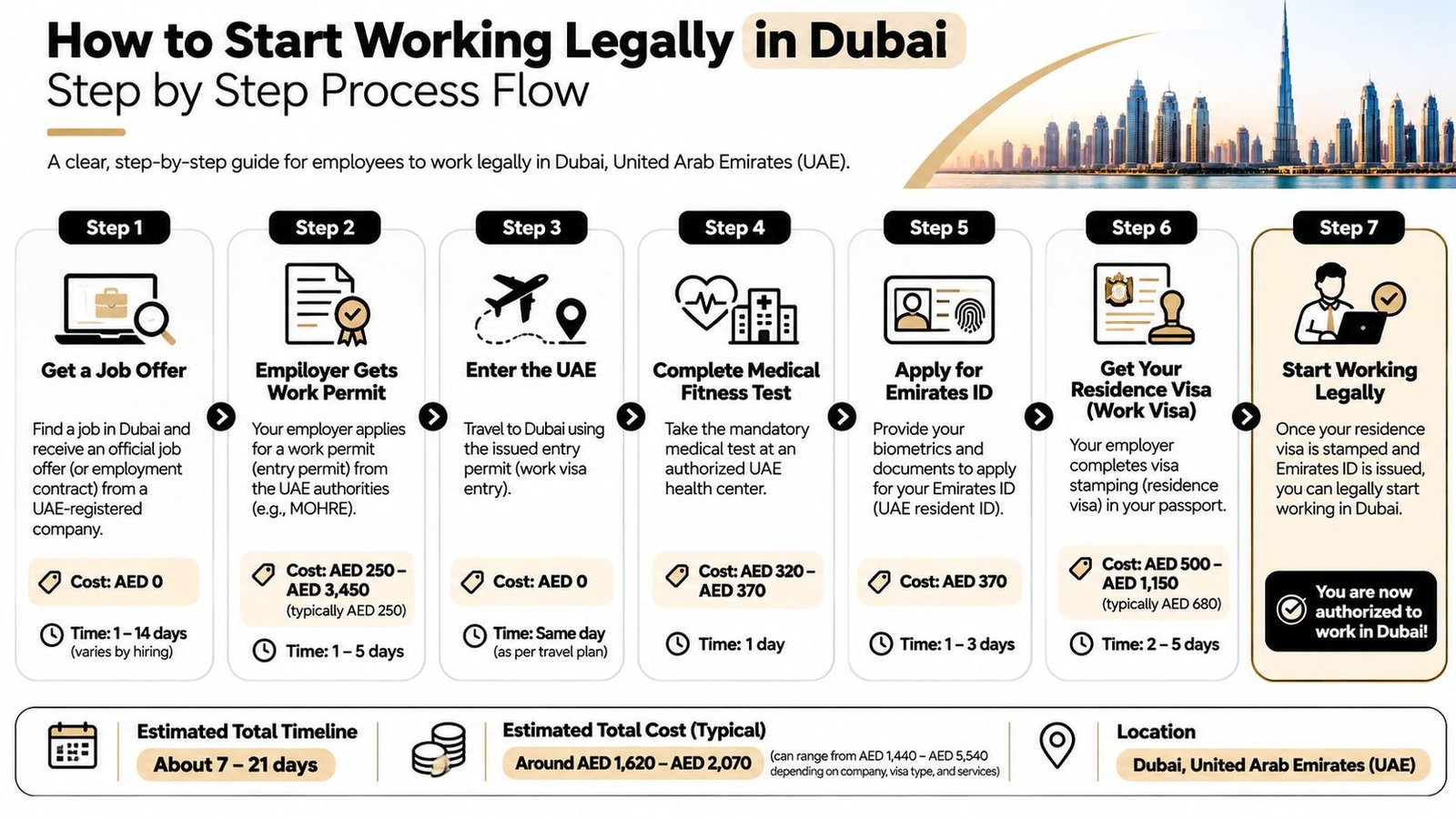
- Define the exact service you'll sell. Write it as an activity, not a job title, then check it against the occupation list on your intended permit. "Brand identity design" and "advertising campaign management" can sit in different activity codes.
- Choose the issuing authority and route. Pick one row from the comparison table and stay with it. Mixing a free zone licence with a mainland permit expectation is where files stall.
- Prepare your documents. Passport valid at least six months, identity papers, qualification certificates and any activity-specific approvals. Foreign academic certificates may need attestation, which is a chain of confirmations from the issuing country and the UAE, so start it early.
- Obtain professional approvals before you apply. Some professions need a separate nod from a regulator, and that step usually takes longest. Filing the permit first doesn't speed it up.
- Apply for the freelance work permit through the Ministry of Human Resources and Emiratisation (MOHRE), the federal ministry that issues work permissions.
- Arrange lawful residence or self-sponsorship. In Dubai that means GDRFA, elsewhere in the UAE generally ICP. Your permit and your residence are separate approvals with separate queues.
- Keep renewals, tax records and signed client contracts current for the life of the permit. A signed scope of work per client is what proves your activity matches your licence if anyone asks.
How long does each step take?
Licence and visa processing times depend on UAE government approvals and may vary, so build slack before any client deadline rather than promising a start date on the day you file. Attestation and professional approvals are the two steps I'd never compress.
A PRO firm is a company that handles government paperwork on your behalf. We prepare and submit applications to GDRFA, ICP, MOHRE and the licensing authorities, and we track deadlines for visas, work permits, Emirates IDs, renewals and document attestation. You still attend your own biometrics and medical, because no representative can do those for you.
Sequence rule: approvals before permit, permit before residence, residence before your first invoice.
Mistakes That Stall Freelancers in Dubai
None of these are exotic. They're the ordinary shortcuts people take when a client is waiting, and each one has a fix that costs time rather than money.
- Working on a tourist or visit visa. UAE guidance prohibits paid work under either status, and a signed contract doesn't change that. Fix: secure the correct permit and residence before your first invoice. Allow weeks, not days.
- Hiring under a freelance licence. Current 2025 guidance doesn't permit employees on a freelance licence, so a "part-time assistant" on your payroll is a compliance problem. Fix: form a company before the first hire. Weeks.
- Assuming a free zone licence covers mainland clients. Free zone companies can trade freely within their zone and internationally, but selling directly to the UAE mainland usually requires a local distributor or an additional licence. Fix: check market access before you sign a mainland client, then add the structure you need. Weeks.
- Choosing a permit that doesn't match the occupation. The activity on your permit must align with the establishment's business activity, and a mismatch can block renewal long after the work started. Fix: read the activity list before filing. Days.
- Letting residence paperwork lapse. Medicals, Emirates ID and visa renewal run on their own dates, and the grace period after expiry isn't extra working time. Fix: diarise renewal ahead of expiry. Days to weeks.
- Building a Green Residence case on income you can't document. Cash invoices and mixed personal accounts don't evidence two years of self-employment earnings. Fix: gather two years of invoices and matching bank records early. Weeks.
Say a designer wins a Dubai retainer while still on a visit visa and starts billing immediately. The work is real, the client is happy, and the file is still non-compliant, which surfaces at the residence stage rather than at the invoice stage. Sorting status first would have cost a few weeks. Sorting it afterwards costs the same weeks plus an awkward conversation with a client who expected a legally established supplier.
The pattern behind all six is the same: people treat the licence as the finish line. It's the entry ticket, and the activity, immigration and hiring rules keep applying afterwards.
Confirm Your Route Before You Apply
Three actions before you file anything, and each takes an afternoon at most.
Write your route down in one sentence. Name the row you've chosen and the reason it fits: where your clients are, what your visa status is today, and whether you'll hire within the year. If you can't write that sentence without hedging, you haven't chosen a route yet.
List the documents you already hold. Passport and its expiry date, qualification certificates, any sponsor letter or no-objection certificate. Mark each one as ready, needing attestation, or needing renewal. Attestation is the item most likely to move your start date, so identify it now rather than at submission.
Mark every unknown cost line as needing a written quote. Insurance, medical, Emirates ID, workspace and attestation should each come back to you as a number in writing before you commit. Then check your step plan against the processing reality: government approvals set the pace, and no adviser can guarantee a date.
We handle PRO work for Dubai mainland companies and free zone partners including IFZA (International Free Zone Authority), RAKEZ (Ras Al Khaimah Economic Zone) and Ajman, so the paperwork for each route can be prepared in one place rather than scattered across three inboxes. That matters most when your licence, permit and residence sit with different authorities.
Not sure which route fits? Talk to the inpro.me team before you file anything. Reach us on +971 55 583 8679 or contact@inpro.me, and we'll map your activity to the right permit and residence path for the UAE. A short conversation about your clients and hiring plans usually saves weeks of rework in the United Arab Emirates.
Inpro prepares and submits freelance permit, licence and residence applications to Dubai's immigration office, the federal identity authority and the labour ministry, and tracks every renewal date so nothing lapses while you're delivering client work. We'll tell you plainly which route your activity, visa status and hiring plans support, and what each line will cost before you commit. Visit Inpro to compare your options and start your UAE setup with the paperwork in the right order.