


JAFZA is a port-centric logistics hub hosting more than 11,000 businesses from 157 countries, with full foreign ownership and setup options suited to trading, warehousing, manufacturing, and distribution companies. It works best when your business needs control over cargo and customs, not when you only want a low-cost office and a tax assumption.
You may be comparing UAE jurisdictions, checking whether your goods can move through Dubai, or trying to understand what happens after your Jebel Ali Freezone licence is issued. The practical answer depends on your supply chain, premises, customer location, visa needs, and tax records. JAFZA can be a strong base for regional inventory, but it isn't automatically the simplest choice for a consultancy, SaaS company, or business selling directly into the UAE mainland.
Table of Contents
- Beyond the License – Understanding the Jebel Ali Ecosystem
- How to Set Up Your Company and Secure Visas
- What It Actually Costs to Operate Here
- Why Customs and Logistics Are Your Real Advantage
- The Corporate Tax Reality – Qualifying vs. Non-Qualifying Income
- Is Jebel Ali Freezone the Right Choice for You?
- Taking the Next Step with Inpro.me
Beyond the License – Understanding the Jebel Ali Ecosystem
A founder may arrive expecting a free-zone package, a desk, and a certificate of incorporation. That model can work in an office-focused jurisdiction. Jebel Ali Free Zone, commonly called JAFZA, is different. It was built around the port, warehouses, industrial premises, customs processes, and road connections that allow goods to enter, stay, be handled, and move onward.
Jebel Ali Port construction began in 1979, the first legal framework for the free zone was issued on 6 May 1980, and JAFZA became operational in 1985 under a royal decree. It started with 19 companies and had grown to more than 500 businesses by 1995. By 2025, JAFZA reported more than 11,000 businesses from 157 countries, including over 100 Fortune 500 companies. These milestones are recorded in JAFZA's history and business overview.
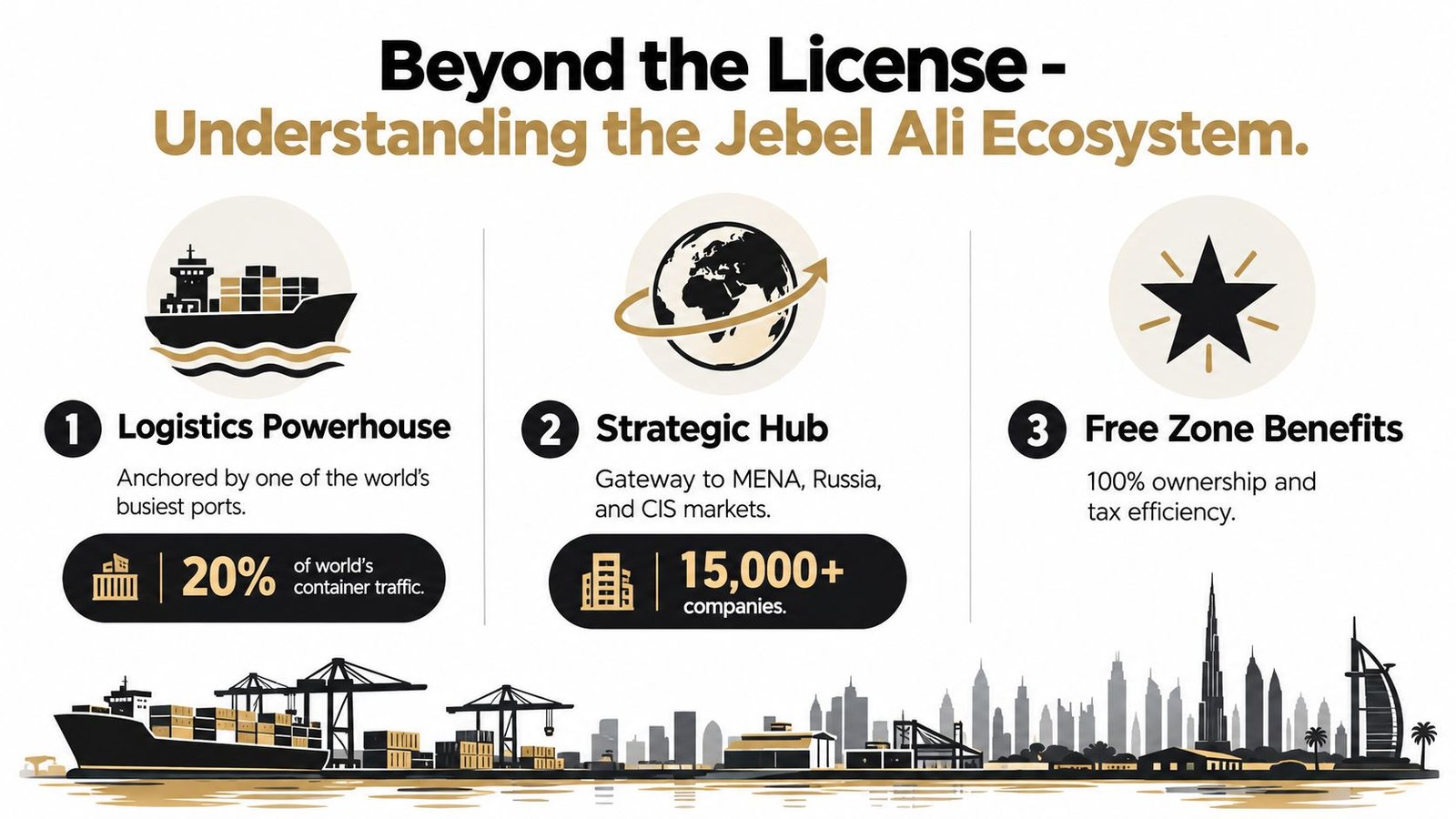
What makes JAFZA different from an office-only free zone?
The distinction is physical. A trading company can receive stock near the port, store it in an appropriate facility, arrange customs treatment, and dispatch goods to the UAE, the Gulf Cooperation Council region, or overseas markets. A manufacturer may need an industrial unit, a plot, loading access, and approvals that a flexi-desk package can't provide.
The zone covers approximately 59 square kilometres and includes land, warehouses, offices, and commercial facilities. Its property portfolio includes about 4.2 million square metres of leasable logistics space and more than 11,400 offices, according to JAFZA's property information.
Practical rule: Choose the premises from the movement of your goods backwards. Don't choose a desk first and try to force the supply chain around it.
JAFZA's adjacency to Jebel Ali Port matters because every extra handoff creates coordination work. Cargo can move between maritime transport, bonded storage, road freight, and regional distribution within one connected ecosystem. The zone also sits close to Al Maktoum International Airport, with direct road connectivity and planned rail integration, as described in DP World's JAFZA logistics overview.
If your business needs a Dubai office, employee visas, and occasional local service delivery, another free zone may be easier. If you import containers, hold inventory, assemble products, or re-export across the UAE and wider Middle East, JAFZA's infrastructure is the reason to consider it. Businesses should also understand the difference between JAFZA and other designated free zones in the UAE before committing to a structure.
How to Set Up Your Company and Secure Visas
JAFZA formation starts with the activity and premises, not the application form. Decide whether you need trading, service, industrial, logistics, warehousing, or another approved activity, then match that activity to the facility and ownership structure.

What should you decide before applying?
Start with four questions:
- What will the company do? The licence activity should reflect the actual commercial model, not a vague description chosen for convenience.
- Where will goods go? Re-export, bonded storage, and UAE mainland distribution can require different customs planning.
- What premises are needed? An office, warehouse, showroom, light-industrial unit, or land-based facility each affects approvals and operating commitments.
- Who owns the company? JAFZA supports foreign ownership, but the shareholder documents must be prepared and, where required, attested and translated.
The application typically requires shareholder identification, constitutional documents, a business plan or activity information where requested, and evidence connected to the proposed premises. Corporate shareholders may need certificates of incorporation, board resolutions, and authorised signatory documents. Exact requirements vary by structure and activity, so document checking before submission prevents avoidable rework.
How do the visa and employment steps work?
After licensing, the company usually establishes its immigration and labour file, then applies for investor, partner, manager, or employee visas according to its eligibility and approved quota. MOHRE, the Ministry of Human Resources and Emiratisation, is the federal authority involved in many mainland employment processes. Free-zone employers also deal with the relevant free-zone and immigration channels, so an employee's visa, work authorisation, medical examination, Emirates identity card, and health insurance must be treated as connected tasks.
A founder relocating to the United Arab Emirates should also separate company formation from residence planning. A shareholder visa, employee visa, and Golden Visa are different routes with different evidence requirements. HR teams should keep passport validity, signed contracts, medical results, insurance, and cancellation records organised.
This video provides a visual introduction to the business environment:
A realistic timeline depends on document readiness, activity approvals, premises, immigration checks, and whether a regulated product or corporate shareholder is involved. Fast handling is possible when the file is complete, but no responsible adviser should promise an identical timeline for every applicant.
What It Actually Costs to Operate Here
The headline licence figure rarely tells you what JAFZA will cost to run. The meaningful commitment often sits in the premises, warehouse specification, staffing, customs administration, transport, deposits, and visas.
JAFZA's property model ranges from office space to warehouses, industrial facilities, and land. A service company may need only a compliant office. A distributor may need racking, loading access, stock insurance, handling space, and a transport arrangement. A manufacturer may require a larger facility, utility capacity, production approvals, and an operational team.
Which cost categories should you budget?
A practical budget should separate one-off and recurring items:
- Licence and registration: The amount depends on the activity, entity type, and approvals.
- Premises: Office rent and warehouse or industrial rent can differ sharply. A low office commitment won't support containerised operations.
- Immigration: Investor and employee visa processing, medical examinations, identity services, and related administration add to the setup budget.
- Deposits and utilities: Landlords, facility operators, and service providers may require deposits or connection charges.
- Operations: Customs brokers, freight forwarding, storage, local delivery, insurance, accounting, and compliance support continue after incorporation.
The right comparison isn't “cheap licence versus expensive licence”. It's office-only overhead versus a facility that prevents repeated storage and handling problems.
How should you compare the operating models?
| Business Type | Licence Range | Office/Warehouse Estimate |
|---|---|---|
| Service or consultancy company | Depends on activity and structure | Office premises suited to administrative work |
| Trading company with limited stock | Depends on trading activity and approvals | Office plus suitable storage arrangement |
| Importer, distributor, or re-exporter | Depends on goods and customs workflow | Warehouse, handling, and transport capacity |
| Manufacturer or industrial operator | Depends on industrial activity and approvals | Industrial unit, warehouse, or land-based facility |
These descriptions are decision categories, not fixed quotations. JAFZA's own property information confirms that the zone offers offices, warehouses, land, and logistics facilities, which means the final budget follows the physical model you select.
Budgeting discipline: Ask for a written schedule showing licence, premises, deposits, visas, government charges, facility services, and recurring support. A low initial quote can become expensive if it excludes the space your business actually needs.
Founders should also allow for VAT registration and filing where applicable, corporate tax compliance, bookkeeping, customs support, and employee administration. Those aren't optional extras once the company trades. A transparent setup plan should show which costs arise before incorporation and which appear after the first shipment or hire.
Why Customs and Logistics Are Your Real Advantage
JAFZA's strongest commercial case is usually logistics, not a slogan about zero tax. A bonded warehouse is a facility where imported goods can remain under customs control without being treated as released into the UAE domestic market. This can allow a company to store, handle, assemble, label, or re-export goods before domestic import procedures apply.
Goods intended for re-export can stay in the zone under the relevant bonded arrangement. If goods are released to the UAE mainland, ordinary customs procedures and applicable charges arise. The exact treatment depends on the goods, movement, documentation, and destination, so a customs broker should confirm the workflow before the shipment leaves the port.
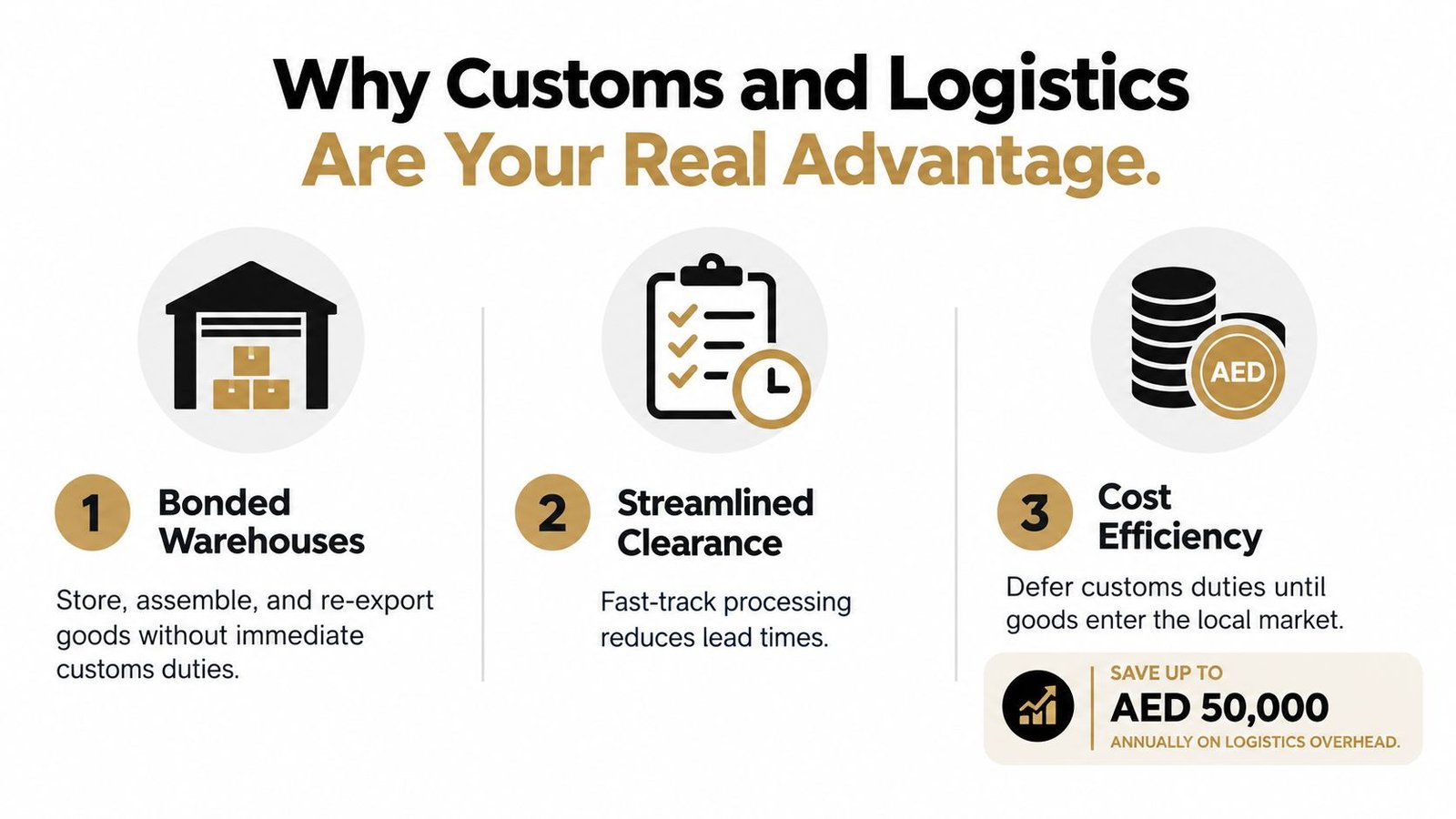
When does bonded storage make commercial sense?
Consider three operating models:
- Re-export only: Goods enter the zone, remain under the planned customs status, and leave for another market. This is often the cleanest model for regional distribution businesses.
- Bonded storage followed by release: Stock stays in JAFZA until an order requires UAE delivery. The company then plans the mainland release, customs declaration, applicable charges, and local transport.
- Routine mainland distribution: Goods are regularly sold to UAE customers. JAFZA may still support inventory positioning, but the cost and administration of repeated release should be assessed against a mainland warehouse or another structure.
The third model is where assumptions often fail. A JAFZA licence doesn't grant unrestricted access to every UAE customer or remove the need for correct import and distribution procedures.
JAFZA's clusters can also reduce practical friction. The food and agriculture cluster covers approximately 1.57 million square metres, hosts more than 550 companies from over 70 countries, and employed over 6,000 people. JAFZA facilitated AED15.9 billion in food and beverage trade in 2021, according to JAFZA's food and agriculture update.
The metal, steel, and construction cluster exceeds 3.4 million square metres, with more than 1,000 companies from 89 countries and a reported cluster value of AED26.7 billion. These concentrations can make it easier to find specialised storage, freight, suppliers, and sector knowledge, but they don't replace product approvals or accurate declarations.
Product classification deserves early attention. The correct Harmonised System code affects customs treatment and documentation. Before importing, review Dubai customs HS codes with a qualified customs professional and reconcile the code against invoices, packing lists, certificates of origin, and permits.
The Corporate Tax Reality – Qualifying vs. Non-Qualifying Income
A JAFZA company isn't automatically a tax-free company. UAE corporate tax rules apply a 9% rate to taxable income above AED375,000, unless the company qualifies as a Qualifying Free Zone Person and earns qualifying income under the applicable rules. The threshold and rate are stated in UAE corporate tax guidance for free-zone businesses.
What is a Qualifying Free Zone Person?
A Qualifying Free Zone Person is a free-zone company that meets the conditions for the favourable corporate tax treatment. The analysis can involve the company's activity, customers, income type, audited or maintained records, and whether the company has sufficient substance in the UAE.
Substance means the business has real economic presence for its activity. That may include suitable premises, people performing relevant work, operating expenditure, decision-making, and records that support what the company claims to do. A paper company with a licence and bank account may not provide the evidence needed for a defensible position.
A trading company with stock, warehouse activity, invoices, and shipping records presents a different factual picture from a consultant who invoices overseas clients from a minimal office. A holding company, SaaS business, and advisory firm each need a separate review of income classification and operating substance.
Which income needs closer review?
Founders should distinguish:
- Qualifying income: Income that falls within the qualifying categories and conditions under the current rules.
- Non-qualifying income: Income outside those categories, which may be taxed under the standard rules.
- Mixed activity income: Revenue streams that require segregation, contracts, invoices, and accounting records.
- Related-party income: Transactions that may require additional documentation and arm's-length support.
Corporate tax also differs from VAT, customs treatment, and personal income tax. A company can have a favourable position for one area while still needing VAT registration, customs compliance, payroll administration, or individual immigration planning.
Defensible tax planning starts with invoices and operations, not the phrase “free zone”.
Keep contracts, customer details, delivery records, warehouse agreements, staff records, accounting ledgers, and board decisions organised. Review the structure before signing customers, not after the first tax return is due. Founders can use this corporate tax guide for UAE companies as a starting point, then obtain advice based on the actual activity and income streams.
Is Jebel Ali Freezone the Right Choice for You?
JAFZA suits companies whose commercial model is tied to trade, logistics, manufacturing, warehousing, or regional distribution. DIFC, the Dubai International Financial Centre, is generally more aligned with financial services, investment structures, and businesses that value a specialised financial-regulatory environment. ADGM, the Abu Dhabi Global Market, is often considered by fintech, financial, holding, and international businesses seeking Abu Dhabi's common-law framework.
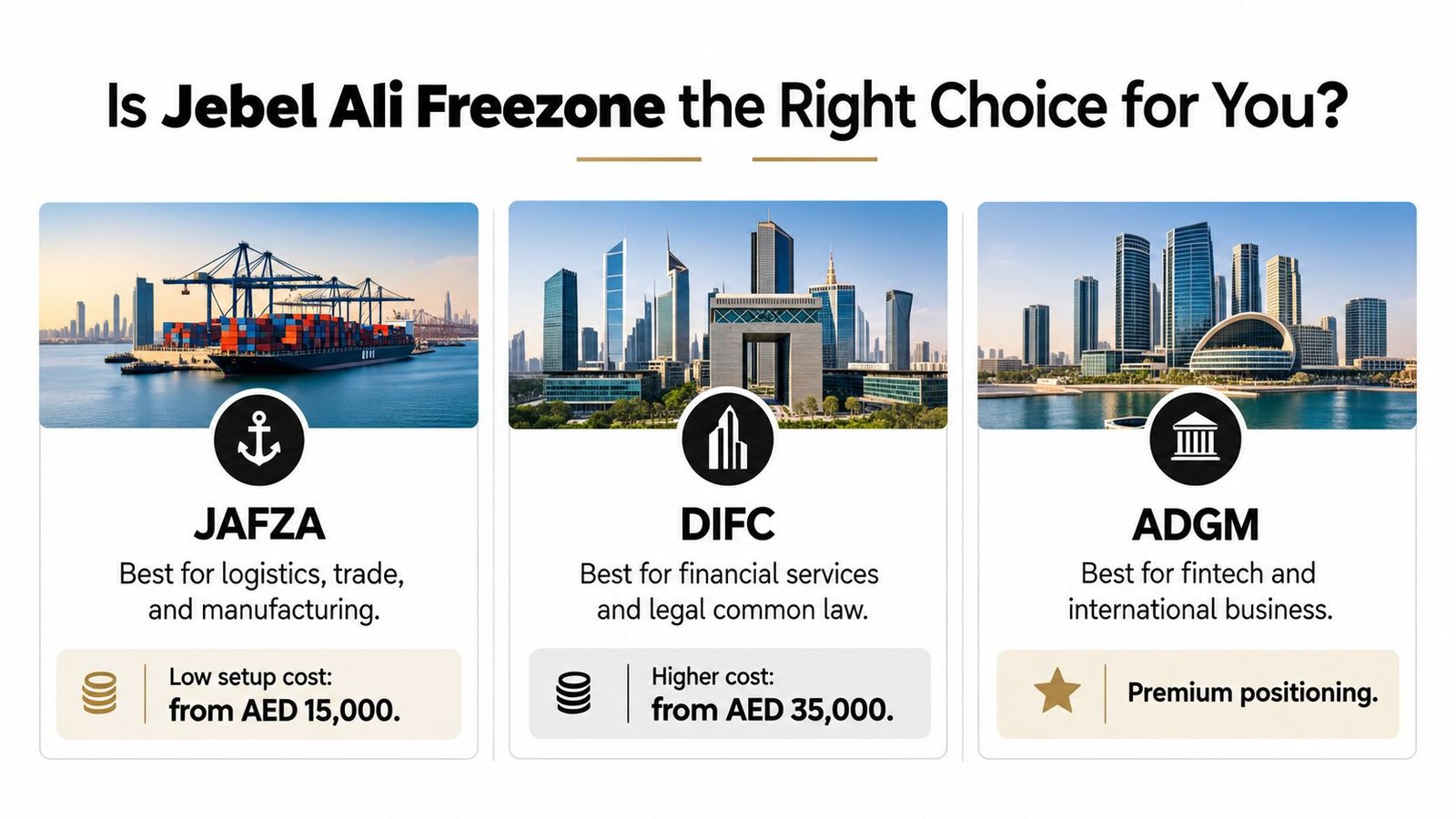
Which jurisdiction fits the operating model?
| Jurisdiction | Practical fit | Main trade-off |
|---|---|---|
| JAFZA | Logistics, trade, manufacturing, and inventory | Premises and customs planning can be more involved |
| DIFC | Financial services and legal common-law structures | Usually a poor fit for physical stock and port-led operations |
| ADGM | Fintech, financial activity, holding, and international business | Premium positioning may not suit a warehouse-led business |
The correct choice depends on where value is created. If value comes from moving goods, JAFZA's port connection can outweigh the attraction of a simpler office package. If revenue comes from advisory work, software, fund activity, or financial services, a financial free zone may be more coherent.
Don't select JAFZA only because someone says it offers full ownership or tax efficiency. Select it when your customers, inventory, premises, customs status, and staffing plan support the decision. Dubai, Abu Dhabi, and Sharjah each offer different combinations of location, market access, rent, regulation, and infrastructure.
Taking the Next Step with Inpro.me
A sound JAFZA decision begins with a written operating map. List your products or services, origin countries, customer locations, expected stock flow, premises needs, shareholders, managers, employees, and visa requirements. Then test that map against the proposed activity, facility, customs route, VAT position, and corporate tax treatment.
What should you prepare first?
Prepare the following before requesting a final setup plan:
- Activity description: Explain what the company will sell, buy, store, manufacture, or deliver.
- Ownership file: Gather passport copies, corporate documents, resolutions, and attestations where required.
- Premises requirement: State whether you need an office, warehouse, industrial unit, showroom, or land.
- Trade route: Separate re-export, bonded storage, and UAE mainland distribution.
- People plan: Identify investor, Golden Visa, manager, and employee visa needs.
- Compliance calendar: Include accounting, VAT, corporate tax, customs, renewals, and employment records.
This approach prevents a common bureaucratic problem: incorporating a company that cannot operate in the way the founder intended. It also gives advisers enough information to explain trade-offs instead of presenting a generic licence package.
Inpro can support free-zone company formation, licensing, PRO services, investor and employee visas, Golden Visa workflows, accounting, VAT registration, tax compliance, and corporate bank account support. The right provider should give you clear assumptions, required documents, expected stages, and a list of costs before submission.
For a founder outside the UAE, document attestation and immigration sequencing can be as important as the licence itself. For an existing SME, the central question may be whether JAFZA improves inventory control compared with mainland storage. For an HR team, the priority may be visa renewals, employment files, and timely government submissions.
Inpro helps founders assess JAFZA against their real supply chain, premises, ownership, visa, and compliance requirements before they commit. Visit Inpro to discuss your UAE setup and get a practical plan for company formation, customs-related coordination, and ongoing PRO support.