


Foreigners with UAE residency have the clearer route to a personal bank account, while non-residents and overseas founders should expect extra proof of address, source of funds and account purpose, with no guaranteed approval. A passport or a new company licence alone won't open the account.
The useful question is not only whether foreigners can bank in Dubai, but whether the bank accepts your residency status, ownership structure and actual payment activity. A salaried employee, an overseas investor and a founder processing customer payments need different files, even when they hold the same nationality.
Table of Contents
- Which UAE Bank Account Fits Your Status
- Which Licence Type Changes What a Bank Accepts
- How Do You Build the File and Open the Account
- How Long Does Opening Take and What Does It Cost
- Which Banks Take Foreign Clients
- Why Applications Stall and What to Use Instead
- Book Help Before You Submit the File
Which UAE Bank Account Fits Your Status
The same passport can lead to different bank decisions. A resident employee, a non-resident individual and a foreign-owned company apply under different account routes, and each must explain who owns the funds and how the account will be used.
Account path by foreigner status
| Who you are | Account to request | Core proof | What to expect |
|---|---|---|---|
| Resident employee | Personal current account | Passport, residence visa, Emirates ID, salary certificate or no-objection letter | A clear employment and income explanation supports the application |
| Self-employed resident | Personal account, sometimes alongside the company account | Trade licence and company documents plus identity | The bank checks the activity and source of income |
| Golden Visa holder | Personal account | Passport, visa, Emirates ID and address proof | Residency supports the application; a tax-residency certificate is separate |
| Non-resident individual | Personal account, subject to the bank's terms | Passport, permanent home address, temporary UAE address and, where requested, a home-country banker reference | Features may be limited and approval is discretionary |
| Foreign-owned UAE company | Corporate account in the company name | Licence, ownership chart, source of funds and expected volumes | The company's ownership and transaction profile are assessed separately |
What makes the resident route clearer?
A UAE resident holds valid UAE residence status, normally evidenced by a residence visa and Emirates ID. The Emirates ID is the UAE-issued identity card used in government and banking processes.
For a salaried resident, employment gives the bank a clear explanation for incoming funds. A salary certificate confirms employment and earnings; an employer-issued no-objection letter confirms that the employer has no objection to the application.
The UAE Government's finance guidance covers standard expatriate document requirements. Bank-specific non-resident files can ask for more, often including a reference from a home-country bank. Check the UAE residence visa requirements before relying on the resident route.
Can a non-resident still obtain an account?
A non-resident has no UAE residence status. Banks record this status and may offer fewer features than they provide with a resident current account.
Confirm that the account supports the transactions you need. An account suited to holding personal savings may not include the cheque facilities or international payment access you expect.
The Central Bank of the UAE's September 2025 banking figures report 61 banks, assets of AED 4.973 trillion, total deposits of AED 3.046 trillion, and non-resident deposits of AED 257 billion, approximately 8.4% of deposits, at the end of Q2 2025. These figures show the scale of non-resident deposits, not a right to open an account.
Start with the account holder and use the corresponding row to prepare the file. Approval still depends on the bank's assessment of ownership, funds and intended activity.
Which Licence Type Changes What a Bank Accepts
A trade licence is the authority-issued permission defining a company's approved business activities. The bank uses it to assess whether the customers, suppliers and payments you describe make sense for that company.
A mainland trading business buying stock for UAE customers presents a different operating model from an offshore holding company receiving investment income. Neither should submit a generic description such as international business.
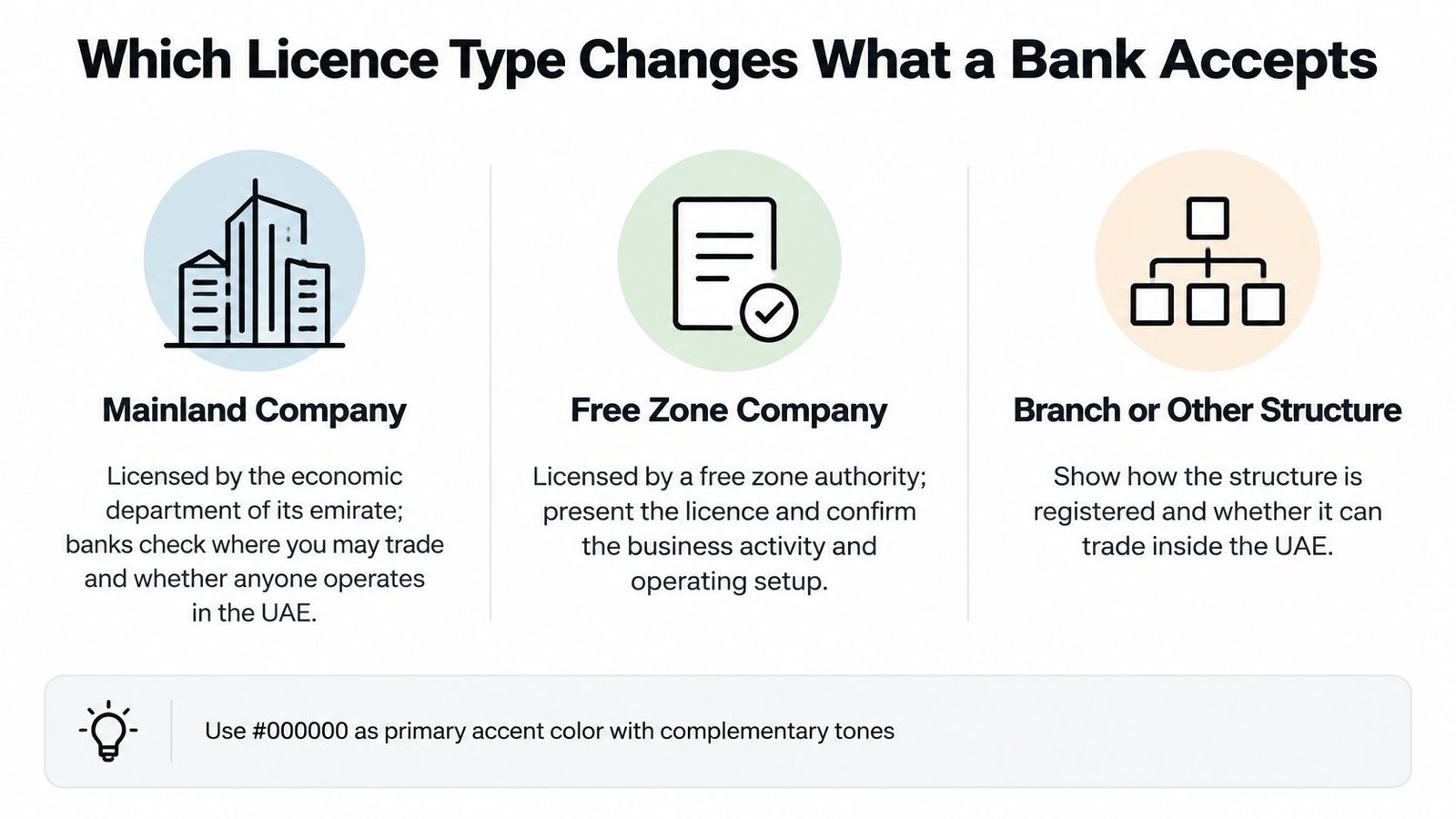
Licence setup and what the bank checks
| Setup | Where it can trade | Local substance | What the bank checks |
|---|---|---|---|
| Mainland | Across the UAE and abroad, within licensed activities | Physical office; locations can be established in more than one emirate | Real office, local contracts and staff where applicable |
| Free Zone | Inside the zone and abroad; local trade requires the appropriate permissions | Office or flexi-desk under the zone's rules | Zone licence matches invoices and payment flows |
| Offshore | International holding and trade | Usually no UAE office | Why a UAE account is needed and where money moves |
How should you explain your operating setup?
A mainland company is licensed by the economic authority of its emirate, such as Dubai's Department of Economy and Tourism. A free zone company is licensed within a designated jurisdiction, such as the International Free Zone Authority, Ras Al Khaimah Economic Zone, Dubai International Financial Centre or Abu Dhabi Global Market.
Describe what your licence permits in a plain sentence, then show the commercial evidence. For example, a software consultancy can explain its service, contracting entity, customer locations and delivery arrangements without claiming it has a staffed Dubai office when it uses a flexi-desk.
An offshore company is generally structured for holding assets or conducting international business rather than operating a local UAE business. Explain its commercial purpose directly, including why its assets or international contracts require UAE banking.
Practical rule: Don't promise local customers, premises or employees merely to strengthen an application. Submit the operating setup you can prove.
Does a Golden Visa establish tax residency?
A tax-residency certificate is evidence of tax residence issued separately from immigration documents. For a natural person seeking a certificate for tax-treaty purposes, the Federal Tax Authority's tax-residency guide states that the applicant must generally have been resident in the UAE for at least 183 days during the relevant financial year.
A residence visa or Golden Visa doesn't automatically issue that certificate. If a bank asks for tax-residency information, answer that request separately from your immigration status and don't assume a UAE address settles your overseas tax obligations.
How Do You Build the File and Open the Account
Customer due diligence, or CDD, is the bank's check of who you are, where you live and why the account exists. Know your customer, or KYC, is the related process of identifying customers and understanding their activities.
Build a single, indexed application folder, but keep personal evidence and company records in separate subfolders. Use descriptive filenames, legible scans and a document tracker showing what you've supplied and what remains outstanding.
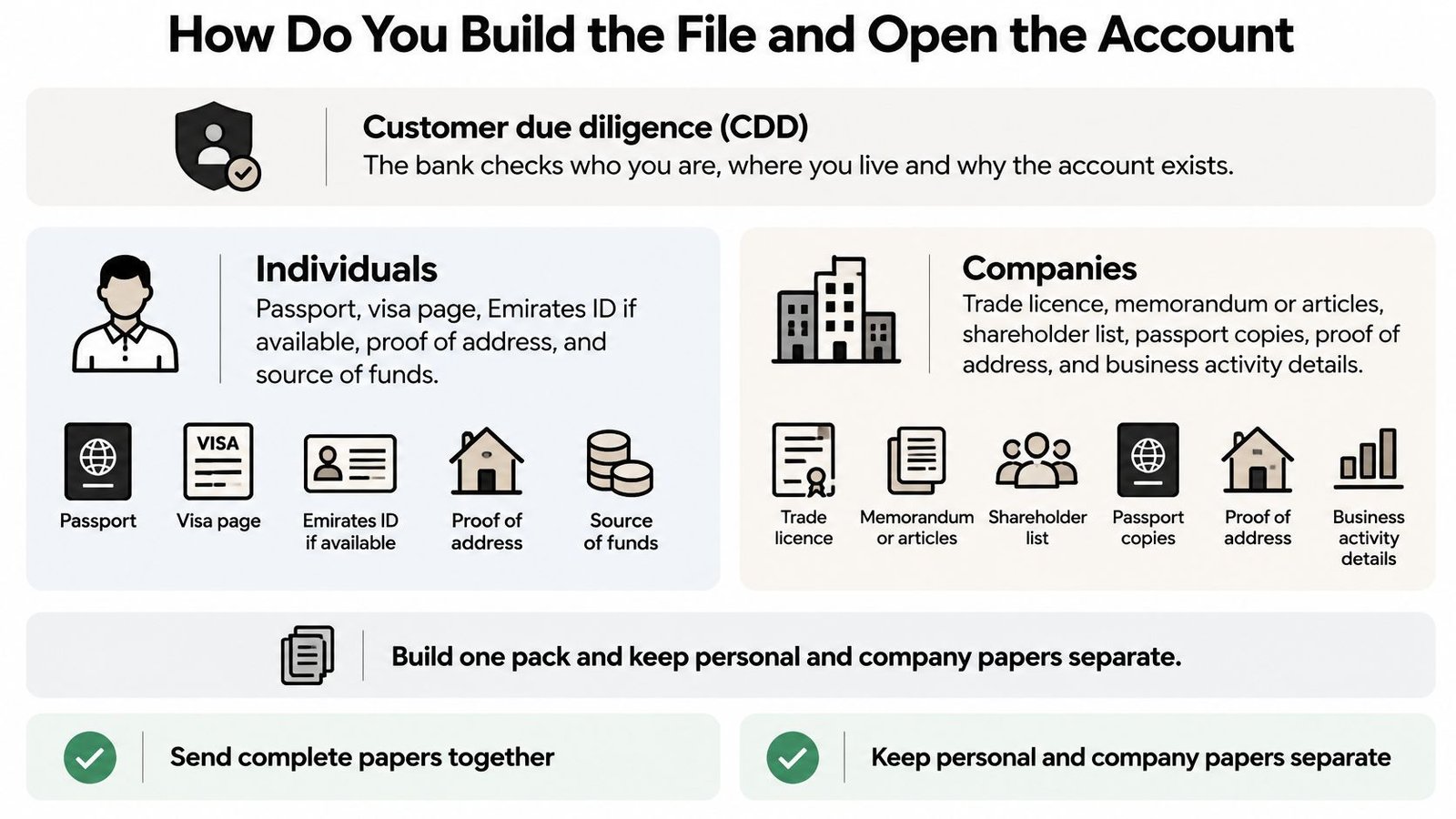
Which papers should you assemble first?
Start with identity and address evidence, then add the explanation for the money. A recent utility bill or bank statement should identify the applicant and show a usable residential address, not a mailing address.
An ultimate beneficial owner, or UBO, is a natural person who ultimately owns or controls a company. The Central Bank's customer due diligence guidance requires verification of individuals owning 25% or more, so show qualifying owners clearly and disclose anyone exercising control.
Document pack by account type
| File | Identity | Address | Activity or money | Often requested extra |
|---|---|---|---|---|
| Resident personal | Passport and Emirates ID | UAE residential proof | Salary certificate or no-objection letter | Visa copy if not available through the identity record |
| Non-resident personal | Passport | Permanent home address and temporary UAE address | Home banker reference and evidence explaining funds | Visa, tenancy or employer letter if a UAE tie exists |
| Company | Passports of qualifying beneficial owners and other persons the bank identifies | Registered office and owners' home addresses | Licence, contracts or invoices, source of funds | Ownership chart, expected volumes and counterparty countries |
Company papers should include the incorporation certificate, constitutional documents, shareholder register and registered-address evidence. If an overseas company sits in the ownership chain, include its documents rather than stopping the chart at that corporate shareholder.
What order should you follow?
Use this sequence so the bank receives an intelligible file rather than disconnected attachments.
- Pick the account path and a suitable bank. Confirm that the institution considers your residency status, company structure and business sector before completing its application. Check whether the signatory needs to attend in person.
- Identify the applicant and beneficial owners. Draw the ownership chain through to natural persons, including control arrangements. Even a founder who owns the entire company should provide a clear chart.
- Submit the identity and company pack together. Include both addresses for a non-resident and distinguish the registered office from the place where work is performed. If documents need certification, establish the bank's requirements before arranging document attestation for the UAE.
- Explain the money and expected activity. Supply evidence of initial capital, how the owner accumulated that money, expected incoming and outgoing payments, and counterparty countries. Support the description with contracts, invoices or other records.
- Complete the visit or video interview. Keep the submitted pack open and answer consistently with it. If a commercial arrangement has changed, explain the change rather than improvising a different business model.
- Allow the bank to finish screening. The bank checks sanctions exposure, adverse information and financial-crime risk. A request for more evidence isn't permission to begin trading through the account.
- Wait for confirmation of activation. The UAE anti-money-laundering regulations require customer and beneficial-owner verification and prohibit continuing a relationship when required due diligence cannot be completed. Don't treat an account number as confirmation that transactions are authorised.
How do you prove the source of money?
Source of funds is the origin of the particular money entering the account. Source of wealth is how the owner accumulated their wider assets or financial position.
For capital transferred from employment savings, connect the transfer to bank statements and earnings evidence. For money from a business sale, connect it to the sale documents and receipt, rather than providing only a statement showing the final balance.
Prepare a cash-flow forecast that distinguishes customer receipts, owner capital, supplier payments, and operating expenses. New businesses can use signed proposals or credible pipeline evidence but should label expected revenue clearly instead of presenting it as completed sales.
What should you check before submission?
Compare names character-for-character across passports, the incorporation certificate, shareholder register and application. Middle names, transliteration and abbreviated company names can create avoidable questions.
Check that ownership percentages reconcile and that every company in the chain appears in the supporting records. Replace broad descriptions such as consultancy with a description of the service, buyer and delivery method.
A bank officer should be able to understand who owns the company, what it sells and why money will move without reconstructing the story from scattered emails.
For owners based outside the UAE, we can act on government matters, but clients must attend steps requiring their own presence, such as biometrics or medicals. That government support doesn't remove a bank's separate identity or interview requirements.
How Long Does Opening Take and What Does It Cost
The Central Bank's account-opening rulebook says a low-risk application with standard due diligence documents should be capable of completion within three business days, but this isn't a guaranteed approval deadline. Sanctions screening, source-of-funds checks and other financial-crime controls can delay activation, and deposits may remain blocked while requirements are unfinished.
A straightforward resident salary application has fewer commercial questions than a newly formed company with overseas corporate shareholders. For the latter, build a buffer into your launch plan rather than promising suppliers a payment date before approval.
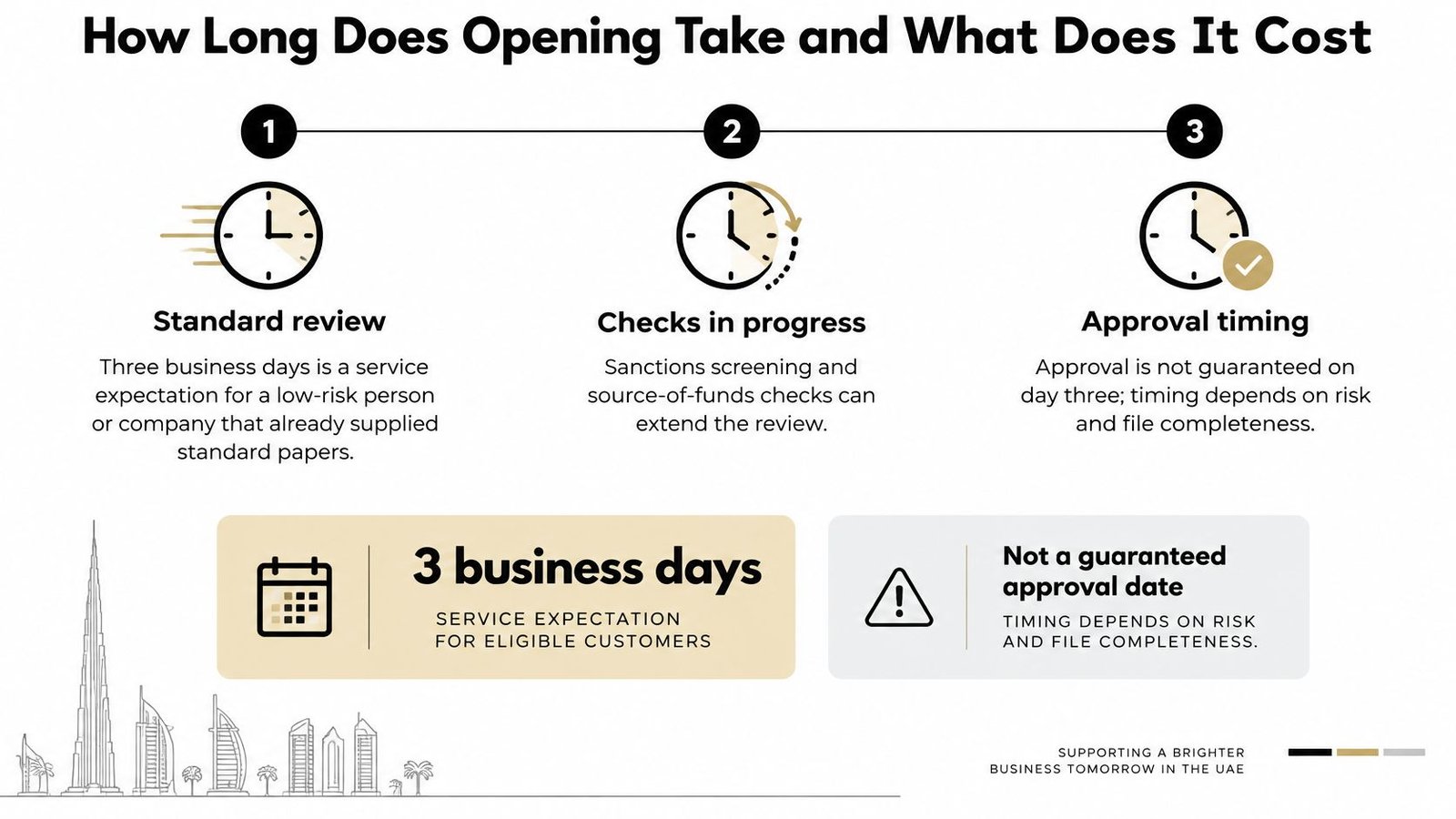
What usually happens to the clock
| Stage | Timing if the file is simple | What extends it |
|---|---|---|
| Standard account opening | Short service expectation for low-risk, complete files | Missing documents or mismatched names |
| Sanctions and source-of-funds review | May continue after account creation | Unexplained capital or higher-risk country exposure |
| Permission to transact | Only after financial-crime checks finish | Early deposits may stay blocked |
| Enhanced review | No dependable application deadline to plan around | Complex owners, nominees, crypto or payment activity |
Which costs should you compare?
There's no single national account-opening price. Obtain the bank's published tariff for the specific account package and compare the cost of your expected usage, not just the headline monthly fee.
- Maintenance and balance requirements: Check the monthly charge, required balance and charge for falling below it.
- Payments and conversion: Compare inward and outward transfer fees, intermediary charges and currency-conversion pricing.
- Cards and cheques: Check issuance, replacement and usage charges for facilities you need.
- Account category: Confirm whether non-resident or corporate status changes the package or minimum balance.
A cheaper subscription can still cost more if the account charges heavily for frequent international payments. Conversely, an expensive package with unused facilities offers little value to a founder receiving occasional consulting income.
What happens during the interview?
Treat the interview as a consistency check, not a formality. Expect questions about ownership, customer countries, the origin of capital, third-party payments and any connection to crypto, gambling or payment services.
Bring the ownership chart and supporting records you submitted. If you attend a branch in Dubai or Abu Dhabi, allow time for follow-up requests and keep a written record of material answers.
Once the bank confirms full activation, make a small legitimate first transfer with supporting documentation. Don't send money early merely to test whether restrictions have been lifted.
Which Banks Take Foreign Clients
For a UAE bank account for foreigners, shortlist institutions by eligibility before comparing apps or branch locations. A bank can accept foreign residents while declining non-resident applicants or particular business sectors.
Use these checks before contacting a candidate:
- Applicant status: Does it consider resident individuals, non-residents or your company structure?
- Onboarding method: Can the process be completed remotely, or must an owner or signatory attend?
- Published tariff: What balance requirements and account charges apply to the selected package?
- Currencies: Can you receive and send the currencies your customers and suppliers use?
- Sector acceptance: Does the bank consider your actual activity, including any financial-services exposure?
Which type of bank suits your use?
Large national retail banks are a sensible starting point for resident salary banking and applicants who want branch access. Emirates NBD is a candidate to investigate, but use its current document checklist for your category rather than another applicant's recollection.
Digital-first options such as Wio may move more of the process online, while Mashreq NEO Biz is a business-banking option to assess once your company documents are ready. Online onboarding doesn't mean lighter ownership or source-of-funds checks.
Foreign bank branches may be worth considering if you already have a banking relationship abroad. Ask whether that relationship can support the UAE application, without assuming the overseas bank can approve it locally.
Choose the institution that can support your payment pattern, not simply the one with the shortest application form.
Don't distribute an unfinished file to several banks hoping that one won't notice the gaps. Resolve unanswered eligibility and documentation questions first, then submit a consistent application to the bank that fits.
Why Applications Stall and What to Use Instead
Routing unrelated third-party money through a new account to make it look active is a poor strategy. Mismatched payers, unexplained cash, sudden international transfers and undisclosed crypto flows can lead to holds, further evidence requests or rejection.
The Central Bank's business-conduct framework supports risk-based customer checks and limited-feature accounts; relevant due diligence markers include AED 55,000 for certain occasional transactions and AED 3,500 for wire transfers, while banks may apply stricter controls. These aren't safe amounts below which checks disappear.
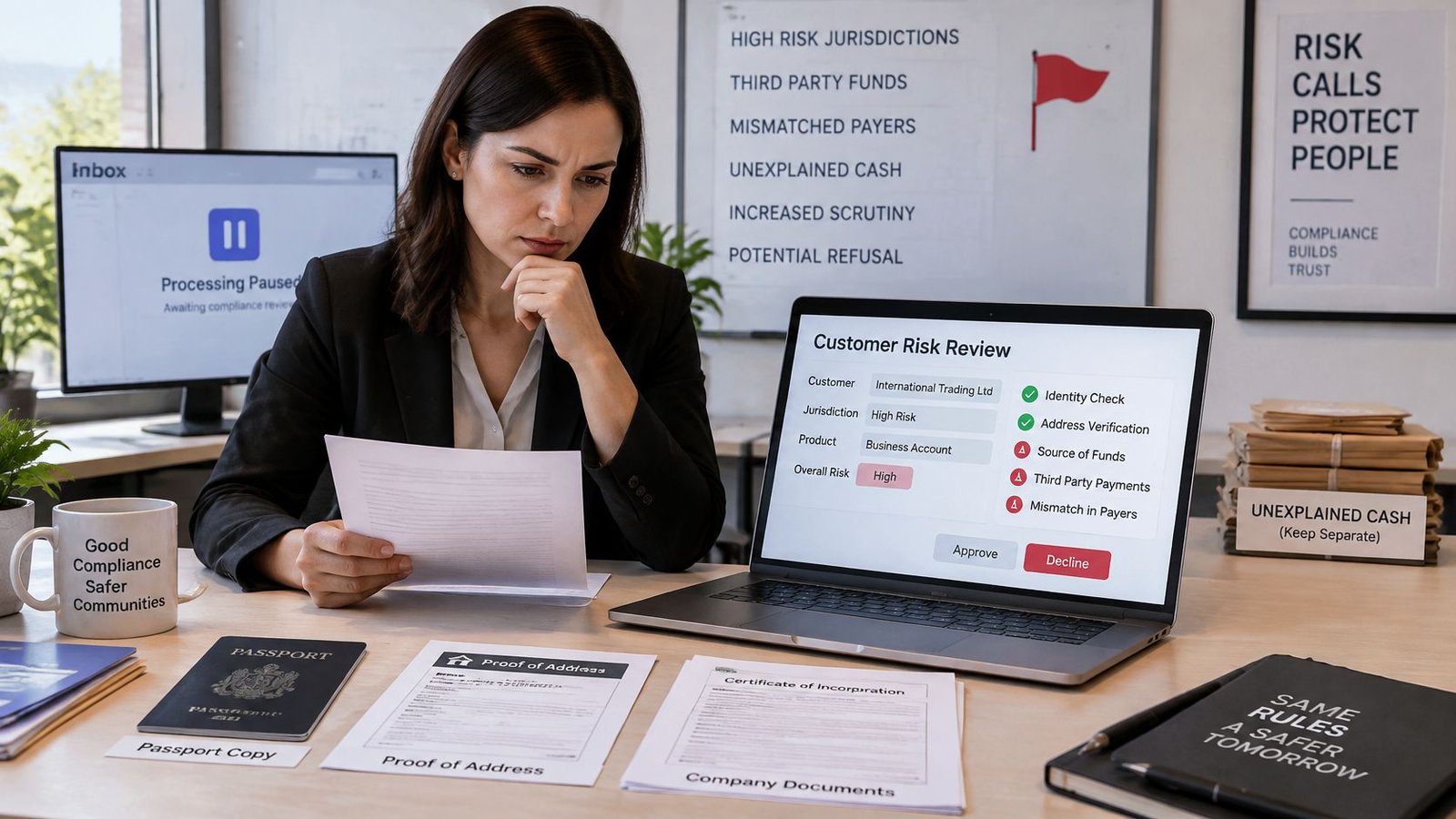
Why can crypto or payment activity change the decision?
A software business charging customers for its own product isn't the same proposition as a business moving money for others. Payment services, virtual assets and complex international settlement arrangements require a different explanation of licensing, counterparties and financial-crime controls.
The Central Bank's paper on emerging financial-sector risks identifies expanding virtual-asset activity and its connections with conventional finance as a source of money-laundering, terrorist-financing and proliferation-financing exposure. A valid visa and trade licence therefore don't make every fintech or crypto-related model acceptable to a bank.
Disclose material wallet exposure and payment-service relationships at the outset. Describing a payments business as ordinary consultancy can leave the bank with a transaction pattern it never agreed to support.
What can you use while resolving the application?
A regulated multi-currency provider or electronic-money wallet may support supplier payments and currency conversion while you complete residency or establish operating substance. It isn't automatically a UAE corporate bank account, and it will still assess where funds come from.
For a UAE-regulated payments route, verify the provider's Central Bank licence, permitted services and published limits. Compare the legal account holder, customer-fund arrangements, supported countries and payment restrictions before relying on multi-currency accounts for business operations.
- Keep personal use separate: Use personal banking for salary and living costs, not as an undisclosed company collection account.
- Correct the commercial explanation: Align the licensed activity, contracts, countries and expected payments.
- Resolve ownership questions: Explain nominees and control arrangements rather than removing them from the diagram.
- Reapply with changed evidence: Another application with the same unexplained capital or counterparty gaps is unlikely to solve the problem.
Book Help Before You Submit the File
A new UAE licence does not guarantee a bank account. Before completing an application, clarify which entity will earn the revenue, who ultimately owns and controls it, and how customer payments will reach it.
Inpro supports corporate account opening through bank selection, document preparation and assistance until the account is active. The banks include Wio, Emirates NBD and Mashreq NEO Biz. Inpro also offers a cost estimator to compare UAE company setup paths before you commit to a structure.
What should you bring to the first discussion?
Bring an ownership chart, your available licence or proposed business activity, and a concise outline of your customers, suppliers and payment countries. Include any deadline tied to payroll, investment capital or a signed contract.
Flag unresolved details, such as missing residence documents, overseas shareholders or financial-services activity. A passport or licence alone does not settle the bank's decision. Residency status, beneficial ownership and the expected transaction profile all matter, and crypto or payment activity can make an otherwise complete file difficult to accept.
The bank makes the final decision. Clear, consistent documents help show that the licensed activity, ownership structure and expected payments describe the same business.
To discuss your setup with Inpro, bring your ownership chart and expected payment countries. That gives the team a practical starting point for bank selection and preparation of your corporate account application.