

If you're an individual, UAE tax residency mainly starts with 183 days or more in the UAE during a relevant consecutive 12-month period, but two other legal tests also exist. A Tax Residency Certificate (TRC) is separate: you apply for it through the Federal Tax Authority, and approval depends on evidence supporting the route you rely on.
You may have just moved to Dubai, opened a company in Abu Dhabi, taken a Golden Visa, or started splitting time between Sharjah and London. The practical question is not whether you hold a UAE residence visa. You need to identify the legal test that fits your facts, preserve the right records, and decide whether you need a domestic certificate or one connected to a double-taxation agreement.
Table of Contents
- What UAE Tax Residency Actually Means in 2026
- The Three Legal Tests for Individual Residency
- What Evidence the FTA Expects for Each Route
- How to Apply for a UAE Tax Residency Certificate
- Treaty Relief, Substance, and Dual Residence
- Two Founder Scenarios and How They Play Out
- Common Reasons TRC Applications Get Delayed
- Quick Answers and How Inpro Can Help
What UAE Tax Residency Actually Means in 2026
A founder who has relocated to Dubai often assumes the visa, Emirates ID, and company licence settle the question. They don't. Tax residency is a legal status based on your presence, residence, personal interests, and UAE activity. A TRC is official evidence of that status for a defined period.
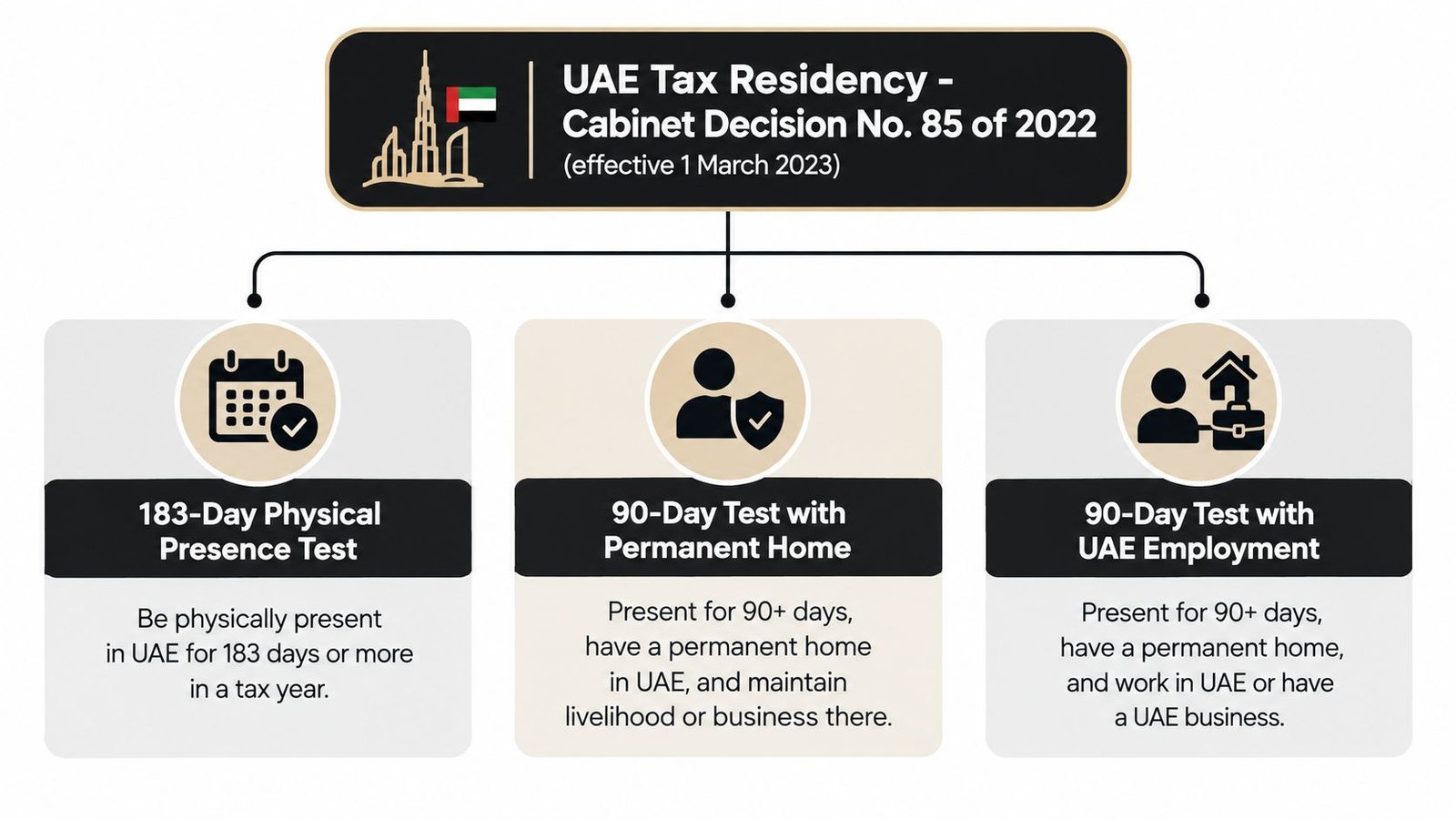
The UAE framework was established by Cabinet Decision No. 85 of 2022, which entered into force on 1 March 2023. It applies to individuals through three alternative routes. The clearest is physical presence in the UAE for at least 183 days during a relevant consecutive 12-month period. The other routes can apply after at least 90 days, subject to additional conditions, or where the UAE is your usual or principal residence and the centre of your financial and personal interests.
The Federal Tax Authority, or FTA, is the government body that reviews TRC applications. A certificate doesn't create residency by itself. Instead, it records that the FTA accepts your evidence for the period and purpose selected.
Practical rule: Decide why you need the certificate before collecting documents. A certificate for UAE domestic purposes isn't automatically enough for treaty relief in another country.
The distinction matters for founders, freelancers, executives, HR teams and Golden Visa applicants. A person can have a valid UAE visa without satisfying the relevant residency test. Someone can also qualify as a UAE domestic tax resident but still fail to meet the conditions for a treaty-purpose certificate.
The rest of the process is evidence-led. You need to establish the correct route, calculate days using the UAE method, obtain government travel records, gather home and business documents where required, and check whether another country may still treat you as resident.
The Three Legal Tests for Individual Residency
The UAE has three separate legal tests, not one blanket six-month rule. Cabinet Decision No. 85 of 2022 applies them over a relevant consecutive 12-month period, which means your calculation can roll across calendar years. It isn't limited to January through December, and the days don't need to be consecutive.
What is the 183-day physical presence test?
You qualify under this route when you're physically present in the UAE for 183 days or more during the relevant consecutive 12-month period. The calculation is cumulative, and any part of a day in the United Arab Emirates counts as a day.
That makes the test different from a simple “six months in one calendar year” calculation. A founder who enters Dubai late in the evening and leaves early the next morning needs to include those UAE presence days in the record. Maintain official entry-and-exit information rather than relying on calendar notes or flight emails.
How does the 90-day route work?
The 90-day route has several conditions that must work together. During the relevant 12-month period, you must be physically present in the UAE for at least 90 days and be a UAE national, a Gulf Cooperation Council national, or the holder of a valid UAE residence permit.
You must also have either a permanent place of residence in the UAE or carry out employment or business here. A residence visa alone doesn't complete the test. A permanent home doesn't need to be owned, but it must be continuously available to you.
What is the centre-of-interests test?
You may qualify where your usual or principal residence and the centre of your financial and personal interests are in the UAE, subject to the applicable ministerial criteria. This is a factual assessment rather than a simple day count.
Your family arrangements, home, business management, work, investments and personal ties may all matter. Don't rely on this route because you own a Dubai apartment or registered a company in a free zone. The evidence must show that the UAE is the main base of your life and interests.
What Evidence the FTA Expects for Each Route
The route you choose determines the strength and type of evidence you need. The 183-day route is usually the most straightforward because official travel records establish the central fact. The 90-day route is more evidence-intensive because you must prove your UAE home and employment or business connection as well as your presence.
For a 183-day-or-more application, prepare your Emirates ID and residence visa, or your passport together with an official entry-and-exit report issued by the Federal Authority for Identity and Citizenship or another competent government authority. Don't submit a self-created spreadsheet as the main travel record.
The 90-to-182-day route requires more. The FTA may ask for an Emirates ID, passport, official travel report, and evidence that a UAE home was continuously available. Suitable home evidence can include a title deed, a registered Dubai Ejari tenancy, utility bills, or another long-term lease. Business or employment evidence may include a salary certificate, employment documentation, trade licence, or proof of business income.
A residence visa on its own doesn't establish the practical evidence needed for a TRC. If your documents were issued outside the UAE, check whether they need document attestation for UAE use before you depend on them.
| Route | Day Count | Identity & Travel | Home in the UAE | Employment or Business |
|---|---|---|---|---|
| 183-day route | 183 days or more in the relevant consecutive 12-month period | Emirates ID and residence visa, or passport with an official entry-and-exit report | Usually not an additional condition for this route | Not an additional condition for this route |
| 90-day route | At least 90 days in the relevant consecutive 12-month period | Emirates ID, residence status or qualifying nationality, passport and official travel report | Continuously available home, such as a title deed, Ejari tenancy, utility bills or long-term lease | UAE employment or genuine UAE business activity |
| Centre of interests | No single day threshold stated in the route | Documents supporting identity and the factual residence position | Evidence that usual or principal residence is in the UAE | Evidence that financial and personal interests are centred in the UAE |
Start a digital folder before you apply. Keep travel reports, tenancy records, utility documents, employment or business records, and copies of identity documents together. Mismatches between names, dates, passport numbers and visa records cause avoidable questions.
How to Apply for a UAE Tax Residency Certificate
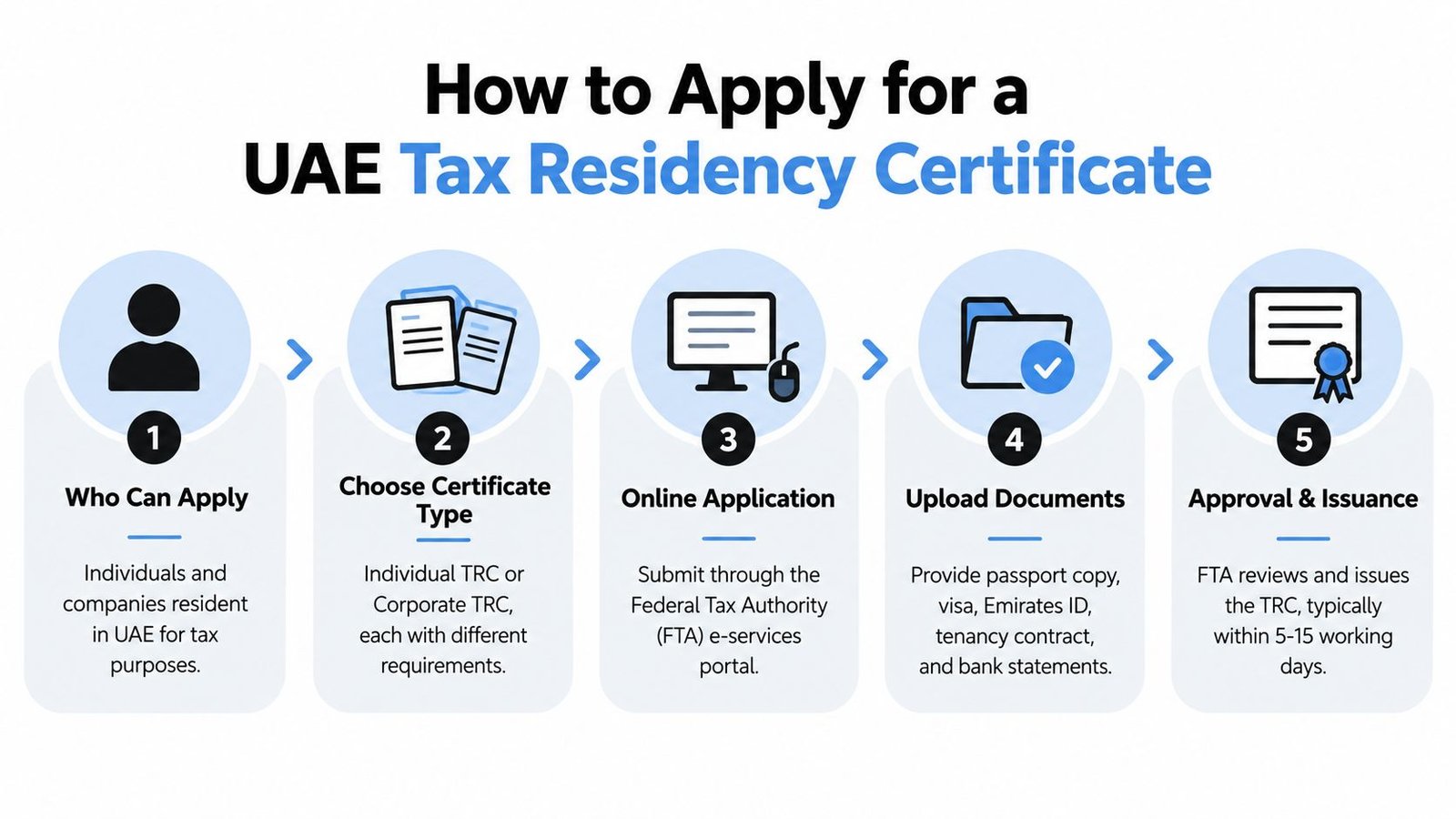
A Tax Residency Certificate is an official document issued by the FTA for a specified period and purpose. Individuals apply for an individual certificate. Companies and other legal persons apply under a separate corporate process, with different evidence around incorporation and management.
The application is made online through the FTA's EmaraTax portal. Choose the certificate type carefully. A domestic-purpose application and a double-taxation-agreement application don't serve the same objective, and the treaty country may have its own conditions.
What should you prepare before opening EmaraTax?
Prepare the identity and residence documents that match your route. Depending on the facts, the FTA may request:
- Identity records: Passport, Emirates ID and UAE residence visa.
- Travel evidence: An official UAE entry-and-exit report.
- Home evidence: Title deed, registered Ejari tenancy, utility bills or another long-term lease.
- Employment evidence: Salary certificate or other proof of UAE employment.
- Business evidence: Trade licence, business-income records or documents showing UAE activity.
- Treaty information: The specific double-taxation agreement and country for which the certificate is required.
Retroactive applications are possible, but they need evidence covering the earlier period. Don't wait until a foreign authority has set a deadline if you know you'll need a certificate.
What happens after submission?
The FTA reviews the application and may ask for clarification or additional documents. A complete file is normally processed within a few weeks, but missing travel data, weak home evidence or an unclear certificate purpose can extend the process.
The certificate relates to the financial year or other defined period selected in the application. It doesn't provide open-ended proof for every future year. You'll need to keep monitoring your presence and circumstances if you expect to rely on UAE residency repeatedly.
If your business also needs formal evidence of its legal standing, keep that request separate from your TRC application. A certificate of good standing serves a different corporate purpose and doesn't replace tax-residency evidence.
Treaty Relief, Substance, and Dual Residence
A TRC is a starting point, not a universal answer to foreign tax exposure. The FTA may issue a UAE certificate, but another country can still examine your facts under its domestic rules and the relevant double-taxation agreement.
Does a UAE TRC guarantee treaty relief?
No. Treaty eligibility can involve additional residence tests and tie-breaker rules. If you're also resident in another country, the treaty may examine your permanent homes, centre of vital interests, habitual abode, nationality, or the agreement between the two tax authorities.
The FTA states that a person applying for a certificate for tax-agreement purposes generally needs to have been a UAE resident for at least 183 days during the required financial year. That creates a practical distinction: the domestic 90-day route may establish UAE tax residency, while treaty relief may require the stronger presence record.
Does a TRC prove economic substance?
No. The Ministry of Finance separates tax residence from the Economic Substance Test. That test looks at whether relevant activities are directed and managed in the UAE, with UAE-resident employees potentially supporting the required substance.
A UAE licence, office or TRC doesn't prove where a company is managed. Keep board resolutions, management records, contracts, financial records and evidence of UAE decision-making where those facts apply.

Why do banks ask about CRS?
The Common Reporting Standard, or CRS, is an international information-reporting framework used by financial institutions. UAE banks and other financial institutions ask customers to self-certify their tax-residence jurisdictions and tax-identification details.
A person or entity can be tax resident in more than one jurisdiction. If your bank asks about another country, don't answer only with your UAE visa or TRC. Review your actual residence position and provide complete, consistent information.
Two Founder Scenarios and How They Play Out
Consider a SaaS founder who has moved permanently from Europe to Dubai. She works from a Dubai office, keeps her home in the UAE, and spends more than 183 days in the country during the relevant rolling period. Her evidence file is relatively direct: passport, Emirates ID, residence visa and official entry-and-exit report, supported by home and business records.
For her, the TRC application is mainly an exercise in matching the certificate period to the travel evidence. She should still check whether the certificate is for domestic purposes or a treaty claim, because the receiving country may apply separate rules.
Now consider a UK-based founder who spends roughly 120 days each year in the UAE, attends investor meetings in Dubai and runs a UAE office. He holds a UAE residence permit and maintains a Dubai home that remains available to him. His application depends on the 90-day route, so the FTA will focus on more than his travel count.
He should prepare the official entry-and-exit report, residence permit, Emirates ID, registered tenancy or other continuous home evidence, UAE trade licence and records showing genuine business activity. A licence with no corresponding UAE activity is a weak answer.
The founder should also examine whether the UK still treats him as resident and whether a treaty certificate is required. If he needs help with banking while his residence evidence is being assembled, he should keep that question separate from the TRC analysis and review the requirements for a non-resident bank account in the UAE.
Common Reasons TRC Applications Get Delayed
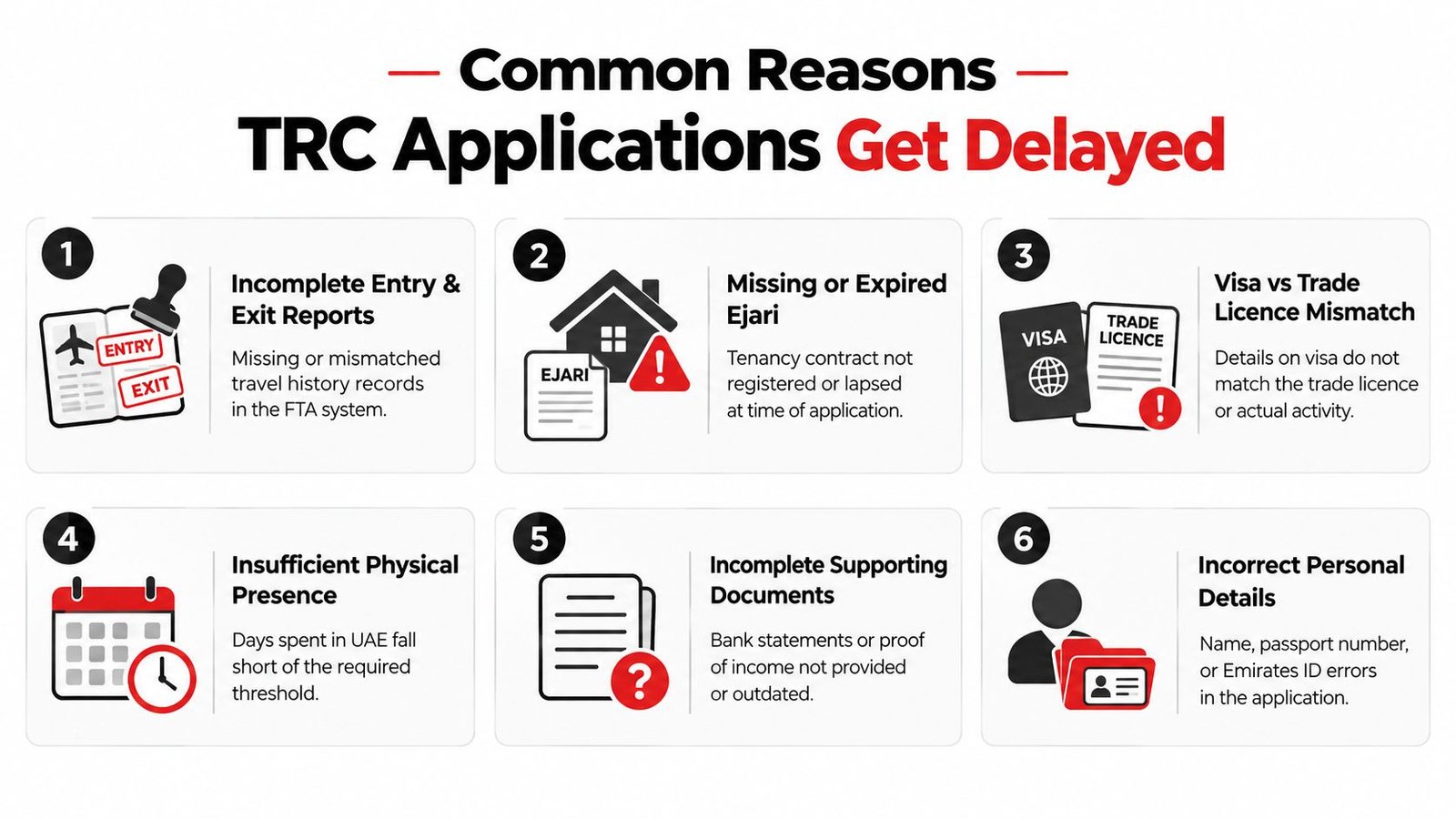
Most delays come from inconsistencies, not from an obscure legal problem. The FTA needs to see that your identity, travel, residence and business records describe the same person and the same period.
Which documents cause the most trouble?
- Incomplete travel reports: The official entry-and-exit record doesn't cover the relevant period or conflicts with the application.
- Missing or expired Ejari: The tenancy isn't registered, wasn't continuously available, or doesn't cover the period being claimed.
- Visa and licence mismatch: The residence details, trade licence or actual activity don't align.
- Insufficient presence: The day count falls short of the route selected.
- Incomplete supporting records: Proof of income, employment, business activity or home evidence is missing.
- Incorrect personal details: A name, passport number or Emirates ID detail is entered incorrectly.
A Golden Visa doesn't automatically provide tax residency, and company formation doesn't replace individual evidence. Treat both as supporting facts, not as the legal conclusion.
What changes for a corporate TRC?
A company application is assessed separately from an individual's residence. The FTA may examine whether the company is effectively managed in the UAE and may expect board resolutions, financial statements, licensing records and evidence of UAE-resident directors or management.
Before submitting, check the applicant name, certificate purpose, relevant period, travel report, home documents, business evidence and any treaty-specific form. This final consistency check often prevents an avoidable request for more information.
Quick Answers and How Inpro Can Help
Is residency the same as tax residency?
No. Immigration residency gives you permission to live in the UAE through a visa or permit. Tax residency depends on the UAE's legal tests and the evidence supporting the specific period claimed. A visa supports the application, but it does not settle the tax question by itself.
Can a UAE TRC be backdated?
A TRC may cover an earlier period if your records show that you met the relevant conditions during that period. Prepare official travel records, evidence of a continuously available home where relevant, and proof of UAE activity from the period being claimed. Do not rely on documents created only after the fact.
How long is a TRC valid?
A TRC covers the financial year or other period stated on the certificate. It is not permanent evidence of residency. You may need a new application when a bank, treaty partner, or foreign tax authority requests proof for another period.
What should I do if I split my year between the UAE and another country?
Review both countries' rules separately. Keep an official UAE travel report, assess your home and business connections, and check whether the other country still considers you resident. Treaty tie-breakers may produce a separate result from the UAE's domestic test, so obtain tax advice before relying on treaty relief.
Inpro can help founders organise the UAE setup, visa, document, and PRO workflow while a tax adviser handles the residency and treaty conclusions. Visit Inpro to review your options and arrange practical support for your UAE documentation.